While platforms like TikTok and Instagram get all the buzz, facebook influencers marketing remains a quiet juggernaut for performance marketers who care about one thing: results. It’s a powerful mix of a massive, mature user base and an ad ecosystem built for driving measurable outcomes like Return on Ad Spend (ROAS) and Cost Per Acquisition (CPA).
Why Facebook Influencers Still Drive Unmatched ROI
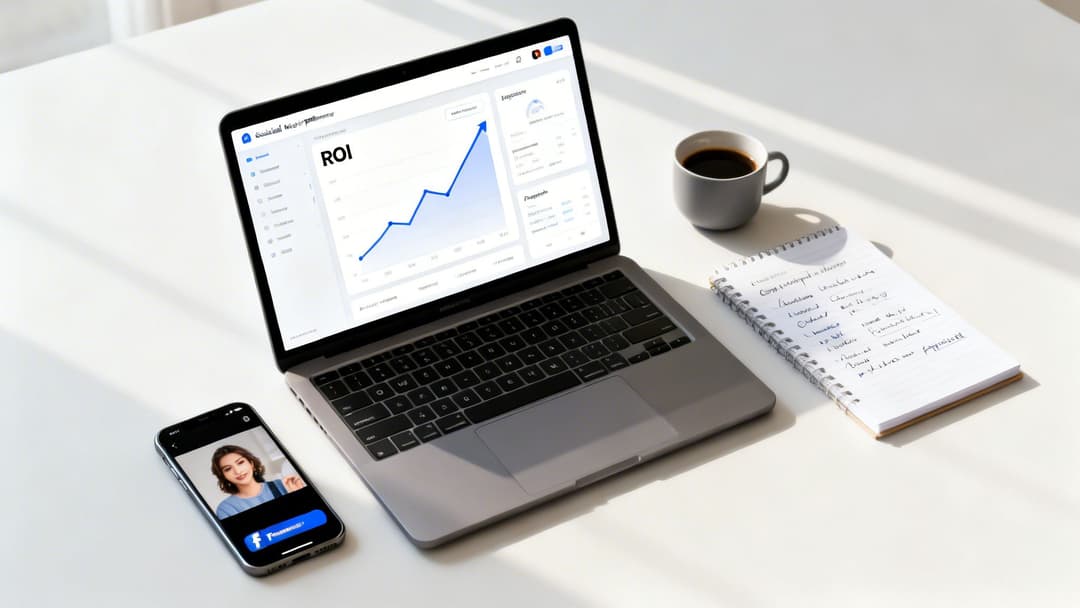
It’s tempting to chase the latest shiny object in social media. But when your goals are scalable growth and real profit, Facebook has some serious advantages that other channels just can't touch. The value isn't just about the sheer number of users; it's about the rich data environment that turns influencer campaigns into predictable revenue streams.
This isn’t about chasing viral moments. It's a calculated strategy where authentic influencer content meets data-driven execution to create repeatable success.
The Power of A Mature Ad Ecosystem
On many platforms, an influencer post is where the campaign ends. On Facebook, it’s just the beginning. The real strength of Facebook is its sophisticated advertising infrastructure, which lets you take that piece of authentic content and amplify it with incredible precision.
This is where performance marketers really thrive. You can put ad spend behind influencer content and target audiences based on:
- Demographics: Age, location, language, and so much more.
- Interests: The pages they’ve liked and the groups they’ve joined.
- Behaviors: Past purchasing habits and even how they use their devices.
This ability to turn organic influencer content into a high-performance ad asset is what sets Facebook apart. It shifts the conversation from vanity metrics like likes and shares to the numbers that actually move the needle: conversions and revenue. To get the most out of your efforts, it's always a good idea to stay current on influencer marketing best practices.
The core strength of Facebook is that it’s built for direct response. An influencer’s content provides the social proof, and Meta’s ad tools provide the engine to turn that trust into sales at scale.
Unmatched Audience Reach and Precision
The numbers behind Facebook’s advertising power are hard to ignore. With the global influencer market projected to hit $32.55 billion in 2026, Facebook is set to keep a huge piece of that pie thanks to its 3.05 billion monthly users.
A staggering 43% of marketers still name Facebook as their highest ROI channel. That success is fueled by an incredible average conversion rate of 7.72% across all industries.
While younger demographics might use other apps for entertainment, Facebook remains a central hub for communities where users actively follow brands and make buying decisions. It's home to a massive audience spanning multiple generations, many with significant purchasing power.
If you're still wondering about the platform's relevance, our deep dive explores how Facebook advertising still works for brands today. This is exactly why facebook influencers marketing continues to be a cornerstone for so many successful growth strategies.
Facebook Influencer Marketing Vs Other Platforms
To put things in perspective, here's a quick breakdown of how Facebook stacks up against other popular platforms for performance-focused campaigns.
| Platform | Primary Demographic | Key Strength for Performance Marketers | Average Conversion Rate |
|---|---|---|---|
| 25-45, broad reach | Advanced ad targeting, direct response focus | 7.72% | |
| 18-34, visually-driven | High engagement, brand storytelling | 3.10% | |
| TikTok | 16-24, trend-focused | Viral potential, user-generated content | 2.50% |
| YouTube | 18-49, diverse | In-depth reviews, high-intent audiences | 2.14% |
As you can see, while other platforms have their strengths, Facebook's conversion-focused ecosystem gives it a distinct edge for marketers whose primary goal is driving sales and leads.
How To Find and Vet Performance-Focused Facebook Influencers
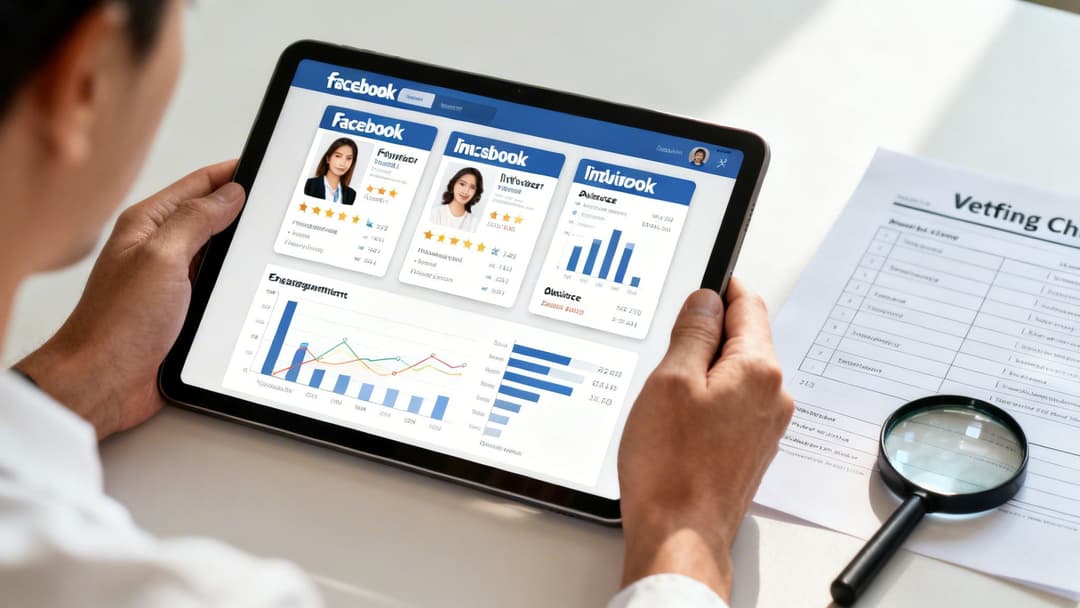
The success of your campaign really boils down to finding the right partners. This isn't about chasing the biggest follower counts; it's about pinpointing creators who produce authentic content that genuinely converts. A winning facebook influencers marketing strategy always kicks off with a tough discovery and vetting process.
We have to look past the vanity metrics and zero in on what actually moves the needle: the quality of engagement, audience demographics, and how they’ve handled past brand deals. This is how we can start to predict performance and team up with creators who can deliver assets built for direct-response.
Go Beyond The Standard Search
Just scrolling through influencer marketplaces will land you the same tired list of creators everyone else is hitting up. To find partners who are actually worth the investment, you need to dig deeper and start thinking like your own customers.
Niche Facebook Groups are absolute goldmines for this. Find the active communities where your ideal customers are already spending their time. Who are the most respected voices in those groups? More often than not, they're nano or micro-influencers with incredibly engaged, trusting audiences.
Here are a few tactics I personally use to uncover these hidden gems:
- Keyword Searches: I search for terms related to my product or industry right inside Facebook Groups. This helps me find users who are consistently dishing out great advice and sparking positive conversations.
- Competitor Analysis: Take a hard look at the influencers your competitors have tagged or worked with. Then, dissect the comments. Are people asking real buying questions, or just dropping generic praise?
- Audience Overlap Tools: Meta's own audience tools can show you which Pages and interests are popular with your existing customers. This is a great way to find influencers whose followers are basically pre-qualified to love your brand.
Once you’ve got a long list, the real work starts. The mission is to find creators who produce that raw, user-generated content (UGC)-style video and imagery that feels completely native to the Facebook feed, not like a glossy ad.
The best performance-focused influencers don't just post; they start conversations. Look for creators whose comment sections are filled with genuine questions, discussions, and testimonials from their followers. This is a powerful leading indicator of a community that trusts the creator's recommendations.
The Performance Vetting Checklist
Before you even think about sliding into their DMs, you have to vet every potential partner against performance-first criteria. A creator with 500,000 followers but a 0.5% engagement rate is way less valuable than one with 20,000 followers and a 5% engagement rate—especially if that engagement leads to conversions.
Remember, research shows that 69% of consumers trust influencer recommendations. You’re not just buying reach; you’re borrowing trust. Your vetting process has to confirm that trust is real.
Here’s the practical checklist I run every potential influencer through:
| Vetting Criteria | What to Look For | Red Flag to Watch For |
|---|---|---|
| Engagement Quality | Authentic comments that spark conversation; questions about the product. | A wall of generic "Great post!" comments or emoji-only responses. |
| Audience Demographics | Strong alignment with your ideal customer profile (ask for a screenshot of their audience data). | A high percentage of followers from regions you don't serve. |
| Past Brand Collaborations | Do their sponsored posts feel authentic and integrated? Check performance if data is available. | Every other post is an #ad, leading to audience fatigue and distrust. |
| Content Style | Do they create UGC-style, direct-to-camera videos that would work well as an ad? | Overly polished, high-production content that doesn't feel native to the feed. |
| Link & CTA History | Does their audience actually click links in their bio or posts? Check for past affiliate links. | They never direct their audience off-platform, indicating a low-intent following. |
This detailed evaluation is what separates creators who look good on paper from those who can actually drive sales. For performance marketers, that distinction is everything. By focusing on these indicators, you ensure your facebook influencers marketing budget is spent on partners who get direct response and can deliver assets ready to convert. If you're looking for more guidance, you can learn more about how Facebook works for influencers in our dedicated article. This groundwork is critical for building a scalable and profitable campaign.
Briefing Influencers For Creative That Actually Converts
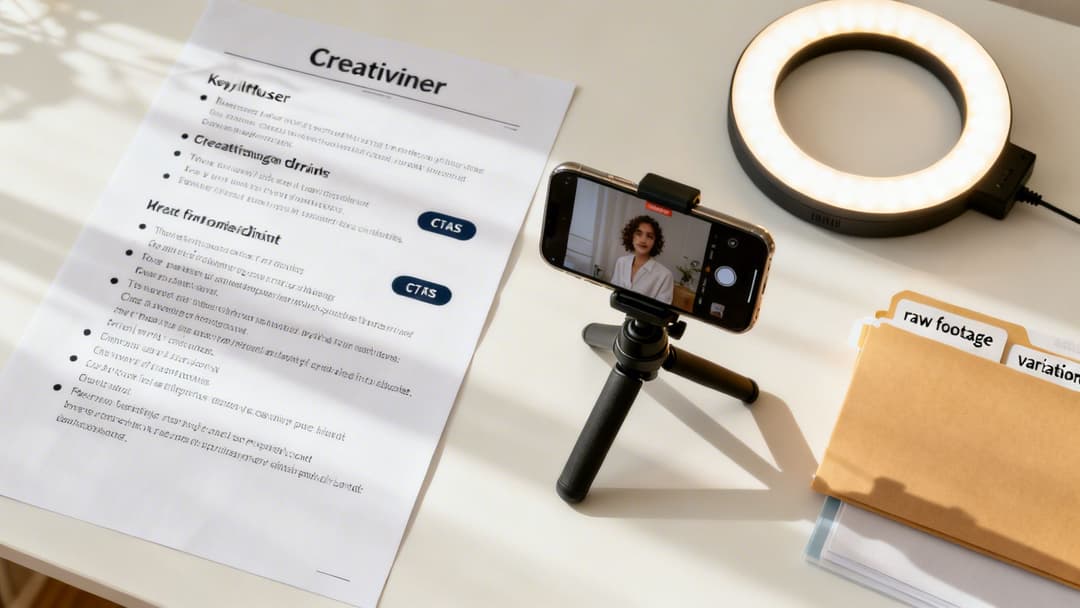
If you send a vague brief, you’ll get generic, one-and-done content. It’s a simple truth many performance marketers learn the hard way. For any facebook influencers marketing campaign, your brief is the single most important document you will create. It’s the blueprint that separates a single fluffy Instagram post from a deep library of ad creative ready to be scaled on Meta.
The point isn't to script every last word and kill the creator's natural style—that authenticity is exactly what you’re paying for. Instead, a performance-focused brief gives them clear guardrails and specific requests. It empowers the influencer to make content that feels genuine to their audience while still hitting your business goals.
Building a Brief for Performance, Not Just Posts
Before you type a single word, you need a mental shift. You are not commissioning a single video. You're commissioning a collection of creative assets that will be tested, iterated on, and scaled up in your ad account.
This means your brief must be brutally clear on the "what" and the "why," while giving the creator total freedom on the "how."
Here are the non-negotiable pieces of a brief built to perform:
- The Big Idea: Nail the core message in one sentence. For instance, "This serum clears up dark spots in just 14 days without any irritation."
- Key Value Props: Give them 3-4 concrete benefits or features. Don't just say it's "amazing"; tell them why. (e.g., "Formulated with 5% Niacinamide," "Tested by dermatologists," "Completely fragrance-free").
- The Target Audience: Give them a quick sketch of who you're trying to reach. This helps the creator adjust their tone and language to really connect with that person.
Getting this foundation right ensures the creator understands the strategy behind the content, which always leads to a better end result.
Think of your brief as a compass, not a GPS. It points the creator in the right direction (your core message and goals) but lets them find their own creative path. Micromanaging is the fastest way to kill authenticity.
How to Ask for Assets You Can Actually Scale
This is where savvy performance marketers pull ahead. A standard brief asks for one video and a couple of photos. A performance brief asks for the raw building blocks needed to spin up dozens, if not hundreds, of ad variations. It’s a completely different mindset.
Your goal is to get a ton of different hooks, body segments, and calls-to-action (CTAs) that you can slice, dice, and remix later.
Here’s how to structure your requests to get maximum mileage from every partnership:
- Multiple Hooks: Ask for 3-5 different opening lines for each video—that’s the first 3 seconds. This could be a question, a shocking statement, or just a quick product-first shot.
- Raw Footage: This is non-negotiable. Always, always ask for the raw, unedited video files. This gives your media buyers or creative team the power to create entirely new ads without having to go back to the influencer for more.
- Varied CTAs: Don't settle for "link in bio." Ask for specific CTA reads like, "Swipe up to get yours," "Comment 'SAVE' below for a discount," or "Tap the link to take the quiz."
- B-Roll Clips: Ask for plenty of extra footage—shots of the product being used, its texture, the unboxing, and the final results. This stuff is gold for making your video ads feel more dynamic.
When you structure your deliverables this way, a single shoot can give you enough creative fuel to run tests for weeks. This is the bedrock of a strong facebook influencers marketing program that drives real returns. Nailing your creative pipeline is just as crucial as the words in your ads, so if you need a tune-up, check out our guide on how to write Facebook ad copy that sells.
The Performance-Driven Influencer Brief Template
To pull this all together, here’s a simple checklist you can build your brief around. This isn't meant to be rigid, but it will make sure you cover all the bases needed for a successful, performance-focused partnership.
| Section | Objective | Key Details to Include |
|---|---|---|
| Campaign Overview | Align on core goals | Single-sentence "Big Idea," target audience persona, primary KPI (e.g., CPA, purchases). |
| Messaging & Value Props | Provide essential talking points | 3-4 bulleted value props, 2-3 "pain points" the product solves, mandatory disclaimers. |
| Creative Deliverables | Secure scalable assets | Specify number of hooks, request for all raw footage, list varied CTA phrases, B-roll shot list. |
| Do's and Don'ts | Set clear brand guardrails | Brand safety guidelines, words to avoid, visual style preferences (e.g., "natural lighting"). |
Using a framework like this strikes the perfect balance. It gives the influencer the creative freedom they need while ensuring you get strategic assets that don't just rack up likes—they drive conversions.
Turn Influencer Content into a Paid Ads Machine
Getting an influencer to post organically is just the first step. That’s the warm-up. The real, scalable growth happens when you pour strategic ad spend behind that authentic content, turning a simple partnership into a full-funnel performance engine.
This is where you graduate from basic influencer marketing to a high-volume testing environment inside Meta Ads. We're going to take all that great influencer-generated content (IGC) you planned for and put it to work.
First Things First: Get the Right Permissions
Before you spend a single dollar, you need the keys to the kingdom. This is a critical setup step that, frankly, too many marketers mess up. You can't just download an influencer's video and run it as your own ad—you have to get official advertising access.
You've got two main routes to get this done:
- Add the Influencer as a Partner: Inside your Meta Business Manager, you can request access to their Facebook Page and ad assets. This is the cleanest, most professional way to do it. It lets you run ads directly through their handle, which wraps your ad in a powerful layer of social proof.
- Use an Ad Creation Code: The influencer can jump into the Meta Creator Studio and generate a unique code for their post. You can then use this code to run their existing organic post as an ad from your account.
I almost always push for partner access. It gives you so much more flexibility, especially for creating "dark posts"—ads that run from the influencer's handle but don't show up on their organic page. This is absolutely essential if you plan on testing hundreds of creative variations without spamming their followers.
Don't even think about skipping this. Running influencer content without the proper permissions is a fast-track way to get your ad account flagged. It can wreck your brand's reputation and burn the bridge with that influencer. Proper access isn't just a good idea; it's non-negotiable.
Build Your High-Intent Audiences
Once you have the permissions sorted, it's time to build out your targeting. This is where you get to cash in on the influencer's built-in credibility. Your first, and often most powerful, target group is the influencer’s own followers.
- Engagement Custom Audiences: Start by creating an audience of people who have already engaged with the influencer’s Facebook Page or Instagram profile. These aren't cold leads; they’re a warm audience that already knows, likes, and trusts the creator.
- Lookalike Audiences: From that core group of engagers, build a 1% Lookalike Audience. Meta’s algorithm will go out and find new users who share the same characteristics as the influencer’s most dedicated followers. This gives you an incredibly potent cold audience to scale with.
From there, you can start testing the influencer content against your brand’s proven audiences, like website visitor retargeting lists or lookalikes of your best customers. The idea is to see where the IGC hits hardest. You can even uncover new segments by applying advanced targeting tactics, similar to how you'd approach advertising in Facebook Groups.
Automate Your Ad Creation and Scale Up
This is where the magic happens. You've got all this great raw footage and a bunch of different variations from your brief. Now, you could sit down and manually build out every possible ad combination of hook, video body, ad copy, and headline... but that would take you days.
This is exactly why a platform like AdStellar is a total game-changer for any serious facebook influencers marketing campaign. Instead of building ads one by one, you can automate the whole process and generate hundreds of variations in minutes.
Just think about it. Let's say your influencer delivered:
- 3 different opening hooks
- 2 main video bodies (e.g., a product demo and a testimonial)
- 4 unique ad copy angles
- 3 distinct headlines
Trying to build all those by hand is a recipe for a headache. But with an ad automation tool, you can instantly spin up 72 (3 x 2 x 4 x 3) unique ads.
The platform takes every element, mashes them together into a perfectly structured campaign in Meta Ads Manager, and gets your tests live with a click. That volume of testing is the key to finding the breakout "winner" you can scale aggressively. It transforms a single influencer video into a data-backed system for finding the exact creative mix that drives your lowest CPA and highest ROAS.
How To Measure And Scale Your Campaign With AdStellar AI
Alright, let's get to the fun part. You've found your influencers, briefed them like a pro, and started amplifying their content. Now it's time to see what's actually working. Guesswork is a budget-killer; data is how you scale.
This is where your facebook influencers marketing campaign really starts to pay off. We’re moving past the vanity metrics—likes, shares, comments—and getting laser-focused on the numbers that drive your business: Return on Ad Spend (ROAS), Cost Per Lead (CPL), and Cost Per Acquisition (CPA).
Think of this stage as building a high-octane feedback loop. You'll use real-time data to pinpoint winning creative, copy, and audiences. Then, you reinvest your budget into what's proven to work, turning what started as a creative bet into a predictable revenue machine.
Connect The Dots To See What's Winning
First thing's first: you need all your data in one place. A single influencer campaign can spawn hundreds of ad variations across dozens of audiences. Trying to sift through all that in Meta Ads Manager to figure out which video, headline, and audience combo is the true winner? It's a fast track to confusion and wasted spend.
This is precisely where a platform like AdStellar becomes your command center. It plugs directly into your Meta Ads Manager and automatically sucks in all the performance data in real time. Forget drowning in spreadsheets. You get a clean, organized dashboard showing exactly how your ads are performing against your most important business goals.
For your facebook influencers marketing campaigns, this means you can see, almost instantly:
- Which creator’s content is pulling in the lowest CPA.
- Which specific video hook is driving the highest ROAS.
- Which audience is actually clicking and converting.
This completely removes the guesswork. You're no longer judging an ad based on a gut feeling. You're making decisions backed by cold, hard numbers tied directly to your bottom line. To really get a handle on this, you need to know how to measure content performance effectively.
Use AI To Surface Your All-Star Ads
With all your data flowing in, the next hurdle is making sense of it. When you have hundreds of ads running, how do you spot the breakout stars? This is where an AI-powered insights dashboard does the heavy lifting, automatically analyzing and ranking every single creative for you.
Think of it as having a 24/7 analyst who never sleeps, constantly monitoring your campaigns and flagging the exact elements that are crushing it.
The goal is to stop just launching campaigns and start learning from them. Your AI dashboard is your cheat sheet, telling you what to cut and what to double down on, so you can stop wasting money and start printing it.
This level of analysis delivers insights that would take a human analyst days to piece together. For instance, the AdStellar AI dashboard can tell you with certainty that "Influencer A's testimonial video paired with Headline 3 and targeted at a 1% Lookalike of past purchasers" is your star player, delivering a 3.5x ROAS.
This whole workflow—from getting creator permissions to automating the ads—is designed to give you that clarity and scale.
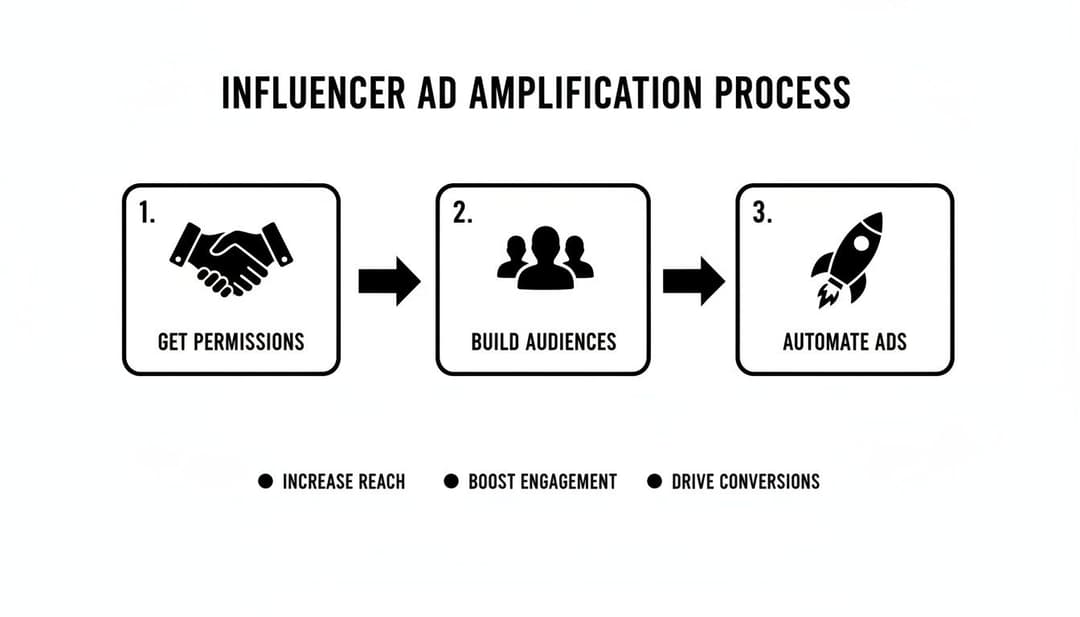
As you can see, it's a clear path: secure the rights, build smart audiences, and let automation take over. That's how you unlock predictable results from your influencer content.
Launch New Campaigns With Proven Winners
Spotting your top performers is great, but it's only half the equation. The real magic happens when you act on that information to scale your success. This is where you close the feedback loop and use your proven winners to build your next round of high-confidence campaigns.
Instead of starting from scratch every time, a feature like AdStellar's AI Launch lets you instantly build new campaigns using only your top-performing assets. The system grabs your best creative, your most effective copy, and your highest-converting audiences, then mashes them up into a new "All-Stars" campaign built for one thing: performance.
With a clear visual ranking of your assets, you can immediately see what's driving results and make faster, more profitable decisions.
This data-first approach completely changes the scaling game. You're not gambling on new ideas anymore; you're making calculated investments backed by performance data. This cycle of testing, learning, and relaunching is what separates a good facebook influencers marketing strategy from an unstoppable growth engine.
If you’re curious about the mechanics, you can dive deeper into AdStellar's AI-powered optimization features and see how it can put your own campaigns on hyper-speed. This iterative process is the absolute key to hitting—and maintaining—a killer ROI.
Common Questions About Facebook Influencer Marketing
Jumping into performance-focused influencer marketing on Facebook always kicks up a few key questions. As a performance marketer, I get asked these all the time, so let's clear the air with some straight-to-the-point answers.
How Much Should I Pay Facebook Influencers?
There’s no one-size-fits-all price tag. Rates depend on everything from the creator's follower count and engagement to the exact deliverables you're asking for.
Instead of getting stuck on a flat fee, I always push for a hybrid payment model. It’s simple: you offer a fair base payment that covers their time for content creation, then add a performance bonus tied directly to the metrics that matter to you, like clicks or conversions.
This structure gets everyone on the same page. The influencer has a real incentive to drive results for you because it puts more money in their pocket.
Here’s a rough ballpark to get you started:
- Micro-influencers (10k-50k followers): You're typically looking at a few hundred dollars for a post or video. Don't underestimate them; their niche audiences are often incredibly engaged and can be a goldmine.
- Macro-influencers (500k+ followers): These creators can command thousands. When you’re paying this much, you have to be absolutely certain their audience is a perfect match for your brand.
The real money in any influencer deal isn't in the one-off post. It's in securing the rights to their content for your paid campaigns. Always negotiate for perpetual usage rights for their raw footage and final assets. That’s where you’ll find true, scalable ROI.
What Is The Difference Between Boosting And Dark Posting?
Boosting a post is the easiest way to give it a little push, but that’s all it is. It gives you almost no control over targeting or optimization. Think of it like putting a rocket on a skateboard—sure, it goes faster, but you can’t really steer it.
A much smarter strategy is running the influencer’s content as a "dark post" through Meta Ads Manager. This just means the ad runs from the influencer's account handle but doesn't live on their organic feed.
This approach is superior for a few critical reasons. It gives you full control to:
- A/B test hundreds of ad variations with different copy, headlines, and CTAs.
- Target hyper-specific audiences that are way more granular than basic interests.
- Track performance directly against your most important KPIs, like CPA or ROAS.
This is how you transform a single piece of influencer creative into a data-driven testing machine. A platform like AdStellar is built for this, letting you instantly build and launch hundreds of dark post variations to find the winning combos that actually perform.
How Long Until I See ROI?
While you might get lucky with some quick wins, a real performance marketing strategy always starts with a test-and-learn phase. I usually tell my team to expect meaningful data within the first 1-2 weeks after we start putting paid spend behind the influencer’s content.
Remember, that initial post is just the raw material. The real ROI is unlocked when you identify the winning ad variations from your testing and start scaling them.
With a rapid, high-volume testing approach, you can slash this discovery period from a couple of months down to just a few weeks. This means you can quickly shift your budget to the top-performing ads and hit positive, scalable ROI way faster than you could with a traditional, one-and-done influencer post.
Ready to stop guessing and start scaling your influencer campaigns? AdStellar can help you launch, test, and find your winning ads 10x faster. Discover how AdStellar can transform your creative workflow today.