Ever wonder what separates a Facebook ad that gets ignored from one that stops the scroll and actually converts? It’s not clever wordplay or a fancy thesaurus. The secret sauce is psychology.
Winning ad copy taps directly into your audience's deepest motivations. Before you even think about writing a headline, you have to get inside their heads.
The Unseen Psychology of Winning Facebook Ad Copy
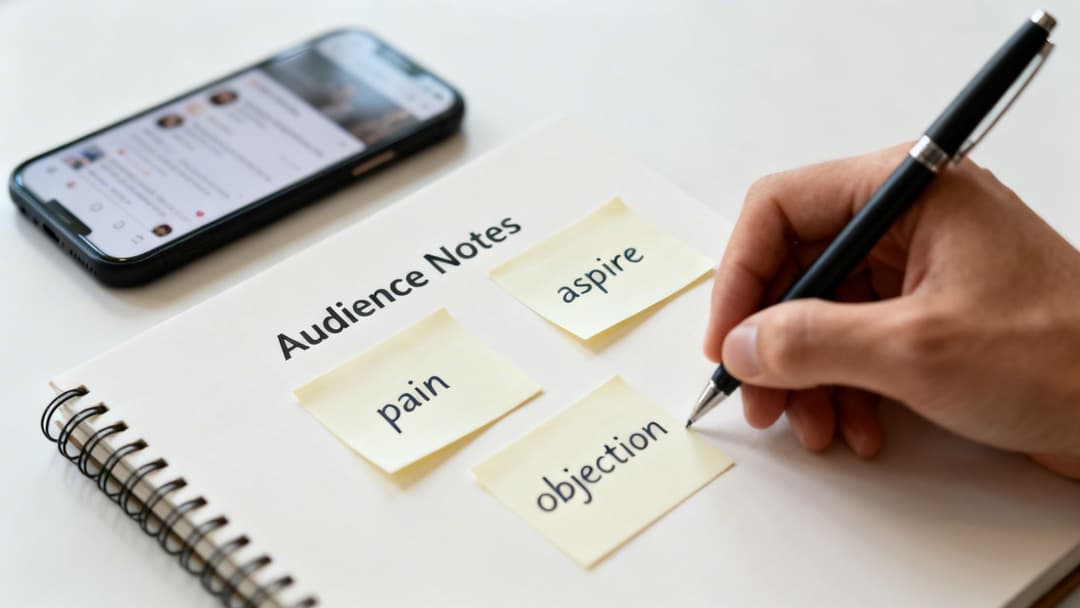
The real work starts long before you open a blank document. Top-tier ad copy isn't just written; it's assembled from a deep understanding of the person you're trying to reach. The best marketers I know are more like detectives than writers—they diagnose the core problems, fears, and desires of their ideal customers.
Forget generic customer avatars. You need to dig much deeper. What really keeps them up at night? What future are they dreaming of? And what’s the first thing they’ll think when your ad pops up that might make them say "no"? Answering these questions gives you the raw material for copy that feels personal and hits home.
Matching Message to Mindset
Here’s a hard truth: your audience isn't one big, uniform group. People are at completely different stages of awareness, and your copy needs to meet them where they are. You wouldn't talk to a total stranger the same way you talk to a friend, right? Same principle applies here.
Let's break it down:
- Problem-Unaware: These folks don't even know they have the problem you solve. Your job is to make them aware. A shocking stat, a relatable story, or a pointed question can jolt them into reality.
- Solution-Aware: They know the problem all too well and are actively looking for a fix. This is where you introduce your unique solution and zero in on the specific benefits that set you apart.
- Product-Aware: They've heard of you but are still on the fence. Your copy needs to tackle their lingering objections, build massive trust with social proof, and give them a compelling reason to act now.
The secret to ads that don't sound like ads is to stop writing them and start assembling them from the real words, stories, and pains of your audience.
Of course, your words don't exist in a vacuum. The message has to be in perfect harmony with the creative it's running alongside. A gut-wrenching video needs copy that echoes that emotion. A product-focused carousel ad demands clear, benefit-driven text on every single card.
When your words and visuals are perfectly aligned, you create a seamless and persuasive experience. This strategic groundwork is what separates ads that just get seen from ads that get results. If you get this right, you're already ahead of 90% of your competition. We dive deeper into the psychology behind great ads in another post, but this foundation is non-negotiable.
Core Components of Winning Ad Copy
To bring it all together, think of your ad copy as a bridge connecting your audience's needs with your solution. Every component must work in sync. This table summarizes the key elements that must align for your ads to truly perform.
| Component | Key Objective | Example |
|---|---|---|
| Audience Insight | To understand the deep-seated pains, desires, and objections of the user. | "Busy moms feel guilty they don't have enough time to cook healthy meals for their kids." |
| Message Angle | To frame the solution in a way that resonates with their mindset. | "What if you could make a healthy, home-cooked dinner in less than 15 minutes?" |
| Creative Harmony | To ensure the visuals and text reinforce each other for maximum impact. | An ad showing a smiling mom serving a meal to her happy family, paired with copy about saving time. |
Ultimately, a winning ad is more than the sum of its parts. It's a cohesive story where the audience, message, and creative all speak the same language, leading the user naturally toward the click.
Proven Frameworks That Outperform AIDA
If you've been in marketing for more than a week, you've heard of AIDA (Attention, Interest, Desire, Action). It's a classic, a solid foundation for understanding the buyer's journey. But on a platform as crowded and fast-moving as Facebook, "solid" often isn't enough.
AIDA is a bit too textbook for the real world. It can lead to copy that feels robotic and fails to forge a genuine connection with your audience. To really cut through the noise, you need something that speaks directly to human psychology. Let's get into the frameworks that top-tier marketers use to build narratives that actually drive action.
The PAS Framework: Problem, Agitate, Solution
One of the most direct and reliable copywriting frameworks is PAS: Problem, Agitate, Solution. It’s incredibly effective because it taps into a fundamental human driver: the desire to move away from pain and toward relief.
You kick things off by calling out a specific, nagging problem your audience deals with every day. Get right to the point.
Then, you agitate it. This is where the magic happens and where most copy falls short. Don’t just mention the problem; twist the knife a little. Use emotional, descriptive language to paint a vivid picture of the frustration, the annoyance, and the negative fallout from that problem. You want the reader to nod along, feeling seen and understood.
Finally, you sweep in with your product as the clear, obvious solution. After stirring up their discomfort, your solution feels like a breath of fresh air. It's the answer they were just wishing they had.
E-commerce Example (Meal Kit Service):
- Problem: "It's 5 PM again. You're exhausted, and you have no idea what's for dinner."
- Agitate: "You're sick of the same greasy takeout, but the thought of battling grocery store crowds after a long day is a total nightmare. You want to eat healthy, but you just don't have the time or the mental energy to plan it all out."
- Solution: "Get chef-designed meals with pre-portioned ingredients delivered to your door. Cook a delicious, healthy dinner in under 20 minutes."
The StoryBrand SB7 Framework
Another powerhouse model is the StoryBrand (SB7) framework. Its genius lies in a simple perspective shift: the customer is the hero of the story, and your brand is the experienced guide who helps them win. People aren't interested in your company's origin story; they're obsessed with their own.
By casting your customer as the hero, you stop yelling "buy our product!" and start saying "we can help you succeed." This subtle change makes your copy resonate on a much deeper, more emotional level.
The framework is all about narrative. You identify what the hero (your customer) wants, shine a light on the villain (the problem standing in their way), and position your brand as the guide who gives them a clear plan of action. For a deeper dive on using narrative in your ads, check out our guide to writing great advertising copy that tells a story.
SaaS Example (Project Management Tool):
- A Character (The Hero): A marketing manager drowning in deadlines and chaotic projects.
- Has a Problem (The Villain): Key information is scattered across emails, Slack, and sticky notes. Nothing is centralized, and deadlines are always a "surprise."
- Meets a Guide: Your all-in-one project management tool.
- Who Gives Them a Plan: 1. Put all your tasks in one place. 2. Automate your status updates. 3. Get a bird's-eye view of every project instantly.
- And Calls Them to Action: "Start your free trial and bring order to your projects today."
When you stop staring at a blank screen and start using proven structures like these, you're not just writing ads anymore. You're building conversion machines.
How to Write Short Powerful Copy That Sells
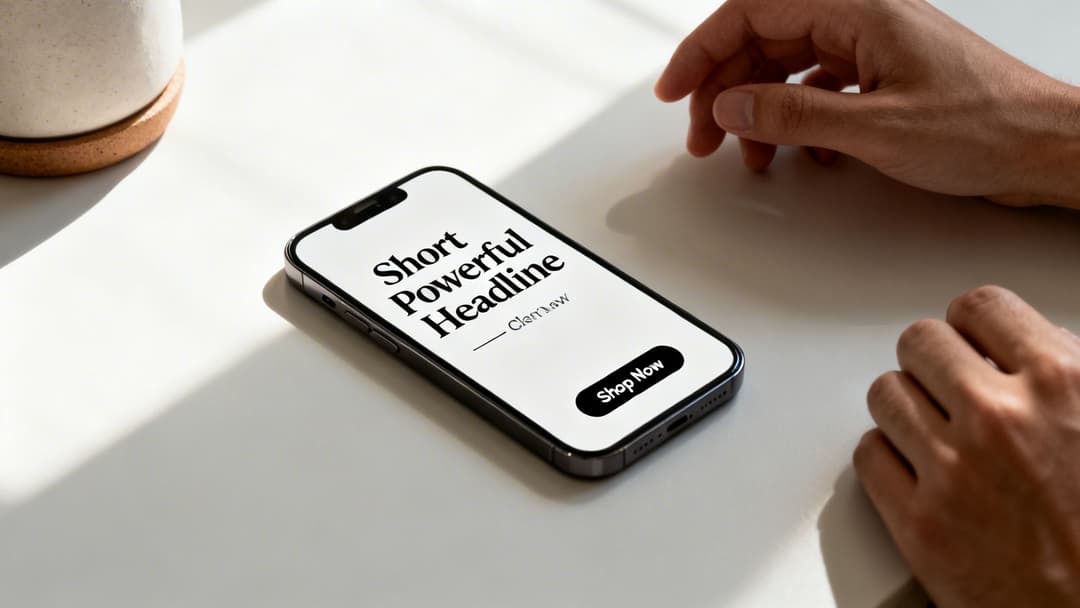
On social media, attention is currency. Your audience gives you maybe a second or two before they decide to keep scrolling. The absolute fastest way to get your ad ignored? A wall of text.
That’s why getting good at short, powerful copy for Facebook ads is non-negotiable. It forces you to get crystal clear on your value proposition because every single word has to fight for its spot. It's a strategic advantage, not just a style choice.
And the data backs this up. We’ve seen that Facebook ads with just 1 to 15 words can crush longer copy, sometimes outperforming them by a staggering 50%. When people are scrolling at lightning speed, a punchy message is the only thing that gets through.
Crafting a Sub-10-Word Headline
Your headline has one job: earn the next three seconds of your reader’s attention. That’s it. Ditch the clever wordplay and focus on one single, compelling idea that makes them stop.
- Bad Headline: "Discover Our Premium, Sustainably-Sourced Coffee Beans Today" (10 words)
- Good Headline: "Tired of bitter morning coffee?" (5 words)
See the difference? The second example hits on a relatable pain point. It’s a simple question that gets your target audience nodding along, making them wonder what solution you have up your sleeve.
The goal of your headline isn't to tell the whole story. It's to create an information gap that the reader feels compelled to close by reading the rest of your ad.
The Single-Sentence Hook
Once your headline stops the scroll, your first line of body copy has to keep the momentum going. All you need is one impactful sentence that either builds on the headline's intrigue or states the primary benefit outright.
Think of it as the direct continuation of the thought your headline just started.
Here are a few quick examples:
- For a Productivity App: "Finally, a to-do list that actually gets done."
- For a Skincare Product: "Get a visible glow in just 7 days."
- For a Financial Service: "Stop overpaying on your monthly mortgage."
Each of these is benefit-driven, concise, and paints a clear picture of what the user stands to gain. To really sharpen this skill, it’s worth diving deeper into the principles of copywriting for businesses that converts.
Finally, your call-to-action (CTA) needs to be just as direct and clear. Simple commands like "Shop Now" or "Learn More" work because they tell the user exactly what to do next. For more on this, our guide on how to write a call-to-action breaks down how to make your CTAs impossible to ignore.
Adapting Your Copy for Different Placements and Formats
Ever launched a campaign only to see your killer ad copy fall flat on Instagram Stories? You’re not alone. It’s a classic mistake: writing one-size-fits-all copy and expecting it to work everywhere. The truth is, a message that sings in the classic Facebook Feed will almost certainly get skipped in the blink-and-you-miss-it world of Reels.
To really get the most out of your budget, your copy has to feel like it belongs wherever it shows up. Think about how people actually use these platforms. On the Feed, they're scrolling more leisurely, often open to a bit of a story or a thoughtful carousel. But in Stories and Reels, it's a different game entirely. They're in a rapid-fire consumption mode, tapping through content in seconds. Your copy needs to respect that context.
Tailoring for Stories and Reels
For those vertical, full-screen formats like Instagram Stories and Reels, your copy must be sharp, direct, and impossible to ignore. The entire goal is to spark an immediate action—like a "Swipe Up"—before the user taps on to the next thing.
- Be Punchy and Direct: Don't bury the lede. Start with your most compelling hook or offer. Think "50% off ends tonight!" or "Swipe up for the secret."
- Use Text Overlays: A lot of people watch videos with the sound off, so don't bank on your caption doing all the work. Burn your key message right into the visual itself.
- Create Urgency: Phrases like "Limited stock," "Shop before it's gone," and "Last chance" are gold in these ephemeral formats.
This mobile-first mindset is where the money is. Here's a powerful insight: Instagram Stories deliver 61% higher CTRs than the Facebook Feed, clocking in at 1.34% vs. 1.11%. This is despite Stories only getting 22% of the traffic share. These figures, which you can dig into deeper with these CTR benchmarks and what they mean for advertisers, show just how much a snappy, optimized message can crush it in immersive formats.
Feed vs. Story vs. Carousel Copy
Let's make this real. Imagine you're writing copy for a sustainable shoe brand. How would you adapt it across different placements? Getting this right is a core part of understanding how all placements in advertising can work together for a cohesive strategy.
The best copy doesn't feel like an ad; it feels like it belongs. Your message should seamlessly blend into the user's experience on that specific placement.
Managing all these variations can get chaotic, which is where a tool like AdStellar comes in handy. This screenshot shows how you can see and manage multiple ad variations for different placements all in one place.
Having a dashboard like this gives you a command center to quickly see what copy and creative combos are working best across your entire campaign.
Here’s how that shoe brand's copy might break down:
| Placement | Headline Example | Body Copy Approach |
|---|---|---|
| Facebook Feed | "The Comfiest Shoes You'll Ever Own" | Tell a short story about the sustainable materials, weaving in the brand's values and focusing on all-day comfort. |
| Instagram Story | "Tap to Shop Our New Collection!" | Use bold, action-focused text overlays. Think "Limited Drop!" with a clear "Swipe Up to Buy" CTA. |
| Carousel Ad | Card 1: "Built for All-Day Comfort" | Dedicate each card to a specific feature or benefit, like "Made from Recycled Bottles" or "Perfect for Travel." |
By tailoring your message this way, you make sure your copy isn't just getting seen—it's actually being effective, no matter where it appears.
Scaling Your Copywriting With AI and Automation
Let’s be honest: manually writing and A/B testing hundreds of ad copy variations is a recipe for burnout. For modern growth teams, it's just not feasible. The sheer volume of headlines, body copy, and creative pairings you need to find a real winner would bring your entire marketing department to a grinding halt.
This is where AI and automation completely change the game for how to copy Facebook ads. We're talking about a fundamental shift—moving away from the tedious, manual grind and toward a smarter, data-backed system. AI-powered platforms like AdStellar AI can churn through hundreds of creative, copy, and audience combinations in minutes, not weeks. This approach helps you shatter creative blocks, test a massive range of messaging angles, and automatically pinpoint the winners at scale.
Generate Variations at Speed
The real magic of AI is its ability to take a single core idea and spin it into countless variations. You feed it the initial pain points, benefits, and target audience, and the AI gets to work generating a whole spectrum of copy angles.
- Emotional vs. Logical: You can test copy that pulls at your audience's heartstrings against copy that lays out the cold, hard facts and features.
- Short vs. Long: Generate those quick, punchy one-liners alongside more detailed, story-driven narratives to see what grabs attention.
- Pain-focused vs. Gain-focused: Pit ads that agitate a problem against those that paint a vivid picture of the dream outcome.
By automating this, you free up your team from the mind-numbing repetition of writing. Instead, they can focus on what really matters: high-level strategy and making sense of the results.
This flowchart shows how different copy ideas can be adapted and flow into various ad formats.
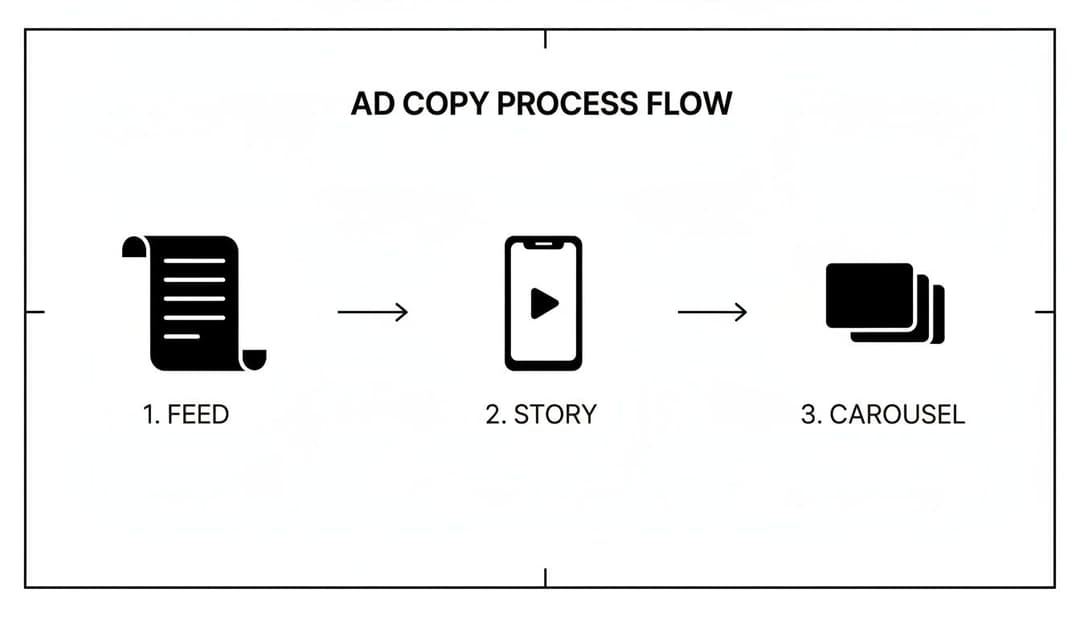
As you can see, you need distinct copy for each placement. That's a task that only becomes manageable when you have automation on your side.
Use Data to Drive Decisions
AI doesn't just write copy in a vacuum; it learns from it. By integrating with your Meta Ads account, these platforms analyze your historical performance data to figure out what’s worked in the past. This creates an incredibly powerful feedback loop.
Instead of just guessing which ad will perform, AI uses real-world data to build new campaigns from your proven winners. This stacks the odds in your favor right from the launch.
This data-driven approach is what makes effective scaling possible. We're seeing how AI-optimized, concise copy can slash ad fatigue by 15.6%. At the same time, Meta’s own machine learning is cutting campaign setup time by a massive 46%.
For agencies and DTC brands, this means you can iterate and test hundreds of messages against key metrics like CPL (which has an industry average of $23.10) or ROAS. Platforms like AdStellar automate this entire workflow, turning raw data directly into winning ads.
If you’re managing multiple clients or juggling complex campaigns, this kind of centralized process is a lifesaver. It replaces scattered spreadsheets and manual ad building with a repeatable, data-backed system. This shift is no longer a "nice-to-have"—it's fundamental to staying competitive.
To go deeper on this, check out our guide on using AI for Facebook Ads. For more strategies on leveraging AI in your ad creation, resources like BuddyPro's blog are also a great read. Ultimately, automation lets you multiply your testing capacity, accelerate growth, and focus your team's creativity where it truly matters: on the big-picture strategy.
Common Questions About Facebook Ad Copy
As you get deeper into writing Facebook ad copy, you’re bound to run into some recurring questions. The truth is, the small details often separate a campaign that just sputters along from one that truly takes off. Let's dig into some of the most common questions marketers have when they’re in the trenches, writing and tweaking their ads.
This isn't about finding one right answer. It’s about building the right mindset—a strategic approach to testing and discovering what actually moves the needle for your brand.
How Many Ad Copy Variations Should I Test?
There isn't a single magic number here, but you absolutely need a structured plan. When launching a new campaign, a solid starting point is to test 3 to 5 completely different 'angles' or core messages against your main audiences. I'm not talking about changing a word or two—I mean testing fundamentally different hooks. One might hit a major pain point, another could focus on a unique benefit, and a third could tell a compelling story.
Once you see a clear winning angle emerge, that’s when you can start iterating. From there, test 5 to 10 variations of that core message, swapping out different headlines or calls to action to see if you can squeeze out even more performance.
The point of early testing isn't to find the perfect ad right away. It's to find the most resonant message. Once you have that, you can refine and optimize it to its peak potential.
This is where an AI platform becomes a game-changer. It allows you to scale this process massively, testing hundreds of combinations at once. The AI can then crunch the performance data, find the top performers, and shift the budget accordingly—a job that’s just not feasible to do by hand.
What Are the Most Important Metrics?
Click-Through Rate (CTR) is a decent starting point. It tells you if your copy is grabbing attention. But it definitely doesn't tell you the whole story. The metrics that really matter are the ones tied directly to your business goals.
- For E-commerce: Your north star metrics have to be Return on Ad Spend (ROAS) and Cost Per Purchase. A great CTR that doesn't lead to sales is just an expensive vanity metric.
- For Lead Generation: You need to be watching your Cost Per Lead (CPL), and even more importantly, your Lead-to-Customer Conversion Rate. Cheap leads that never buy anything are completely worthless.
You also need to keep a close eye on Frequency. If you see that number creeping up without a matching increase in conversions, your audience is getting tired of your ad. This is classic ad fatigue, and it means your copy has gone stale. Also, a high CTR paired with a low conversion rate is a major red flag that there's a disconnect between your ad's promise and what people see on your landing page.
How Often Should I Refresh My Ad Copy?
You should be ready to refresh your ad copy the moment you spot the tell-tale signs of ad fatigue. The biggest red flags are a dropping CTR and a rising Cost Per Result (CPA or CPL), especially while your frequency is holding steady or climbing.
How quickly this happens really depends on your budget and audience size.
- High-Spend Campaigns: If you're pushing a lot of budget, you might need to swap in fresh copy as often as every 7-10 days.
- Lower-Spend Campaigns: For smaller budgets, checking in and refreshing every 2-4 weeks is a more reasonable pace.
The key is to be proactive and monitor performance, not to wait until your campaign has completely flatlined. This is another spot where AI-powered tools give you a massive leg up. They can constantly track performance metrics and automatically flag when it’s time to cycle in new creative and copy, making sure your campaigns are always running with your most effective messaging.
Ready to stop guessing and start scaling your Facebook ads with data-backed precision? AdStellar uses AI to generate, test, and identify winning ad copy and creative at a scale that’s impossible to achieve manually. Launch hundreds of ad variations in minutes and let our platform show you what really works. Unlock faster growth with AdStellar AI today.