Psychology in advertising isn't just a fancy term—it's the practice of using real insights about human behavior, emotions, and those funny little mental shortcuts we all have to build marketing that actually works. It’s about moving beyond a simple list of product features and digging into the why behind people’s decisions.
This approach taps into powerful, fundamental drivers like social proof, scarcity, and our deep-seated fear of missing out. The goal? To build genuine connections and nudge people toward action.
Why Top Performing Ads Target the Brain, Not the Wallet
Think about any great ad campaign you’ve seen, whether it was a viral TikTok clip or a hyper-targeted Meta ad. They all have one thing in common: they connect with a fundamental human response. This guide will reframe psychology in advertising from an abstract concept into a practical toolkit you can use to get measurable results, especially on platforms where emotional connection is everything.
The core idea is simple but incredibly powerful. People almost never make purchasing decisions based on pure logic. Our choices are constantly being shaped by subconscious triggers, gut feelings, and mental shortcuts our brains use to save energy. Cracking this code is the secret to cutting through the noise and ad fatigue that defines modern marketing.
Connecting Psychology to Performance Metrics
The best performance marketers know these psychological principles aren't just theory—they directly influence the metrics that make or break a campaign.
- Social Proof (like customer reviews and testimonials) has a direct impact on your Conversion Rate. It builds trust and makes the purchase feel less risky.
- Scarcity (think "limited time offer" or "only 3 left in stock") is a fantastic way to boost your Click-Through Rate (CTR) by creating urgency and a serious case of FOMO (Fear Of Missing Out).
- Loss Aversion (using phrases like "don't miss out on these savings") can slash Cart Abandonment rates by framing inaction as a tangible loss.
When you learn to speak the brain's language, you create ads that resonate on a much deeper level. This isn't about manipulation; it's about aligning your message with the way people already think and feel, which leads to more authentic engagement.
Building a Foundation for Scalable Growth
Chances are, you're already using some of these principles, even if you don't realize it. That successful ad highlighting a five-star rating? That’s social proof in action. A flash sale that sent your orders through the roof? Pure scarcity.
The goal here is to shift from accidental success to intentional strategy. By the way, if you're curious about the bigger picture, check out our guide on whether Facebook ads still work in today's crowded market.
By consciously weaving these concepts into your creative process, you can build a repeatable framework for ads that consistently perform. This creates a clear, actionable link between psychological triggers and the key performance indicators (KPIs) you care about most. We'll use this link as our foundation as we dive deeper into mastering these concepts and using automation to scale your campaigns.
The Hidden Triggers That Drive Clicks and Conversions
Ever wonder why certain ads just work? It’s not magic—it's psychology. Understanding the core principles of what makes people tick is like having the secret recipe to an irresistible campaign. These aren’t complex, dusty theories from a textbook; they’re fundamental truths about how we all think, decide, and act.
When you weave these principles into your ad strategy, you create campaigns that don't just get seen—they get results. The goal is to move beyond dry definitions and see these for what they are: powerful, predictable patterns in human behavior. To really get a handle on them, it helps to understand the science behind understanding consumer behavior.
This is about tapping directly into the brain's decision-making centers to drive a higher return on ad spend.
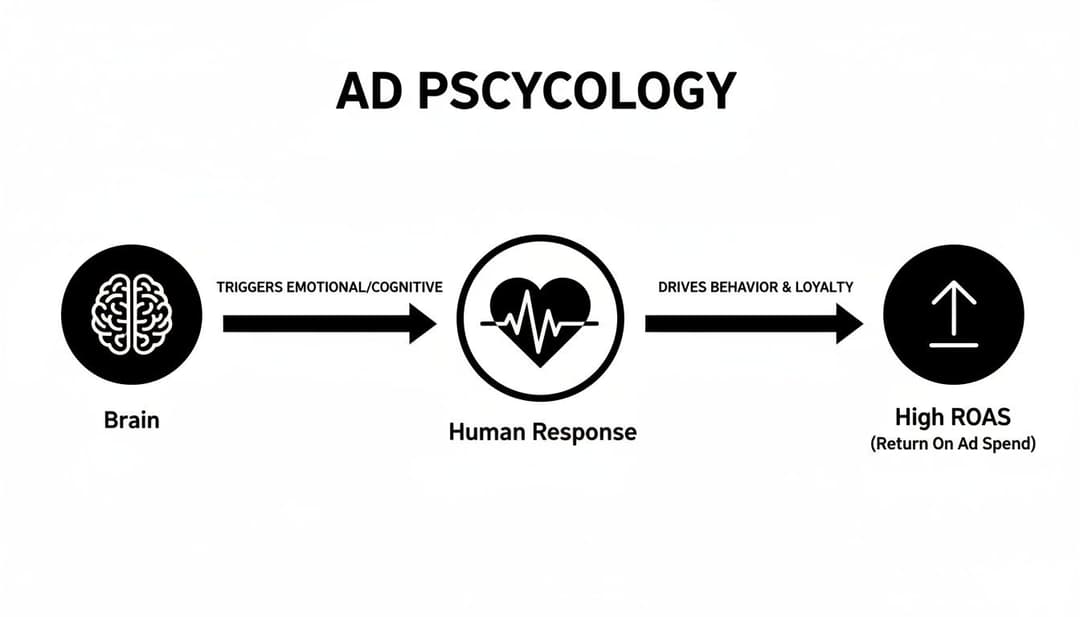
The path is clear: a psychological trigger sparks a human response, which directly leads to better campaign performance. It's a straightforward formula for success.
To give you a quick reference, here are some of the most effective psychological principles you can put to work in your ads right away.
Key Psychological Principles in Advertising
| Principle | Psychological Trigger | Advertising Application Example |
|---|---|---|
| Social Proof | People trust the actions and opinions of others. | "Join over 100,000 happy customers!" |
| Scarcity | Fear of missing out on something limited. | "Only 50 left in stock!" or "Limited Edition" |
| Loss Aversion | The pain of losing is stronger than the pleasure of gaining. | "Don't miss your 50% discount—offer ends tonight!" |
| Anchoring | The first piece of information influences subsequent decisions. | " |
Each of these principles offers a unique way to connect with your audience on a deeper, more instinctive level. Let's break down exactly how they work and how you can use them.
Understanding Social Proof
Think about the last time you were looking for a place to eat in a new city. Did you pick the empty restaurant or the one with a line out the door? Most of us would choose the busy one. That’s Social Proof in action. We assume the crowd knows something we don't—that the food and experience are worth the wait.
In advertising, this is all about building trust and credibility. When a potential customer sees that tons of other people have already bought and loved your product, it immediately lowers their guard. It’s one of the most reliable ways to turn a skeptic into a buyer.
How to Use Social Proof in Ads:
- Customer Testimonials: Use direct quotes or, even better, video reviews from happy customers.
- User-Generated Content (UGC): Nothing feels more authentic than showing real people using your product in their daily lives.
- Displaying Numbers: Quantify your success with stats like "Over 10,000 satisfied customers" or "Rated 4.9/5 stars."
Creating Urgency with Scarcity
The Scarcity Principle is built on a simple truth: we want what we can't have. Or, more accurately, we place a higher value on things that are in short supply. This triggers a powerful fear of missing out (FOMO) that pushes people to act now instead of putting it off.
This works because it taps into our natural loss aversion—the pain of a loss feels much stronger than the pleasure of an equivalent gain. Scarcity reframes the entire decision. It's no longer a casual "Should I buy this?" but an urgent "Can I afford to miss out on this?"
By introducing a genuine limitation, whether by time or quantity, you change the decision-making dynamic. The customer must act now or risk losing the chance forever, which dramatically increases the likelihood of an immediate conversion.
A limited-edition sneaker drop or a 24-hour flash sale are perfect examples. It’s a classic tactic that works for everything from high fashion to concert tickets. For a closer look at how scarcity is used in modern campaigns, check out our deep dive into the psychology in commercials.
The Power of Loss Aversion
Building on scarcity, Loss Aversion is the cognitive bias that makes us feel the sting of losing something about twice as powerfully as the joy of gaining something of equal value. As an advertiser, this is a huge opportunity.
Framing your offer around what the customer stands to lose by not acting can be far more persuasive than focusing only on what they gain. Think about the language you see every day. Phrases like "Don't miss out," "Offer ends tonight," or "Your last chance to save 50%" are all designed to trigger that feeling of impending loss.
How It Works in Ad Copy:
- Countdown Timers: A visual clock ticking down is a potent reminder that time is running out.
- Limited Stock Alerts: "Only 3 left at this price!" creates immediate urgency.
- Cart Abandonment Emails: A simple "Your items are waiting, but not for long!" reminds users what they'll lose if they don't complete their purchase.
Using Anchoring to Frame Value
Have you ever seen a price tag that says "$100 Now $49" and thought, "Wow, what a deal!"? That's the Anchoring Bias at work. Our brains have a tendency to rely heavily on the very first piece of information we receive (the "anchor") when making a decision.
By showing the original $100 price first, the advertiser anchors your perception of the product's value at that higher number. Suddenly, the $49 price feels like a massive bargain, making you much more likely to buy. It's a simple but incredibly effective way to frame your offer and make the value proposition irresistible.
By understanding and applying these core psychological triggers, you can craft ads that are not just seen but felt, compelling your audience to move from passive viewer to active customer.
Putting Psychology to Work in Your Meta Ad Creative
Knowing the theory behind psychological triggers is one thing. Actually turning that knowledge into scroll-stopping, high-performing Meta ads? That’s where the magic happens. This is the moment where abstract concepts like scarcity and social proof become tangible assets—the exact ad copy, images, and videos that get people to act.
When you start applying these principles intentionally, you shift from just guessing what might work to running a deliberate, repeatable playbook for creating ads that genuinely connect.
Let's break down how to translate these ideas into creative you can run tomorrow.

Crafting Ads That Create Urgency with Scarcity
Scarcity is powerful because it taps directly into our fear of missing out (FOMO). But for it to land, your ad needs to feel authentic. Vague claims just don't hit the same way. You have to be specific and believable to make people feel like they need to move now.
Headline Formulas:
- Time-Based Scarcity: "Flash Sale Ends Tonight: 50% Off All Orders"
- Quantity-Based Scarcity: "Only 50 Left at This Price—Get Yours Now"
- Exclusive Access Scarcity: "Last Chance for Early-Bird Tickets"
Your visuals need to scream urgency, too. A simple graphic overlay with a countdown timer or a bold "Limited Stock" banner does the job instantly. Make the whole ad feel dynamic and time-sensitive, so the user’s gut reaction is to click before the opportunity is gone for good.
Building Trust with Social Proof Creatives
Social proof is your best weapon against the natural skepticism people have toward ads. It works because it's not you talking about how great your product is—it’s real customers sharing their genuine experiences. This is why user-generated content (UGC) is the gold standard; it feels raw, real, and completely trustworthy.
The core idea is simple: let your happiest customers do the selling for you. An unedited video from a real user is often more persuasive than a high-budget commercial because its authenticity is undeniable.
Here’s a simple framework for a social proof-driven ad:
- Lead with a Testimonial: Kick things off with a powerful quote or a short video clip from a happy customer. Pair it with a headline like, "See Why 10,000+ Customers Gave Us 5 Stars."
- Show the Product in Action: Use UGC photos or videos of people using and loving your product in their daily lives. This helps potential buyers see themselves using it, too.
- End with a Clear CTA: Finish with a direct call to action that invites them to become part of the community, like "Shop the Look" or "Join Our Happy Customers."
If you’re looking for more ways to frame these powerful testimonials, digging into examples of good ad copy can give you some great ideas.
Leveraging the Decoy Effect in Carousel Ads
The Decoy Effect is a fascinating cognitive bias. In short, you can make an option seem far more attractive by placing a slightly less attractive option right next to it. It nudges people toward the choice you want them to make without being pushy.
Meta's carousel ads are the perfect format for this. Let's say you're selling a subscription with three tiers.
- Card 1 (The Decoy): Basic Plan - $9/month (Limited Features)
- Card 2 (The Target): Pro Plan - $15/month (All Features + Priority Support)
- Card 3 (The Anchor): Standard Plan - $14/month (All Features, No Support)
In this setup, the Standard Plan at $14 makes the Pro Plan at $15 look like a steal. For just a dollar more, you get priority support? It frames the Pro Plan as the obvious "smart" choice and guides the decision-making process beautifully.
Using Color Psychology to Influence Emotion
Color is one of the most subtle yet powerful tools in advertising. Long before someone reads a single word of your copy, the colors in your ad are already setting a mood and influencing their perception. While meanings can vary across cultures, some general rules hold true in most Western markets.
- Blue: This color is all about trust, security, and reliability. It’s no surprise it's a favorite for tech and finance brands.
- Red: Red creates a sense of excitement, passion, and urgency. It's fantastic for grabbing attention and is a go-to for CTAs and sale announcements.
- Green: Naturally linked to health, nature, and peace. This makes it perfect for wellness brands or any eco-conscious products.
- Orange/Yellow: These colors radiate optimism, energy, and friendliness. They are great for drawing the eye and creating a positive, approachable vibe.
When designing your ad, first decide on the primary emotion you want your audience to feel. Pick a dominant color that aligns with that feeling, then use a contrasting color to make your call-to-action button pop. A well-chosen color palette can have a huge subconscious impact, making your entire message more compelling.
How Advertising Pioneers Hacked Consumer Behavior
The psychological tactics that make today's Meta ads so effective aren't just trendy digital marketing hacks. They're timeless principles of human influence, built on over a century of figuring out what makes people tick. To really get a handle on psychology in advertising, it pays to look back at the pioneers who first turned human behavior into a marketing science.
These early innovators proved you could sell much more than just a product—you could sell an idea, an identity, a feeling. They didn't have fancy analytics dashboards or A/B testing software. What they had was a deep, intuitive understanding of human desire, fear, and ambition. Their work laid the groundwork for every data-driven strategy we use today.
The amazing part? What worked in the golden age of print and radio still works wonders now, because the fundamentals of human nature haven't changed a bit.
The Father of Public Relations
One of the most important figures was Edward Bernays, Sigmund Freud’s nephew, who proudly called himself the 'father of public relations.' He was one of the very first to systematically apply his uncle's psychoanalytic theories to mass media, arguing that to sell something, you first had to tap into the unconscious motivations of the crowd.
Bernays operated on the belief that people were fundamentally irrational, driven by hidden desires they weren't even aware of. His true genius was in forging a link between everyday products and those deep-seated emotions, turning mundane items into powerful symbols of who we want to be.
"If we understand the mechanism and motives of the group mind, is it not possible to control and regiment the masses according to our will without their knowing it?" - Edward Bernays
This single idea completely flipped the advertising world on its head. The focus shifted from what a product does to the emotional and psychological payoff it promises the buyer.
A Legendary Example of Influence
In the roaring 1920s, Bernays orchestrated his most legendary campaign for Lucky Strike cigarettes. Back then, smoking was considered a taboo for women, so he set out to reframe cigarettes as a symbol of female empowerment.
During the 1929 Easter Sunday Parade in New York City, he staged a masterful publicity event. He had a group of fashionable women light up their cigarettes, which he had pre-branded to the press as "Torches of Freedom." This simple act linked smoking directly to the women's liberation movement. The media ate it up, the story was explosive, and within months, women's cigarette sales reportedly shot through the roof. This campaign showed just how powerfully psychological framing could shatter social norms and unlock massive new markets. You can learn more about the history of psychology in the marketing profession for a deeper dive.
Think about it—the campaign had nothing to do with the taste of the tobacco. It was all about what smoking represented: rebellion, freedom, and equality.
Timeless Principles for Today's Marketer
The "Torches of Freedom" story isn't just a fascinating anecdote; it's a masterclass in applying psychology to advertising. It offers critical lessons that are just as potent for a Meta ad campaign today as they were a century ago:
- Sell the Transformation, Not the Product: Bernays didn't sell tobacco leaves. He sold the vision of becoming a modern, liberated woman.
- Link Your Brand to a Bigger Idea: When you associate your product with a powerful cultural movement or a core identity, you create an unbreakable emotional bond.
- Leverage Social Movements: Tapping into existing social trends can amplify your message ten-fold, making it feel authentic and urgent.
These historical foundations prove that understanding consumer psychology isn't just another tactic—it's the very soul of effective advertising. The tools have changed, but the human brain we're trying to connect with hasn't.
Using AI to Test and Scale Psychological Triggers

Knowing about psychological principles is one thing, but putting them to work effectively is a whole different ball game. The real challenge for any performance marketer isn't just understanding scarcity or social proof; it’s figuring out precisely which trigger hits home with a specific audience, right now. Guessing is expensive, and it’s slow.
The answer is to stop guessing and start testing—rapidly and at scale, with a little help from artificial intelligence. This is where timeless persuasion tactics meet modern, data-driven optimization. It’s how we move beyond gut feelings and start making decisions based on what the numbers actually prove is working.
Moving From Manual Guesses to Automated Insights
Not too long ago, testing these psychological angles was a slow, manual grind. A marketer would carefully build two or three ad variations to test a single hypothesis, like whether a "limited-time offer" (scarcity) could beat a customer testimonial (social proof). This approach is just too sluggish for today’s ad platforms.
AI completely flips the script. Instead of painstakingly testing a couple of ideas, you can generate hundreds of ad variations in minutes, each built around a different psychological hook. This opens up a much broader, more efficient testing framework.
By automating the creative process, you can systematically pit a whole range of emotional triggers against each other. For example, an AI platform can help you instantly create campaigns to test:
- Urgency vs. Authority: Does a countdown timer outperform a quote from an industry expert?
- Social Proof vs. Loss Aversion: Will a user-generated video get more clicks than copy framed around "Don't miss out"?
- Reciprocity vs. Scarcity: Does a free guide generate better leads than an announcement for a limited-edition product?
This ability to test at such a massive scale is a true game-changer. It gives you the data to understand your audience's motivations with a level of precision that was simply out of reach before.
How AI Pinpoints Winning Emotional Hooks
Once these campaigns go live, AI analytics engines get to work. They crunch performance data in real-time, spotting patterns a human analyst might never catch. Instead of just telling you which ad won, AI can tell you which specific elements—the psychological triggers—are driving the best results.
AI-powered insights can connect specific words, phrases, and visual styles to hard metrics like Return on Ad Spend (ROAS) or Cost Per Lead (CPL). This doesn't just show you what works, but why it works on a psychological level.
This data-backed approach has deep roots. Behaviorism first shook up advertising in the 1910s, turning ads from simple announcements into finely-tuned machines of desire. Fast forward to today, and neuromarketing studies show that consumers process emotional ads up to 30% faster than rational ones. AI puts this on steroids, letting growth teams automate creatives that tap into proven triggers like FOMO or reciprocity, then scale the winners based on live data to slash acquisition costs.
Of course, knowing what your competitors are doing is a huge advantage. Getting that insight is easier than ever with tools that provide AI for competitor analysis.
A Practical Workflow for AI-Powered Testing
Putting this all together in your workflow is pretty straightforward with a platform like AdStellar. It turns theory into a repeatable system for growth.
- Generate Variations: Use AI to spin up dozens of ad copy and creative combinations based on different psychological principles.
- Launch at Scale: Push all those variations live to your target audiences on Meta with a single click.
- Analyze AI Insights: Let the platform automatically track performance and tell you which emotional hooks, images, and headlines are delivering the best ROAS.
- Automate and Scale: Double down on the winning combinations, automatically shifting budget to the ads that are psychologically proven to connect with your audience.
This transforms your ad management from a reactive, manual process into a proactive, data-driven engine. By testing constantly, you create a powerful feedback loop where every campaign makes the next one smarter. To see how this fits into a bigger strategy, check out our guide on what Dynamic Creative Optimization is.
Drawing the Ethical Line Between Persuasion and Manipulation
Wielding the power of psychology in advertising is a serious responsibility. While these principles are incredibly effective at getting people to act, there's a fine—but critical—line between ethical persuasion and outright manipulation. The difference is simple, yet profound.
Ethical persuasion is all about helping a customer make a choice that genuinely benefits them. It’s about using psychological triggers to clarify your value, build real trust, and forge a positive connection. Manipulation, on the other hand, is when you exploit cognitive biases to deceive, mislead, or pressure someone into a decision that serves you, not them.
Persuasion vs. Manipulation
Real persuasion is honest. When you use scarcity, it needs to be based on actual inventory limits or a genuine, time-sensitive promotion. Faking it—like slapping a "only 2 left!" banner on a product when your warehouse is full—is a fast track to eroding customer trust and can permanently damage your brand's reputation once people catch on.
Manipulation often preys on fear or targets vulnerable audiences with predatory tactics. For example, using extreme loss aversion to create anxiety around a non-essential purchase definitely crosses that line. The goal of ethical marketing should always be to build long-term relationships, not to squeeze out a single sale through deceit.
The ultimate test comes down to intent. Are you trying to help the customer solve a problem and feel great about their choice? Or are you exploiting their psychological weak spots for your own gain? The first approach builds a loyal following; the second just creates resentment.
An Ethical Advertising Checklist
Before you hit "launch" on any campaign, run your creative and copy through this quick ethical checklist. It's a simple way to make sure you're building your brand on a solid foundation of integrity.
- Is my messaging truthful and transparent? Steer clear of exaggerated claims or burying important details in the fine print.
- Does this tactic add value or just create pressure? Your job is to inform and guide, not to back a customer into a corner.
- Am I targeting an appropriate audience? Avoid using tactics that could disproportionately harm vulnerable individuals or groups.
- Would I be proud of this ad if my customers knew the strategy behind it? This is the ultimate gut check for authenticity.
Committing to these principles ensures that your use of advertising psychology actually strengthens your brand and fosters lasting customer loyalty. For more on how we handle data responsibly, you can read about our commitment to user privacy and data protection right here on our site.
Got Questions About Using Psychology in Your Ads?
Alright, so you've got the strategy down, but putting these psychological principles into practice can bring up some real-world questions. Let's get straight to the point and tackle the common hurdles performance marketers face when trying to move from theory to actual, money-making campaigns.
Which Psychological Principle Works Best for E-Commerce?
This is the million-dollar question, but there's no single magic bullet. The "best" principle really depends on what you're selling, who you're selling it to, and the offer you're putting on the table.
That said, Social Proof (think customer reviews, UGC, testimonials) and Scarcity (limited stock, flash sales) are absolute powerhouses for e-commerce. Why? Because they hit on the two biggest challenges online stores face: building trust with strangers and creating a compelling reason to buy now.
The only way to know for sure is to test them against each other. Pit an ad loaded with killer testimonials against one pushing a limited-time discount. Let the data tell you which one gets you a better ROAS. That’s how you stop guessing and start winning.
How Do I Actually Measure if This Stuff Is Working?
You measure it the same way you measure everything else that matters: with rigorous A/B testing.
Set up a control ad with your standard, everyday message. Then, create a variation that leans into a specific psychological trigger. For example, use loss aversion in your copy with a line like, "Don't let this sell out." Run both ads to the same audience and watch the numbers.
You're looking for a clear, statistically significant winner in the metrics that actually move the needle for your business:
- Click-Through Rate (CTR)
- Conversion Rate
- Cost Per Acquisition (CPA)
If you want to do this at scale, a smart automation platform can test dozens of these psychological angles at once. The AI can quickly pinpoint which emotional triggers are driving your KPIs, giving you clear insights way faster than you could ever manage by hand.
Can These Psychology Tricks Backfire on Me?
Yes, absolutely. And they will if you use them in a sleazy or dishonest way.
Creating fake scarcity—like slapping a "Only 2 left!" banner on a product you have a warehouse full of—is a fantastic way to obliterate customer trust forever if you get caught. The same goes for over-the-top fear-mongering; it just creates negative feelings about your brand and leads to ad fatigue.
The golden rule is to be genuine. Use real testimonials. Run actual limited-time offers. Your goal is to persuade, not to manipulate. Make sure your tactics align with your brand's values, because you're trying to build a long-term relationship, not just a one-time sale.
Authenticity is your best defense. It ensures your campaigns build up your brand's reputation instead of tearing it down.
Ready to stop guessing and start testing psychological triggers at scale? AdStellar AI helps you launch, test, and scale Meta ad campaigns 10x faster. Automate your ad creation and discover what truly drives results.