Let’s get one thing straight about advertising in Facebook Groups: you don’t. At least, not in the way most people think. You can’t just run an ad directly inside a group. The real magic—and where the money is made—is in using group engagement to build incredibly targeted Custom and Lookalike Audiences you can advertise to later.
The Untapped Goldmine of Facebook Group Ads
Imagine finding a place already buzzing with your ideal customers. That’s what Facebook Groups are. They're no longer just simple forums; they're high-conversion ecosystems waiting for a smart marketer to show up.
The old playbook of shouting into the void with broad, generic ads is dead. The new strategy is all about using organic group engagement to build audiences that are so precise, it almost feels like cheating.
This works because these communities are packed with pre-qualified, high-intent people. You get to skip the noise of the main feed and connect directly with individuals actively talking about the exact problems your product solves. It’s the difference between cold calling a random phone number and speaking to a room full of people who’ve already raised their hands.
To give you a clearer picture of why this is so effective, here’s a quick comparison of where the engagement really happens.
Group Engagement vs Page Engagement At a Glance
This comparison highlights why group-centric strategies are a powerful focus for marketers.
| Metric | Facebook Groups | Facebook Pages |
|---|---|---|
| Engagement Rate | High; community-driven conversations generate more interaction. | Lower; often feels like one-way brand communication. |
| Audience Intent | Very high; members actively seek solutions and discussions. | Varies; followers may be passive or have low purchase intent. |
| Trust Factor | Strong; peer-to-peer recommendations feel more authentic. | Moderate; seen as direct advertising from the brand. |
| Organic Reach | Higher reach within the group's ecosystem. | Extremely limited; often requires paid boosting. |
As you can see, the quality of interaction inside a group is on another level, which is exactly what we want to tap into.
Why This Strategy Outperforms Traditional Ads
The secret sauce is the quality of the audience. A user who engages with content shared from a niche group is miles ahead of someone who just mindlessly scrolls their feed. That engagement is a powerful signal of genuine interest.
And the scale is massive. A staggering 1.8 billion people use Facebook Groups every single month. More than half of them belong to five or more active groups. This isn't just casual browsing; these community-focused Groups generate a massive 50% more engagement than standard brand Pages. The result is loyalty and a pipeline of high-intent leads that simply convert better.
By focusing on the engagement signals from these communities, you're essentially building a private pool of warm leads. In my own campaigns, audiences built from group interactions consistently smoke broad interest targeting, often by a huge margin.
Of course, to really nail these high-intent campaigns, you need a solid grasp of overall Facebook marketing principles. These fundamentals give you the framework to build upon before diving into group-specific tactics.
This approach flips the entire script on its head:
- You move from interruption to participation. Instead of shoving an ad in someone's face, you become part of a conversation they’re already invested in.
- You build trust before you sell. By providing real value inside the group first, your eventual paid ads feel less like an intrusion and more like a helpful solution from a familiar face.
- You create hyper-relevant audiences. You can build powerful Custom Audiences from people who watch videos you shared in a group or who visit your website from a group-specific link.
This guide will show you exactly how to connect those dots. But as you start exploring these methods, you might be wondering: do Facebook ads still work in today's crowded market? The answer is a resounding yes—especially when you apply smart, community-driven strategies just like this one.
Laying the Groundwork with Organic Group Strategy
Before you even dream of spending a dollar on Facebook advertising in groups, you have to roll up your sleeves and become part of the community. This isn't a shortcut. It's about playing the long game to build real trust, which is the bedrock of any successful campaign.
Think of it this way: you want to go from being a stranger in the room to a recognized, helpful voice. Once you've earned that status, any paid advertising you do will feel like a natural part of the conversation, not a jarring sales pitch. This organic phase is your reconnaissance mission—it’s where you learn the group’s culture, what members really care about, and the unwritten rules of the road.
Identifying High-Potential Groups
First things first, you need to find out where your ideal customers are actually hanging out and talking. This goes way beyond just searching for your industry niche. You have to put yourself in your customer’s shoes. Where do they go to vent about problems, celebrate wins, or ask for recommendations?
A great place to start is with very specific search phrases on Facebook. Forget generic terms like "marketing." Instead, try searching for things like:
- "SaaS founders networking"
- "DTC brand owners support"
- "E-commerce growth hacks"
These long-tail searches will lead you to the active, high-value groups where real business talk happens. And don't get mesmerized by a huge member count. A smaller group with deep engagement is infinitely more valuable than a massive one cluttered with spam.
Key Insight: Before you even click "Join," snoop around the group's 'Activity' section. A high number of daily posts is a good sign, but you need to check the quality. Is it a wall of self-promo links, or are people having genuine discussions?
Once you've got a shortlist, it's time to do some real vetting. You're looking for clear signs that a group is well-managed and worth your time.
Analyzing Group Dynamics and Rules
Let’s be clear: not all Facebook groups are created equal. A well-run group with active moderators and clear rules is a goldmine. On the other hand, a free-for-all where everyone just drops spammy links is a complete waste of your time—and a fast track to getting your account flagged.
Before joining, look for these green flags that signal a healthy community:
- Strict Rules: The best groups have crystal-clear rules that forbid self-promotion outside of specific threads. This might sound restrictive, but it’s a huge sign that the admins actually care about quality.
- Admin Engagement: Are the admins and mods actively involved? Look for scheduled weekly posts like "Promotion Tuesday" or "Feedback Friday." This shows an invested leadership team that’s steering the conversation.
- Member Sentiment: Skim the comments on a few recent posts. Are members helpful and supportive, or is the vibe argumentative and negative? You want to be in a community that’s collaborative, not combative.
Groups with entrance questions are almost always a good sign. It shows the admins are actively filtering new members to protect the quality of the discussion, which is exactly what you want.
Building Your Authentic Presence
Okay, you're in. Now what? For the first few weeks, your only goal is to provide value, not to sell. You want your name to become associated with helpful advice and smart comments. This is how you earn trust and, just as importantly, visibility.
Start by finding questions you're genuinely qualified to answer. If someone is wrestling with a problem that your business happens to solve, offer them real advice without even hinting at your product. Just help them.
Make sure to participate in the daily or weekly engagement threads, too. It’s a low-effort way to network and get your name out there. For those new to this organic game, learning how to effectively bump a post on Facebook can also keep your valuable comments from getting buried. By consistently showing up and being generous with your knowledge, you're building the essential trust that will make your future ad efforts feel welcome and relevant.
Turning Organic Insights into Paid Ad Campaigns
All that time you spend in Facebook Groups isn't just for schmoozing and brand awareness. It’s actually the first, most critical step in building paid ad campaigns that genuinely convert. This is where you connect the dots—turning the goodwill and data you've gathered from community engagement into audiences that blow cold targeting out of the water.
You've earned their trust. Now it's time to use what you've learned to reach more people just like them.
The whole idea is to work around Meta's direct targeting blind spots. You can't just plug "members of Group X" into Ads Manager, so you have to get creative and build your own proxy audiences based on their actions. This is the bridge between authentic community participation and scalable ad performance.
This simple flow shows how we move from just watching what happens in a group to creating a real strategy for our paid campaigns.
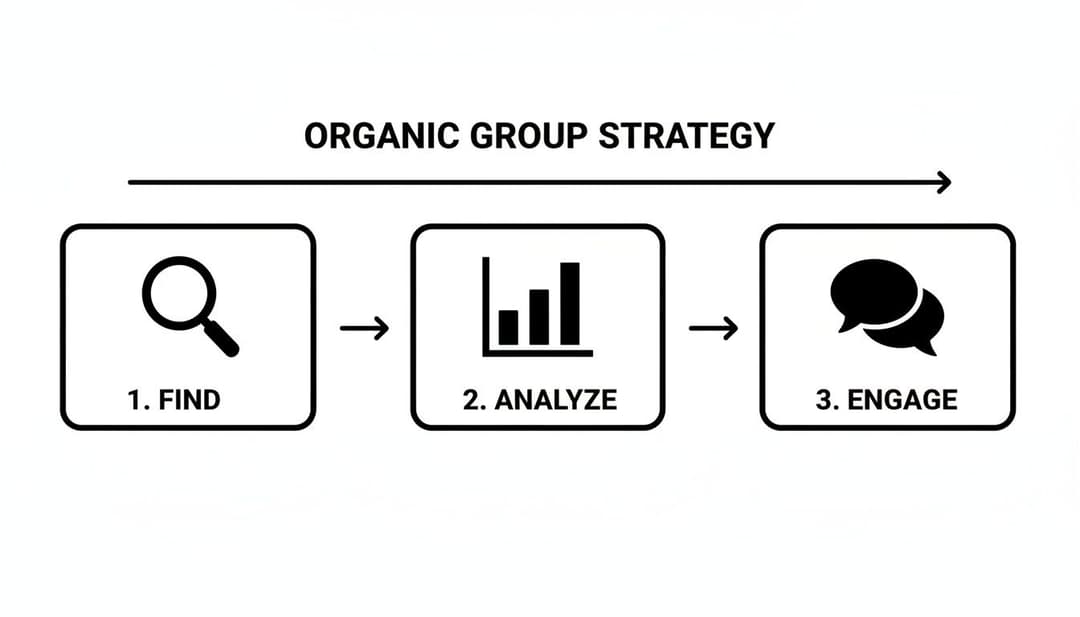
The takeaway is clear: finding and analyzing the right groups is the groundwork. Meaningful engagement is what turns that work into fuel for your paid ads.
Building Custom Audiences from Group Engagement
This is where you build a digital trail. When you share something valuable in a group (always, always following the rules), you create opportunities to build high-intent Custom Audiences. You're essentially pulling interested members out of the group and into your own advertising ecosystem.
Here are the most effective ways I’ve seen this done:
- Video View Audiences: Drop a native video in the group—maybe a quick tutorial or a user-generated-content-style clip. In Ads Manager, you can create a Custom Audience of people who watched, say, 50% or 75% of it. These viewers are highly qualified and already warmed up.
- Website Traffic Audiences: Share a link to a blog post or a specific landing page. The trick is to use a unique UTM parameter for that group. This lets you build an audience of only the people who clicked through from that specific, high-intent community.
- Facebook Page Engagers: When your awesome group posts get people curious enough to check out your brand's Facebook Page, you can capture their interactions. Create a Custom Audience of everyone who liked, commented, or shared something on your Page within a certain timeframe.
By creating these separate audiences, you’re segmenting users by their origin and intent. That gives you incredibly powerful data for what comes next. To get a better handle on this, check out our guide on how you can derive actionable steps from your marketing data: https://www.adstellar.ai/blog/ai-driven-marketing-insights.
Creating Your First Group-Sourced Audiences
Let's walk through a real-world scenario. Say you’re in a group for "DTC Brand Founders" and you share a 3-minute video case study on a common shipping logistics nightmare and how one brand solved it.
You'd then hop into Ads Manager and create two distinct Custom Audiences:
- Audience A: People who watched at least 50% of that specific case study video.
- Audience B: People who visited your website from the link in that group (which you tracked with a
utm_source=facebook_group_dtcparameter).
Just like that, you have two pools of warm leads. These people already know who you are and have shown interest. You can now retarget them with a direct offer or a lead magnet, and your ads will land with so much more impact. This process of finding low competition keywords and hot topics within these communities is also a goldmine for ad copy and content ideas.
Scaling with Lookalike Audiences
This is where the real growth happens. Those small, high-quality Custom Audiences you just built are the "seeds" for creating incredibly powerful Lookalike Audiences. You’re essentially telling Meta, "Go find me more people who look and act just like these folks."
Because your seed audience is built from hyper-relevant group members, the resulting Lookalike Audience will be far more accurate and efficient than one built from broad Page likes or general website visitors.
The data absolutely backs this up. Facebook Groups aren't just communities; they're conversion engines. We’ve seen ads targeting audiences derived from group engagement hit an average conversion rate of 8.95%. After the iOS 14.5 update, these strategies helped our clients recover 15-20% of what seemed like lost attribution.
Even better, Lookalikes built from these highly engaged members have yielded 20-30% better CPMs.
Start by creating a 1% Lookalike Audience from your strongest seed audience (like the 75% video viewers). This gives you a large, highly relevant group of new prospects to target. As you gather more data and your seed audiences grow, you can start testing larger Lookalike percentages, like 2-5%, to scale your reach without sacrificing quality.
This methodical approach transforms organic community interaction into a predictable, scalable engine for customer acquisition.
Crafting Ads That Actually Resonate with the Group
So you’ve built these incredible audiences from all your hard work in Facebook Groups. They’re warm, they’re engaged, and they’re way more likely to listen than some random person you targeted on the street. This is pure gold.
But if you turn around and show them the same glossy, corporate ad you show everyone else, you’re throwing all that hard-earned trust right out the window. The real trick is to create ads that feel like a natural part of the group's own conversation and culture.
Your ads shouldn't really look like ads at all. They need to blend in, looking more like the authentic, user-generated stuff people are already posting. Authenticity isn’t just a nice-to-have here; it’s a core requirement for successful Facebook advertising in groups.
Think about the posts that blow up in these communities. They’re usually a bit raw, unpolished, and intensely relatable. That’s exactly the vibe you’re aiming for.
Match the Native Vibe
Your one and only goal is to stop the scroll by looking familiar. When someone sees your ad, you don’t want their first thought to be, "Ugh, an ad." You want them to see it as just another interesting post from a fellow member. This means you have to totally rethink how you produce ad creative.
Here are a few ways I’ve seen this work incredibly well:
- UGC-Style Video: Grab your smartphone and record a simple, direct-to-camera video. It can be you, a colleague, or even a customer just talking honestly about a common problem and how you solve it. Forget the fancy lights and complex editing—just have a real conversation.
- Simple Graphic + A Question: Hop into Canva and whip up a basic graphic that asks a question you know is a hot topic in the group. Something like, "Still trying to land your first 10 SaaS customers?" This opens the door for engagement and feels like a discussion starter, not a sales pitch.
- Lo-fi Memes or Screenshots: If the group has a sense of humor, a well-placed, niche meme can work wonders. A simple screenshot showing a common frustration, like a messy analytics dashboard, can also create an instant "I feel that" moment.
In this context, being too polished is actually a problem. Your ads need to feel like they were made by a person, for other people.
Write Copy That Speaks Their Language
This is where you prove you’ve been paying attention. Your ad copy is your chance to use the specific jargon, inside jokes, and pain points you’ve picked up on while engaging organically in the group. It’s a signal that you’re one of them, not just an outsider trying to make a quick sale.
Check out this A/B test I ran for a project management tool. The difference is night and day.
| Ad Variation | Ad Copy | Result |
|---|---|---|
| Generic Ad | "Streamline your workflow with our all-in-one project management software. Sign up for a free trial today." | 1.2% CTR |
| Group-Specific Ad | "Tired of tracking Q4 OKRs in a messy spreadsheet? Saw this pain point in the 'SaaS Founders' group. Here’s a template we built to fix it." | 3.8% CTR |
The group-specific ad didn’t just do a little better—it absolutely crushed the generic one. By directly referencing the group and a real problem discussed there, we created an immediate connection. The result? A staggering 216% lift in click-through rate. If you want to dive deeper, understanding the basics can help you write truly good ad copy that actually converts.
Your ad copy should feel like a direct reply to a conversation that's already happening in the user's mind—and in their group feed. Use their words, call out their struggles, and offer a solution that feels like it was made just for them.
This is what makes advertising to group audiences so powerful. These communities are incredibly sticky; according to recent data, users spend an average of 15 minutes engaging in them every single day. B2B SaaS marketers have even seen vertical video ads with simple voiceovers lift conversions by 3% per dollar spent when shown to these niche professional audiences. If you’re curious, you can find more about Facebook's powerful user statistics and see just how engaged these users are.
When you pair native-looking creative with copy that speaks like an insider, you create an ad that feels helpful instead of intrusive. That’s how you turn a warm audience into a base of loyal, paying customers.
Measuring Performance and Scaling Your Campaigns
You’ve done the groundwork. You’ve sifted through groups, built your Custom Audiences, and launched ads that speak directly to those communities. Now what? Launching the campaign is just the starting line—the real race is won through constant measuring, learning, and scaling.
This is where you move beyond a quick glance at your Return On Ad Spend (ROAS). While ROAS is important, it doesn't even begin to tell you the full story of your group-based strategy. You need to dig deeper into the metrics that show the quality of the audiences you're building and how effectively you're turning group members into customers.
Key Metrics for Group-Based Ad Campaigns
To figure out what’s actually moving the needle, you have to track the right data. The KPIs below give you a much clearer picture of success than you'll find in a standard campaign report.
Track these specific KPIs to measure the true impact of your Facebook Group advertising efforts.
| Metric | What It Measures | Benchmark/Goal |
|---|---|---|
| Audience Seed Quality | The conversion rate or cost-per-result from your initial Custom Audiences (e.g., video viewers, specific UTM traffic). | Look for a significantly lower CPA than your broad or interest-based campaigns. |
| Lookalike Performance by Seed | The ROAS or CPA of Lookalike Audiences segmented by their original source (e.g., LAL from Group A vs. LAL from Group B). | Identify which group sources produce the most profitable Lookalikes. |
| Group-Sourced Lead CVR | The conversion rate of leads who originated from a specific group, tracked via UTMs or dedicated landing pages. | A high CVR here indicates a strong group-to-customer fit. |
| Ad-Level Engagement Rate | The likes, comments, and shares on ads targeted to your group-derived audiences. | High engagement suggests your creative is resonating and feels native. |
This kind of granular view helps you spot which groups are not just active, but are actually full of your future best customers. If you want to get serious about organizing these numbers, our comprehensive guide to Facebook advertising reporting will walk you through setting up a dashboard that makes sense of it all.
Creating a Continuous Feedback Loop
Your performance data is essentially a roadmap telling you what to do next. It fuels a powerful feedback loop that makes your entire strategy smarter and more efficient with every ad dollar you spend. It’s all about turning raw data into concrete actions that drive growth.
This loop really comes down to three things:
- Refine Your Creative: Did that UGC-style video knock it out of the park compared to a static graphic? Great, double down on that video format. If your ad copy zeroed in on a specific pain point and got a massive CTR, it's time to test new variations on that theme.
- Segment Your Audiences: Let's say the Lookalike Audience from "DTC Brand Owners" is converting at a 20% lower cost-per-acquisition than the one from "E-commerce Startups." That’s a clear signal to shift more budget to the winner and figure out what’s holding the other one back.
- Discover New Groups: Your best-performing audiences are a goldmine of clues. Analyze the demographics and shared interests of your top converters, then go find new, similar groups that match that exact profile.
This feedback loop transforms your advertising from a series of disconnected tests into an intelligent, self-improving system. Every dollar spent teaches you something new about your customers.
Scaling Your Winning Formulas
After you’ve run this feedback loop a few times, clear patterns will start to pop. You'll pinpoint winning combinations—the perfect storm of an ad, a message, and a group-sourced audience that consistently delivers. This is your green light to hit the accelerator.
But scaling is more than just cranking up your budget. It's about methodically expanding what you know works. For example, if a tight 1% Lookalike built from your video viewers is hitting your CPA targets, it's time to test a broader 2-3% Lookalike to see if you can expand your reach without sacrificing performance.
If a specific ad creative is an undeniable champion, use a tool like AdStellar AI to quickly generate and test dozens of new copy and headline variations against that same winning image or video.
This structured process takes what can feel like a complex, manual strategy and turns it into a repeatable engine for growth. By systematically finding and scaling your winning formulas, you can confidently manage multiple campaigns—or even multiple clients—knowing every move is backed by hard data from your most engaged prospects.
Your Top Questions About Facebook Group Ads, Answered
Let's be honest: navigating the world of Facebook Group advertising can feel a bit like walking a tightrope. You see the incredible potential in these niche communities, but you're also worried about breaking the rules, getting kicked out, or just wasting your ad budget.
It’s a common feeling. But this isn't about finding sketchy loopholes. It's about strategically and ethically connecting with high-intent audiences where they already gather. The goal is to be a welcome resource, not an uninvited advertiser.
Is Advertising in Facebook Groups Even Allowed?
This is the big one, and the answer isn't a simple yes or no. It’s absolutely against Meta's policies—and just about every group's rules—to join a community and start spamming links to your products. That’s a surefire way to get yourself banned from the group and your ad account potentially flagged.
However, the strategies we're talking about are completely different and fall well within the rules. You're not trying to force an ad into a group's feed.
Instead, you're doing things like:
- Participating Organically: This means actually adding value. You're answering questions, sharing helpful content, and becoming a known expert. This is always encouraged.
- Partnering with Admins: In many cases, you can work directly with a group admin for a sponsored or branded content post. It’s a legitimate form of advertising that respects the community's structure.
- Building Audiences Ethically: You're using Meta’s own tools in Ads Manager to create Custom Audiences from user actions, like people who watch a video you posted or visit your site from a group link. This is a standard, approved advertising method.
The whole game is about respecting the community and using Meta's platform the way it was designed. You're building audiences from genuine engagement signals, not shoving ads where they don’t belong.
How Do I Actually Track ROI from a Specific Group?
Attributing sales or leads back to one specific Facebook Group is the key to knowing where to double down. If you're not tracking, you're just guessing. Thankfully, with a little setup, it’s pretty straightforward.
Your best friend here is the UTM parameter. A UTM is just a bit of code you add to the end of a URL to tell your analytics tools where that click came from.
For instance, if you share a blog post in the "SaaS Founders Club" group, your link might look something like this: yourwebsite.com/blog-post?utm_source=facebook&utm_medium=social&utm_campaign=group_outreach&utm_content=saas_founders_club
Pro Tip: By creating a unique
utm_contenttag for every single group you're active in, you can log into Google Analytics and see exactly how much traffic, how many leads, and even how much revenue each specific group is generating for you.
From there, you can jump into Ads Manager and create a website Custom Audience of people who visited URLs containing that specific UTM. Now, when you run ads to that segmented audience, you can measure the direct ROI from the members of that community.
Can I Just Target Members of My Competitor's Group?
The short answer is no. Meta doesn't have a feature that lets you directly target members of a specific Facebook Group—not yours, not a competitor's, not anyone's.
This is exactly why the workarounds we've discussed are so effective. You can't target the group itself, but you can get awfully close by building a profile that mirrors its members.
Here’s how you can approach it:
- Become a Student of the Group: Join the competitor's group as a user (not a marketer!) and just listen. What are their job titles? What other pages or influencers do they follow? What software do they mention?
- Build a Mirror Audience: Take all those juicy details and use them to build a detailed targeting profile in Ads Manager. Layer interests, behaviors, job titles, and demographics to create an audience that looks just like the group's membership.
- Attract and Capture: Run top-of-funnel ads (think valuable videos or helpful guides) to this new interest-based audience. Anyone who engages with that content can then be added to a Custom Audience, effectively letting you "capture" a segment of people who are nearly identical to that competitor's group.
What's a Realistic Budget to Get Started?
The good news is you don't need a massive budget to make this strategy work. You just need to be smart. The first phase is all about gathering data, not chasing immediate sales.
I always recommend starting with a small, dedicated testing budget, maybe in the range of $20 to $50 per day.
Your initial spend has one job: building your seed audiences. This money should go toward "Engagement" or "Video View" campaigns to promote the valuable content you’re sharing. The goal isn't direct sales at this point. The goal is to get enough people (you want at least 1,000) into your high-quality Custom Audiences.
Once you have those strong, validated seed audiences, you can start putting more serious money behind Lookalike campaigns built from them. Let the performance be your guide. If a 1% Lookalike from your best group source is delivering a fantastic CPA, it's time to scale that ad set's budget and start testing broader 2-5% Lookalikes.
Ready to stop guessing and start scaling? AdStellar AI helps you launch, test, and manage hundreds of ad variations in minutes, not hours. Our platform automates the tedious work of campaign creation and uses AI to identify your winning creatives and audiences, so you can double down on what’s working and unlock more revenue from Meta. See how much faster you can grow.