Your stack probably looks familiar. Meta ads in one tab, GA4 or product analytics in another, CRM records that only partially match paid traffic, and a landing page builder that lives outside the rest of the system. Campaigns launch, but answers arrive late. You know spend, but not always why a segment converts, why another stalls, or which signal should drive the next test.
That is the primary job growth marketing tools should solve.
Many teams do not need more software. They need fewer blind spots between acquisition, activation, and retention. A good stack lets you move from ad click to customer record to product behavior to remarketing audience without manual cleanup every time. A weak stack gives you channel reports that look busy but do not help you decide what to scale next.
That is why I would not evaluate growth marketing tools as isolated point solutions. I would evaluate them as connected roles inside one operating system. One tool creates demand. Another unifies identity. Another tells you what users did. Another helps you test the page or product experience. When those parts connect cleanly, growth work gets faster and more defensible.
AI has pushed this further. In 2025, 73% of marketers were already using AI, primarily for content creation, according to Elementor’s digital marketing statistics roundup. That does not mean every AI feature is useful. It does mean the practical question has changed from “should we use AI” to “where does AI remove repetitive work without hiding the data we need.”
If your immediate bottleneck is conversion on site, this companion guide on best conversion rate optimization tools is worth keeping open alongside this one.
1. AdStellar AI
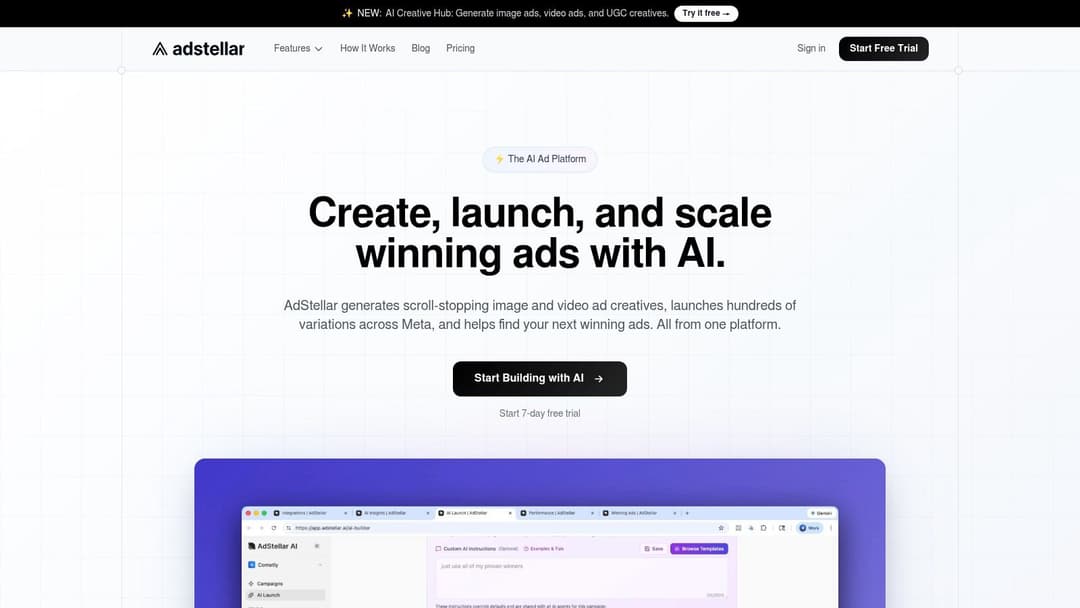
AdStellar AI is the tool I would put at the center of a Meta-first paid social stack when the problem is production speed, testing discipline, and campaign orchestration.
A lot of paid teams do not struggle with strategy. They struggle with throughput. They know they should test more creative angles, more audience combinations, and more message variants. They just cannot justify the manual setup overhead every week. AdStellar is built around that exact bottleneck.
It automates bulk ad creation, pushes large sets of variations live quickly, connects to Meta Ads Manager through OAuth, and learns from historical account performance. That matters because most ad tools stop at drafting. AdStellar is trying to compress the full loop from idea to launch to optimization.
Where it fits in a real stack
The best use case is straightforward. Use AdStellar for campaign assembly and Meta-side optimization. Feed audience logic from your CRM or CDP. Send downstream performance signals into your analytics environment so paid outcomes do not live in a silo.
A practical workflow looks like this:
- Acquisition layer: Build and launch Meta campaigns in AdStellar using large batches of creative, copy, and audience combinations.
- Data layer: Sync customer and behavioral traits from a CDP so audience definitions stay consistent with lifecycle stages.
- Decision layer: Compare paid campaign winners against activation and retention behavior in analytics, not just top-of-funnel metrics.
That combination is what makes growth marketing tools useful. Without the middle layer, ad automation often becomes faster guesswork.
One reason this matters. Growth marketing frameworks increasingly stress full-funnel accountability and data-driven personalization, yet many teams still treat integration as optional. Simon-Kucher points to the need for “high-tempo experimentation” and a shift from opinion-led decisions to data-led ones in its discussion of building a growth marketing engine, while also highlighting the integration gap many teams still face (Simon-Kucher on growth marketing engines).
What works and what does not
What works:
- High-volume creative testing: If your team wants many launch-ready permutations fast, this is the point of the platform.
- Learning from account history: Historical Meta data gives the system context before the next round of testing.
- Centralized paid workflow: Campaigns, creatives, audiences, media assets, and performance views in one place reduce operational friction.
What does not:
- Multi-channel media buying: AdStellar is focused on Meta inventory. If Google, TikTok, LinkedIn, and email all need equal orchestration, you still need other tools.
- Quick self-serve price comparison: Pricing is not published publicly, so evaluation likely starts with a demo.
For teams that want to inspect how the optimization layer works, the platform’s AI optimization features are the best place to review.
Use AdStellar when Meta is a primary growth channel and execution speed is the constraint. Do not use it as a substitute for measurement discipline or audience strategy.
A related idea matters here too. Turning product behavior into better ad decisions is where paid social gets sharper, which is why I also like the framing behind product to model AI.
2. HubSpot Marketing Hub
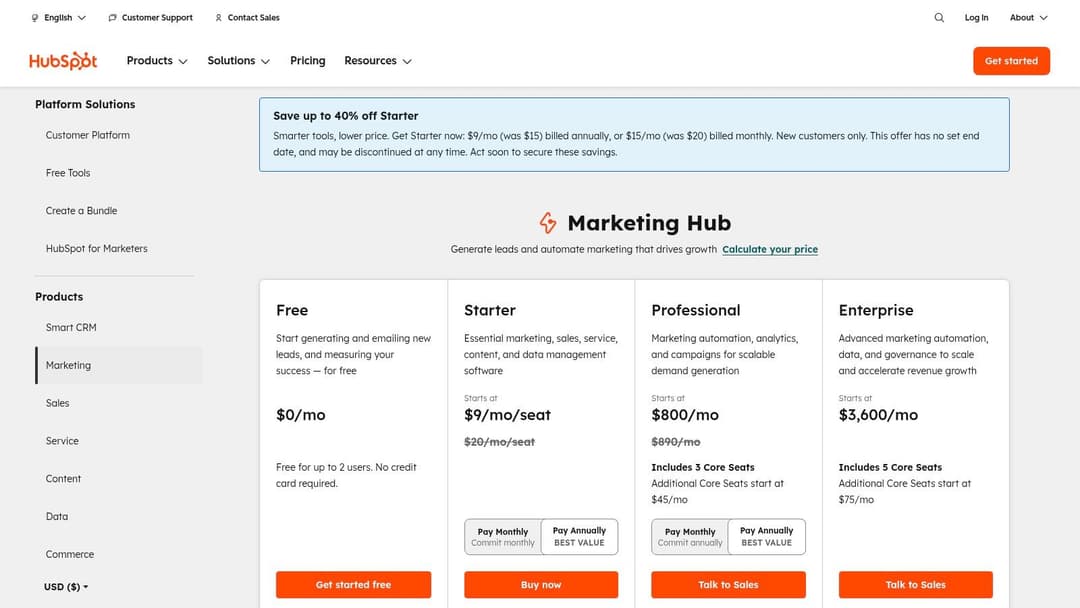
HubSpot Marketing Hub is the all-in-one option I recommend when a team is tired of stitching contacts, forms, email, attribution, and basic automation across too many systems.
Its strength is not novelty. It is operational coherence.
HubSpot had over 238,000 customers across 135+ countries by 2025, according to 6Minded’s HubSpot marketing statistics roundup. That scale matters because you are not buying a niche workflow. You are buying a widely adopted operating layer for marketing and CRM.
Best use cases
HubSpot is a strong fit for:
- Startup and scaleup teams: One place for CRM, forms, email, and campaign reporting.
- B2B demand generation: Lead scoring, lifecycle stages, nurture flows, and deal attribution matter more than deep retail messaging.
- Ops-heavy marketing teams: Governance matters when several people touch lists, automations, and reporting.
The biggest practical upside is the unified data model. Contacts, deals, forms, email engagement, ad interactions, and workflows all live close together. That reduces the amount of hand-built logic your team maintains elsewhere.
Trade-offs to watch
HubSpot becomes expensive when your database grows and when your team needs advanced automation or reporting. That is the trade. You save time and complexity in exchange for less pricing flexibility.
It also works best when you accept its worldview. If your stack already revolves around a warehouse, a specialized CDP, and product-led event analytics, HubSpot may become one layer among many rather than the true system of record.
Still, there is a reason growth teams keep it in the stack. In the same HubSpot statistics roundup, marketing teams using CRMs like HubSpot were reported as 128% more likely to deem their strategies effective. I would not use that as a promise of outcomes for any single company, but it aligns with what many teams experience. Shared customer context improves decision quality.
HubSpot is rarely the most exciting tool in the stack. It is often the one that prevents expensive messes.
3. Klaviyo
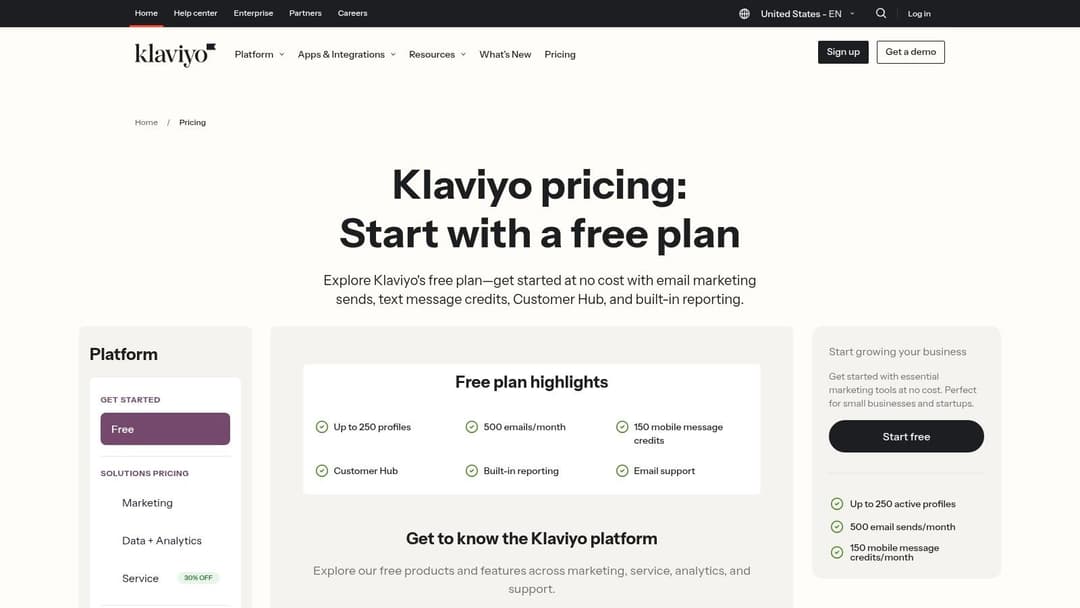
Klaviyo is strongest when retention revenue depends on fast, behavior-based messaging.
A common scenario looks like this. Paid social brings in first-time visitors. AdStellar AI helps your team produce and test more creative variations. Traffic lands on product pages, some visitors browse, some add to cart, a few buy, and many leave without taking the next step. Klaviyo earns its keep by turning that behavior into follow-up flows that recover demand and increase repeat purchase rate.
That is the right way to evaluate it. Not as a standalone email tool, but as the retention layer in a connected growth stack.
Where Klaviyo shines
Klaviyo works well for ecommerce teams because the underlying model matches how merchants market. Product views, cart events, order history, predicted replenishment windows, and catalog data are close to the messaging workflow, so teams can launch useful automations without stitching together as much custom logic.
The practical payoff is speed. A retail team can go from raw behavior to a live flow quickly, then spend time improving offer, timing, and audience rules instead of cleaning data between systems.
The highest-value programs usually include:
- Welcome and first-order flows: Adjust messaging by source, product interest, or discount sensitivity.
- Browse and cart recovery: Follow up based on actual item interest, not broad list segments.
- Post-purchase sequences: Drive repeat orders with replenishment reminders, cross-sells, education, reviews, and win-back campaigns.
Klaviyo also gives smaller teams a reasonable path to personalization without building a large martech stack first.
Where it gets harder
Klaviyo is less natural for B2B funnels, sales-assisted nurture, or account-based journeys with complex ownership rules. Those use cases usually need tighter CRM logic and different reporting.
There are also two trade-offs I see repeatedly in practice.
- SMS costs scale fast: SMS can perform well, but margin matters. If your average order value is modest, aggressive SMS usage can erode the upside.
- Tool overlap creates confusion: If HubSpot already controls lifecycle stages and core contact orchestration, Klaviyo needs a clear job. Usually that means ecommerce retention, merchandising-driven campaigns, and transactional-adjacent lifecycle messaging.
The mistake is giving both platforms partial ownership of segmentation and automation. That creates audience drift, duplicate sends, and attribution arguments your team does not need.
A better setup is straightforward. Let acquisition tools such as AdStellar AI drive testing and traffic generation. Let your CDP or ecommerce platform keep customer traits and event logic clean. Let Klaviyo execute the retention and revenue flows tied directly to shopper behavior. If your team is working through that handoff, this guide on how to scale your marketing automation campaigns is a useful reference point.
4. Twilio Segment
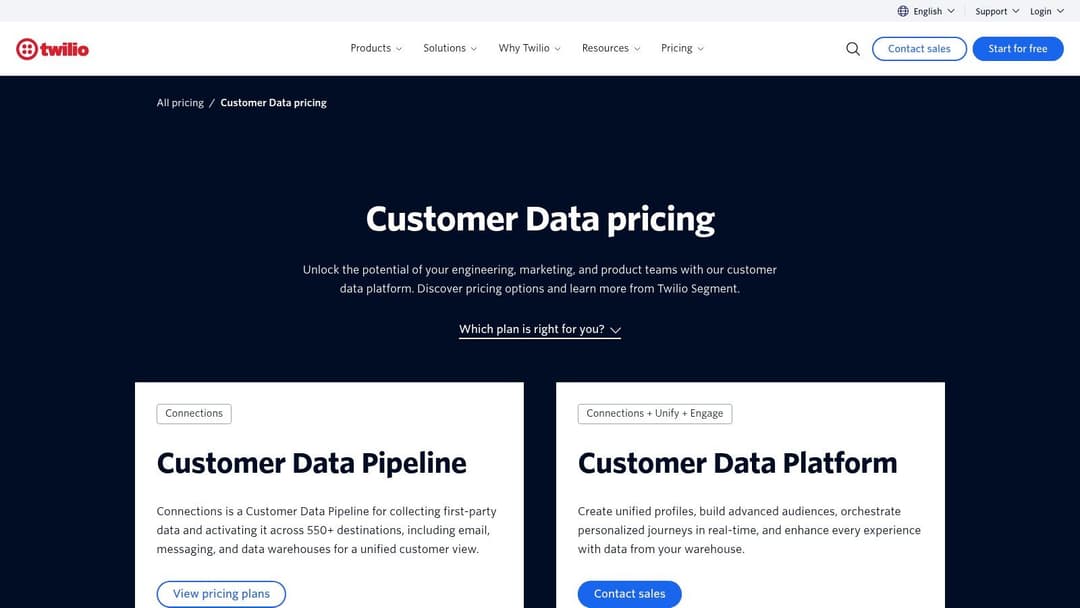
Twilio Segment is the tool I reach for when growth breaks because data definitions do not match across systems.
Ads say one thing. CRM says another. Product analytics counts users differently. Email audiences drift. At that point, buying another execution tool usually makes the problem worse. You need a customer data platform.
Why a CDP changes the stack
A CDP is not glamorous, but it solves one of the most expensive stack failures. Identity and event consistency.
Segment collects events, resolves profiles, routes data to downstream tools, and gives teams a better shot at keeping audience logic aligned. That is the foundation for accurate attribution, suppression logic, retargeting, and lifecycle messaging.
This matters more than most articles admit. Growth marketing discussions often celebrate individual tools while underplaying orchestration complexity. The integration problem is especially sharp for teams managing large numbers of ad variations across channels, where too much disconnected data creates more noise than insight, as noted in the Simon-Kucher gap analysis cited earlier.
What to expect in practice
Segment works best when your team has the discipline to define a clean tracking plan.
- Good implementation: Clear event naming, ownership, governance, and destination rules.
- Bad implementation: Every team sends slightly different events, profiles duplicate, and trust disappears.
That is the hard truth with growth marketing tools at this layer. The software does not create clarity on its own. It enforces the clarity your team is willing to build.
The upside is substantial when done well. You instrument once and route to many destinations. Analytics, ad platforms, warehouses, and messaging tools can all run from a more consistent data source.
For teams tightening audience logic across paid and lifecycle channels, these audience segmentation strategies are the kind of thinking that makes a CDP investment pay off.
5. Mixpanel

Mixpanel is for teams that need to answer behavioral questions quickly without waiting on analysts for every funnel cut.
Why did paid signups increase but activation stay flat? Which onboarding path leads to repeat usage? Which campaign source brings users who complete the key event? Mixpanel is built for those questions.
What it does well
Its strongest use is event-based analysis tied to acquisition and activation.
You can inspect funnels, cohorts, retention patterns, and user paths with enough flexibility for daily growth work. For self-serve SaaS, consumer apps, and product-led motions, that speed matters.
I like Mixpanel most when the team already knows its critical events and wants to make experimentation routine. It gives marketers and PMs enough autonomy to explore without turning every request into a dashboard backlog.
Where teams get in trouble
Event schema design is the whole game.
If teams track everything loosely, Mixpanel becomes a warehouse of half-useful events. If they define a small set of meaningful events and properties, the tool becomes one of the clearest ways to connect acquisition to activation.
Product adoption is the metric to keep an eye on here. Count’s summary of adoption benchmarks notes that mature tools often reach adoption in the 25% to 40% range, while early-stage platforms often sit lower, and that adoption correlates with retention and profit outcomes (Count on user adoption rate). You do not need Mixpanel to track every vanity event. You need it to watch whether users are reaching the behaviors that predict staying power.
That is why I often pair it with paid acquisition systems. Meta can tell you what got the click. Mixpanel helps answer whether that click turned into meaningful usage. For teams building that loop, this primer on marketing campaign analytics is relevant.
6. Amplitude
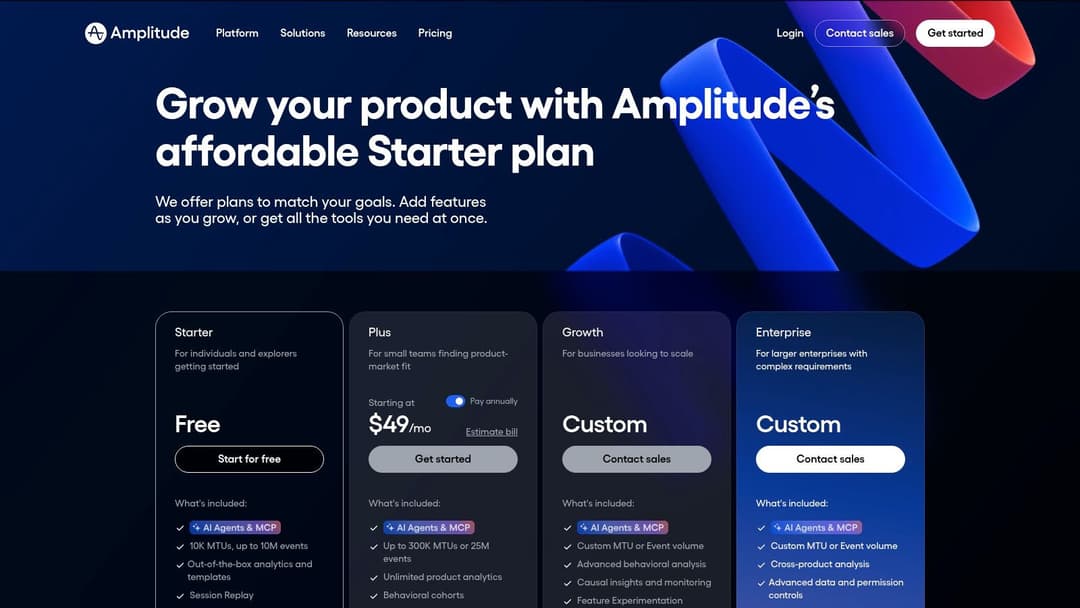
Amplitude is the broader growth platform choice when you want analytics, experimentation, and activation capabilities closer together.
Mixpanel is often the faster self-serve answer for many teams. Amplitude tends to appeal when the organization wants a more expansive system for product and growth analysis.
Why teams choose it
Amplitude is strong when growth work extends beyond campaign reporting into product change management.
Its suite covers analytics, cohorts, session replay, experimentation, and governance. That creates fewer handoffs between “what happened,” “why it happened,” and “what should we test next.”
If your growth model depends on onboarding, feature discovery, paywall exposure, retention loops, or in-product nudges, that breadth is valuable. You are not only measuring marketing. You are measuring the user journey after acquisition.
Trade-offs that matter
The challenge is complexity. Plan structures, data sizing, and feature packaging can feel less intuitive than teams expect.
Amplitude rewards organizations that already think in systems. Clear taxonomy. Shared definitions. Dedicated owners. It is less forgiving for teams that just want a quick dashboard.
There is also a broader strategic reason to consider tools like this. Salesforce’s overview of marketing analytics tools emphasizes adoption metrics such as product adoption rate and DAU/MAU as core KPIs, and notes that engagement benchmarks vary by sector, with examples like subscription media at 40% to 60% and fintech at 25% to 40% (Salesforce on marketing analytics tools). Amplitude fits that style of operating. It is built for teams that care whether users adopt and return, not just whether campaigns attract clicks.
7. Optimizely Experimentation
Optimizely Experimentation is what I would bring in when experimentation is no longer occasional. It is a program.
There is a big difference between running a few A/B tests and operating an experimentation engine across web and product surfaces. Optimizely is designed for the second case.
Where it earns the cost
Smaller teams can get by with simpler testing tools for a while. Mature teams need stronger governance, audience targeting, statistical controls, and feature experimentation support.
That is where Optimizely starts to justify itself.
Use it when you need:
- Parallel experiments: Multiple tests without chaos or accidental overlap.
- Web and feature testing: Marketing and product teams working from a common experimentation discipline.
- Enterprise process: Permissions, auditability, and cleaner rollout control.
Conversion gains are now easier to find than they used to be. For instance, in HubSpot-focused marketing statistics, nearly 56% of marketers reported that improving conversion rates is much easier now than a decade ago, a shift tied in part to better tooling and data environments. Easier does not mean automatic. It means teams with disciplined experimentation infrastructure can move faster than teams relying on opinion.
What to watch
Optimizely is generally overkill for small teams that are still trying to establish basic analytics hygiene. If your events are messy and your landing pages are not instrumented well, advanced experimentation software will not save you.
Custom pricing is the other obvious barrier. This is not the low-friction option.
Still, for teams turning testing into a core operating rhythm, the investment can be justified. If you need a practical refresher on test design before buying a premium platform, start with what is A/B testing in marketing.
8. Branch
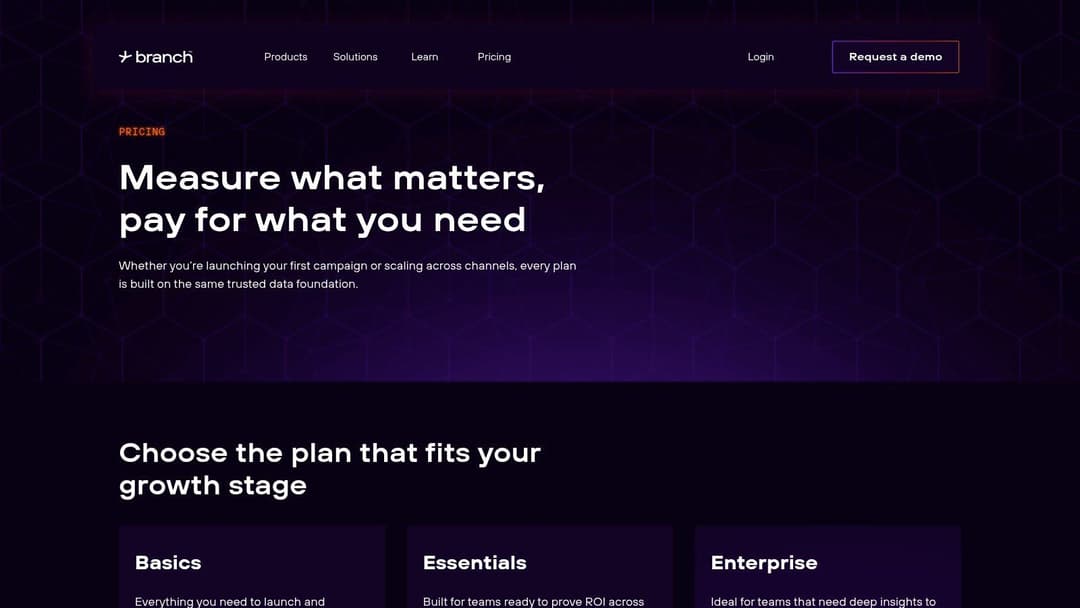
Branch solves a specific mobile growth problem. A user clicks a paid ad, installs the app, opens it, and ends up on the home screen instead of the product, offer, or referral flow that drove the click. Attribution gets fuzzy, onboarding loses context, and paid acquisition looks weaker than it appears.
That break in continuity is expensive for app-led teams.
Branch handles deep linking, deferred deep linking, and mobile attribution in one layer. If the app is already installed, users go to the intended in-app destination. If it is not, they install first and still land in the right place after opening. That makes campaign intent survive the jump from ad platform to app store to product.
Why it earns a place in the stack
Web analytics platforms can track plenty of acquisition activity, but mobile app journeys create edge cases they were not built to manage cleanly. Branch is useful because it closes that gap.
Used well, it helps teams answer practical questions such as:
- Which campaigns drove installs that turned into activation, not just downloads
- Whether a creator, referral, or paid social link sent users into the right screen
- Which onboarding paths perform better once users enter the app
- Where attribution starts to break across iOS, Android, and web-to-app flows
This is less about getting one more dashboard and more about preserving context.
How to connect it with the rest of your tools
Branch is rarely a standalone answer. It works best as the mobile routing and attribution layer inside a broader growth system.
A practical setup looks like this:
- Branch handles link routing, deferred deep linking, and campaign-level mobile attribution.
- Twilio Segment unifies user and event data across app, site, and downstream tools.
- Mixpanel or Amplitude measures activation, retention, and cohort behavior after install.
- AdStellar AI or your paid media platforms use those downstream signals to refine targeting and creative decisions.
That stack gives acquisition teams cleaner source data and gives product teams a way to judge traffic quality after the install.
What to watch
Branch makes the most sense when mobile is central to revenue or retention. If your app is secondary to the main buying journey, the implementation effort may outpace the value.
Teams also underestimate taxonomy work here. Deep links, campaign naming, event mapping, and app screen definitions need to stay consistent across marketing, product, and engineering. If that discipline is missing, Branch will still route users correctly, but your reporting will stay messy.
Mobile journey continuity is becoming more important, especially for brands that acquire users through paid social, creators, referrals, and web-to-app flows. Branch earns its place when you need those journeys to stay measurable from click to install to retained user.
9. Hotjar
Hotjar is the tool I add when the dashboards say a page is underperforming but nobody can explain why.
That is a common gap in growth stacks. Quantitative tools tell you where people drop. They do not always tell you what the experience felt like.
What it solves
Hotjar gives you the qualitative layer.
Heatmaps, session replays, funnels, surveys, and user feedback expose friction that standard campaign reports miss. For landing pages, signup flows, pricing pages, and checkout steps, that context is often enough to generate the next strong test.
This is one of the fastest tools to implement. You do not need a major data project to start learning from it. That makes it especially valuable for lean growth teams that need directional answers this week, not next quarter.
How to use it well
Do not treat session replay as a replacement for analytics. Use it to explain anomalies.
A good workflow looks like this:
- Analytics identifies a step with unusual drop-off.
- Hotjar recordings and heatmaps reveal hesitation, confusion, or broken UX patterns.
- Testing tools validate a fix.
- CRM or lifecycle tools follow up based on the improved path.
There is also a practical AI angle emerging here. Elementor reports that 62% of marketers expect AI content improvements, which lines up with the need to iterate faster on page messaging and on-site content. Qualitative insight tools like Hotjar are useful because they tell you where that content still fails the user.
If analytics tells you what happened and Hotjar shows you why users struggled, your CRO work gets sharper fast.
10. Unbounce
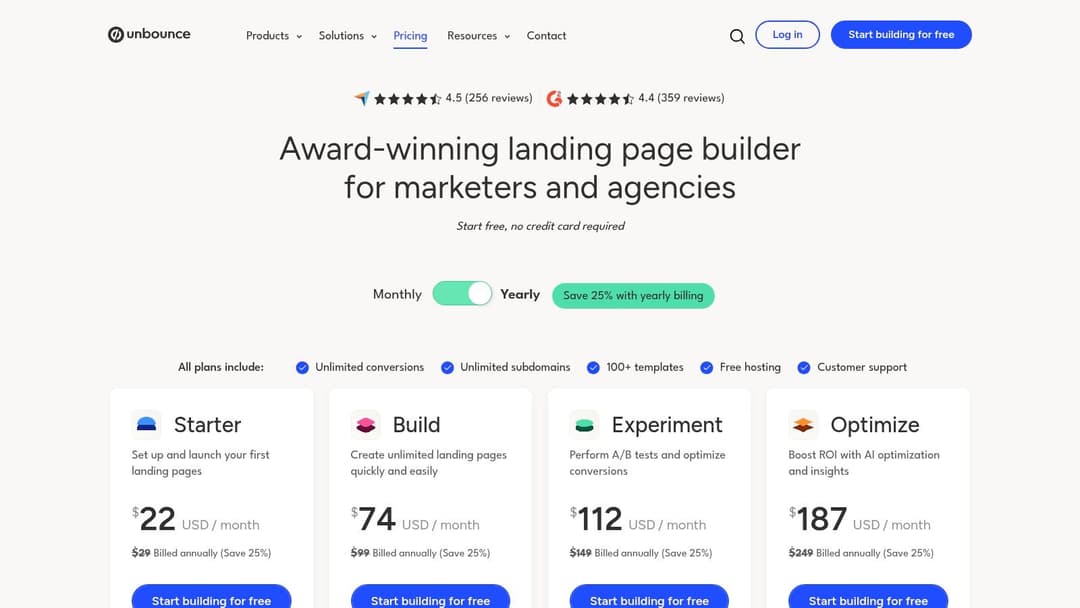
Unbounce is still one of the most practical growth marketing tools for teams that need paid landing pages live fast without waiting on engineering.
That sounds basic, but speed matters. If every page variation depends on a sprint, paid media testing slows down and creative learnings pile up before the page catches up.
Best use case
Unbounce is strongest when you run campaign-specific pages that need:
- Fast launch cycles
- Simple A/B testing
- Message matching between ad and page
- Ownership by marketers, not developers
For acquisition teams, that is often enough.
It is also a useful complement to a Meta-first paid setup. Ad tools help identify strong hooks and audiences. Unbounce helps carry those hooks into the click destination with less production lag.
The limitation
It is not a full CMS. If your site requires deep template logic, complex localization, heavy content relationships, or application-like experiences, you will hit its edges.
Traffic-based plan limits are another thing to watch. These tools feel cheap until volume rises and the economics change.
Still, there is a reason landing page builders remain central. Short-form content is now a major format for discovery, and blog posts still rank among the top content formats marketers use, according to Elementor’s roundup. Faster top-of-funnel testing creates more pressure on the page layer to keep up. Unbounce is a clean answer when the landing page is the bottleneck.
Top 10 Growth Marketing Tools Comparison
| Product | Core features | Target audience | Value proposition | Unique selling points | Pricing |
|---|---|---|---|---|---|
| AdStellar AI (Recommended) | Bulk ad creation, AI Insights, AI Launch, Meta OAuth integration, auto-scaling | Media buyers, growth teams, DTC/e‑commerce, agencies, B2B acquisition | Launch & iterate Meta campaigns 10× faster; data-driven winner selection to boost ROAS/CPL/CPA | Meta-focused auto-assembly; one-click live pushes; continuous learning from account history | Not public; demo / sales required; Meta-only focus |
| HubSpot Marketing Hub | CRM-native automation, ads, forms, landing pages, attribution | SMB to enterprise marketing ops and inbound teams | Unified CRM + marketing for multi-channel campaigns and attribution | Native CRM integration, large partner/education ecosystem | Tiered pricing; scales with contacts and seats |
| Klaviyo | Email & SMS flows, AI recommendations, deep ecommerce integrations, segmentation | DTC/e‑commerce brands and retailers | Fast time-to-value for lifecycle revenue and personalized commerce messaging | Commerce-first data model, strong deliverability and templates | Usage-based; SMS costs add up with volume |
| Twilio Segment (CDP) | Event collection, profiles, audiences, reverse ETL, routing to destinations | Data teams, enterprises needing unified customer data | Centralize customer data for accurate targeting, attribution, and activation | Identity resolution, governance, broad downstream destinations | Contract & volume-based; pricing scales with usage |
| Mixpanel | Event-based analytics, funnels, cohorts, retention, fast queries | Product & marketing teams, startups, PMs | Quick behavioral insights for acquisition, activation, and retention | Strong self-serve UX, clear event-based pricing, fast segmentation | Event-based tiers; generous free allotment |
| Amplitude | Product/marketing analytics, experimentation, session replay, AI insights | Scaling product + growth teams running experiments | End-to-end analytics + experimentation for rigorous growth work | Cohorts + causal analysis, feature flags, predictive audiences | Published entry tiers; MTU/event sizing can be complex |
| Optimizely Experimentation | Web & server-side A/B, multivariate, personalization, SDKs | Enterprise experimentation and engineering teams | Statistically rigorous testing and personalization at scale | Full-stack experimentation, Stats Engine, governance tools | Premium, custom-quoted pricing |
| Branch | Mobile attribution, deep linking, cohort measurement, fraud prevention | App marketers and mobile growth teams | Accurate mobile attribution and seamless paid→app journeys | Deferred deep linking, cross-channel attribution, app ecosystem support | Plan & volume-based; sales engagement often required |
| Hotjar (Contentsquare) | Heatmaps, session replay, funnels, surveys, AI summaries | CRO teams, UX researchers, product marketers | Fast qualitative + quantitative UX insights to reduce friction | Quick setup, non-technical self-serve insights, surveys + replay | Plans via Contentsquare; advanced features may need sales |
| Unbounce | Drag-and-drop landing pages, A/B testing, Smart Traffic AI, templates | Paid media marketers needing rapid landing pages and CRO | Launch campaign-specific pages fast and improve conversion without dev | AI visitor routing (Smart Traffic), DTR, many templates | Published tiers with traffic limits; costs rise with volume |
Final Thoughts
The best growth marketing tools do not win because they have the longest feature list. They win because each tool has a clear job, the data moves cleanly between them, and the team knows which system owns which decision.
That is the core mistake I see most often. Teams buy one more tool to fix a workflow problem that is a stack design problem. The result is duplicated audiences, inconsistent attribution, unclear handoffs, and reporting nobody fully trusts. More software. Less clarity.
A better approach is to build from the bottleneck outward.
If paid social on Meta is your main acquisition engine, start with campaign execution and optimization. That is where AdStellar AI fits. If customer records and lifecycle workflows are messy, put a CRM or automation layer like HubSpot in place. If ecommerce retention is the main lever, Klaviyo should sit closer to the center. If your customer data is fragmented, a CDP like Segment becomes the priority before you add more channel tools. If you still cannot explain behavior after acquisition, Mixpanel or Amplitude gives you the product lens. If users stall on page, add Hotjar and an experimentation layer. If your mobile journey breaks between ad click and app event, Branch becomes essential. If landing page deployment is the bottleneck, Unbounce buys speed immediately.
That sequence matters because good stacks are built in layers.
The first layer is execution. Ads, pages, messaging.
The second layer is identity and routing. CRM, CDP, clean event flow.
The third layer is analysis. Product analytics, attribution, behavioral review.
The fourth layer is optimization. Testing, personalization, and automation.
When those layers work together, the stack stops behaving like separate subscriptions and starts behaving like a growth system.
There is also a strong operational reason to care about adoption inside your own team. Count’s summary of SaaS adoption benchmarks notes that adoption rates are closely tied to retention and profit outcomes, and highlights the importance of time to value and feature adoption in reducing churn. The lesson is simple. Even the best growth marketing tools fail when the team never fully operationalizes them.
So choose fewer tools. Set naming conventions early. Define ownership. Decide where source-of-truth fields live. Map the path from ad click to customer profile to product event to retention audience before you buy the next platform. That work is less exciting than trying a new AI feature, but it produces better growth decisions.
If I had to reduce the whole guide to one rule, it would be this. Buy tools in service of a workflow, not a category.
A stack that helps you launch quickly, segment cleanly, measure behavior, and act on learnings will outperform a bigger stack that only produces more dashboards. Growth teams do not need more tabs. They need a system that lets them see the next move clearly.
If Meta is a core acquisition channel and your team is spending too much time building, duplicating, and sorting campaigns by hand, AdStellar AI is worth a close look. It is built for performance marketers who want faster creative testing, cleaner campaign assembly, and optimization driven by historical account data instead of manual guesswork.