Manual creative testing on Meta is broken. Not because marketers lack skill or creativity, but because the process itself operates at a fundamentally different speed than the platform it's trying to optimize. While you're coordinating with designers for the next batch of variations, your competitors are already three testing cycles ahead.
The problem runs deeper than slow turnaround times. Traditional A/B testing methodologies were built for an era when digital advertising moved at a measured pace. Audiences took weeks to fatigue. Creative elements had longer shelf lives. Sequential testing made sense because the market didn't shift underneath you while you isolated variables.
That world no longer exists. Meta's algorithm demands volume and velocity. Audiences scroll past thousands of ads daily, burning through creative concepts faster than manual testing processes can adapt. By the time you've identified a winning variation through traditional methods, that creative has often already peaked and started its decline.
The Hidden Time Drain in Traditional Creative Testing
The designer-marketer handoff represents the first major bottleneck in most creative testing workflows. You brief the concept, wait for initial drafts, provide feedback, wait for revisions, and finally receive assets ready for upload. This cycle typically spans three to five business days for a single variation. Need to test five different image concepts? That's potentially three weeks before you even launch.
This production timeline creates a cascade of delays. While you're waiting for creative assets, market conditions shift. Competitor messaging evolves. Seasonal trends emerge and fade. The strategic context that informed your original brief becomes outdated before the first ad goes live.
Sequential testing compounds the time problem exponentially. Testing one variable at a time feels methodologically sound. Isolate the headline first, then test images against the winning headline, then test audiences against the winning creative combination. The logic is impeccable. The timeline is catastrophic.
Consider the math: Testing four headlines takes one week. Testing five images against the winning headline takes another week. Testing three audience segments takes a third week. You're now three weeks into finding your optimal combination for a single campaign. During those three weeks, you've spent budget on suboptimal variations while gathering data at a pace that cannot match the speed of audience behavior changes.
Meta's algorithm requires substantial data volume to exit its learning phase and deliver stable performance. Manual testing processes struggle to provide this volume efficiently. Each new variation you launch triggers a fresh learning phase. Each sequential test means another round of algorithmic calibration, another period of inefficient spend while the system gathers signals. This is why so many marketers find their ad creative testing takes forever to produce actionable results.
The budget implications extend beyond direct ad spend. Every day spent in testing is a day not spent scaling winners. Every week in learning phase is a week of suboptimal ROAS. The opportunity cost of slow testing often exceeds the actual media spend, but remains invisible in standard reporting.
Production bottlenecks also limit testing ambition. When each variation requires designer coordination, marketers naturally test fewer concepts. You might have ten ideas worth testing but practical constraints force you to pick the three that seem most promising. This pre-filtering based on intuition rather than data means potentially breakthrough creative concepts never get tested at all.
Where Most Testing Strategies Break Down
The pursuit of statistical significance creates a paradox in Meta advertising. You wait for enough data to make confident decisions, but by the time you reach significance, the creative landscape has shifted. Audiences have seen your ads multiple times. Frequency climbs. Performance degrades. The "winning" variation you finally identified is already fatiguing.
This timing mismatch happens because statistical rigor and platform velocity operate on incompatible timescales. Traditional testing frameworks assume relatively stable conditions during the test period. Meta advertising offers no such stability. Auction dynamics fluctuate daily. Audience composition shifts as the algorithm optimizes delivery. Creative fatigue accelerates with each impression.
Variable isolation presents another common breakdown point. The goal seems straightforward: test one element at a time to understand its impact. The execution becomes messy quickly. You test five headlines against the same image, declare a winner, then test new images against that headline. But those new images change the context entirely. A headline that performed well with lifestyle photography might underperform with product close-ups.
This context dependency means your sequential testing produces results that don't reliably predict performance when you combine elements differently. You've identified individual winners in isolation, but their interaction effects remain unknown. The final combination might perform worse than expected because elements that won separately don't complement each other.
Inconsistent testing frameworks compound the problem. Different campaigns use different success metrics. One test optimizes for CTR, another for conversions, a third for ROAS. When you try to apply learnings across campaigns, you discover that "winning" elements from a CTR-focused test don't necessarily drive conversions. Your knowledge base becomes fragmented rather than cumulative.
The scaling lag represents perhaps the most costly breakdown. You've finally identified a winning creative through weeks of testing. Now you need to scale it. Budget increases trigger another learning phase. Audience expansion requires additional testing. By the time you've scaled the campaign to meaningful spend levels, that creative has accumulated significant frequency among your core audience. Performance plateaus or declines just as you've invested resources to amplify it.
Many marketers respond to this scaling lag by being more conservative with initial tests, using smaller budgets to minimize risk. This conservatism creates its own problem: insufficient data volume to reach conclusions quickly. You're trapped between spending enough to get reliable data and spending so much that scaling becomes risky if the creative fatigues during testing. Understanding the root causes of Facebook ad creative testing problems is the first step toward solving them.
The Real Cost of Slow Creative Iteration
Opportunity cost in advertising operates silently but devastatingly. Every day your suboptimal creative runs is a day of lost conversions. Calculate it directly: if your current ad generates 20 conversions daily at $50 CPA, and a better creative could deliver 30 conversions at $40 CPA, each day of delay costs you 10 conversions and $200 in efficiency losses. Over a month, that's 300 missed conversions and $6,000 in wasted spend.
These calculations assume static conditions, which understates the real impact. Market opportunities are time-bound. Seasonal trends peak and fade. Competitor activity intensifies and subsides. Cultural moments emerge and pass. Slow testing means you miss the optimal window to capitalize on these dynamics entirely.
Consider a product launch scenario. You have a two-week window of peak interest following the announcement. Traditional testing might take one week to identify winning creative, leaving only one week to scale before interest wanes. A faster testing approach could identify winners in two days, providing twelve days of scaling runway. The revenue difference between these scenarios often exceeds the total testing budget by an order of magnitude. This is why Facebook ad testing that takes weeks represents such a significant competitive disadvantage.
Creative fatigue has accelerated dramatically across Meta's platforms. Audiences see more ads than ever before. The novelty threshold for any creative concept has shortened accordingly. What might have remained fresh for six weeks in previous years now fatigues in two weeks or less for many audiences.
This acceleration means the window for any creative to perform optimally has narrowed. If your testing process takes three weeks to identify a winner, and that winner has a two-week performance window before fatigue sets in, you've missed the majority of its potential value during the testing phase itself. You're essentially testing creatives into obsolescence.
Frequency management becomes nearly impossible with slow iteration cycles. By the time you've tested and scaled a creative, your core audience has seen it multiple times. You need fresh creative to maintain performance, but your production and testing pipeline cannot deliver it fast enough. You're forced to choose between continuing with fatigued creative or pausing campaigns while you develop new assets.
Competitive dynamics amplify every efficiency gap. While you're running your third week of sequential headline tests, competitors using automated testing systems have already tested dozens of creative variations, identified multiple winners, and begun scaling the best performers. They're learning faster, adapting quicker, and capturing market share while you're still gathering data.
This competitive disadvantage compounds over time. Their systems get smarter with each campaign, building libraries of proven elements and performance patterns. Your manual process remains linear, starting from scratch with each new test. The gap widens with every campaign cycle until catching up requires not just better tools but a fundamental operational transformation.
Modern Approaches That Eliminate Testing Bottlenecks
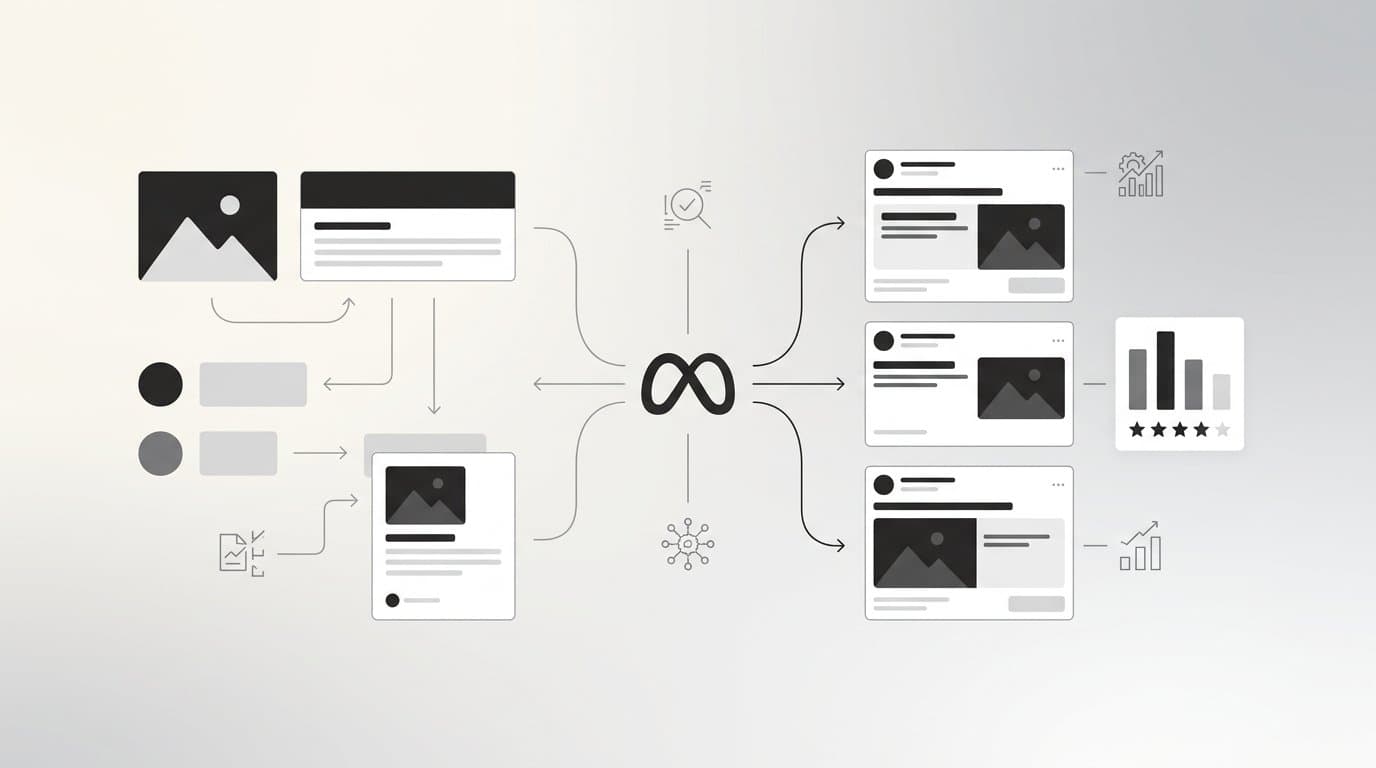
Bulk variation generation transforms the creative production bottleneck from a weeks-long process into a minutes-long task. Instead of coordinating with designers to create individual variations, you generate hundreds of combinations from core assets instantly. Take three product images, five headlines, and four ad copy variations. That's 60 unique ads created in the time it previously took to brief a single concept.
This volume unlocks testing strategies that were simply impossible with manual production. You can test every meaningful combination of elements rather than pre-selecting which concepts seem most promising. Your intuition no longer limits your testing scope. The data determines what works rather than your assumptions about what might work.
AI-powered creative generation accelerates this further by producing the assets themselves. Provide a product URL and the system generates scroll-stopping image ads, video content, and UGC-style creatives without requiring designers, video editors, or actors. The production timeline collapses from days to minutes. The creative bottleneck simply disappears.
Parallel testing at scale replaces sequential methodologies with simultaneous exploration. Launch all your creative, headline, and audience combinations at once. Let Meta's algorithm distribute budget across variations based on performance signals. Winners emerge naturally through market feedback rather than through your sequential testing schedule.
This approach provides several advantages beyond speed. You discover interaction effects between elements immediately rather than inferring them from isolated tests. A headline that underperforms with one image might excel with another. An audience that seems marginal with one creative might convert strongly with different messaging. Parallel testing reveals these patterns that sequential testing obscures.
The data volume from parallel testing also helps Meta's algorithm exit learning phase faster. Rather than trickling budget through one variation at a time, you're feeding the system substantial signal across multiple combinations simultaneously. The algorithm calibrates more quickly, delivering stable performance sooner and reducing the inefficient learning phase spend. Implementing Facebook ad creative testing at scale becomes achievable with the right systems in place.
Automated performance ranking eliminates the analysis bottleneck. Instead of manually comparing metrics across dozens of ad variations, leaderboards surface top performers based on your specific goals. Whether you optimize for ROAS, CPA, CTR, or conversion rate, the system ranks every creative, headline, and audience by actual performance against your benchmarks.
This automation transforms decision-making from a time-consuming analytical task into an instant visual scan. You immediately see which combinations are winning and which are underperforming. No spreadsheet analysis required. No manual metric comparisons. The insights surface automatically as data accumulates.
Goal-based scoring takes this further by benchmarking every element against your targets. Set a target CPA of $40 and the system scores every creative based on how it performs against that goal. Elements that consistently beat your benchmark get higher scores. Those that underperform get flagged immediately. You know at a glance what's working and what needs replacement.
Real-time winner identification means you can scale successful variations while they're still fresh rather than after they've fatigued. The system surfaces top performers as soon as statistically meaningful patterns emerge. You're not waiting weeks for manual analysis. You're acting on performance signals within days or even hours of launch.
Building a Faster Creative Testing System
Organizing winning elements creates compounding efficiency gains over time. Instead of starting each campaign from scratch, you build from a library of proven performers. That headline that drove a 4% CTR in your last campaign becomes a starting point for your next test. The audience segment that delivered $35 CPA gets added to your winner roster. Each campaign contributes to institutional knowledge rather than existing in isolation.
This organizational approach transforms testing from a repetitive process into a refinement process. Your baseline performance improves with each campaign because you're building on proven elements rather than testing unproven concepts. New tests focus on incremental improvements and fresh variations rather than rediscovering fundamentals. Building a winning creative library becomes essential for sustained performance.
A dedicated winners hub centralizes this knowledge. Your best-performing creatives, headlines, audiences, and copy all live in one place with their actual performance data attached. When launching a new campaign, you can instantly pull proven elements rather than recreating them from memory or hunting through past campaigns. The friction of reusing winners drops to near zero.
Continuous learning loops mean your system gets smarter with every campaign you run. Historical performance data informs future recommendations. The system identifies patterns across campaigns that individual marketers might miss. This creative performed well with this audience. That headline style consistently drives conversions for this product category. These insights accumulate and compound.
The learning happens automatically rather than through manual analysis. You're not spending hours reviewing past campaigns to extract insights. The system analyzes historical data, identifies performance patterns, and surfaces relevant recommendations when you build new campaigns. Your institutional knowledge grows without requiring additional analytical effort.
This continuous improvement creates a flywheel effect. Better recommendations lead to better initial performance. Better performance generates more data. More data produces more refined recommendations. Each campaign cycle strengthens the next. The efficiency gap between your current campaigns and your early campaigns widens progressively.
Goal-based scoring provides consistency across all testing efforts. Instead of optimizing for different metrics in different campaigns and struggling to compare results, you establish clear goals and measure everything against those benchmarks. Every creative gets scored on ROAS. Every audience gets evaluated on CPA. Every headline gets ranked on conversion rate. Developing a solid Meta campaign testing framework ensures these measurements remain consistent.
This consistency enables true apples-to-apples comparisons across campaigns, time periods, and product lines. You can definitively say this creative outperformed that one because they're measured against the same standard. Your winner library becomes genuinely useful because performance metrics are comparable and meaningful.
The scoring system also accelerates decision-making by removing ambiguity. You don't need to interpret whether a 2.1% CTR with a $45 CPA beats a 1.8% CTR with a $42 CPA. The system scores both against your goals and tells you which actually performs better for your specific objectives. Decisions become obvious rather than debatable.
Integration between creative generation, campaign building, and performance tracking closes the loop entirely. Generate creatives, launch campaigns with bulk variations, and surface winners through automated leaderboards all within a single workflow. No tool switching. No data export and import. No manual coordination between systems. The entire testing cycle operates as one continuous process.
The Competitive Advantage of Speed
Inefficient creative testing is not an inevitable constraint of Meta advertising. It's a symptom of processes designed for a different era, still being applied to a platform that has fundamentally transformed. The bottlenecks that slow traditional testing—manual production, sequential methodologies, delayed analysis—can all be eliminated through modern approaches that embrace automation and parallel testing at scale.
The efficiency gains are substantial and measurable. Creative production that took days now takes minutes. Testing that required weeks now delivers insights in days. Analysis that consumed hours now surfaces automatically. These time savings compound into competitive advantages that extend far beyond operational efficiency.
Faster iteration means you capture market opportunities while they're active rather than after they've passed. You scale winners while they're fresh rather than after they've fatigued. You adapt to competitive moves in days rather than weeks. Speed becomes a strategic asset that amplifies every other aspect of your advertising performance.
The learning advantages matter just as much as the time savings. Systems that continuously improve based on historical data get smarter with every campaign. Your baseline performance rises. Your testing becomes more targeted. Your winner library grows more valuable. The gap between your capabilities and those of competitors using manual processes widens with each campaign cycle.
Modern platforms that integrate creative generation, bulk launching, and automated performance tracking represent more than tool upgrades. They represent operational transformations that change what's possible in Meta advertising. Testing hundreds of variations becomes routine rather than exceptional. Identifying winners in real-time becomes standard rather than aspirational. Building on proven performers becomes systematic rather than ad hoc.
Marketers who embrace these systems gain significant competitive advantages in increasingly crowded advertising environments. While others struggle with production bottlenecks and sequential testing limitations, you're already three testing cycles ahead, scaling proven winners, and building institutional knowledge that compounds with every campaign.
The question is not whether creative testing efficiency matters, but whether you can afford to maintain inefficient processes while competitors accelerate past you. Every day of delay in adopting modern testing approaches is a day of lost conversions, wasted spend, and missed opportunities that cannot be recovered.
Ready to transform your advertising strategy? Start Free Trial With AdStellar and be among the first to launch and scale your ad campaigns 10× faster with our intelligent platform that automatically builds and tests winning ads based on real performance data.