To really get the most out of your Facebook ads, you have to start with a solid campaign structure. This isn't just about being organized; it's about setting yourself up for rigorous testing and making sense of the data later.
Think of it as the foundation of a house. Before you even touch the creative or copy, you need a logical framework in place. A messy account with confusing naming and overlapping audiences? That’s a surefire way to burn through your ad spend with nothing to show for it.
Building Your Campaign Foundation for Success
First things first: let's get your campaign structure clean and logical inside Ads Manager. This is non-negotiable. A clean setup helps Facebook's algorithm learn faster and lets you actually understand what's working and what's not.
The biggest decision you'll make right away is whether to use Campaign Budget Optimization (CBO) or Ad Set Budget Optimization (ABO). This choice fundamentally changes how you control your budget and test different audiences.
- Campaign Budget Optimization (CBO): You set one budget for the whole campaign, and Facebook automatically pushes the money toward the best-performing ad sets. This is fantastic when you trust the algorithm to chase the cheapest conversions and you want to scale your winners without much fuss.
- Ad Set Budget Optimization (ABO): Now called Advantage+ ad set budget, this lets you set a specific budget for each ad set. It gives you way more control, which is perfect for testing brand-new audiences or making sure a certain group sees your ads, even if they aren't the top performers right out of the gate.
Structuring Campaigns for Different Business Models
There's no single "best" way to structure your campaigns—it all comes down to your business goals.
An e-commerce brand, for example, will almost always want separate campaigns for prospecting (finding new customers) and retargeting (bringing back website visitors). Keeping them separate prevents your audiences from overlapping and lets you tailor your message. You wouldn't talk to a total stranger the same way you'd talk to someone who abandoned their cart, right?
A SaaS company might take a different approach, structuring campaigns around their marketing funnel. Think top-of-funnel ads for a content download, mid-funnel for webinar sign-ups, and bottom-of-funnel for demo requests. This aligns your budget and creative with exactly where the user is in their journey. Of course, this only works if you're tracking everything properly with a correctly installed Meta Pixel. If you need a hand with that, our guide breaks down exactly how to set up the Facebook Pixel.
A clean campaign structure is your secret weapon. By separating prospecting, retargeting, and re-engagement campaigns, you get clearer data, better budget control, and can deliver the perfect message at the perfect time.
Visualizing the Campaign Hierarchy
It helps to see how it all fits together. This flowchart shows the simple, three-level hierarchy Meta uses for all campaigns.
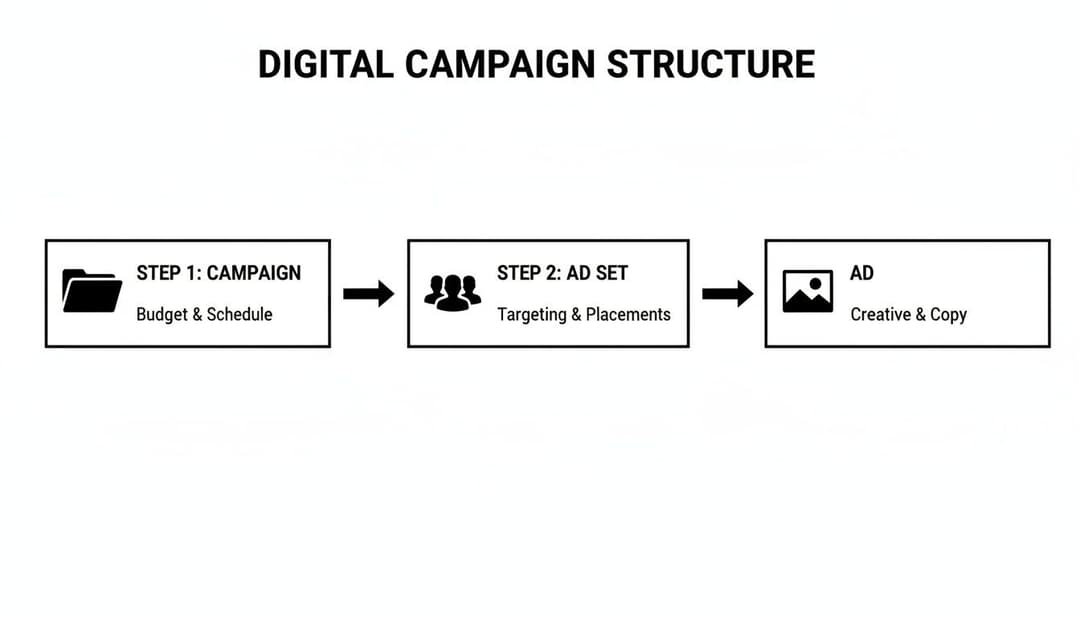
This structure is deceptively powerful. At the campaign level, you set your main goal. At the ad set level, you test different audiences. And down at the ad level, you can throw in all your different creative and copy variations. This organized approach is the only way to get clean insights and build a truly optimized Facebook ads machine from the ground up.
Unlocking High-Intent Audiences and Segmentation
Let's be blunt: even the most amazing ad creative is just expensive noise if it's shown to the wrong people. Getting your audience strategy right is what separates wasteful spending from profitable, precision-guided campaigns.
This means moving beyond basic demographics. We need to tap into the high-intent signals that feed Meta's algorithm what it needs to find your next customer. The absolute bedrock of any smart strategy is your own first-party data—the goldmine of information you've collected from customer lists or your Meta Pixel. These are people who already have a relationship with your brand, making them incredibly valuable.
Harnessing the Power of Custom Audiences
Some of the most powerful audiences you can target are the ones you already own. This is where Custom Audiences come in, letting you target people based on their direct interactions with your business. Honestly, this is where the real work of optimizing Facebook ads begins.
But don't just stop at a generic "all website visitors" list. That's entry-level stuff. To get serious results, you have to get granular.
- High-Value Action Takers: Think about users who "Added to Cart," "Initiated Checkout," or made a "Purchase" in the last 30-60 days. These people are hot leads.
- Top Spenders: Upload a list of your highest lifetime value (LTV) customers. They already love what you do and are prime candidates for new offers.
- Engaged Email Subscribers: What about the people who open every email but haven't bought anything yet? They're on the fence and just need the right ad to push them over.
Segmenting like this allows you to tailor your messaging perfectly. A cart abandoner needs a completely different ad than a VIP customer. For a more foundational look at this, check out our guide on how to identify a target audience.
Your first-party data is your greatest competitive advantage on Meta. By creating Custom Audiences from your pixel events, customer lists, and app activity, you’re telling the algorithm exactly what a valuable customer looks like.
Building Potent Lookalike Audiences
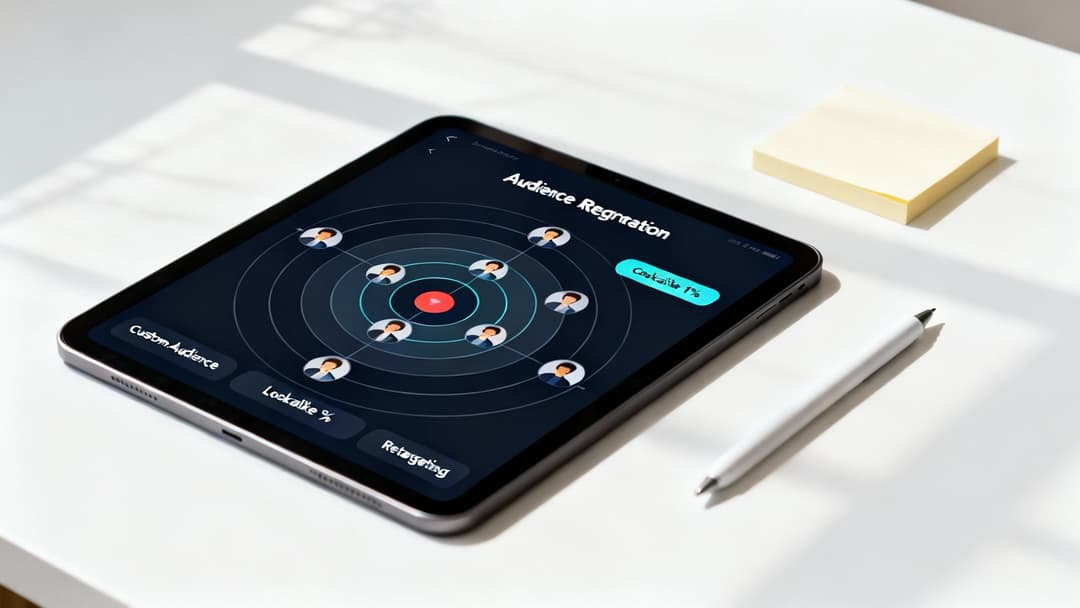
Once you've isolated your best customers with Custom Audiences, you can ask Meta to find more people just like them. That's the magic behind Lookalike Audiences. But remember the old saying: garbage in, garbage out. The quality of your source audience is everything. Always build Lookalikes from a high-intent source, like a purchasers list, not a broad, low-intent list like "all website visitors."
When you build a Lookalike, you choose a percentage from 1% to 10% of a country's population that best matches your source.
- A 1% Lookalike is your sniper rifle. It creates a smaller, hyper-targeted audience that mirrors your best customers. Perfect for bottom-of-funnel campaigns where every lead needs to be high-quality.
- A 3-5% Lookalike gives you more scale. It's a bit less precise, but it's fantastic for top-of-funnel campaigns where you're introducing your brand to new people without straying too far from your core customer profile.
- A 6-10% Lookalike is all about maximum reach. Use this for brand awareness or when you have a massive source audience and need to expand your prospecting efforts in a big way.
Layering Interests and Behaviors
While Custom and Lookalike audiences are your heavy hitters, don't write off Detailed Targeting just yet. This is where you can stack interests, behaviors, and demographics to find untapped pockets of potential customers. The trick is to be logical and specific.
Don't just target a broad interest like "fitness." Layer it. For example, target users interested in "weight training" AND "protein supplements" AND who also have a purchase behavior of "Engaged Shoppers." This simple layered approach filters out the casual lurkers and zeroes in on people with real commercial intent.
This kind of precision is what makes retargeting so incredibly effective. In fact, some data shows retargeting can deliver conversion rates up to 10 times higher than prospecting alone. When advertisers dial in these strategies, around 70% report seeing a positive ROI within the first three months.
Mastering Creative and Ad Copy Testing
So you've dialed in the perfect audience. That's a huge win, but it’s only half the battle. If your ads get stale, your campaigns will eventually stall out. It's a guarantee.
Creative fatigue is the silent killer of profitability. It creeps in when your audience has seen your ad so many times that their brains just start filtering it out. This is where a systematic, relentless process for creative and copy testing becomes your most powerful lever for growth.
The whole point is to build a repeatable, data-backed system for iterating on your ads. This isn't about throwing spaghetti at the wall to see what sticks. It's about surgically isolating variables to learn what truly makes your customers tick.
Building Your Testing Framework
To get clean, actionable data, you absolutely have to be methodical. The number one rule is to test one variable at a time. Seriously. If you change the headline, the image, and the body copy all at once, you have zero idea which element actually moved the needle.
A simple yet brutally effective way to structure this is by setting up a dedicated testing campaign using Ad Set Budget Optimization (ABO). This gives you granular control over the spend for each ad variation, ensuring each one gets a fair shot to collect data.
For instance, a classic test structure looks like this:
- One Campaign: Your "Creative Testing Campaign"
- One Ad Set: Target a proven, high-performing audience (like a 1% purchaser Lookalike).
- Multiple Ads: Each ad isolates a single variable. Think three ads with the exact same image and body copy, but three totally different headlines.
This controlled environment is the bedrock of good experimentation. If you want to go deeper on this, it's worth taking a look at https://www.adstellar.ai/blog/what-is-a-b-testing-in-marketing to understand the core principles.
The secret to great creative testing isn't finding one "perfect" ad. It's building an engine that constantly produces new insights about what your audience responds to, allowing you to adapt and stay ahead of creative fatigue.
Crafting Copy That Converts
Your ad copy has to do a ton of heavy lifting in just a few seconds. It needs to stop the scroll, create intrigue, and drive someone to actually do something. Using a proven copywriting framework gives you a solid foundation for your tests.
One of the most reliable models out there is AIDA:
- Attention: Hook them immediately with a powerful statement or a question that hits on their biggest pain point.
- Interest: Build on that hook. Show them you understand their world and the problem they're facing.
- Desire: Paint a vivid picture of the solution. How does your product make their life better? Focus on the benefits, not just the features.
- Action: End with a crystal-clear, low-friction Call to Action (CTA). Tell them exactly what to do next.
When testing copy, think in terms of different angles. You could pit a pain-point-focused headline against a benefit-driven one, or try long-form storytelling versus short, punchy bullet points.
Dominating Video with the Right Structure
On Meta's platforms, video is king. But you're dealing with an attention span that's shorter than ever. The Hook-Story-Offer framework is tailor-made for this environment and gives you a great structure for testing.
- The Hook (First 3 seconds): This is everything. Test wildly different opening scenes, bold on-screen text, or surprising questions to see what stops thumbs most effectively.
- The Story (Next 5-15 seconds): Quickly demonstrate the problem and introduce your product as the solution. This is a great place to test different user-generated content (UGC) clips or simple animated explainers.
- The Offer (Final seconds): Clearly state your call to action. You can test different visual CTAs or voiceovers to see what drives the highest click-through rate.
When you optimise Facebook ads with video, your main focus should be on testing different hooks. Often, you can use the same core video but create three to five unique variations just by swapping out those first three seconds.
The Rise of AI in Creative Production
Let's be honest: manually creating and testing dozens of ad variations is a massive time sink. This is exactly where AI-powered tools are changing the game for performance marketers.
To illustrate the difference, here's a quick breakdown of how the two approaches stack up.
Creative Testing Framework At a Glance
| Element | Manual Testing Approach | AI-Powered Approach |
|---|---|---|
| Speed | Slow and methodical. Can take days or weeks to get results from a single test. | Incredibly fast. Generates hundreds of variations and provides insights in hours. |
| Scale | Limited by human bandwidth. Can realistically test only a few variables at a time. | Massive scale. Tests hundreds of combinations of images, copy, and headlines simultaneously. |
| Learning | Incremental. Each test provides a single data point. | Exponential. Identifies winning patterns and combinations across a huge dataset. |
The takeaway here is that AI doesn't just do the same work faster—it enables a fundamentally different approach to testing.
Platforms like AdStellar AI can automate the creation of hundreds of ad variations in minutes. You feed it a few core images, headlines, and copy snippets, and the AI will mix and match them to produce a huge volume of testable ads.
This lets you test different angles, visuals, and messages at a scale that's just not humanly possible. The result? A much faster learning curve and the ability to quickly identify winning combinations you can scale across all your campaigns.
Optimising Bids, Budgets, and Delivery

This is where the rubber meets the road. How you manage your ad spend is the difference between a campaign that turns a profit and one that just burns through cash. Getting a handle on Meta’s bidding, budgeting, and delivery systems isn't just some technical checklist item—it’s how you take direct control over your profitability.
Get this part right, and you can easily turn a break-even campaign into a revenue-generating machine. The way you allocate money and tell Meta how to spend it directly impacts the algorithm’s ability to find you customers. A poorly chosen bid strategy or a restrictive budget can choke a campaign before it ever gets a chance to breathe.
Choosing the Right Bid Strategy for Your Goal
Meta gives you a few different bid strategies, each built for a different objective. Picking the right one is absolutely fundamental when you optimise Facebook ads. The two you'll run into most often are 'Highest Volume' and 'Cost Per Result Goal.'
Highest Volume (Lowest Cost): This strategy basically tells Meta, "Get me the most results you can for this budget." It's fantastic for maximizing conversions when you're less worried about the exact cost of each one. Think of a new e-commerce store launching a product—they might use this to rack up as many initial sales as possible, letting the algorithm hunt down the cheapest wins first.
Cost Per Result Goal (Cost Cap): This option puts you in the driver's seat. You set an average cost you’re willing to pay per conversion, and Meta's algorithm does its best to stick to that target. This is perfect for businesses with fixed margins who know their target Cost Per Acquisition (CPA) down to the dollar.
A critical metric for keeping your ads profitable is understanding what Return On Ad Spend (ROAS) means. This KPI ties your ad spend directly to the revenue it generates, making it non-negotiable for any performance-focused campaign.
Navigating the Learning Phase and Delivery Issues
Ever launch an ad set only to see it get slapped with that dreaded "Learning Limited" status? It’s a common—and incredibly frustrating—problem. The learning phase is the period where Meta's system figures out the best way to deliver your ads. To exit this phase, it typically needs about 50 optimization events (like purchases or leads) within a 7-day window.
If your budget is too low to hit those 50 events, the algorithm can't gather enough data, and your performance will tank. For example, if your target CPA is $20, you'd need a budget of at least $145 per day ($20 CPA x 50 conversions / 7 days) just to give the ad set a fighting chance.
It's worth the investment. Conversion-optimized campaigns are known to deliver 2–3x higher ROI compared to standard setups. When you properly fund the learning phase and focus on real business goals like purchases, Meta's algorithm can do its job and find people who will actually convert.
Advanced Budget and Scheduling Techniques
Once your campaigns are humming along, you can start using more advanced tactics to squeeze every last drop of performance out of your budget.
A powerful method is dayparting, also known as ad scheduling. This lets you run ads only during specific hours or days of the week. If you dig into your data and see that most of your conversions happen on weekdays between 9 AM and 5 PM, why waste money at 3 AM on a Sunday? By scheduling your ads for peak times, you focus your entire budget on the moments that matter most.
Another game-changer is setting up automated rules. These are simple "if/then" conditions you create in Ads Manager to manage your campaigns for you.
- Rule Example 1 (Scale a winner): If ROAS is greater than 3.0 in the last 3 days, increase the daily budget by 20%.
- Rule Example 2 (Cut a loser): If spend is greater than $50 and there are 0 purchases today, turn off the ad set.
These rules act as your 24/7 campaign manager, making smart, data-driven decisions to protect your budget and scale your winners without you having to be glued to your screen. Properly managing your spend is a deep topic, and you can learn more about how to optimize ad budget allocation in our dedicated guide.
Scaling Winning Campaigns Without Losing Profitability
So, you did it. After all the testing and tweaking, you’ve finally got a winning ad set that’s churning out consistent results. This is the moment every media buyer lives for. But be careful—what you do next is often what separates the pros from the amateurs.
The classic rookie mistake? Taking that winning ad set and just jacking up the budget. It’s tempting, but it’s a surefire way to throw the campaign straight back into the learning phase. Before you know it, your Cost Per Acquisition (CPA) is through the roof and your Return On Ad Spend (ROAS) has tanked.
To optimise Facebook ads for real growth, you need a smarter plan. Scaling isn't just about spending more; it's about methodically expanding your reach and revenue while keeping your profits intact. This comes down to a careful mix of controlled budget increases and strategic audience expansion.
Vertical Scaling: The Slow and Steady Method
Vertical scaling is the most straightforward approach: you take an existing, high-performing ad set and gradually increase its budget. The key word here is gradually. Big, sudden budget hikes shock Meta's algorithm and kill the stable performance you worked so hard to achieve.
The safest way to pull this off is by bumping the daily budget by a small, fixed percentage.
- The 20% Rule: It's a well-known best practice for a reason. Increase your ad set budget by no more than 20% every 48-72 hours.
- Watch It Like a Hawk: After every increase, give the ad set at least two full days to settle down. Keep a close eye on your core metrics. If your CPA and ROAS are holding steady, you’re clear to make another small increase.
This patient, methodical approach is designed to keep your ad set out of the volatile learning phase, letting the algorithm find new customers at a sustainable cost. It’s not the fastest game, but it’s the foundation of profitable growth.
Horizontal Scaling: Finding New Ponds to Fish In
While vertical scaling gets more out of your current ad set, horizontal scaling is all about finding new audiences. This means duplicating a winning ad set and pointing it at new, similar groups of people. You’re essentially taking your proven creative and copy and showing it to a fresh set of eyes.
This method is so effective because it lets you pump more budget into your strategy without messing with the performance of your original winning ad set.
Don’t just duplicate an ad set and hit publish. Treat each duplicate as a new test. This is your chance to try new Lookalike percentages (like a 3-5% Lookalike if your 1% is crushing it) or layer in some new interest targets. Every duplicate should have a clear hypothesis behind it.
Let's say your ad with a 1% Lookalike of purchasers is an absolute home run. You could scale horizontally by creating new ad sets that target:
- A 3% Lookalike of the same purchaser list to broaden your reach.
- A 1% Lookalike built from a different high-intent source, like people who "Initiated Checkout."
- A "stacked" interest audience that combines several of your top-performing interests into one larger group.
This strategy lets you maintain efficiency while systematically testing just how far your winning formula can go. For a deeper dive into these techniques, exploring detailed guides on how to scale Facebook Ads can provide even more advanced playbooks.
Advanced Scaling Playbooks
Once you get comfortable with the basics, you can start combining methods. The "stacking" method, for instance, involves taking multiple winning ad sets that target similar audiences and merging them into a single powerhouse campaign. This gives the algorithm a much larger budget and a broader audience to play with, which often leads to more stable, long-term performance.
To really push your campaign efficiency and growth, look into different marketing automation strategies. Modern tools can help you spot top performers and shift budget automatically, which helps avoid the performance dips that often come with aggressive manual scaling. This is how you start growing ad spend intelligently to maximize revenue, not just reach.
Frequently Asked Questions About Facebook Ad Optimization
Even the most seasoned advertisers hit a wall sometimes. Let's be honest, Meta's ad platform can be a beast, and it's easy to get bogged down with questions about performance, strange metric shifts, and what your next move should be.
This section cuts through the noise with direct answers to the most common challenges you'll face while trying to optimise Facebook ads.
What Should I Do If My Ad Performance Suddenly Drops?
That sinking feeling when a winning campaign suddenly tanks is all too familiar. But don't panic—it's almost always fixable. The first thing you need to do is play detective. Pull up your metrics for the last 7-14 days and look for clues.
Did your Frequency spike? If you're showing the same ad to the same people over and over, they'll tune you out. We call this ad fatigue, and it’s a conversion killer. If your frequency is creeping up (usually anything over 3-5 in a short window is a red flag), it’s time for fresh creative.
Another common culprit is audience overlap. If you’re running a bunch of ad sets targeting similar interests or lookalikes, you might be bidding against yourself. This drives up your costs for no good reason. Jump into Meta's Audience Overlap tool to see if this is the problem. If it is, consider consolidating your ad sets to give the algorithm more room to breathe.
How Do I Know When It Is Time to Kill an Ad?
Knowing when to pull the plug on an underperforming ad is one of the most important skills for protecting your budget. Don't make emotional decisions—let the data tell you what to do.
Before you even launch, you need to know what success looks like. Define your Key Performance Indicators (KPIs) upfront. For an e-commerce store, that’s probably a target Cost Per Acquisition (CPA) or a minimum Return On Ad Spend (ROAS).
Give a new ad at least 3-5 days to get out of the learning phase and collect some real data. If an ad has spent 2x your target CPA without a single conversion, it’s a pretty clear sign that it isn’t working. Cut your losses and move on.
Which Metrics Matter Most for Optimization?
It’s easy to get lost in a sea of data, but only a few metrics truly move the needle. While things like Reach and Impressions are nice to know, they don't pay the bills. Your focus should be squarely on the actions that tie directly to your bottom line.
Here’s what you should be obsessed with:
- Cost Per Result (CPR) / Cost Per Acquisition (CPA): This is the bread and butter. It tells you exactly how much you're paying for a purchase, a lead, or whatever your goal is.
- Return On Ad Spend (ROAS): For any e-commerce brand, this is the ultimate report card. It answers the most important question: for every dollar I put in, how many am I getting back?
- Click-Through Rate (CTR): A consistently low CTR is a strong signal that your creative or copy just isn't connecting. It's an early warning sign that something in your ad needs to be fixed.
Focusing on these core metrics keeps your optimization efforts tied to actual business growth. It's how you make smarter, more profitable decisions without getting distracted by vanity metrics.
Ready to stop the guesswork and start scaling your campaigns? AdStellar AI automates ad creation, testing, and optimization, giving you the data-backed insights needed to launch winning campaigns 10x faster. Learn more and book a demo at https://www.adstellar.ai.