A retargeting ad campaign is a digital marketing strategy that targets users who have already interacted with your website or app. Instead of reaching cold audiences, you're re-engaging warm leads, making it one of the most efficient ways to drive conversions and maximize your return on ad spend (ROAS).
Why Retargeting Is Your Strongest Play in 2026
You spend significant time and money driving traffic to your site, only for the vast majority of those visitors to leave without taking any action. It’s a classic marketing headache. A well-executed retargeting ad campaign turns this lost traffic into a pipeline of high-intent prospects, giving you a second, third, and even fourth chance to win them over.
This isn't just about endlessly showing the same ad to past visitors. It's about continuing the conversation you already started. Think of it as a helpful store associate reminding a customer about the item they left in their shopping cart. For performance marketers, this strategy is the most reliable way to turn your existing website traffic directly into revenue.
The Power of Familiarity
Retargeting works because it taps into a simple psychological principle: familiarity breeds trust. People are far more likely to click on and engage with a brand they already recognize. This pre-existing awareness is exactly why retargeting campaigns consistently blow standard prospecting out of the water across every key metric.
The performance gap isn’t small—it’s massive. Let's look at the data.
Retargeting vs. Standard Display Ads At a Glance (2026 Data)
The numbers paint a clear picture. Retargeting isn't just slightly better; it operates on a completely different level of effectiveness compared to standard display ads aimed at cold audiences.
| Metric | Retargeting Ad Campaign | Standard Display Campaign |
|---|---|---|
| Average Click-Through Rate (CTR) | 0.89% | 0.07% |
| Conversion Rate (Visitors to Leads) | Up to 70% higher | Baseline |
| Brand Recall | Significantly higher | Low |
| Primary Audience | Warm (past site visitors) | Cold (new prospects) |
An analysis tracking over 18 billion ad impressions found that retargeting achieved an average CTR of 0.89%, which is a 27% jump from previous years. In stark contrast, standard display ads lag far behind at a mere 0.07% CTR. That makes retargeting nearly 13 times more effective at just getting the click.
Key Takeaway: Retargeting isn't just some add-on tactic. For most successful growth teams, it's a core profitability engine. It guarantees that every dollar you spend on top-of-funnel marketing works harder by capturing and converting the interest you've already generated.
From High Costs to High Returns
Ultimately, the goal of any marketing effort is sustainable growth. One of the biggest wins from a strong retargeting campaign is the ability to reduce customer acquisition cost. Instead of repeatedly paying top dollar to acquire new, cold leads, you're investing in an audience that has already raised its hand.
This simple shift in focus has a direct, positive impact on the metrics that matter most:
- Higher Return on Ad Spend (ROAS): You're focusing your budget on users who are much further down the funnel and closer to making a purchase.
- Improved Conversion Rates: Your messages are far more relevant because they're based on a user's previous actions, like viewing a specific product or visiting the pricing page.
- Increased Brand Recall: Consistent, strategic exposure keeps your brand top-of-mind, so when the user is finally ready to buy, you're the first one they think of.
By re-engaging these warm audiences, you create a powerful feedback loop that directly boosts your bottom line. It's a non-negotiable tool for any marketer serious about maximizing their budget. To see how this fits into a broader framework, you can explore these proven performance marketing strategies.
Building Your Retargeting Audience Foundation
The most successful retargeting campaigns aren't built by blasting ads at every person who ever glanced at your website. That’s a rookie mistake. The real magic happens with smart, strategic audience segmentation. Your goal isn't to cast a wide, expensive net; it's to create small, hyper-relevant audiences based on what people actually did on your site.
Someone who bounced from your homepage in three seconds is worlds apart from someone who spent five minutes digging into your pricing page. Hitting both with the same generic "Come Back!" ad is just burning cash. The power move is matching your message to their implied intent.
Segmenting Audiences Based on Behavior
First things first, you need to ditch the default "All Visitors" audience. That’s where most people stop, but it’s just the starting line for us. All the data you need for this is typically captured by tracking pixels from platforms like Meta or Google.
If you're new to pixels, our guide on the Facebook Pixel and how to find its ID is a great place to start.
Here are a few high-value segments I build for almost every account:
- Product Page Viewers: These people showed clear interest in a specific item but didn't take the next step. You can segment them by individual products or, even better, group them by category (like everyone who viewed "running shoes").
- Cart Abandoners: This is your lowest-hanging fruit, period. They were one click away from giving you money. They picked out an item, put it in their cart, and got distracted. This is your prime audience for a direct, compelling offer.
- High-Engagement Content Readers: Someone who binged three of your blog posts on a single topic is sending a huge signal of interest. They might not be ready to buy today, but they're the perfect audience for a softer conversion, like a webinar invite or an ebook download.
- Pricing Page Visitors: Anyone who hits your pricing page is in the evaluation phase. For B2B, this is a massive intent signal. They've moved past awareness and are now actively comparing their options.
This simple flow chart shows you the basic mechanics. A visit is just the trigger; the real strategy kicks in when you analyze their behavior to serve up an ad that actually means something to them.
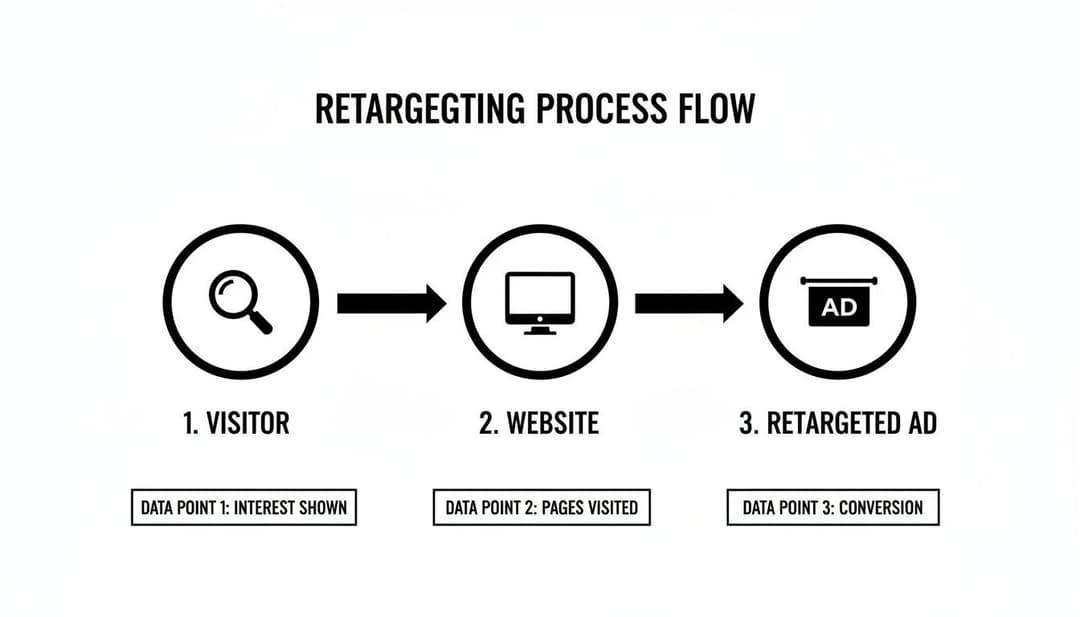
The key takeaway is that the visit itself is just noise. Their actions on your site are the signal you need to listen to.
Choosing the Right Lookback Window
Once you've figured out who to target, the next question is for how long. This is your lookback window—the number of days a user stays in your audience after their last visit. Get this wrong, and your whole campaign can fall flat.
Your lookback window should mirror your customer's consideration period. Mismatching this timing is like asking someone to marry you on the first date or waiting a year to ask for a second one.
The right window depends completely on your sales cycle. A one-size-fits-all approach is doomed to fail.
Scenario 1: An E-commerce Store For a D2C brand selling something like apparel, the buying decision is fast and often impulsive. A customer sees a shirt they like, adds it to their cart, and then their boss walks in.
- Audience: Cart Abandoners
- Lookback Window: 7 to 14 days
- Reasoning: The intent to buy is white-hot but fades quickly. Retargeting within a week or two keeps the product top-of-mind while that desire is still fresh. A 90-day window here is just a recipe for annoying people.
Scenario 2: A B2B SaaS Company Now, think about a business selling project management software. The decision involves demos, stakeholder buy-in, budget approvals, and competitor shootouts.
- Audience: Pricing Page Visitors or Demo Request Page Visitors
- Lookback Window: 60 to 90 days
- Reasoning: The sales cycle is long. Your prospect is in a deep research phase. A 90-day window keeps you on their radar throughout that entire evaluation process, reminding them of your value prop as they get closer to making a choice.
Layering Conditions for Precision Targeting
The real art of audience building comes from layering these rules together. Don't just target "Product Page Viewers." That's too broad.
Instead, build an audience of users who viewed a specific product category BUT did not add anything to their cart within the last 14 days.
Here's another powerful combo I love for SaaS: target users who visited the pricing page more than once in the last 30 days BUT did not sign up for a trial.
This kind of specific, layered targeting is what lets you create ads that feel incredibly personal and relevant. It speaks directly to where the user is in their journey, and it’s how you turn a good retargeting campaign into a great one.
Crafting Ad Creatives That Re-Engage and Convert
 You've done the hard work of building your high-intent audience segments. They're ready and waiting. But all that work goes right down the drain if your ad creative falls flat. The heart of any great retargeting campaign is a message that connects with a user's unique journey and current mindset.
Showing everyone the same generic ad is a massive missed opportunity. Your creative needs to feel like the next natural step in the conversation you already started on your website. This means ditching the broad branding and adopting a more personal, sequential story.
Matching the Message to User Intent
The golden rule for retargeting creative is incredibly simple: match the message to the intent the user showed you. Someone who bounced off your homepage needs a completely different ad than someone who ditched a full shopping cart.
Think of it as a tiered conversation. A visitor who only saw your homepage has pretty low intent. Your ad's job is to make a proper introduction. Maybe a short video about your brand's mission or a quick showcase of what makes you different. It’s a soft touch, meant to build a little familiarity.
On the other hand, a user who clicked through multiple product pages is much warmer. They’re in consideration mode. This is your signal to be more specific and genuinely helpful.
The goal isn't just to remind them you exist; it's to provide the exact piece of information or nudge they need to take the next step. Generic ads feel like spam, but relevant ads feel like helpful suggestions.
Implementing Creative Sequencing
One of the most powerful tactics in our playbook is creative sequencing. This is where you deliberately show a series of different ads to a user over a set period. It guides them along the path to purchase without being annoying. It’s storytelling, not just advertising.
For a mid-funnel user, a sequence might play out like this:
- First Touch (Days 1-3): Start with a brand awareness video or an ad that highlights a key benefit, solving a common problem for your customers.
- Build Trust (Days 4-7): Follow up with social proof. This could be a customer testimonial, a graphic of a 5-star review, or a killer case study result. You’re building their confidence in you.
- The Ask (Days 8-14): Now it’s time for a direct offer. This is where you introduce a compelling reason to act now, like a limited-time discount, free shipping, or a bonus gift with their purchase.
This progression respects the user's headspace, warming them up before you come in with a hard sell. It works far better than just blasting them with "15% OFF!" on day one.
Using Dynamic Product Ads for E-commerce
For any e-commerce brand, Dynamic Product Ads (DPAs) are an absolute must-have for a retargeting ad campaign. These ads automatically serve up the exact products a user looked at, added to their cart, or browsed on your site. It’s personalization on autopilot.
Instead of a generic ad for "running shoes," a user sees the specific pair of Nikes they were checking out yesterday. That level of relevance is unbelievably powerful and is often the main reason so many DTC brands see such a high Return on Ad Spend (ROAS).
The setup is pretty straightforward—it just connects your product catalog to your ad platform. When someone interacts with a product, the platform creates an ad for that item on the fly, pulling in the current price and description. It’s the ultimate "Did you forget something?" reminder. For a deeper dive into making great ads, check out our guide on designing ads that get clicks.
Testing and Refreshing Your Creatives
Here's a hard truth: even your best-performing ad will eventually burn out. Ad fatigue is very real. Your audience sees your ad so many times they just start ignoring it. You'll see your click-through rates dive and your costs climb.
To get ahead of this, you need a solid system for testing and refreshing your creatives.
- A/B Test Your Messaging: Are you always testing different headlines and copy? You should be. Try a benefit-focused headline ("Run faster, recover quicker") against one that hits a pain point ("Tired of sore muscles after every workout?").
- Experiment with Visuals: Test your images and videos. Pit a lifestyle shot of your product being used against a clean studio photo on a white background. See what your audience responds to.
- Refresh Creatives Regularly: I recommend having a fresh batch of ads ready to go every 4-6 weeks. If you see performance start to dip sooner, swap them out. Sometimes, even small tweaks like a new background color or a different call-to-action button can breathe new life into a campaign.
By constantly testing and iterating on your ads, you keep your message from going stale. This is what keeps your retargeting engine running smoothly and efficiently.
Mastering Bidding, Budgeting, and Measurement
You’ve got your audience segments dialed in and your creative is looking sharp. Now for the moment of truth—turning all that strategic work into actual profit. This is where your bidding, budgeting, and measurement come into play. It's the engine room of your campaign, where you make every dollar count.
Get this part right, and you’ll have a campaign that drives real, measurable growth. Get it wrong, and you're just burning cash on clicks. Let's make sure you're set up for success.
Choosing the Right Bidding Strategy
When you're on a platform like Meta, your bidding choice is a direct command to the algorithm. You're telling it exactly what you want it to hunt for. It’s a strategic decision, not just a technical setting. Your two main options are usually some version of "Lowest Cost" and "Value Optimization."
Lowest Cost Bidding: Think of this as the volume play. You're telling the platform, "Get me the most conversions you can for my budget." It's perfect for top-of-funnel retargeting where the goal is just to re-engage a broad audience, like getting past site visitors back to read a new blog post.
Value Optimization Bidding: This is for when profit is king. Instead of just chasing any conversion, this strategy tells the algorithm to find people who are likely to become high-value customers. It requires your pixel to track purchase values, but it's an absolute must for maximizing Return on Ad Spend (ROAS), especially with your hottest audiences like cart abandoners.
My go-to playbook is to use "Lowest Cost" for my wider, top-of-funnel retargeting segments and then switch to "Value Optimization" for my bottom-of-funnel audiences. This lines up my spending with the user's intent perfectly.
Allocating Your Budget for Maximum Impact
You wouldn't talk to a cart abandoner the same way you'd talk to a first-time blog reader, right? So why would you give them the same budget? Your budget allocation should mirror the intent of your audiences. The hotter the lead, the bigger their slice of the budget pie.
Here's a practical budget split I often start with:
| Audience Segment | Percentage of Retargeting Budget | Rationale |
|---|---|---|
| Cart Abandoners (7-Day Window) | 40-50% | These are your hottest leads. They're on the verge of buying and offer the highest potential ROAS. Go all in. |
| Product Viewers (14-Day Window) | 30-35% | This group showed clear interest in a specific product. They just need a final nudge to get them over the line. |
| High-Engagement Visitors (30-Day Window) | 15-20% | These users are still in the consideration phase. The goal is to stay top of mind and nurture them, not push for an immediate sale. |
This tiered approach ensures you’re spending your money where you're most likely to see a fast and profitable return. You're fueling the fire where it's already burning brightest.
Retargeting consistently delivers incredible returns, which is why it's a non-negotiable for so many of us. Projections show average ROAS climbing to 4.2x by 2026, with some B2B brands I've seen hitting 7x or more. With 70% of marketers now dedicating specific funds to it, you can't afford to ignore it. You can dig into more retargeting statistics on whitehat-seo.co.uk.
Measuring What Truly Matters
Impressions and clicks are nice for a vanity check, but they don't pay the bills. To run a truly successful retargeting ad campaign, your eyes need to be glued to the metrics that tie directly back to revenue.
These are the big three:
- Return on Ad Spend (ROAS): The ultimate bottom line. For every dollar you put in, how many did you get back? This is your profitability north star.
- Cost Per Acquisition (CPA): How much are you paying to get a new customer? This number has to be comfortably below your customer's lifetime value (LTV).
- Conversion Value: Simply put, the total revenue your ads have generated. This helps you see the big-picture impact of your campaigns.
It’s also crucial to understand how your attribution model shapes these numbers. A "last-touch" model gives all the credit to the final ad someone clicked, which can be misleading. A more sophisticated "data-driven" model spreads the credit across all the touchpoints that influenced the sale, giving you a much more accurate picture.
If you want to go deeper on this, we've put together a full guide on how to measure advertising effectiveness. By tracking these key performance indicators, you can confidently optimize and scale your campaigns for maximum profit.
Implementing a Scalable Testing Framework
If you think "set it and forget it" works for retargeting, you're leaving a ton of money on the table. The best campaigns aren’t born from a single brilliant idea—they're built, refined, and scaled through constant, structured testing.
This isn't about throwing a few A/B tests at the wall and hoping something sticks. It's about creating a repeatable system that turns data into growth. A good testing framework transforms optimization from a chore into your most powerful engine for improvement, letting you scale your wins and cut your losses with total confidence.
Creating Your Testing Hierarchy
Before you start obsessing over button colors, we need to talk about your testing hierarchy. This is a dead-simple concept that’s shockingly easy to get wrong: prioritize your tests based on their potential impact. Testing your fundamental offer will always move the needle more than tweaking a tiny design element.
My hierarchy almost always looks like this, starting with the highest-impact items first:
- The Offer: This is the heart of your value proposition. Are you pushing a discount, a free trial, a demo, or a free guide? The offer is the single most powerful lever you can pull in any retargeting campaign.
- The Audience: Who are you actually showing the ad to? Pitting a 7-day cart abandoner segment against a 30-day product page visitor segment will have a massive impact on your results.
- The Creative Concept: This is the "big idea" behind your ad. Is it a raw customer testimonial video? A slick product demo? A static graphic that hammers home one key benefit? The overall concept is far more important than the minor details.
- The Ad Copy: Now we're getting into the specifics. This is where you test different headlines, body copy, and calls-to-action (CTAs). Small changes here can absolutely lead to significant lifts.
- The Visuals: Finally, you can test the individual creative elements—different images, video cuts, background colors, and all the little details.
When you structure your tests this way, you guarantee you're always working on the stuff that will actually drive meaningful results.
A Real-World CTA Test That Doubled Conversions
Let me give you a quick example from a B2B SaaS client. They were retargeting mid-funnel prospects who had visited their product features pages but hadn't signed up. Their default call-to-action was "Request a Demo." It was doing okay, but we had a hunch we could do better.
We ran a simple A/B test targeting the exact same audience with two different offers:
- Ad A (The Control): "Request a Demo"
- Ad B (The Test): "Start Your Free Trial"
"Request a Demo" signals a sales conversation and a time commitment—a major point of friction for someone who's still just browsing. In contrast, "Start Your Free Trial" offers immediate value and hands-on access with a much lower perceived commitment.
The results were staggering. The "Start Your Free Trial" ad doubled the conversion rate almost overnight. This one simple change in the offer completely changed the campaign's trajectory, proving that for this audience, reducing friction was the key.
Building a Repeatable Testing Process
Once you’ve got your hierarchy, you need a process. A great testing framework is disciplined and data-driven, not random. It makes sure you learn something from every single experiment, whether it's a winner or a loser.
Here’s a simple, repeatable process you can start using today:
- Formulate a Hypothesis: Start with a clear "If I change X, then Y will happen because Z" statement. For instance: "If I change the CTA from 'Learn More' to 'Get 15% Off,' then the click-through rate will increase because the offer is more specific and compelling."
- Isolate One Variable: This is non-negotiable. Only test one thing at a time. If you change the headline, the image, and the CTA all at once, you'll have no idea which change actually drove the results.
- Run the Test to Statistical Significance: Don’t call a test after one day or a few dozen clicks. Let it run long enough to gather enough data to make a confident decision. Patience is a virtue here.
- Analyze and Document the Results: Was your hypothesis right? Why or why not? Document everything—the winner, the loser, the key metrics, and your takeaways. This builds an invaluable library of insights for your team. We've got some great tips for setting up controlled experiments in our guide on how to properly test your ads.
- Iterate or Scale: If you have a clear winner, it's time to scale. Shift more budget toward what's working. If the results are flat, take what you learned, form your next hypothesis, and start the process all over again.
Common Retargeting Pitfalls and How to Avoid Them
 You can follow every step in the playbook, but even the most well-oiled retargeting ad campaign can spring a leak. I’ve seen it happen time and again. These common mistakes often go unnoticed, quietly draining your budget and tanking your results before you even know what hit you.
Spotting and plugging these leaks is the difference between a campaign that just breaks even and one that’s wildly profitable.
One of the biggest money-wasters is creating audiences that are way too broad. Think "all website visitors from the last 180 days." It feels like you’re casting a wide net, but you’re actually lumping your hottest prospects in with people who clicked once and left forever. You end up treating your warm audience like cold traffic, which dilutes your message and sends your costs soaring.
The fix is simple: tighten your focus. Get granular with your segments based on recent and specific actions. For example, build an audience of users who hit a product page in the last 14 days. Now you’re talking to people with real, current interest.
Ignoring Ad Fatigue and Conversion Exclusions
Another classic mistake is running the exact same ad creative into the ground. We call this ad fatigue, and it’s a silent killer for your click-through rates. Once someone has seen your ad a dozen times, they just tune it out. Your performance metrics will nosedive, and you'll be left wondering why.
Key Fix: Get proactive. Refresh your creative assets every 4-6 weeks, minimum. You should also be using frequency capping to limit how many times one person sees your ad—say, no more than three impressions in a day. It keeps you from annoying your audience into ignoring you.
Finally, one of the most painful and easily avoidable errors is failing to exclude recent buyers. There is almost nothing more frustrating for a customer than being chased around the internet by ads for a product they just bought. It’s a complete waste of your ad spend and, worse, it creates a terrible post-purchase experience.
- The Problem: You’re blasting a "15% off!" ad at someone who paid full price yesterday. Not a good look.
- The Solution: Build a "Recent Purchasers" exclusion list. This is a dynamic audience of everyone who converted in the last 30 days. Apply this list as a universal exclusion across your retargeting campaigns, and you’ll ensure your budget is spent finding new customers, not bothering existing ones.
Frequently Asked Questions About Retargeting
Once you get your hands dirty with retargeting, the real-world questions start popping up. It's no longer just about theory; it's about budgets, customer experience, and actual results.
I’ve heard these same questions from countless marketers over the years. So, let's get you some straight, practical answers to the most common hurdles you'll face.
How Much Should I Spend on a Retargeting Ad Campaign?
There’s no magic number here, but a reliable rule of thumb is to dedicate 10-20% of your total digital ad budget to retargeting efforts. You can start on the lower end to get a feel for performance and establish a baseline. From there, keep a close eye on your Return on Ad Spend (ROAS)—if it's profitable, you have a green light to scale up.
It’s also smart to put more of that budget toward your most valuable segments. Someone who abandoned a shopping cart is a much hotter lead than someone who just bounced from your homepage. Funnel your spend accordingly.
How Do I Avoid Annoying My Audience with Too Many Ads?
This is a big one. The line between a helpful reminder and an outright annoyance is razor-thin, and crossing it can sink your campaign. Ad fatigue is real, and it’s your job to manage it.
Here’s how you stay on the right side of that line:
- Frequency Capping: This is non-negotiable. Set a hard limit on how many times one person sees your ad in a given timeframe. A good starting point is no more than three impressions per person, per day.
- Creative Sequencing: Don't just hammer people with the same static ad. Tell a story. Your first ad could be a brand video, the next could feature a customer testimonial, and the final one can present a direct offer.
- Exclude Recent Buyers: Make sure you have an exclusion audience for recent purchasers. There’s almost nothing more frustrating for a customer than being advertised a product they just bought.
When you manage your frequency and mix up the messaging, you stop being an interruption and become a helpful guide. It keeps your brand in a positive light and stops users from hitting that “hide ad” button.
What Is a Good ROAS for a Retargeting Campaign?
Every industry is different, but a widely accepted benchmark for a solid retargeting campaign is a ROAS of 4x or higher. In simple terms, for every $1 you put in, you should be getting at least $4 back in revenue.
Current data shows the average ROAS for retargeting is hovering around 4.2x. That said, the most important metric is your own profitability. If your ROAS is comfortably above your break-even point and adding to your bottom line, you’re winning.
Ready to launch, test, and scale your Meta ad campaigns faster than ever? AdStellar AI automates bulk ad creation and uses AI to identify your top-performing creatives and audiences. Learn more and book a demo with AdStellar AI.