So, what exactly is advertising agency software? At its core, it’s a central hub that pulls together every piece of your agency’s operations. Think of it as the single source of truth that finally gets you out of scattered spreadsheets, a mess of disconnected tools, and those never-ending email chains.
What Is Advertising Agency Software
Picture an orchestra warming up. The creative team are the violinists, the media buyers are hammering away on percussion, and the account managers are the wind section. Without a conductor, it’s just a wall of noise. This software is that conductor, making sure every instrument—every person and every task—plays in perfect harmony to create something great, not just chaos.
It’s more than just another tool; it’s the central nervous system for a modern agency. It’s the operational backbone that connects every person, every task, and every data point to solve some of the most frustrating challenges in the agency world.
The Big Problems This Software Actually Solves
When you get right down to it, advertising agency software is built to crush operational friction. Agencies are constantly wrestling with the same tough questions:
- Scaling Operations: How do you take on more clients and bigger budgets without your whole system falling apart or having to hire an army of people?
- Campaign Speed: How can you possibly launch, test, and tweak campaigns fast enough to keep up with the market and your clients' demands?
- Proving Your Value: How do you go beyond vanity metrics and clearly show clients how your work is directly impacting their bottom line?
Think of it like an air traffic control system for your campaigns. It coordinates every ad, every audience, and every dollar, making sure they all take off smoothly, avoid colliding mid-air, and land profitably. This is what stops you from making costly mistakes and burning through ad spend.
From Manual Chaos to Software-Driven Clarity
Moving to an integrated software platform is a huge shift. You’re trading fragmented, manual work for a unified, automated workflow. This change doesn’t just affect your day-to-day tasks; it reshapes your long-term strategy.
It's a change agencies are making in droves. The global advertising software market was valued at USD 24.04 billion in 2024 and is expected to hit USD 46.23 billion by 2035. This massive growth is all about agencies looking for smarter ways to manage their increasingly complex work.
To really see the difference, let’s compare the old way of doing things to the new, software-driven approach.
From Manual Chaos to Software-Driven Clarity
| Agency Task | The Old Manual Way | The New Software-Driven Way |
|---|---|---|
| Campaign Planning | Scattered docs, endless email threads, and multiple versions of spreadsheets. | Centralized briefs, collaborative planning spaces, and a single source of truth. |
| Client Approvals | Chasing feedback through emails, Slack messages, and phone calls. | Automated approval workflows with clear version control and status tracking. |
| Media Buying | Manually logging into each ad platform to set up and manage campaigns. | One platform to launch, monitor, and adjust ads across multiple channels. |
| Reporting | Hours spent manually pulling data from different sources into a clunky spreadsheet. | Automated, customizable dashboards that pull real-time data from all sources. |
| Optimization | Guesswork based on incomplete data, leading to slow and often inaccurate changes. | AI-powered recommendations and automated rule-based adjustments. |
As you can see, the right software brings a level of order and efficiency that’s nearly impossible to achieve manually.
To get a feel for what a truly all-in-one solution looks like, it helps to explore what comprehensive digital agency management software offers today. These platforms are quickly becoming a necessity, not just a nice-to-have.
And for agencies that live and breathe social media, specialized tools like social media advertising software offer even more focused features. The end goal is always the same: bring order to the madness of modern advertising so you can focus on strategy and results, not repetitive grunt work.
Core Features That Power Winning Agencies
So, we know what this software is, but what's actually under the hood? Great advertising agency software isn't a single tool; it's a collection of powerful features that all talk to each other. Think of it as the central nervous system for your entire agency.
The main goal is to get the repetitive, soul-crushing work off your plate so you can focus on strategy. For instance, instead of spending hours manually creating a handful of ad variations, you use a tool to spin up hundreds in minutes. This isn't just a time-saver—it unlocks a level of creative testing that was simply out of reach before.
This concept map shows how the software acts as a central hub, connecting your creatives, clients, and campaigns into one smooth workflow.
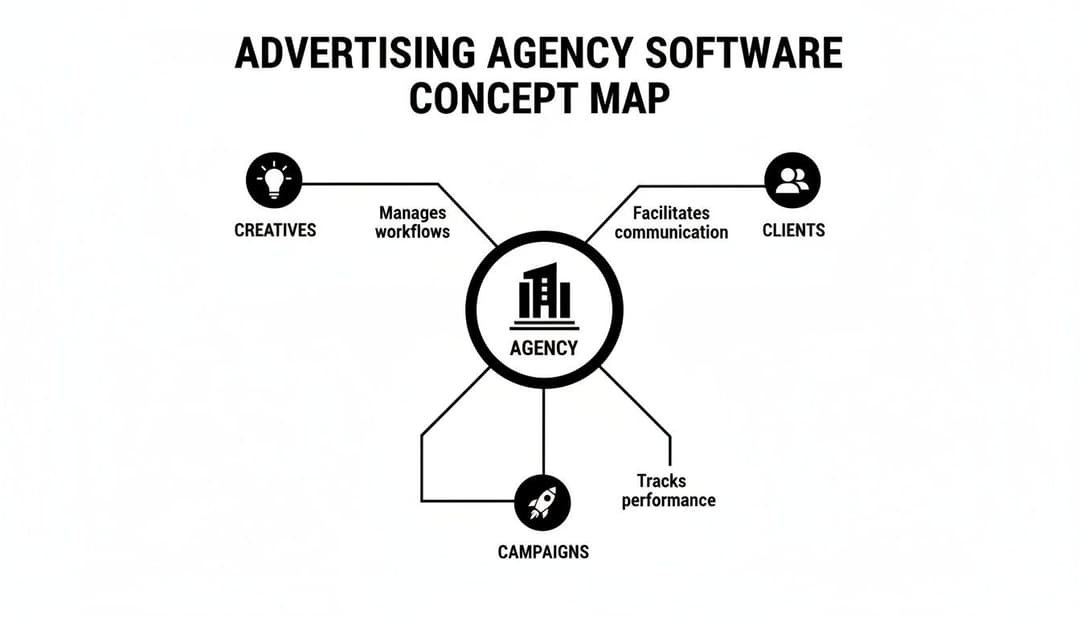
It’s all about breaking down the walls between departments. When creatives, account managers, and media buyers are all working from the same playbook, magic happens.
Automated Campaign and Ad Creation
The days of building campaigns one tedious click at a time are long gone. Modern agency platforms come with bulk creation tools that completely change the game for media buyers. You can build a grid of headlines, ad copy, images, and audiences, and the software will generate every possible combination for you instantly.
This directly tackles one of the biggest bottlenecks in any agency. Instead of launching five test ads, you can launch 500. This explosion in testing speed means you find the winning combinations faster, driving better performance and showing clients just how quick and agile you are.
Centralized Asset and Audience Libraries
Chaos is the enemy of growth. A top-tier platform must have a central library for all your creative assets and audience segments. No more digging through messy shared drives or old campaigns to find that one killer image or that high-performing lookalike audience you built last quarter.
Everything gets stored, tagged, and is ready to deploy in seconds.
- Creative Library: A single home for every approved image, video, and piece of ad copy.
- Audience Library: Save, share, and reuse your most valuable custom, lookalike, and saved audiences across different clients and campaigns.
This builds a repeatable system for success. When you strike gold with an audience for one client, you can easily adapt and test that strategy for another. You're building on your wins instead of starting from scratch every single time.
Real-Time Performance Dashboards
Data is useless if you can't see it or understand it. Forget spending hours exporting CSVs and fighting with spreadsheets to build client reports. A key feature is the real-time performance dashboard, which pulls all your key metrics into one clean, easy-to-read interface.
This isn't just about reporting faster; it's about deciding faster. When you can see creative fatigue creeping in or notice one ad set blowing the others out of the water, you can act immediately. You shift budget and optimize performance on the spot.
These dashboards are often fully customizable. You can build specific views for each client, focusing only on the metrics they care about, whether that's ROAS, CPA, or lead volume. This kind of transparency builds serious trust and proves your agency's value. For a deeper look at how AI is supercharging these tools, you can explore the top features of AI ad platforms.
AI-Powered Insights and Optimization
This is where things get really exciting. The integration of artificial intelligence turns the software from a simple management tool into a strategic partner. AI models chew through your historical and real-time performance data to give you recommendations you can actually use.
These aren't just basic reports. An AI co-pilot can:
- Spot Creative Fatigue: It alerts you the moment an ad's performance starts to dip, so you can swap it out before you waste another dollar.
- Flag Top Performers: It pinpoints the exact combinations of creative, copy, and audience that are crushing your goals.
- Suggest Budget Shifts: It recommends moving spend to the campaigns and ad sets that have the highest potential to deliver a return.
This intelligent layer gives your team the power to make smarter, data-backed decisions without getting lost in the weeds of manual analysis. It frees your media buyers from being button-pushers and turns them into high-level strategists.
How This Software Boosts Your Bottom Line
Let’s be honest—a long list of features doesn't mean much if it doesn't make a real difference to your business. The true test of any advertising agency software isn't what it can do, but the tangible results it delivers. This is the point where a tool stops being a nice-to-have and becomes the engine driving your agency’s profit and your clients’ success.
Think about it from two perspectives: the overworked media buyer and the results-hungry client. For your media buyer, this kind of software is a game-changer. It pulls them out of the endless cycle of spreadsheet management and manual "button-pushing," transforming them into a strategic thinker focused on what really moves the needle.
And for the client? The benefits are just as clear. They see their campaigns go live faster, get transparent reports that build genuine trust, and watch their return on ad spend (ROAS) climb. It creates a powerful feedback loop where your agency consistently proves its worth, forging stronger partnerships and securing long-term retainers.

Supercharge Your Team's Efficiency
The first thing you’ll notice is the impact on your agency’s day-to-day operations. When you automate the soul-crushing tasks—campaign setup, data pulling, report building—you give your team back their most valuable asset: time. A media buyer who once spent 80% of their day on manual work can now flip that ratio, dedicating their brainpower to strategy and high-level analysis.
This isn’t just about working faster; it's about unlocking a new level of performance. It frees up your team to:
- Test on a Massive Scale: Imagine launching hundreds of creative and audience variations in the time it used to take to build five. You’ll uncover winning combinations at a speed you never thought possible.
- Make Quicker Optimizations: Spot underperforming ads in near real-time and shift budgets to the winners before you waste another dollar. This is how you protect client budgets and maximize ROAS.
- Focus on High-Value Strategy: Let your team spend their energy on what they do best—coming up with brilliant creative ideas and deep audience insights, not getting lost in repetitive tasks.
This operational boost means you deliver better results without driving your team into the ground. For a closer look at this, our guide on performance marketing software breaks down how these tools directly improve campaign outcomes.
Drive Scalable Growth and Higher Margins
For any agency with ambition, scalability is everything. The right software is the backbone that lets you take on more clients and manage bigger ad spends without your costs spiraling. When your key processes are automated, you can manage ten clients just as efficiently as you used to handle five.
A single platform becomes your engine for profitable growth. It allows you to manage more accounts with the same headcount, directly boosting your agency's profit margins.
This is absolutely critical in today's market. You can discover more insights about the digital advertising market and see that specialization and efficiency are what separate the leaders from the pack. Research shows that agencies with focused, tech-powered solutions don't just grow faster—they achieve impressive 30% net margins. An efficient software stack isn't a cost; it's your path to thriving.
Build Lasting Client Relationships
At the end of the day, client loyalty comes down to two things: results and transparency. The right software delivers on both fronts. By consistently putting up strong numbers, you prove your value with every report. By giving them clear, automated dashboards, you build trust and eliminate any doubt about where their money is going.
Clients shouldn't have to wait a week for a performance update. Imagine giving them access to a live dashboard that shows exactly how their campaigns are performing against their most important KPIs. This kind of radical transparency turns you from a vendor into a true growth partner. The result? Stickier clients, more referrals, and a rock-solid reputation.
Your Advertising Agency Software Buyer's Checklist
Picking the right advertising agency software is a huge decision. It’s going to define how your team operates every day and, frankly, how fast your agency can grow. This isn't about chasing the platform with a million features; it's about finding the one that actually solves your problems.
Think of this checklist as a guide to asking the right questions. We'll cut through the noise and focus on what really moves the needle for a modern agency.
This decision is more important now than ever. The advertising agency software market, while a niche part of the ad tech world, is expected to be worth over USD 2.65 billion in 2026. It's growing because campaign complexity is off the charts, and agencies need tools that bring sanity back to their workflows. You can read the full research about this market growth to see just how many agencies are making this investment.
Software Evaluation Checklist for Agencies
Before diving deep into demos, use this checklist to get your team aligned on what matters most. It helps turn a subjective "I like this one" conversation into a structured, objective decision.
| Evaluation Criteria | Key Questions to Ask | Your Agency's Priority (High/Med/Low) |
|---|---|---|
| Platform Integrations | Does it have deep, two-way API connections with the ad platforms we use daily (Meta, Google, TikTok)? | |
| Scalability & Performance | Can this tool handle 5x our current client load and ad spend without slowing down? | |
| User Experience (UX) | Is the interface intuitive? Can a new team member get the hang of it quickly without weeks of training? | |
| Workflow Automation | Does it automate our biggest time-sinks, like campaign creation, budget pacing, or rule-based optimizations? | |
| Reporting & Dashboards | Can we build fully custom, white-labeled client reports and dashboards that are automated? | |
| Team Collaboration | Does it have features for assigning tasks, leaving comments, and managing approvals across the team? | |
| Pricing & ROI | Is the pricing model clear and predictable? Does it scale fairly as our agency grows? | |
| Customer Support | What level of support is included? Is there a dedicated account manager or just a general helpdesk? |
This table provides a solid foundation. Now let's break down what to look for in a few of these key areas.
Integration Quality And Depth
First things first: how well does the software talk to platforms like Meta and Google Ads? A surface-level integration that just scrapes a few top-line metrics is practically useless. You need to dig deeper.
Look for real, two-way communication built on official APIs.
- API Connection: Does it use the official, secure APIs from the ad platforms? If a tool asks for your personal login details, run. That's a huge security risk.
- Data Sync: How fast does performance data sync up? For quick optimization calls, you need data that's real-time or at least updated every few minutes.
- Campaign Push: Can you build out entire campaigns inside the software and push them live to the ad network? This single feature can save dozens of hours compared to manual exports and uploads.
A truly great integration makes the software feel like a command center for your ad platforms, not just another disconnected dashboard.
Scalability and Performance
Your agency wants to grow, right? Your software needs to be ready for that future. A tool that’s fine with five clients might completely fall apart when you hit twenty. Scalability isn't just some tech buzzword; it’s the key to unlocking your agency's potential.
Your software shouldn't just support your current workload; it should be ready for the agency you want to become in two years. Think about how it will handle more clients, larger ad spends, and a growing team without slowing down.
This is all about handling volume without adding friction. Can you manage campaigns for 100 clients as easily as you do for 10? The best platforms are designed to smash bottlenecks, letting you scale your revenue without having to scale your headcount at the same rate.
User Experience and Workflow Fit
Let’s be honest, a powerful tool that your team hates using is a worthless tool. The user experience (UX) is everything. Does the software actually make your existing workflows easier, or does it try to cram your process into a clunky, rigid system?
When you’re in the evaluation stage, always push for a live demo and a free trial. Get your actual media buyers and account managers to use it. Give them real tasks. Can they build a campaign, pull a report, or spot a key insight without needing a 50-page manual? The goal is to find a platform that feels like it was built by people who get the day-to-day agency grind. For a closer look at what makes a great workflow, check out our guide on the best campaign management software.
Reporting Depth and Customization
Client reporting is a notorious time-suck and a common source of frustration. Generic, out-of-the-box reports just don't work for savvy clients who want to see the specific KPIs that matter to their business. Your advertising agency software has to deliver flexible, powerful reporting.
Here’s what to check for:
- Custom Dashboards: Can you create a completely unique dashboard for each client that only shows what they care about, whether it's ROAS, CPA, or new leads?
- Automated Delivery: Can you set up reports to be automatically generated and emailed to clients on a schedule? This is a simple feature that saves your team countless hours every single month.
- Data Visualization: Does it create clean, easy-to-read charts and graphs? Communicating performance wins should be simple, not something you need a data scientist to decipher.
At the end of the day, great reporting is how you prove your value and build the kind of trust that keeps clients around for the long haul.
See How AdStellar AI Powers Agency Growth
All the theory and feature lists in the world don't mean much until you see how it all works in the trenches. This is where we connect the dots. Let's walk through a real-world scenario to show you exactly how a platform like AdStellar AI takes the usual agency friction and turns it into smooth, rapid execution.
We’ll see how it solves the exact problems that keep performance marketers staring at the ceiling at 2 AM.
Imagine a fast-growing direct-to-consumer agency that just won a new client. It's an exciting e-commerce brand, and they're about to launch a new skincare line on Meta. The pressure is on to deliver results, and fast. The agency's top performance marketer, Sarah, is on point to get the launch campaign live.
In the old days, this would have been a week-long scramble. We're talking endless spreadsheets, confusing email chains, and mind-numbing manual campaign building inside Ads Manager. Sarah would burn hours just to get a handful of ad variations set up. But today, she’s using advertising agency software built for this very moment.
From Creative Brief to Campaign Launch in Minutes
Sarah opens up AdStellar AI. Instead of digging through shared drives, she pulls five approved product images and three new video ads directly from the centralized media library. Next, she grabs the four different headlines and three ad copy variations the creative team dropped in.
With just a few clicks, the platform’s bulk creation engine does the heavy lifting, cross-multiplying every single element.
- 5 Images & 3 Videos (that’s 8 total creatives)
- 4 Headlines
- 3 Ad Copy Variations
In less than a minute, Sarah has generated 96 unique ad combinations (8 x 4 x 3). They’re all perfectly structured and ready to launch. She then assigns them to three core audience segments she already has saved in her audience library: a warm retargeting group, a lookalike of past buyers, and a broad, interest-based audience.

This is what it looks like when modern software turns a tangled, complex task into a clean, visual workflow. It’s all about giving marketers the power to build at scale without getting lost in the weeds.
Finding the Winners with AI Insights
With a single click, the entire campaign structure is pushed live to Meta. Sarah never even had to open a new tab for Ads Manager. Now, instead of obsessively checking dozens of ads every hour, she lets the platform’s AI co-pilot take over.
Within 48 hours, the AdStellar AI dashboard starts to light up with clear patterns.
The AI Insights module automatically flags the top-performing combinations. It points out that one specific video paired with a question-based headline is driving 70% of all conversions—and at a cost per acquisition 45% lower than the campaign average.
This isn't just a hunch; it's data-backed certainty. Sarah immediately pauses the ads that are burning cash and shifts more budget to the clear winner. That one move protects her client's ad spend and skyrockets the campaign’s ROAS in its first few days.
Scaling Success with Automated Intelligence
But the real magic happens next. Armed with undeniable data on what’s working, Sarah uses the AI Launch feature. She selects the winning creative-copy-audience combination, and the platform automatically builds an entirely new, dedicated scaling campaign around it.
This isn’t just a simple copy-paste job, either. The system taps into its learning models to intelligently expand the audience and optimize bidding, all designed to find more customers who look just like the ones already converting. A process that used to take hours of manual analysis and setup is now done in less than five minutes.
This story isn't about replacing the marketer; it's about empowering them. By automating all the tedious, repetitive work, the software freed Sarah to focus on what actually moves the needle: strategy, analysis, and making high-impact decisions. She delivered better results, faster, proving the agency's value and setting her client up for incredible long-term success.
For any agency looking to get this kind of efficiency, exploring a platform like AdStellar AI is the logical next step.
So, you're considering new software for your agency. It's a big step. Beyond all the feature lists and sales pitches, a handful of practical, real-world questions always come up. It's one thing to see a slick demo, but it’s another to imagine how a new tool will actually slot into your team’s day-to-day grind.
Let's cut through the noise and tackle those nagging "what ifs" head-on. We're talking about the real concerns that keep agency owners up at night: implementation headaches, data security, team impact, and of course, the return on investment.
How Hard Is It to Implement New Advertising Software?
The very thought of a long, painful software migration is enough to give any agency leader a headache. We've all been there. But here's the good news: modern platforms are built for speed, not for month-long IT projects. The best advertising agency software is designed to get you and your team onboarded and finding value, fast.
For the most part, getting set up is a simple, guided process:
- Connecting Your Ad Accounts: You'll use a secure, official API to link your ad platforms, like Meta Ads Manager. This is a standardized process and usually takes just a few clicks. It's designed to be foolproof.
- Inviting Your Team: Bringing your people in is as easy as sending an email invite and setting their permissions.
- Getting Your Bearings: A good platform won't just throw you in the deep end. Look for a solid knowledge base, quick video tutorials, and—most importantly—responsive live chat support from real humans.
The whole point is to find a tool with an intuitive interface that feels familiar from day one. It should simplify your team's life, not add another layer of complexity to their tech stack.
Is My Client's Ad Data Safe on a Third-Party Platform?
This is a big one. In our world, client data security isn't just a "nice-to-have"—it's a foundational, non-negotiable requirement. Your clients trust you with their sensitive information, so any software you use has to be a fortress.
A secure platform will always use official, approved methods for connecting to your accounts.
For example, when you link a Meta account, the software should use OAuth. This is a secure protocol that grants access without ever asking for or storing your passwords. It's the industry standard for a reason. If a tool asks you to type in your personal login details, it’s a massive red flag. Run, don't walk.
Beyond that, look for assurances that all data is encrypted, both in transit (as it moves between your browser and the server) and at rest (while stored in a database). Take five minutes to review the provider's privacy policy and check for compliance with regulations like GDPR. You have to be able to trust your software as much as your clients trust you.
Will This Software Replace My Media Buyers?
This question comes up all the time, and it usually stems from a place of fear. Let's be crystal clear: this technology is designed to augment your team's talent, not replace it. It’s about making your experts more powerful, not making them obsolete.
Think about all the tedious, low-value tasks that eat up a media buyer's day. Manually building hundreds of ad variations, pulling numbers from five different places for a single report, or constantly refreshing a dashboard to make tiny budget tweaks. This is the grunt work that leads to burnout and kills strategic thinking.
Advertising agency software automates precisely those tasks.
By taking that manual labor off their plate, the software frees up your team to do what humans do best: think. It lets your media buyers graduate from being "button pushers" to becoming true strategists. Now, they can spend their time digging into performance trends, coming up with brilliant creative hypotheses, and making the big-picture decisions that actually grow your clients' businesses. The software handles the "what," so your team can finally focus on the "why" and "what's next."
How Do I Measure the ROI of This Software?
Justifying a new expense requires a clear business case. Measuring the return on investment (ROI) for agency software isn't some fuzzy, abstract concept; you can break it down into three tangible areas.
1. Efficiency and Time Savings This is the most direct calculation. Start by tracking the hours your team spends on routine tasks like campaign setup, daily management, and reporting—both before and after you adopt the new tool. Multiply those saved hours by your team's blended hourly cost, and you'll have a clear dollar figure for the time you've reclaimed.
2. Direct Performance Lift This is where the rubber meets the road. Compare your core key performance indicators (KPIs) before and after implementation. Look at your clients' Return on Ad Spend (ROAS), Cost Per Acquisition (CPA), and lead quality. A great platform should help you identify winning campaigns faster and cut losing ones sooner, which will show up directly in your clients' results.
3. Increased Scalability and Capacity Finally, look at your agency's capacity for growth. With the new software, can you now confidently manage more client accounts or handle much larger ad spends without having to hire more people? This newfound leverage is a massive driver of long-term ROI. If the software lets you double your client load with the same-sized team, its value speaks for itself.
Ready to see how an AI-powered platform can automate the tedious work and unlock your agency's true potential? AdStellar AI is built to help performance marketers launch, test, and scale Meta campaigns faster than ever.