Most performance marketers do not need another dashboard. They need fewer repetitive decisions.
A normal week already has enough drag. You brief designers on five new concepts, rewrite copy for three audience angles, rebuild the same campaign structure in Meta, duplicate ad sets, rename assets, check tracking, launch late, then spend the next morning sorting through results that arrived in different places. By Friday, the team is busy, but not always learning faster.
This is why interest in an ai marketing service keeps climbing. It is not just about novelty. It is about replacing manual campaign assembly with a workflow that can create, test, and refine at a pace a human team cannot sustain alone.
Beyond Manual Marketing Overload
Sarah runs paid social for a growing ecommerce brand. Her team is small, her budget is real, and her backlog never gets shorter.
On Monday, she needs fresh Meta ads for a product push. By Tuesday, she is still waiting on resized assets. On Wednesday, she is duplicating ad sets manually because each audience needs a slightly different creative mix. By Thursday, performance data starts coming in, but now she has to answer a bigger question: which variable moved results?

That pattern feels familiar because the bottleneck is rarely “marketing strategy” by itself. The bottleneck is the handoff-heavy operating model around it. Creative production lives in one place. Media buying lives in another. Reporting sits somewhere else. The marketer becomes the glue.
Why the pressure feels higher now
The urgency is not imagined. The generative AI market is projected to reach $62.72 billion in 2025 with a CAGR of 41.53% through 2030, and 57% of marketers report pressure to adopt AI to avoid becoming irrelevant while 86% save over 1+ hour daily on creative tasks according to Sequencr’s 2025 generative AI statistics roundup.
That matters because time saved on creative admin is not just convenience. It creates room for work that changes outcomes, like angle selection, offer testing, landing page alignment, and budget decisions.
The hidden cost of doing everything by hand
Manual work creates three expensive problems:
- Slow testing cycles: If building variants takes too long, the team tests fewer ideas.
- Creative fatigue: Good marketers get buried under resizing, naming, exporting, and uploading.
- Weak feedback loops: Results arrive after too much friction, so the next campaign starts with guesswork again.
A modern workflow often begins earlier than ad setup. For brands creating lifestyle imagery at scale, tools like product to model can shorten the gap between a product feed and usable visual inputs for campaigns.
If you want a practical look at where the hours usually disappear before launch, this breakdown on reducing time spent on ad campaigns maps the daily pain clearly.
The core shift is simple. An ai marketing service moves the team from assembling campaigns by hand to managing a system that keeps producing and learning.
What Is an AI Marketing Service Really
Many people hear “AI marketing” and picture a copy generator. That is too narrow.
An ai marketing service is better understood as a campaign operating layer. It connects your data, uses that data to automate repeated marketing work, and improves decisions as new performance signals come in. A normal tool waits for instructions. An AI service uses history and live feedback to help shape the next action.
Think of it as a co-pilot, not a vending machine
A vending machine gives you exactly what you ask for. Put in the right input, get a fixed output.
A co-pilot behaves differently. It watches conditions, tracks patterns, flags risk, and helps you respond faster. In marketing terms, that means the system is not just storing assets or scheduling ads. It is helping you decide what to launch, what to stop, and what to expand.
That is why static automation and AI should not be treated as the same thing.
| Approach | How it behaves | Typical limitation |
|---|---|---|
| Traditional automation | Follows preset rules | Breaks when conditions change |
| AI marketing service | Learns from historical and live inputs | Still depends on clean goals and good data |
What it usually includes
In practical terms, an AI service often combines several functions inside one workflow:
- Data intake: It pulls in campaign history, customer behavior, and performance signals.
- Generation: It creates or adapts copy, images, audiences, and campaign structures.
- Decision support: It surfaces likely winners, weak spots, and next actions.
- Optimization: It shifts effort toward combinations that align with goals like ROAS, CPA, or lead quality.
A paid social manager feels this difference immediately. Instead of opening five tabs to build one test, they can review a machine-prepared set of variations and spend their energy choosing strategic direction.
Why this matters for busy teams
The main value is not that AI can “do marketing for you.” It cannot own your positioning, offer strategy, or customer empathy.
It can, however, remove the heavy repetition that keeps strong marketers from acting like strategists. That includes variant creation, audience sorting, pattern detection, and repetitive campaign setup. The result is fewer decisions made from memory and more decisions made from evidence.
For a more direct look at how AI fits ad workflows specifically, this guide on AI for ads is a useful next read.
A good ai marketing service does not replace judgment. It gives judgment better raw material and a faster feedback loop.
The Core Capabilities of AI Marketing Automation
When marketers ask what an AI system does all day, the answer is usually less magical and more useful than they expect. It handles repeated work across four areas: segmentation, content, budget allocation, and analysis.
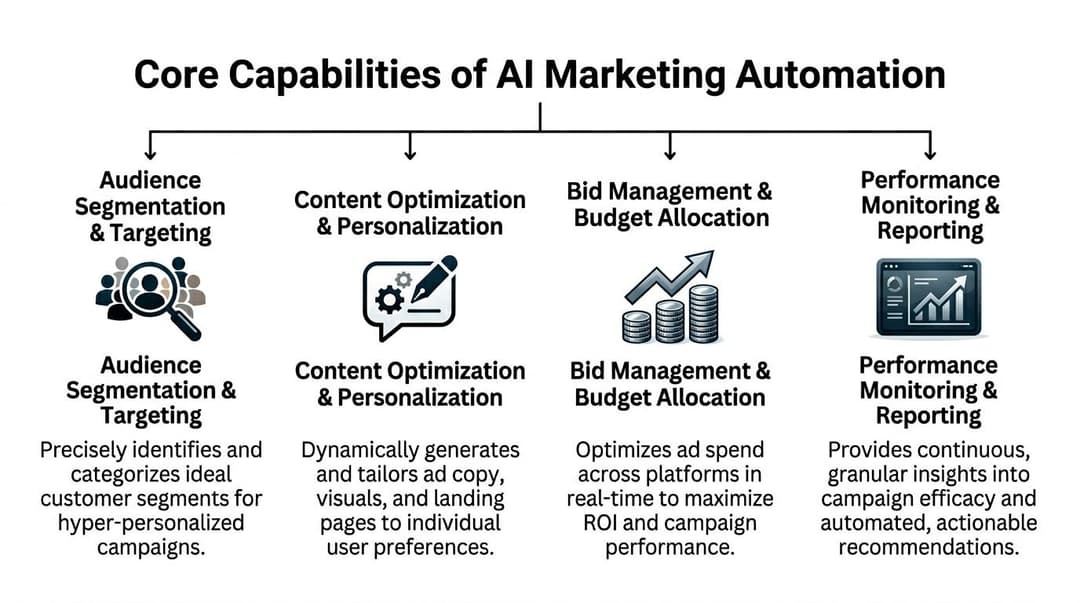
Audience selection gets smarter
The first job is sorting signal from noise.
Predictive models can analyze historical behavior, demographics, seasonality, and conversion trends to estimate who is more likely to buy, engage, or drop off. In DTC and ecommerce settings, this supports more focused targeting and stronger inventory and demand planning. McKinsey benchmarks cited in Eversana Intouch note 3-15% revenue uplift and 10-20% sales ROI improvement for AI adopters in these workflows, and the article also describes how dynamic content and predictive scoring support scalable execution for DTC teams in practice through platforms such as Meta Advantage+ and Klaviyo’s AI features in personalization workflows (Eversana Intouch).
A simple example: a fitness brand does not need to treat all site visitors the same. One segment may browse training plans, another may watch recovery content, and another may repeatedly view product bundles. AI can separate those patterns faster than a person scanning spreadsheets.
Creative production moves from batch work to flow
Most campaign teams do not struggle with having zero ideas. They struggle with turning ideas into enough ad-ready variants to test properly.
AI helps by generating derivative assets quickly. That includes copy angles, image combinations, headlines, and localized versions. In DTC use cases, this kind of dynamic content optimization can deliver 50-70% efficiency gains in content supply chains by automating derivative generation across formats and languages, as described in Eversana Intouch’s analysis of AI in DTC marketing.
That does not mean every output should ship untouched. It means the first draft work gets compressed.
If you manage email alongside paid media, even seemingly small details like subject line formatting can become testable inputs at scale. A reference like this guide to email subject line capitalization is useful because AI systems can generate many options, but marketers still need clear editorial standards.
Budget shifts happen with less lag
Manual budget optimization usually happens after a marketer has enough confidence to intervene. That delay matters.
An AI system can monitor live performance and route spend toward stronger combinations sooner, especially when campaign volume is high. This is the practical value of dynamic scaling. The system watches which creative, audience, or placement combinations are aligning with business goals and pushes attention there faster than a weekly reporting ritual can.
The point is not blind automation. The point is tighter reaction time.
Insights become operational, not decorative
A lot of reporting is descriptive. It tells you what happened after money was spent.
AI-powered analysis becomes more useful when it ranks patterns by actionability. Instead of showing dozens of disconnected metrics, it can help answer questions like:
- Which message themes keep producing qualified clicks
- Which audiences are drifting in efficiency
- Which creatives deserve more variants
- Which combinations should stop consuming budget
That is the moment an ai marketing service starts feeling like an operating system. The output is not just a prettier chart. It is a recommendation tied to the next move.
For teams evaluating platforms built around this workflow, this overview of an AI-powered marketing platform gives a useful frame for what to compare.
Strong AI marketing automation is not one feature. It is a closed loop of targeting, creation, allocation, and learning.
Business Benefits and Tangible ROI
The easiest way to misunderstand AI in marketing is to see it as a feature upgrade. The bigger change is operational. Teams work differently when setup, testing, and optimization happen faster and with less manual drag.

Faster execution changes the economics of testing
A manual team often limits tests because every new variation creates more production work, more QA, and more launch overhead.
An ai marketing service changes that equation. When the system can support personalization, segmentation, and automated decision-making, the cost of trying another angle falls. That matters because good performance marketing depends on throughput. You need enough creative and audience combinations in market to learn something useful.
The business case is already visible in adoption data. In 2025, 92% of businesses utilize AI for campaign personalization, and companies using AI for automated decision-making achieve 10-20% higher ROI and 60% lower campaign costs. The same source notes that 41% of marketers report higher conversions from AI-optimized segmentation (Litslink AI marketing statistics).
Better ROI comes from better allocation
When teams talk about ROI, they often jump straight to revenue. But ROI improves earlier in the chain.
It improves when marketers stop spending hours rebuilding campaign structures. It improves when weak combinations get identified sooner. It improves when personalization and segmentation stop being occasional projects and become normal workflow behavior.
Here is the practical shift:
| Before AI service | With AI service |
|---|---|
| Limited variants due to production bottlenecks | More variants available for live testing |
| Budget changes happen after manual review | Budget decisions can react faster to data |
| Reporting explains results after the fact | Reporting supports next-best actions |
That is why calculating return should include both media efficiency and workflow efficiency. If your team wants a clean framework for that, this guide on how to calculate return on ad spend is worth keeping nearby.
The strategic payoff is time
The least discussed benefit is often the most important. AI gives skilled marketers time back for work only humans can do well.
That includes offer design, creative direction, customer research, and deciding when not to trust the machine. Teams that reclaim that time usually make better decisions because they are no longer buried under production logistics.
A quick visual walkthrough helps make the business logic concrete:
How AdStellar AI Delivers on This Promise
A performance marketer usually feels the value of an AI system in one place first: campaign launch day.
You connect the ad account. The platform reads historical Meta data through secure OAuth. Instead of starting from a blank page, you start with context. That context includes what audiences, creatives, and messages have already produced useful signals.
From setup chaos to structured testing
A common workflow looks like this.
The marketer uploads or selects creative inputs, reviews audience options, and builds many combinations at once instead of assembling them one by one inside Meta Ads Manager. That matters because campaign setup is usually where testing ambition dies. Teams plan broad experimentation, then scale it back because the build process is too slow.
With an AI-driven workflow, the system can prepare combinations in bulk, making it easier to launch broad tests while keeping naming, structure, and organization consistent.
Learning from winners instead of guessing again
The second shift comes after launch.
As results flow in, the system can rank creatives, audiences, and messages against the business metric that matters most, such as ROAS, CPL, or CPA. That changes the marketer’s role. Instead of manually pulling reports and trying to spot patterns by eye, they review prioritized insights and decide where to press harder.
For example, if one message angle consistently pairs well with a particular audience type, that pattern becomes a reusable asset for the next campaign rather than a lucky accident buried in old data.
Workflow transformation in practice
This is why the “AI tool” label can feel too small. The primary value is workflow transformation:
- Launches become repeatable: Teams stop rebuilding basic campaign structures from scratch.
- Creative testing expands: More combinations can go live without multiplying admin work.
- Optimization becomes continuous: New data informs next actions faster.
- Cross-client agency work gets cleaner: Shared process matters when multiple accounts need speed and consistency.
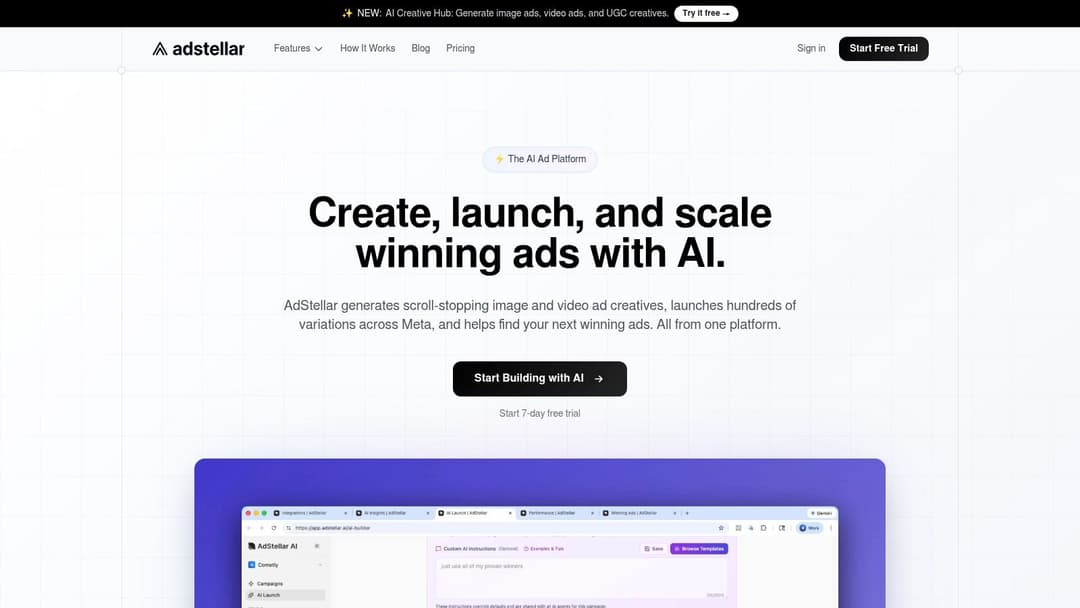
One platform built around this model is AdStellar AI. It connects to Meta Ads Manager, automates bulk ad creation, ingests historical performance, and uses AI insights to rank top creatives and audiences against goals like ROAS, CPL, or CPA. If you want to see how that optimization layer works in more detail, the product page on AI optimization shows the mechanics.
The biggest gain is not just more ads in market. It is a tighter loop between launch, evidence, and the next campaign build.
Evaluating and Implementing an AI Marketing Service
Choosing an AI platform is partly a software decision and partly an operating model decision. A weak evaluation process usually focuses on flashy outputs. A strong one focuses on fit, control, and whether the system improves how the team works every week.
What to evaluate before you buy
Start with the plumbing, not the demo.
- Integration quality: Check how the platform connects to channels like Meta. Secure OAuth access and clean data syncing matter more than slick visuals.
- Learning logic: Ask what inputs the model uses. Historical performance, audience behavior, and campaign goals should influence recommendations.
- Usability: Your team should be able to review, edit, and approve outputs without fighting the interface.
- Control points: Look for approval steps, editability, and clear visibility into what the system is changing.
- Reporting clarity: Good reporting should support decisions, not just generate more dashboards.
A practical mistake is buying an AI service before cleaning up data naming, conversion goals, and asset organization. If the inputs are messy, the automation scales the mess.
Roll it out in phases
Implementation works better when teams avoid a full reset.
Define one clear objective Pick a narrow goal first. That might be faster creative testing, better audience selection, or cleaner campaign scaling.
Connect the right data sources Bring in channel history, conversion events, and any relevant customer signals. AI performs better when it can learn from complete patterns rather than fragments.
Run a contained pilot Start with one account, one product line, or one client segment. Small pilots make it easier to compare workflow before and after.
Review human decision points Decide where people stay in the loop. Creative approval, budget guardrails, and final launch control should be explicit.
Turn wins into process Once the pilot works, document the operating rhythm so the team repeats it consistently.
Agencies need one extra decision
For agencies, tool adoption is tied to packaging. The business model matters as much as the workflow.
A recurring blind spot in AI marketing is service design. As noted in a discussion of agency models, AI automation agencies struggle with sustainability compared to productized services, which offer recurring revenue and scalability. That leaves agencies choosing between project-based delivery and standing creative services at fixed monthly fees (YouTube discussion on productized AI service models).
That matters because implementation is not finished when the tool works. It is finished when the service can be delivered repeatedly, profitably, and clearly.
Common Questions About AI Marketing Services
Marketers usually have the same concerns when AI enters the workflow. Most of them are valid. The good news is that the useful answers are practical, not philosophical.
Will AI replace the performance marketer
No. It replaces chunks of repetitive work.
The marketer still chooses goals, defines positioning, approves creative direction, interprets context, and decides what tradeoffs the business should make. AI is strongest when the task is repetitive, data-heavy, or too fast-moving for a person to monitor continuously.
Do small teams benefit
Yes, often more than large teams.
A smaller team usually feels manual drag more sharply because there are fewer specialists to absorb it. When one person handles creative coordination, launch setup, optimization, and reporting, even modest automation can free meaningful time for strategic work.
Does using AI mean losing creative control
Only if you hand over control by design.
A well-implemented ai marketing service should generate options, not remove editorial judgment. The team can keep control over brand voice, approvals, offers, and campaign boundaries while still using AI to increase variant volume and accelerate testing.
The best setup keeps humans in charge of taste and priorities, while machines handle repetition and pattern detection.
What about data privacy and security
This depends on the platform and its connection model.
Marketers should review how the tool accesses ad accounts, what permissions it requests, what data it stores, and how users manage access. Secure integrations and clear admin controls matter more than broad AI claims.
Is this only useful for ecommerce brands
No. Ecommerce adopted many of these workflows early because it produces fast feedback signals, but the operating model is broader than ecommerce.
Service businesses, B2B teams, agencies, and vertical-specific marketers can all use AI to reduce production overhead, improve targeting logic, and structure testing more efficiently. The implementation details change, especially in industries with longer sales cycles or compliance requirements, but the workflow advantage still applies.
How do you know if the service is working
Look beyond vanity metrics.
You should see improvement in workflow speed, testing volume, campaign clarity, and decision quality. Then measure whether those operational gains are helping business metrics like CPA, CPL, ROAS, or pipeline quality. If the tool creates more content but not better decisions, the implementation needs work.
The strongest signal is simple: your team spends less time assembling campaigns and more time improving them.
If you want an AI workflow built for launching, testing, and scaling Meta campaigns with less manual setup, AdStellar AI is designed for that operating model. It helps teams generate variations in bulk, learn from historical performance, and focus more of the workday on strategy instead of repetitive campaign assembly.