So, what's a good click-through rate for your Facebook ads? It’s the million-dollar question, isn't it?
The short answer is that the average CTR for Facebook ads across all industries currently sits somewhere between 1.44% and 1.91%. But the real answer is a bit more nuanced. A "good" CTR isn't a single magic number; it’s a moving target that depends entirely on your industry, who you're talking to, and what you’re trying to achieve.
What Is a Good Click Through Rate for Facebook Ads

Think of your ad's click-through rate as a conversation starter. It's the percentage of people who saw your ad (an impression) and were interested enough to actually click on it. It’s the digital equivalent of someone window shopping, spotting something they love, and deciding to step inside your store.
A high CTR is usually a great sign. It tells you that your ad creative, your copy, and your targeting are all hitting the mark with your audience.
While a universal "good" CTR is a myth, benchmarks give us a useful starting point. For years, the unofficial industry standard hovered around a measly 0.9%—that’s just nine clicks for every 1,000 sets of eyeballs on your ad.
Thankfully, things have improved. Recent data shows the average click-through rate on Facebook ads is now a much healthier 1.44% to 1.91% in major markets. The best campaigns? They’re often clearing 2.5% and beyond.
To give you a clearer picture, here’s a quick summary of what to expect.
Facebook Ads CTR At a Glance
This table offers a quick snapshot of the key CTR benchmarks that can help set clear expectations for your campaigns.
| Metric | Average Rate |
|---|---|
| Overall Average CTR | 1.44% - 1.91% |
| Old Industry Standard | ~0.9% |
| Top-Performing Campaigns | >2.5% |
Keep in mind that these are just averages. The real magic happens when you start digging into the details of your own campaigns.
Beyond the Averages
Relying too heavily on broad industry averages can be misleading. A "good" CTR is always relative, and you need to look at it through the lens of a few key factors:
- Industry: A retail brand shouting about a 50% off flash sale will almost always see a higher CTR than a B2B SaaS company advertising a complex, high-ticket software solution. The appeal is just more immediate.
- Audience Temperature: Are you talking to strangers or friends? A warm audience of past customers who already know and trust you will click at a much higher rate than a cold audience seeing your brand for the very first time.
- Campaign Objective: An ad built for brand awareness might get tons of views but few clicks, and that's okay. On the other hand, an ad optimized for conversions with a powerful call-to-action is designed specifically to get that click.
Ultimately, the most important benchmark is your own performance history. Your goal shouldn’t be just to beat some generic industry average, but to consistently improve on your own results—turning your good campaigns into great ones.
To really nail this down, it helps to understand what is a good click-through rate in the wider digital advertising world. This broader context helps you set realistic goals for your Facebook efforts. You might also be interested in our guide exploring if https://www.adstellar.ai/blog/does-facebook-advertising-work in today's landscape.
How to Calculate and Understand Your Ad Performance
So, you want to improve your Facebook ad performance. The first step is knowing where to look and what the numbers are actually telling you. Think of your Meta Ads Manager as the cockpit of a plane—it’s packed with gauges and dials, but only a few are critical for a smooth flight. CTR is one of those critical gauges.
The math behind your click-through rate is pretty simple:
CTR = (Total Clicks ÷ Total Impressions) x 100
Let’s break that down. If your ad was shown 1,000 times (impressions) and got 15 clicks, your CTR would be 1.5%. This number is your first and most important diagnostic tool. It tells you, in no uncertain terms, how well your creative and copy are connecting with your audience. A low CTR is often a red flag for a disconnect—your message just isn't compelling enough to make someone stop scrolling and actually click.
Finding Your CTR in Meta Ads Manager
You don’t need a separate calculator for this; Meta lays it all out for you right in your campaign dashboard. The image below shows a standard view where all your performance data is organized into columns.
This is mission control. Here, you can customize the columns to show the metrics that matter most, including CTR, giving you a clear side-by-side comparison of how every ad is doing. It’s the fastest way to spot which ad sets and creative combinations are grabbing your audience's attention effectively.
CTR (All) vs. Link CTR: What’s the Difference?
Once you start digging into your reports, you'll spot two very similar metrics: CTR (All) and CTR (Link Clicks). Don't gloss over this—the difference is crucial.
CTR (All): This is the broader metric. It counts a click on any part of your ad. That means likes, comments, shares, a click to your Facebook page, or even a click on the "see more" link to expand the text. It's a measure of general engagement.
CTR (Link Clicks): This one is much more specific and, frankly, more important for most campaigns. It only counts clicks on the link that takes people to your intended destination, whether that's your website, a product page, or a landing page.
For almost any advertiser trying to drive traffic or conversions, Link CTR is the hero metric. A high CTR (All) paired with a low Link CTR is a classic sign of trouble. It means people are interacting with your ad, but they aren't taking the one action you actually want them to take.
To get a better handle on how to read these signals, check out our complete guide to performance marketing metrics. Keeping your eyes on Link CTR ensures you're measuring the behavior that directly fuels your campaign goals.
How Industry and Campaign Goals Shape Your CTR
When it comes to your Facebook ads, context is everything. A click-through rate that would be cause for celebration in one industry might be painfully average in another. Similarly, the goal you set for your campaign dramatically changes what a “good” CTR looks like.
To get a real sense of your ad performance, you need to understand these benchmarks. It’s the only way to set realistic goals and know if your numbers are truly on the right track.
Why a "Good" CTR Isn't One-Size-Fits-All
Think about it this way: an ad for a new pair of limited-edition sneakers is designed for a fast, emotional click. The user sees it, wants it, and taps "Shop Now." In contrast, an ad for a financial planning service asks for a lot more thought and trust before someone commits to clicking.
This difference in user intent is precisely why the average click-through rate on Facebook ads can vary so much from one industry to the next.
For instance, sectors that are highly visual or tap into impulse buying naturally see higher CTRs. Here’s a quick breakdown:
- Retail & E-commerce: These guys often lead the pack, with CTRs that can easily top 2.0%. Their products are tangible, and the visuals do most of the talking.
- Fitness & Wellness: This industry also performs well, pulling people in with aspirational content and very clear calls to action.
- Finance & Insurance: These ads typically have lower CTRs, often dipping below 1.0%. The decision to click is a much bigger commitment.
- B2B & Tech: CTRs here can be all over the place, but they generally sit on the lower end since they’re targeting very specific, professional audiences.
The chart below shows the critical difference between CTR (All) and Link CTR. It’s a small distinction with big implications for your results.
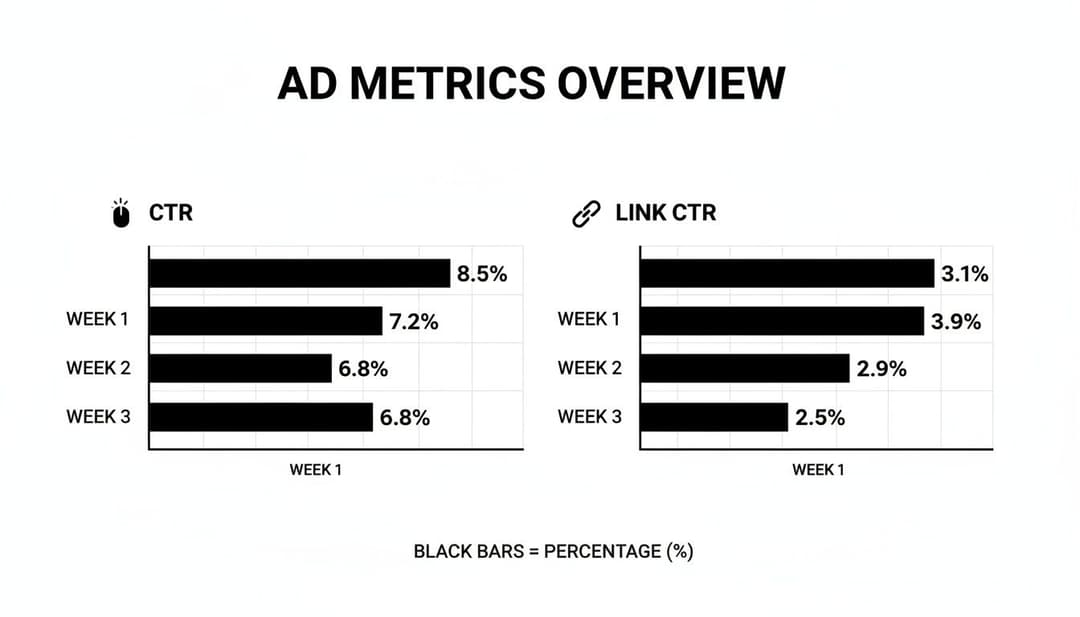
While any engagement is nice, it’s those link clicks that actually move people closer to becoming a customer. That's the metric you really want to watch.
How Your Campaign Objective Changes the Game
Your campaign’s main goal is probably the biggest factor influencing your expected CTR. When you choose an objective, you’re telling Meta’s algorithm what you want to achieve, and it adjusts who sees your ad accordingly.
If you set up a campaign for "Reach," Meta’s job is to show your ad to as many people as possible for the lowest cost. The algorithm isn't looking for click-happy users; it’s just looking for eyeballs. As a result, CTRs for these campaigns are almost always low.
On the other hand, a "Traffic" or "Conversions" campaign tells Meta to hunt for people who are actually likely to click a link and visit your site. The system gets laser-focused on finding those high-intent individuals for you.
Recent data shows that Lead Generation campaigns crush other objectives, hitting an impressive average CTR of 2.53%. That's 61% higher than Traffic campaigns (1.57%) and leaves Reach campaigns (0.87%) in the dust. The same data also reveals year-over-year CTR gains across multiple goals, including a +0.14% bump for Conversion campaigns.
This data makes it crystal clear: you have to align your expectations with your campaign’s mission. You wouldn’t judge a fish by its ability to climb a tree, so don’t judge a Brand Awareness campaign by its Link CTR.
For those who want to dig deeper and see how your own numbers stack up, our Facebook ad performance benchmarking tool can give you a much clearer picture based on relevant industry standards.
The Four Pillars Influencing Your Ad's CTR

Ever wonder why some Facebook ads seem to suck in clicks like a vacuum, while others just sit there collecting dust? It's not luck. It’s strategy. A high click-through rate is always the product of a well-built ad, and every single successful ad stands on four core pillars: Creative, Copy, Audience, and Offer.
Think of it like building a structure. If even one of these pillars is wobbly, the whole thing is at risk of collapsing. Mastering how they all work together is the secret to figuring out what’s wrong with your ads and, more importantly, how to build campaigns that actually work.
The Power of Ad Creative
In the blink-and-you'll-miss-it world of a social feed, your ad's creative is its first and only shot at making an impression. It’s the visual handshake that decides whether someone slams the brakes on their scrolling thumb or just glides right past.
This is why vibrant, high-energy videos often crush static images. They create instant motion and command attention. The real trick is to deliver a killer hook within the first three seconds—that’s all the time you have before they’re gone.
Don't just show your product. Show your product solving a real problem. A great visual tells a story faster than words ever can, making it your most powerful tool for stopping the scroll cold.
Crafting Compelling Ad Copy
Okay, your creative did its job and stopped the scroll. Now what? Your copy has to step in and close the deal. This is everything from your headline and primary text to the call-to-action (CTA) button. Its job is to build on that initial spark of interest and give them a reason to click.
Your headline is like a movie trailer—it needs to create just enough curiosity to make people want the full story. Good copy does three things really well:
- Creates Curiosity: A headline like "The #1 Mistake Homeowners Make in Winter" is way more clickable than "Quality Home Repair Services."
- Speaks to a Pain Point: Get right to the heart of a problem. Something like, "Tired of pouring money into ads that don't convert?" resonates immediately.
- Demands Action: A passive CTA is a dead end. Use strong, benefit-driven language. "Get Your Free Quote" or "Claim My Discount" works a lot harder than a generic "Learn More."
In short, great copy gives the context and the push that turns a passive viewer into an active clicker.
The Importance of Targeting the Right Audience
You could have a masterpiece of an ad—stunning creative, persuasive copy, the works—but if you show it to the wrong people, you might as well have set your money on fire. Your audience is the foundation. Showing the perfect message to the wrong person is just noise.
This is where your targeting strategy becomes critical. A cold audience, made up of people who’ve never heard of you, will almost always have a lower CTR. Why would they click? They have zero trust or familiarity with your brand.
A warm audience—we're talking website visitors, past customers, or people on your email list—is already primed to click. Retargeting these users can send your CTR through the roof because you’re not starting a conversation from scratch; you’re continuing one.
Dialing in your audience targeting is often the single fastest way to lift your CTR without touching your creative or copy.
The Irresistible Offer
Finally, we get to the offer. This is the "what's in it for me?" that ultimately powers the click. It's the value you're promising in exchange for their attention. A truly knockout offer can even make up for so-so creative or copy.
And an offer isn't just a discount. It can be anything that provides clear, immediate value to your target audience:
- A free guide that solves a nagging problem
- A limited-time BOGO deal
- A free trial of your software
- An exclusive invite to a webinar
Think of the offer as the engine of your ad. The more compelling and relevant it is, the more clicks you'll get. It's the final, crucial reason someone decides to stop scrolling and start engaging.
Actionable Strategies to Improve Your Facebook Ads CTR
Knowing what a good CTR looks like is one thing, but actually improving it is where the real work begins. It’s time to move from diagnosis to action. This means rolling up your sleeves and using a practical toolkit of proven tactics designed to lift your campaign performance.
These strategies aren't just theory—they're clear, actionable levers you can pull today. By focusing on methodical testing, precise audience refinement, and creating a seamless user journey, you can start making data-driven decisions that have a real impact on your ad engagement and, ultimately, your bottom line.
Systematically Test Your Ad Components
The fastest way to kill your CTR is to guess what your audience wants. A much better approach? Let them tell you what works through structured A/B testing. This just means creating multiple versions of your ad, changing only one variable at a time to see what performs best.
Don't try to test everything at once. Isolate individual elements to get clear, actionable insights.
- Creative: Pit a video against a static image. Or try a raw, user-generated-content style photo against a polished graphic.
- Headlines: See what happens when you run a question-based headline against one that states a clear benefit.
- Calls-to-Action (CTAs): Compare the performance of "Shop Now" versus "Get 25% Off" to find out if a specific offer drives more clicks.
This methodical approach removes the guesswork and lets the data guide your creative decisions. If you're looking for more ways to boost engagement, our detailed guide offers several techniques on how to improve click-through-rate across your campaigns.
Refine Your Audience Targeting
Showing a brilliant ad to the wrong people is a guaranteed way to get ignored. Improving your targeting is often the quickest path to a higher CTR because you're presenting your message to a much more receptive audience.
Start with the low-hanging fruit: your existing connections.
Key Insight: The average click-through rate on Facebook ads often skyrockets when you target warm audiences. These users already have a relationship with your brand, making them far more likely to engage than cold prospects who have never heard of you.
Build powerful Custom Audiences from your existing data—think website visitors, email subscribers, or people who have engaged with your Facebook page.
From there, you can create Lookalike Audiences. This incredible feature allows Meta to find new people who share similar characteristics with your best customers. It’s an effective way to expand your reach to a highly relevant new audience, ensuring your ad spend is focused on users most likely to be interested in your offer.
Improve the Ad-to-Landing-Page Experience
Your ad's only job is to get the click. After that, the landing page has to do the heavy lifting. A high CTR followed by a low conversion rate often points to a disconnect between what your ad promises and what your landing page actually delivers. This jarring experience can cause users to bounce immediately.
Create a seamless transition by aligning your messaging, branding, and visuals. If your ad features a specific product or a 20% discount, that exact product and offer should be the first thing a user sees on the landing page.
This continuity builds trust and reinforces the user's decision to click, encouraging them to take the next step. To dive deeper into platform-specific tactics, check out these practical strategies for Facebook ads.
Scaling CTR Optimization with AdStellar AI
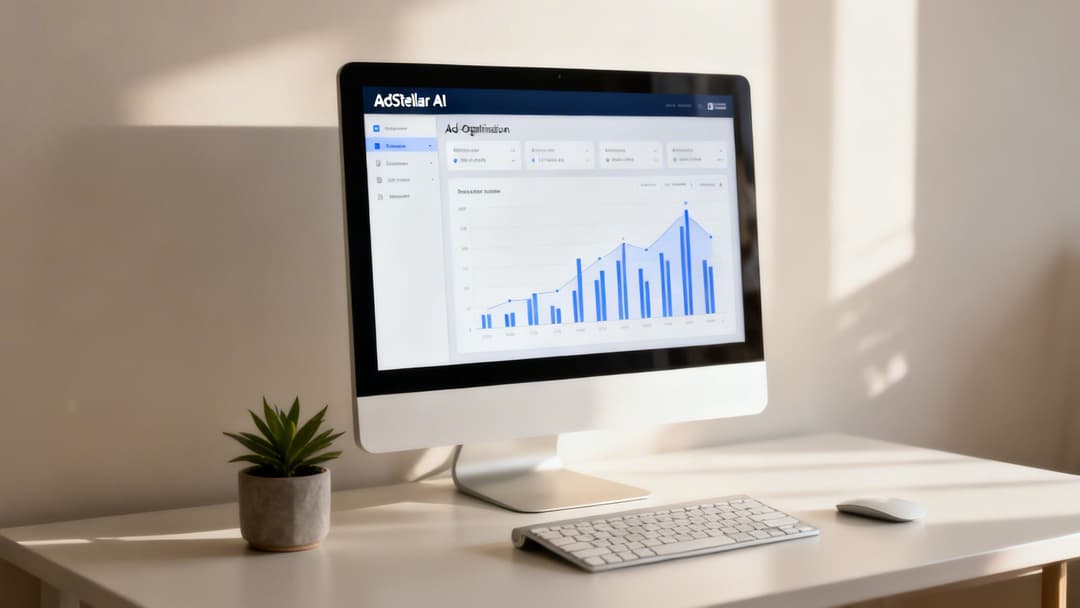
Let's be honest. Manually testing every single ad variation—every headline, image, audience segment, and call-to-action—is a surefire way to burn out. While A/B testing is a non-negotiable part of improving your average click-through rate on Facebook ads, the process is painfully slow and tedious. It puts a hard cap on how many new ideas you can actually test.
This is exactly where automation gives you a massive strategic edge. Trying to manage dozens, or even hundreds, of ad combinations by hand isn't just inefficient; it's nearly impossible to do well. This is the problem intelligent platforms were built to solve, letting you scale your CTR optimization in a way that just isn't humanly possible otherwise.
Automating the Creative Testing Grind
What if you could generate and test hundreds of creative and copy combinations in minutes instead of weeks? Platforms like AdStellar AI plug directly into your historical campaign data to figure out what's worked best in the past. It digs through your top-performing images, headlines, and audiences to spot the winning patterns.
The system then uses those insights to build brand new campaigns that have a much higher chance of success from the moment you hit "launch." You’re no longer starting from scratch with every test. Instead, you're building on a solid foundation of your own proven data.
This completely flips your workflow from a manual grind to an automated system of discovery.
Empowering Strategists, Not Replacing Them
The point of this kind of technology isn’t to make strategists obsolete; it’s to arm them with better tools. By automating the granular, time-sucking testing process, it frees you up to focus on what humans do best: big-picture strategy and creative thinking.
This shift means you can spend more time analyzing performance trends and less time bogged down in the repetitive tasks of campaign setup. Automation turns your raw campaign data into clear, revenue-driving decisions.
For teams looking to push their results to the next level, getting familiar with AI optimization tools can be a critical step forward. It’s all about working smarter, not harder—letting the machines handle the repetitive work so you can focus on the big-picture strategy that actually drives growth.
Frequently Asked Questions
Even with a solid game plan, you're bound to run into some head-scratchers when looking at your Facebook ad performance. Let's tackle a few of the most common questions that pop up for advertisers staring at their CTRs.
What Is the Difference Between CTR and Link CTR?
This is a classic point of confusion, but it's pretty simple once you break it down. Think of CTR (All) as your ad's overall "attention score." It lumps together every single interaction someone has with your ad—likes, comments, shares, clicks to your Facebook page, and even clicks on the "read more" button. It tells you if people are generally noticing and engaging with your ad.
But Link CTR is where the money is. This metric only counts clicks on the specific link you want people to visit, like your website, product page, or app store download. If your goal is to drive traffic and get conversions, Link CTR is the number you should be obsessed with. It's the true measure of how well your ad is doing its primary job.
Why Is My CTR High but My Conversions Are Low?
Ah, the million-dollar question. Seeing a high CTR with barely any conversions is frustrating, but it almost always points to one thing: a major disconnect between your ad and your landing page. Your ad did its job perfectly—it was compelling enough to earn the click. The problem starts after they land.
A high click-through rate with few conversions is a classic sign of a broken user journey. Your landing page isn't delivering on the promise your ad made, and that erodes trust instantly.
Look for a mismatch. Does the offer on the landing page perfectly mirror the ad? Are the visuals and messaging consistent? You also need to check the technical stuff. Is your page slow to load? Is it a nightmare to navigate on a phone? A seamless, trustworthy experience from ad to landing page is non-negotiable.
How Often Should I Check My Facebook Ads CTR?
It’s incredibly tempting to refresh Ads Manager every ten minutes after launching a new campaign, but that's a recipe for making bad, knee-jerk decisions. You have to give Meta's algorithm some breathing room.
Wait at least 48-72 hours before you even think about touching anything. The system needs that time to find its footing, learn who to show your ad to, and gather enough data to be meaningful. After that initial learning phase, checking in once a day or every other day is a healthy rhythm. This lets you spot real trends without panicking over the normal daily ups and downs. Remember, the average click through rate on facebook ads isn't a static number; it will fluctuate.
Ready to stop guessing and start scaling? AdStellar AI automates the tedious work of testing and optimizing your Meta ads. Generate hundreds of ad variations in minutes, let AI identify your top performers, and launch campaigns with a higher probability of success from day one. See how it works at https://www.adstellar.ai.