Teams struggling with converting facebook ads aren't missing one secret trick. They're running a disconnected system.
The campaign objective doesn't match the business goal. The audience strategy is too shallow. Creative is built in isolation from the landing page. Testing is random. Scaling starts before measurement is trustworthy. Then the account gets blamed when the actual problem is operating discipline.
That's why fragmented advice usually fails. Cheap clicks don't fix weak intent. More ad variants don't help if the account isn't structured to learn. Retargeting won't save you if the offer is wrong. Converting facebook ads comes from getting the whole machine working together, from setup to attribution.
Foundation First Campaign Setup and Goal Alignment
The most important choice in Meta isn't your headline. It's the campaign objective.
If you choose traffic because clicks look cheap, Meta will deliver people who click. It won't prioritize buyers, leads, or qualified actions unless you tell it to. That sounds obvious, but a huge amount of wasted spend starts right there.
According to 2025 Facebook conversion benchmarks, video engagement-to-conversion campaigns average 15.31% conversion rates, which is 71% higher than standard traffic campaigns at 2.79%. The same benchmark shows purchase campaigns average 9.21%, while lead generation campaigns outperform traffic campaigns by 321%.
Match the objective to the real outcome
A simple rule works well here.
| Business goal | Wrong default | Better Meta objective |
|---|---|---|
| Generate pipeline | Traffic | Lead generation or sales tied to the actual lead event |
| Drive ecommerce revenue | Engagement | Sales optimized for purchase |
| Build remarketing pools | Purchase from day one | Engagement or video views first, then conversion campaigns |
| Validate message-market fit | Broad sales setup too early | Controlled engagement or lead test with clear follow-up |
The trap is using upstream metrics as the target. Traffic campaigns can still have a role, but they're usually for audience building, content distribution, or diagnosing landing page behavior. They aren't the default answer if the business needs revenue.
Practical rule: Optimize for the deepest event you can measure reliably and affordably.
If your pixel or event setup is weak, fix that before scaling. A clean event foundation is more critical than often realized. If you need a refresher on implementation basics, Meta event tracking starts with a proper Meta Pixel setup.
Keep the account simple enough to learn
Bad structure creates fake complexity. Good structure gives you clean decisions.
A practical starting framework looks like this:
One campaign per core goal Keep lead generation separate from direct sales. Don't mix acquisition and remarketing inside one messy setup if you want clear readouts.
Ad sets based on meaningful variables Split by audience type, geography, offer, or funnel stage. Don't split by every minor targeting tweak.
Ads built around one concept at a time If one ad changes the hook, the format, and the offer all at once, you won't know what moved performance.
What works and what doesn't
Some patterns show up across almost every account.
What usually works
- Clear objective discipline: Sales campaigns for purchases, lead campaigns for form submissions, and engagement only when there's a downstream retargeting plan.
- One primary conversion event: Give Meta one job per campaign.
- Message continuity: The ad promise and landing page should feel like the same conversation.
What usually fails
- Traffic-first thinking: Teams chase cheap CPCs and then wonder why revenue doesn't move.
- Overbuilt campaign trees: Too many ad sets, too little spend per branch, no stable signal.
- Mixed intent inside one campaign: A warm retargeting audience and a cold broad audience rarely belong in the same optimization bucket.
Build for control before you build for scale
The account has to answer basic questions fast.
Which audience is producing qualified actions? Which offer pulls actual demand? Which creative angle deserves more budget? If the campaign setup can't answer those questions, scaling just multiplies confusion.
A clean campaign foundation does something else too. It makes automation useful. Without structure, AI just accelerates disorder. With structure, automation can launch variations faster, compare performance correctly, and help operators make sharper decisions.
Most Meta accounts don't need more activity. They need fewer, cleaner inputs tied to outcomes that matter.
That is the first breakpoint in converting facebook ads. Stop optimizing for what looks busy. Start optimizing for what the business gets paid for.
Finding Your Buyers with Advanced Audience Targeting
A strong ad shown to the wrong person is just polished waste.
Most Meta accounts need three audience temperatures running together. Not eventually. From the start. Cold audiences create reach. Warm audiences convert hesitation. Hot audiences close intent that's already there.
The biggest impact usually comes from the middle and bottom of that stack.
The most useful way to think about audience strategy is by temperature, not just targeting type. If you're building audiences inside Meta, this guide on types of target audience is a good companion to the framework below.
Cold audiences need signal, not obsession
Cold prospecting is where many advertisers overcomplicate things.
They stack too many interests, narrow audiences too hard, and choke delivery before the system has room to find converters. Cold campaigns should introduce a clear problem, a clear promise, and a low-friction next step.
Good cold audience options usually include:
- Broad targeting: Useful when your pixel, creative, and offer are already giving Meta strong feedback.
- Lookalikes from high-quality source lists: Past purchasers, qualified leads, or high-value customers are better seeds than generic email lists.
- Interest clusters: Still useful when you're entering a new market and need directional control.
Cold traffic isn't where you expect miracles. It's where you buy discovery and feed the next stage.
Warm audiences are where intent compounds
Warm audiences are people who know something about you already. They watched videos, engaged with posts, visited product pages, or started a form.
At this stage, many accounts recover efficiency.
According to Facebook ad ROI and retargeting data, retargeting campaigns can produce 10x better conversion rates than prospecting campaigns. In a retail case study from the same source, the advertiser generated a 9.43 ROAS on £3,200 in spend, with 76% of buyers having never heard of the brand before seeing the ad.
That last point matters. Strong retargeting doesn't only monetize known demand. It helps new demand mature into buyers through message sequencing.
Warm audiences don't need more explanation. They need the right nudge at the right moment.
Useful warm segments often include:
| Warm segment | What they need |
|---|---|
| Video viewers | A direct offer after initial education |
| Site visitors | Better product clarity, proof, or urgency |
| Engaged social users | A stronger reason to leave the platform and act |
| Lead form openers | Reduced friction and tighter message match |
Hot audiences should remove friction
Hot audiences are the closest thing you get to low-hanging fruit in Meta.
Think cart abandoners, checkout starters, repeat buyers, demo-booking visitors, and people who reached a pricing page but didn't complete. They don't need a brand manifesto. They need obstacle removal.
That often means:
- Proof: Reviews, demonstrations, customer outcomes
- Incentive: Shipping clarity, bundle logic, trial framing, consultation framing
- Reminder: The product, offer, or action they already considered
- Confidence: Return policy, onboarding process, support expectations
A lot of teams run the same ad to all three temperatures and call it retargeting. That isn't enough. Audience temperature should change both the message and the ask.
Here's a useful breakdown from a practitioner discussion on sequencing and retargeting strategy:
The targeting mistake that hurts most
The biggest audience mistake isn't targeting too broad or too narrow in theory. It's failing to build a system where cold, warm, and hot audiences feed each other.
If you're only prospecting, acquisition costs climb because you're asking strangers to convert on first contact. If you're only retargeting, you eventually exhaust the pool. If your lookalikes are built from weak source data, Meta scales the wrong pattern.
The practical fix is simple:
- Prospecting creates attention
- Engagement and site behavior build audience pools
- Retargeting closes the gap between interest and action
- Customer data feeds stronger lookalikes back into prospecting
That loop is what makes converting facebook ads more predictable. Not easy. Predictable.
The Conversion Engine Creative Copy and Offer
Most ad accounts don't have a targeting problem first. They have a message problem.
When a campaign doesn't convert, teams often respond by changing audiences before they've fixed the actual asset people see. If the creative is weak, the copy is generic, or the offer is forgettable, Meta has nothing good to optimize toward.
The ad itself is the conversion engine.
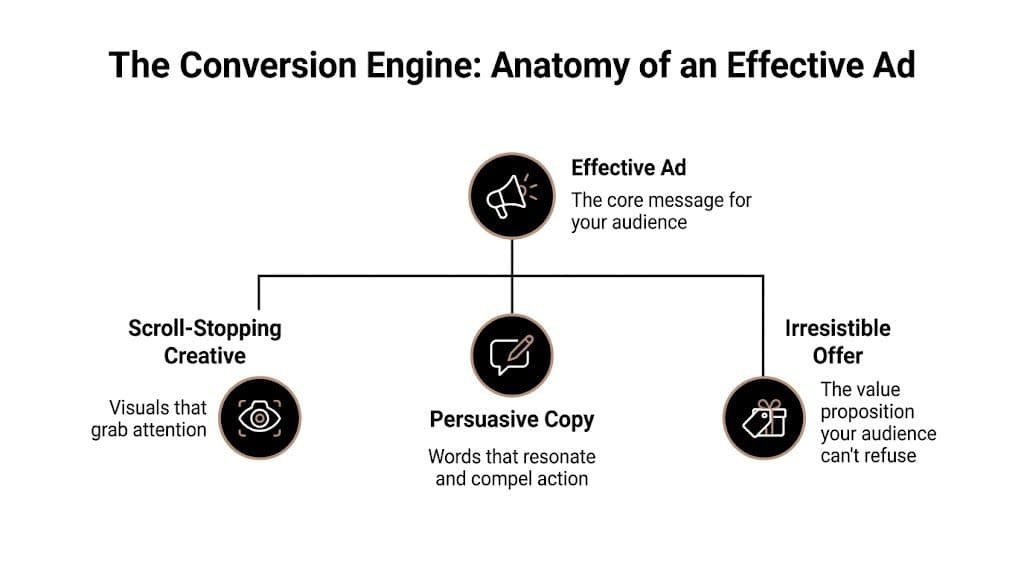
Creative has one job first
Creative doesn't need to explain everything. It needs to earn the next second.
That means the first frame, first visual contrast, or first line of motion has to signal relevance quickly. Most losing creatives fail because they look like ads in the most boring way possible. Generic product shots. Safe brand language. No tension. No obvious reason to stop scrolling.
Three creative formats keep showing up in accounts that convert:
UGC-style ads These work when the product needs demonstration, social proof, or a human point of view.
Problem-solution creatives Strong for pain-aware markets. They work best when the problem is concrete, not abstract.
Before-and-after or transformation framing Effective when the end state is easy to visualize and believable.
The mistake is treating format as strategy. UGC isn't a magic switch. It works when the person, hook, and use case feel credible.
Copy should carry the decision
A lot of Meta copy fails because it's descriptive instead of persuasive.
It tells people what the product is, not why they should care now. Good copy creates momentum. It names the problem, sharpens the consequence, introduces the mechanism, and makes the next step feel low risk.
Two frameworks still hold up because they force discipline.
AIDA for structured persuasion
| Step | What it does in an ad |
|---|---|
| Attention | Opens with a sharp hook or unexpected truth |
| Interest | Builds relevance with a use case or pain point |
| Desire | Shows the payoff, proof, or differentiator |
| Action | Tells the user what to do next |
AIDA works well for colder audiences because it helps you pace the message. The problem is spending too many words on interest and too few on desire.
PAS for pain-aware buyers
Problem. Name the frustration clearly.
Agitate. Show the cost of leaving it unsolved.
Solution. Present the offer as a practical next step.
PAS is strong when users already feel the pain. It usually works better than fluffy benefit copy because it mirrors how buyers think. They don't wake up wanting features. They want relief, progress, confidence, or speed.
If the hook gets attention but the body copy doesn't deepen intent, the click quality collapses.
Offers convert more than adjectives
Teams love changing copy because it's easy. Often the bigger lift comes from changing the offer.
An offer isn't just a discount. It's the full value exchange. Why this, why now, why from you, with what level of risk?
Here are common offer levers that improve conversion quality:
Reduce friction Free consultation, easier signup, simpler checkout, or shorter forms.
Increase clarity Spell out what's included, what happens next, and who it's for.
Lower perceived risk Guarantees, cancellation flexibility, product education, or transparent onboarding.
Add urgency carefully Deadlines and limited availability only work when they're credible.
A weak offer with strong creative usually gets attention and wastes it. A strong offer with average creative can still carry an account farther than people expect.
Message match is where many campaigns leak
An ad doesn't convert in isolation. It hands off the sale to the landing page, product page, lead form, or checkout flow.
If the ad promises one thing and the destination feels different, conversion rates drop. The user clicked for a reason. The page has to continue the same argument with the same language, same benefit hierarchy, and same level of specificity.
Common message-match failures include:
- Ad promises speed, landing page opens with brand story
- Ad focuses on one product use case, page shows everything
- Ad uses social proof, page removes it
- Ad offers a lead magnet, form asks for too much too early
This is why bulk testing only helps when the variants are disciplined. A tool like AdStellar AI can generate and launch large sets of creative, copy, and audience combinations, but the operator still needs to define the right hooks, offers, and conversion path.
A practical ad build checklist
Before launching an ad, check these five points:
- Hook clarity: Can a cold user understand the point immediately?
- Visual relevance: Does the creative look native enough to earn attention?
- Offer strength: Is there a compelling reason to act now?
- Funnel continuity: Does the click destination continue the same message?
- Audience fit: Does this ad speak to one temperature, or is it trying to talk to everyone?
Converting facebook ads don't come from isolated creative hacks. They come from a coherent chain. The visual earns attention. The copy sharpens intent. The offer creates action. The landing page removes doubt.
Break one link in that chain and the algorithm can't save you.
From Guesswork to Growth A Systematic Testing Loop
Teams often claim to test. What they do is rotate assets and hope.
Useful testing has structure. One variable moves, enough data comes in, then the team makes a decision without contaminating the read. That's how you turn Facebook from a creative graveyard into a learning system.
Test one meaningful variable at a time
The biggest testing mistake is changing too much at once.
If you launch a new creative, new audience, new headline, and new offer in the same ad, you don't get an answer. You get noise. Start with the variable most likely to move conversion behavior.
A practical order looks like this:
Creative concept first Hook angle, format, problem framing, product demonstration
Offer second Trial, consultation, bundle, discount structure, CTA framing
Copy refinement third Headline, primary text, proof sequence, objection handling
Audience expansion after a winner exists Don't ask a weak ad to prove a targeting theory
Respect the learning window
The platform needs enough signal before you judge a test.
According to guidance on high-converting Facebook ad setup, Meta optimization typically needs 50 conversions per ad set during the learning phase before performance becomes more reliable. The same source notes that the optimal audience range for many conversion campaigns is 500,000 to 2 million users, and cites one example where improved targeting increased efficiency from 278 clicks at $0.142 CPC to 1,103 clicks at $0.03 CPC.
That doesn't mean every ad set must hit perfect conditions before you act. It means early data can lie if you rush decisions.
The fastest way to kill a potential winner is to pause it before the system has learned who responds.
Use a repeatable testing loop
A simple operating rhythm beats cleverness here.
| Step | What to do | What to avoid |
|---|---|---|
| Form a hypothesis | Tie it to one conversion barrier | Testing random ideas because you're bored |
| Launch a clean comparison | Keep variables isolated | Mixing audience, copy, and offer changes together |
| Let it gather signal | Give delivery time to stabilize | Turning ads off on the first rough day |
| Review by funnel stage | Check click quality and post-click behavior | Judging everything by top-line ROAS alone |
| Promote the winner | Fold insights into the next round | Declaring one ad a permanent champion |
Placement-level testing is where hidden wins show up
One of the most overlooked moves in converting facebook ads is testing creatives by placement instead of assuming one asset should work everywhere.
As discussed in this placement optimization breakdown, static creatives often perform best on Facebook Feed, while UGC often works better on Instagram Reels. The same source notes that Reels traffic surged 25% year over year. When marketers don't isolate winners by placement, spend shifts without deliberate adjustment and ROAS often gets worse.
That matters because Meta is not one channel in practice. Feed, Stories, Reels, and other placements behave differently. User intent, scroll speed, sound-on behavior, and creative tolerance all change.
A smart testing setup often includes:
- Placement split tests: Static for Feed, creator-style video for Reels
- Placement reporting reviews: Check where spend is drifting before results slide
- Creative adaptation: Same angle, different execution by placement
- Outlier review: Find ads winning in one placement before broad spend hides them
If you want a framework for building more disciplined experiments, this guide on how to test ads is worth keeping in your playbook.
Scaling Winners and Measuring True Impact
A winning ad can get ruined in two ways fast. You raise budget too aggressively, or you trust reporting that isn't telling the whole story.
Scaling and measurement belong together because budget decisions are only as good as the data behind them. A campaign that looks profitable in Ads Manager but breaks in the CRM isn't a winner. It's a reporting problem dressed up as performance.
Scale with less disruption
The first job is protecting signal quality.
If an ad set is still unstable, constant edits make it worse. Meta's learning phase needs enough conversion data to settle, and frequent budget or structural changes can throw delivery back into volatility. That's why patient operators usually scale in controlled steps rather than treating every strong day like a green light.
There are two practical paths.
Vertical scaling means increasing budget on an existing winner. Use it when the audience still has room and the ad is holding efficiency.
Horizontal scaling means carrying a proven message into adjacent audiences, placements, or geographies. Use it when one pocket of demand is working and you want more volume without forcing the same ad set to do all the work.
A simple operating view helps:
| KPI | Poor | Good | Excellent |
|---|---|---|---|
| Objective alignment | Click-focused setup with no revenue link | Campaign mapped to one business outcome | Objective, event, audience, and offer all aligned |
| Learning stability | Frequent edits and inconsistent delivery | Stable setup with enough signal to assess | Stable setup plus clear promotion rules for winners |
| Audience expansion | Random duplication into weak segments | Expansion based on proven buyer patterns | Expansion driven by strong source data and clear intent tiers |
| Measurement confidence | Platform-only reporting | Platform metrics checked against backend outcomes | Platform, CRM, and server-side tracking working together |
Don't trust last-click reporting blindly
Attribution is where many Meta accounts drift away from reality.
According to Facebook attribution and conversion tracking analysis, modeled conversions account for about 10 to 35% of total reported conversions in privacy-constrained environments. The same source notes that the 7-day click attribution window often reports 1.0 to 2.5% higher conversion rates than a 1-day window.
That doesn't mean Meta reporting is useless. It means you need context.
Browser-based tracking misses things. Cross-device journeys get blurred. Some users click on mobile and convert later elsewhere. Some revenue lands offline. Some reported conversions are modeled because direct signal is missing.
When the dashboard says performance is rising, check whether revenue quality is rising too.
CAPI is not optional if you're serious
If you're spending seriously on Meta, server-side tracking should already be part of the stack.
Facebook's Conversions API helps recover conversion data that the browser pixel can miss because of privacy restrictions, cookie loss, or blockers. It won't solve every attribution problem, but it improves signal quality and makes optimization decisions less fragile.
That matters even more when you're scaling. More spend amplifies both what works and what you misunderstand.
For teams that want a deeper look at evaluation frameworks beyond in-platform metrics, how to measure advertising effectiveness is a useful reference. And if you're operating in ecommerce, the tactical details in Facebook Ads for Dropshipping: The 2026 Blueprint are worth reviewing because scaling pressure tends to expose weak attribution and weak offer economics at the same time.
Use automation where the bottleneck is real
The primary bottleneck in scaling usually isn't "coming up with ideas." It's executing enough structured variations, monitoring them consistently, and promoting winners without drowning in manual work.
That's where AI systems earn their place. Not by replacing judgment. By reducing the time between signal, action, and deployment.
For Meta operators, the best use of automation is usually:
- ranking creatives and audiences against ROAS, CPA, or CPL goals
- pushing new variations from proven patterns
- surfacing placement and funnel-stage breakdowns before performance drifts
- helping buyers scale based on evidence instead of recency bias
If your process can't connect testing, budget moves, and attribution truth, scaling becomes expensive theater.
Troubleshooting Common Conversion Killers
A lot of campaigns look broken when they're just mismatched.
Ask the right question first.
Is CTR decent but conversions weak
Your ad may be doing its job. Your landing page may not be.
If the click is there and the sale isn't, inspect message match, form friction, page speed, offer clarity, and checkout flow. For ecommerce teams, this practical guide on how to improve ecommerce conversion rate is useful because many "Facebook problems" start after the click.
Is the campaign stuck in learning
The issue is often budget, fragmentation, or too many edits.
Consolidate where possible. Stop touching live ad sets every few hours. Let the system collect enough data before making judgment calls.
Is retargeting underperforming
Retargeting isn't magic. If it fails, the audience may be too small, the window may be off, or the message may be too generic.
Cart abandoners need a different ad than casual page visitors. Past purchasers need upsell logic, not the same acquisition pitch.
Is frequency rising while results drop
Creative fatigue is usually the symptom. Weak offer rotation is often the cause.
Refresh the angle, not just the colors. Introduce new proof, a new hook, or a sharper use case. If the same people keep seeing the same promise, response falls.
Are you getting leads but not customers
That's a qualification problem, not a platform win.
Tighten the form, pre-frame the offer better, and align ad copy with who the offer is for. More leads can still mean worse performance if sales quality drops.
If your team is spending too much time building ad variants, sorting through noisy results, and manually pushing winners live, AdStellar AI gives you a more operational way to run Meta. It automates bulk campaign creation, ranks creatives and audiences against goals like ROAS, CPL, or CPA, and helps teams launch, test, and scale with less manual drag.