Teams running facebook ads for engagement often hit the same wall. The post gets likes, a few comments roll in, CPM looks cheap, and everyone feels productive. Then the lead volume doesn't move. Sales don't improve. Retargeting underperforms because the campaign attracted curiosity, not intent.
That usually isn't a platform problem. It's a campaign design problem.
Engagement works when you treat it as an input to performance, not the end goal. A comment is useful if it helps you identify message fit. A video view matters if it builds a retargeting pool worth selling to later. A share matters if it expands qualified reach around a clear offer, angle, or problem statement.
I've seen too many accounts separate "brand" and "performance" so aggressively that neither side wins. The brand team chases visible activity. The acquisition team ignores those signals and keeps forcing cold conversion traffic through unproven creative. On Meta, that split leaves money on the table.
Beyond Likes An Introduction to Performance-Driven Engagement
A familiar scenario goes like this. A brand boosts a post, sees a flood of reactions, screenshots the result for Slack, and calls it a win. Two weeks later, the conversion campaigns still struggle. The likes didn't build a useful audience, the comments weren't from buyers, and nobody had a plan for what happened after the first interaction.
That is why beginner advice around facebook ads for engagement often disappoints experienced teams. It treats engagement as proof of success by itself.
The better frame is simpler. Engagement is an efficient way to buy attention and signals. Used well, it helps you test hooks, surface audience pockets, build warm pools, and give Meta stronger behavioral data before you ask for a purchase or lead.
Facebook engagement ads remain one of the most cost-effective entry points in Meta's ecosystem, with engagement CPMs averaging just over $4, and warm engagement audiences still trail broad automation by approximately 11% on final purchase cost, which is exactly why they need a strong retargeting plan instead of being judged in isolation (Leadenforce on engagement ads in 2025).
That trade-off matters. Cheap top-of-funnel attention is useful. Cheap attention with no path to revenue is not.
What engagement should do in a real account
A healthy engagement campaign usually serves one of these jobs:
- Validate a message fast: You can learn which problem statement, product promise, or creative angle earns attention before pushing more budget into conversion.
- Build retargeting assets: Video viewers, post engagers, page engagers, and clickers become the audiences your sales-focused campaigns can work with.
- Support content distribution: If your team already runs organic content, paid engagement can help your strongest posts reach enough relevant people to create meaningful downstream data.
If you're tightening your broader acquisition system, it helps to think of engagement as one part of the promotional mix for eCommerce, not a disconnected tactic.
Engagement is cheap inventory for learning. Revenue comes from what you do with that learning.
This is also where teams need a clear definition of performance marketing. If your setup still treats top-funnel activity and revenue as separate worlds, this breakdown of https://www.adstellar.ai/blog/what-is-performance-marketing is worth reviewing before you touch campaign structure.
Building Your Campaign The Strategic Foundation
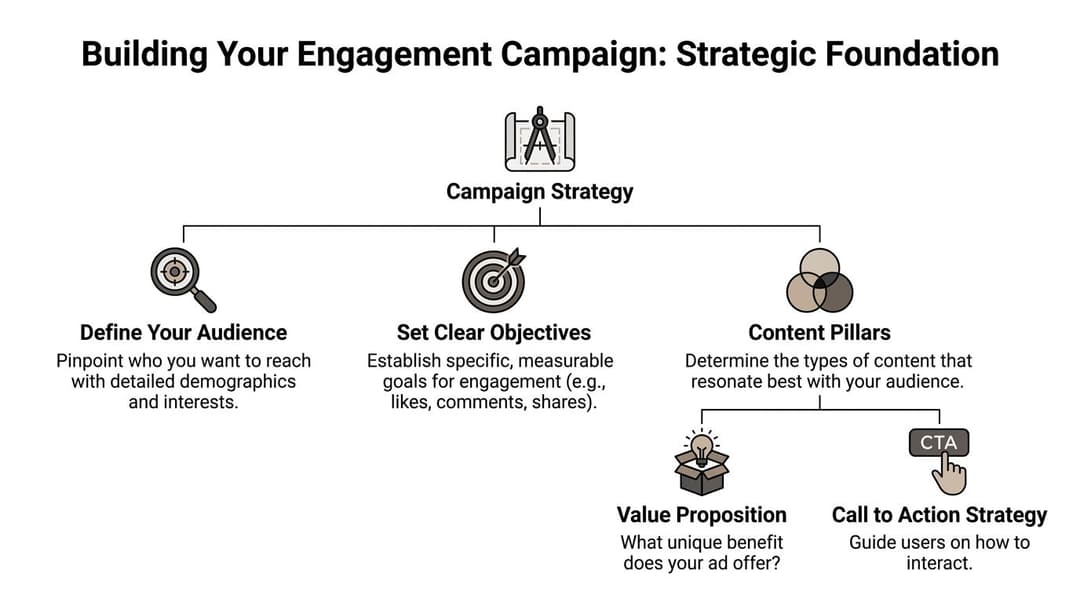
Most engagement campaigns fail before launch. Not because Meta is hard to use, but because the account never answered three questions:
- What signal are we trying to buy?
- What audience asset do we want to create?
- What downstream action should this campaign improve?
If those answers are fuzzy, the campaign becomes expensive noise.
Pick the engagement objective based on the next step
Not all engagement goals are equal.
If you're testing content and message resonance, Post Engagement is usually the cleanest choice. It helps distribute specific pieces of creative and gives you a straightforward read on which concepts pull interaction.
If the brand has an active content engine and wants to build an owned audience around regular publishing, Page Likes can make sense. But it's weak if the page itself is inactive or filled with generic content. Paying for followers into a dead page is wasted spend.
If you have a webinar, launch event, store event, or community activation, Event Responses can work because the interaction maps to a more concrete action. That signal is often more useful than a generic like because the user has acknowledged intent around something time-bound.
Here's the practical filter:
| Campaign type | Best use case | Weak use case |
|---|---|---|
| Post Engagement | Testing hooks, angles, and content resonance | Trying to force bottom-funnel efficiency directly |
| Page Likes | Supporting a real publishing cadence and community strategy | Inflating audience size with no content plan |
| Event Responses | Promotion tied to a real event or launch moment | Always-on acquisition for standard products |
Build for data quality, not vanity volume
The campaign structure should help you learn something specific.
Use a narrow set of variables at launch. If you test too many audiences, too many messages, and too many formats at once, you'll get activity but not clarity. For engagement, clarity matters more than scale early.
A practical starting framework:
- One campaign per testing intent: Keep message testing separate from audience testing.
- A few ad sets with clear logic: For example, one broad set, one interest cluster, one warm pool expansion.
- Multiple ads per ad set: Change the hook, angle, or format. Don't create near-duplicates.
CBO versus ABO for engagement testing
Teams often overcomplicate things.
ABO is usually better when you're trying to learn. You control spend at the ad set level, which means each audience gets a fair chance. If you're comparing broad against a lookalike, or one interest cluster against another, ABO prevents Meta from starving one test too early.
CBO becomes useful once you already know the campaign ingredients are directionally sound. It lets Meta shift budget toward stronger pockets of performance. That's helpful when the goal moves from learning to extracting more efficient engagement at scale.
Use this decision rule:
- Choose ABO when the account needs answers.
- Choose CBO when the account already has answers and needs more volume.
Practical rule: If you can't explain what each ad set is supposed to teach you, don't launch it.
Audience and placement choices that support performance
The setup itself matters. Engagement-focused workflows that use Custom Audiences from page interactions, website visitors, or uploaded databases, then expand with Lookalike Audiences at 1-2% similarity, can drive 2-3x higher engagement than broad targeting alone, according to the methodology summarized here: YouTube walkthrough on Meta engagement setup.
That same methodology also notes a reach-based engagement rate of 1-2% is considered optimal. That gives you a useful sanity check. If your campaign sits well below that range, the problem is often one of three things: weak creative, weak audience fit, or an offer/message mismatch.
A few setup choices tend to improve signal quality:
- Use Custom Audiences first when possible: Existing engagers and visitors give you cleaner starting points than random cold pools.
- Build Lookalikes from meaningful interaction pools: A high-intent engagement seed is better than a bloated, low-quality one.
- Prioritize placements that suit the creative: If the creative needs context, don't force it into placements built for speed.
For a deeper framework on segmenting audience pools by behavior and intent, this guide on https://www.adstellar.ai/blog/audience-segmentation-strategies is useful.
Crafting Creatives That Compel and Convert
Engagement campaigns don't rescue average creative. They expose it.
If the ad doesn't stop the scroll, invite a reaction, or frame the product in a way that feels relevant, you'll get low-quality interaction or none at all. The fastest way to waste budget on facebook ads for engagement is to treat the format as secondary.

Video should carry most of the load
The format environment is not subtle anymore. In 2026, video drives over 85% of ad engagement across all placements, vertical video with audio produces a 35% higher click-through rate in Reels ads, and videos under 15 seconds show 23% higher completion rates than longer formats (Increv's Facebook ads stats roundup).
That doesn't mean every message belongs in a short video. It means video is the default starting point unless the message clearly needs another format.
For most brands, the strongest engagement creative has these traits:
- Fast orientation: The viewer understands the topic immediately.
- A clear tension point: Problem, contrast, objection, mistake, or surprise.
- An opinion or prompt: Something people can react to, not just passively consume.
- A natural bridge to the product: The ad earns interaction while filtering for fit.
Script the first seconds with intent
Many advertisers still waste the opening on logo animation, scene-setting, or generic lifestyle footage.
That first beat should identify the person, problem, or claim as quickly as possible. You want the viewer to know, "this is for me" or "I disagree with that" almost immediately. Both are useful outcomes in engagement campaigns because they generate signal.
Three opener patterns that consistently work better than vague intros:
Call out the user
- "If you're running Meta ads and your comments are high but purchases are flat, this is the issue."
State the mistake
- "Most brands use engagement campaigns backward."
Open with a direct comparison
- "This creative gets comments. This creative gets customers."
Match format to message complexity
One of the biggest mistakes in engagement strategy is assuming one format wins everywhere. It doesn't.
Short-form video is usually stronger for simple, emotionally clear, thumb-stopping messages. Carousel can outperform when the message needs progression, product comparison, or sequential proof. Static images still work when the core idea is instantly legible and the copy does the persuasion.
Here is one practical approach:
| Message type | Better format fit | Why it works |
|---|---|---|
| Simple emotional claim | Vertical short video | Delivers fast reaction and easier interaction |
| Product comparison | Carousel | Lets users inspect differences slide by slide |
| Educational point | Video or carousel | Gives enough room for structure |
| Bold visual proof | Static image | Works when the image itself carries the argument |
If your team needs inspiration on how to structure ads by format, hook, and offer presentation, this creative guide at https://www.adstellar.ai/blog/facebook-ad-creatives is a strong reference.
Write copy that invites the right reaction
Good engagement copy doesn't beg for likes. It frames a useful conversation.
That usually means one of these approaches:
- Ask a qualified question: Not "What do you think?" but "Would you choose the cheaper option if it meant slower delivery?"
- Take a stance: Opinion attracts comments faster than neutrality.
- Name a buyer problem in plain language: People respond when they feel recognized.
- Use contrast: Before/after, old way/new way, wasted budget/profitable budget.
Avoid copy that sounds engagement-baited. Users can feel when a brand is fishing for comments with no substance behind it.
A better pattern is:
- Lead with the problem.
- Add a point of view.
- Give the audience a reason to respond.
- Let the product sit naturally inside that conversation.
Here's a useful creative reference before your next production sprint.
What works versus what usually fails
What works
- Founder-led clips with a clear opinion
- UGC-style problem/solution videos
- Customer objection breakdowns
- "Choose this or that" comparisons
- Product demos that reveal a surprising detail
What fails
- Stock-heavy lifestyle videos with no argument
- Generic brand manifestos
- Posts that ask for engagement without earning it
- Product shots with weak copy and no tension
- Polished creative that hides the actual offer
The best engagement ads don't just attract attention. They sort the audience by relevance before the click ever happens.
Targeting Strategies For Building Valuable Audiences
A common failure pattern looks like this. A team launches an engagement campaign, celebrates cheap comments, then realizes none of that activity improves lead quality or lowers acquisition costs. The problem usually is not the creative. The problem is that the audience strategy was built for reactions, not for revenue.
Targeting decides whether engagement becomes a useful signal for CPL and ROAS, or just a cheap metric in Ads Manager. The goal is to build audience layers you can retarget, exclude, expand, and compare over time. Done well, facebook ads for engagement gives growth teams a lower-cost way to identify buying intent before they spend harder on traffic or conversion campaigns.
Build audience architecture before you launch tests
Accounts that scale cleanly usually separate engagement into three audience groups:
- Cold testing audiences
- Warm engagement audiences
- Expansion audiences built from proven warm signals
Each group has a job.
Cold audiences tell you which message gets a real response from people who do not know you yet. Warm audiences help you turn that response into a click, lead, demo request, or purchase. Expansion audiences help you find more users who resemble the people already showing useful intent.
Without that structure, engagement campaigns stay isolated. They generate activity, but they do not create reusable audiences for the rest of the funnel.
Use engagement campaigns to test message-audience fit at lower cost
Engagement is a practical top-of-funnel filter. It lets teams test whether a message resonates before asking a cold audience to submit a form or start checkout. That matters in expensive categories where every conversion test can burn budget fast.
A disciplined setup uses a control and a few structured audience types side by side. Broad targeting shows whether the creative can stand on its own. Interest clusters help you test problem awareness or category context. Warm custom audiences show how familiarity changes response. Lookalikes built from stronger engagers can extend what already works.
| Audience layer | What to test | What you're learning |
|---|---|---|
| Broad | Core message and strongest hook | Whether the creative has enough native pull |
| Interest cluster | Specific pain points or use cases | Whether relevance improves response quality |
| Warm custom | Proof, objections, and stronger offers | Whether prior exposure changes intent |
| Lookalike | Winning message from your best warm seed | Whether a useful signal can scale |
Broad is often the benchmark, not the enemy. I have seen plenty of accounts where detailed targeting looked smarter on paper, but broad traffic produced better downstream conversion rates once the creative and offer were strong enough.
Build custom audiences from actions that correlate with intent
Not all engagement deserves the same value.
A like is a weak signal. A comment on an opinion-led ad can mean much more. A deeper video view is often stronger than a passive reaction because it suggests the person stayed long enough to understand the problem and the pitch. A click to the site from an engagement ad usually matters more than on-platform activity because the user accepted more friction.
Useful audience pools often include:
- Video viewers by depth
- Post engagers
- Commenters and sharers
- Website visitors driven by engagement campaigns
Keep those pools separate early on. That gives you a clean read on what produces qualified traffic and lower-cost conversions later. Once you combine every engager into one audience, you lose the ability to tell whether comments, video consumption, or click-through behavior created the value.
If your team is formalizing these layers across lifecycle stage and intent, this guide to audience segmentation strategies is a useful framework.
Retarget based on the signal people gave you
The handoff between engagement and performance campaigns needs logic.
Someone who commented on a founder opinion video should not see the same follow-up ad as someone who watched 75% of a product walkthrough. Those users responded to different buying triggers. Treating them as one pool usually raises CPL because the second message feels disconnected.
A stronger sequence looks like this:
- Cold engagement ad frames the problem and gets the right people to self-identify.
- Warm traffic or lead ad answers the objection tied to that first interaction.
- Bottom-funnel ad presents the offer, proof, and reason to act now.
That structure works because it respects intent progression. The first ad earns attention. The second ad qualifies it. The third ad asks for the conversion.
Retargeting should continue the same conversation the prospect already chose to join.
This is also where exclusions matter. Exclude low-value engagers from expensive conversion campaigns if they never clicked, watched meaningfully, or visited the site. Include higher-intent segments more aggressively. That one decision can improve efficiency faster than adding more creative volume.
If your account keeps struggling despite solid sequencing, it can help to benchmark your mix against other Facebook Ads alternatives. That comparison usually makes one thing clear. The issue is rarely the channel alone. It is the quality of the audience signals you are feeding into it.
Optimizing and Measuring What Truly Matters
Once the campaign is live, cheap engagement can become a trap.
If you're only watching cost per engagement, you'll scale ads that generate reactions but don't create any meaningful buying path. Serious teams look at engagement metrics as early indicators, then validate them against click quality, audience quality, and what happens after the first touch.

The metrics that tell you if the ad is healthy
For advanced analysis, monitor frequency in the 1.5-2.5 range. Once frequency goes above 3, CPM can rise by 25-50%. Track Hook Rate, calculated as 3-second plays divided by impressions, and aim for 30% or higher. Track Hold Rate, calculated as full views divided by 3-second plays, and a 7-10% range is a strong signal that the creative is holding attention (advanced analysis reference).
Those numbers matter because they help you diagnose the actual problem.
If Hook Rate is weak, the opening isn't landing or the audience is wrong. If Hook Rate is healthy but Hold Rate is poor, the opener worked but the body collapsed. If both are strong and downstream click quality is weak, the creative may be attracting the wrong kind of curiosity.
Build a custom column set in Ads Manager
A practical engagement dashboard should include:
- Frequency
- Reach
- Impressions
- Cost per result
- Unique outbound CTR
- 3-second video plays
- Full views or equivalent view depth
- Hook Rate
- Hold Rate
- Landing page views or lead outcomes in the next-step campaign
The point is not to stare at more columns. The point is to identify which creative deserves more distribution and which audience deserves the next sales ask.
For teams that want a structured way to connect top-funnel metrics to business outcomes, this resource on https://www.adstellar.ai/blog/measure-advertising-effectiveness is useful.
How to read the story in the data
Use this quick diagnosis table when performance starts drifting:
| Symptom | Likely issue | Common fix |
|---|---|---|
| High frequency, rising CPM | Audience fatigue | Refresh creative or widen audience |
| Low Hook Rate | Weak opener or poor audience fit | Rewrite the first seconds and sharpen targeting |
| Good Hook Rate, weak Hold Rate | Video loses momentum | Tighten the middle and remove setup fluff |
| Good engagement, weak outbound action | Curiosity without intent | Change angle, CTA, or audience qualification |
| Strong warm engagement, weak sales | Poor retargeting sequence | Match the next ad to the original engagement context |
Many marketers also need to make a broader channel decision at this point. If Facebook is still underperforming after you've fixed creative, sequencing, and audience quality, it's reasonable to review Facebook Ads alternatives and compare channel fit rather than force budget into a broken setup.
A working optimization rhythm
Daily checks should be light. Weekly checks should be deeper.
Daily
- Spot frequency spikes
- Watch for sudden creative drop-off
- Check comments for message mismatch or recurring objections
Weekly
- Compare Hook Rate and Hold Rate across creatives
- Review audience overlap and fatigue
- Promote winners into new retargeting or conversion sequences
- Pause ads that attract interaction without useful next-step behavior
Cheap engagement is only good if it improves the next campaign's economics.
That sentence keeps teams honest. Engagement is not a reporting category. It's a way to buy learning, attention, and audience quality at a lower cost than going straight for the conversion every time.
Advanced Workflows For Scaling and Testing
Winning one engagement ad is helpful. Building a system that keeps producing new winners is what scales an account.
Teams often plateau because they scale spend before they scale process. They find one strong creative, push budget, watch performance soften, then start over from scratch. A better workflow turns every winner into the seed for the next round of structured testing.
Scale in two directions
There are two practical ways to scale a winner.
Vertical scaling means increasing budget on the ad set or campaign that's already working. This is the cleaner move when the audience is still broad enough and frequency remains under control.
Horizontal scaling means duplicating the winning concept into new audiences, new placements, or new message variations. This is usually safer when the original audience is small or signs of fatigue are starting to appear.
A reliable rule is simple. If the creative is still healthy and the audience isn't crowded, try vertical scaling first. If the signal is strong but delivery is getting stale, move horizontally.
Test angles, not just assets
Advanced teams separate themselves at this point.
Changing colors, cropping, or headlines can help. But real gains often come from testing ad angles, meaning the core motivation behind the message. The same product can be framed around convenience, identity, fear of missing out, social proof, cost waste, time savings, or category frustration.
That matters because advanced teams that test 10+ angles at scale can uncover problem-unaware messages that produce a 20-50% engagement uplift compared to direct CTAs, based on the angle-testing methodology summarized here: YouTube discussion on ad angles.
Instead of building your matrix around formats alone, build it like this:
| Variable | Example |
|---|---|
| Angle | Save time, avoid waste, look smarter, feel safer |
| Format | Vertical video, carousel, static |
| Hook | Mistake, opinion, comparison, question |
| Offer frame | Demo, proof, explanation, objection handling |
That structure gives you useful answers. If one angle works across multiple formats, you've found a strategic message. If one format works only with one angle, you've found a tactical winner that may fatigue faster.
Make scaling operational, not heroic
A lot of media buyers still run this process manually. That can work in a small account. It breaks down once you're managing multiple products, audiences, or clients.
This is the point where workflow tools help. Platforms like AdStellar AI can automate bulk ad creation, generate multiple copy and creative combinations, and organize campaign builds around performance goals rather than manual duplication. For teams trying to move faster from engagement insight to conversion testing, that's operationally useful. Related guidance on moving engaged users toward sales outcomes is covered in https://www.adstellar.ai/blog/converting-facebook-ads.
A practical scaling loop looks like this:
- Keep the winner live: Don't shut off the control too early.
- Launch adjacent tests: New angles, same audience. Or same angle, new audience.
- Feed learnings into retargeting: Strong engagement messages should influence lower-funnel creative.
- Refresh before fatigue becomes obvious: Waiting too long usually means paying more for weaker attention.
The account grows faster when your team treats each winning ad as a data source, not a lucky break.
Your Playbook for Profitable Engagement
facebook ads for engagement work when they have a job beyond collecting reactions.
Use them to test messages cheaply. Use them to build warm audiences with clear behavioral signals. Use them to improve the efficiency of the campaigns that come next. If you can't point to the downstream role an engagement campaign plays, it probably shouldn't be running.
The teams that get the most from engagement think in sequences. They connect creative to audience quality, audience quality to retargeting, and retargeting to revenue metrics like CPL and ROAS. That approach is less exciting than posting a screenshot of thousands of likes. It is a lot more useful.
You don't need a complicated account to do this well. You need discipline. Strong hooks. Clean audience architecture. Honest measurement. A testing process that focuses on angles and intent, not just surface-level engagement.
That is what makes engagement profitable. Not the cheap click. Not the visible comment count. The system behind it.
If your team wants to launch, test, and scale Meta campaigns with less manual setup, AdStellar AI is built for that workflow. It helps generate and organize large sets of creative, copy, and audience combinations, connects to Meta via secure OAuth, and surfaces which messages and audiences are lining up with goals like ROAS, CPL, or CPA so your engagement campaigns can feed a more disciplined performance system.