You open Ads Manager for a local business and the pattern is usually the same. The owner wants more calls, more walk-ins, or more booked appointments. The account, if it exists at all, is cluttered with broad audiences, recycled creatives, and a boosted post that got likes but didn't move the business.
That gap is where most local campaigns stall.
facebook ads for local businesses work best when they stop trying to act like national brand campaigns. A neighborhood gym doesn't need vague awareness across an entire metro. A roofer doesn't need traffic from people outside the service area. A coffee shop doesn't need polished corporate creative if a simple ad featuring the counter, the staff, and a tight local offer will get nearby residents through the door.
The hard part isn't just launching. It's operating. Local advertisers often know the basics of radius targeting and lead forms, but they get buried by manual work. One creative for one neighborhood turns into six versions. One audience becomes a dozen ZIP code combinations. One offer becomes multiple seasonal variants. Managing that by hand is where performance starts leaking.
This playbook is built for that reality. It covers the strategic basics, but also shows the operating model behind campaigns that can scale across neighborhoods, service areas, and store locations without turning into a mess.
Why Facebook Ads Are a Key Channel for Local Businesses
At 7:15 a.m., a parent is scrolling Instagram while waiting in the school drop-off line. By noon, that same person may need a dentist, a lunch spot, or a last-minute birthday cake. Local buying decisions often happen fast, and Meta's apps give nearby businesses a chance to show up before that intent turns into a search or a visit to a competitor.
That timing matters more than raw reach.
For Main Street businesses, Facebook and Instagram ads work because they combine local visibility with control. A direct mail piece reaches every mailbox on the route, including households outside your customer profile. Radio gives broad coverage but little flexibility once the spot is booked. Meta lets you choose who sees the offer, where they live, and which message fits that area or audience segment.
That control is what makes the channel practical, not just popular.
A restaurant can push weekday lunch to office-heavy ZIP codes and weekend family bundles to nearby residential pockets. A med spa can rotate different offers by age range and service interest. A home service company can keep spend inside the actual service radius instead of paying for clicks from the other side of the city. Local relevance is rarely a creative problem alone. It is an operating problem, and Facebook ads solve part of it through targeting, placement control, and fast iteration.
The catch is execution. One local campaign is manageable by hand. Ten audience variations across multiple neighborhoods, offers, and creative formats usually are not. That is where teams start losing efficiency. Naming gets messy, testing slows down, and strong local ideas never get launched because no one has time to build the variations. Tools like AdStellar AI help handle that production bottleneck so the account can scale without turning into manual busywork.
Businesses that need help connecting paid social to broader channel strategy often benefit from reviewing a practical Paid Social Media Marketing framework. It helps clarify where Facebook sits relative to creative, audience, and funnel strategy.
If you're comparing where limited ad dollars should go first, this guide to online advertising channels for small business growth gives useful context.
Why local businesses can outperform bigger advertisers here
Larger brands have budget. Local businesses have proximity, speed, and specificity.
A neighborhood bakery can run a stronger campaign than a national chain when the ad uses real store photos, mentions the Saturday block event, and reaches people within a few miles who can act on it today. Big advertisers usually cannot match that level of local detail across every market. Smaller businesses can, but only if the campaign setup and creative workflow are built to support it consistently. This is a significant advantage. Facebook ads let local businesses buy relevance, test it quickly, and expand what works without rebuilding the account from scratch every week.
Choosing Your Campaign Blueprint
Most wasted local ad spend starts with the wrong objective. The business wants booked jobs, but the campaign is optimized for clicks. The owner wants store traffic, but the ads are driving people to a generic homepage. The offer is solid, but the campaign architecture points Meta in the wrong direction.
The fix is simple in theory. Match the campaign objective to the action that creates value for the business.
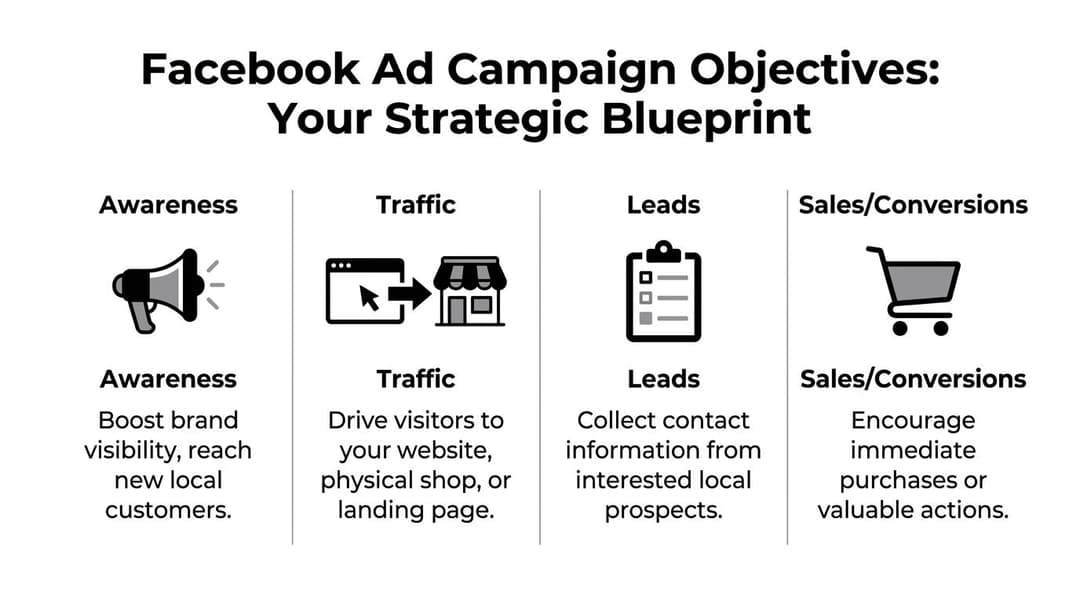
Start with the business outcome, not the ad format
A café, a med spa, and an HVAC company shouldn't use the same blueprint.
Use this simple lens:
| Business situation | Better objective direction | Why it fits |
|---|---|---|
| New location, low awareness in a tight area | Awareness | Puts the brand in front of nearby residents before asking for action |
| Menu launch, event push, website visit needed | Traffic | Good when the next step happens on-site and the page experience is strong |
| Service business that sells through calls or forms | Leads | Removes friction and captures intent directly inside Meta |
| E-commerce, bookings, or tracked purchase actions | Sales/Conversions | Gives delivery toward the actions that matter most if tracking is reliable |
A lot of local businesses still ask whether they should run "store visits" style campaigns. In practice, the better question is where the conversion happens. If customers usually call after seeing an ad, lead generation may outperform traffic. If they buy online or complete a booking flow, conversion campaigns usually make more sense. If the market doesn't know you yet, awareness can be the right opening move.
The three blueprints most local advertisers actually use
Awareness for new market presence
Awareness is useful when the business has a location problem, not an offer problem.
A boutique opening in a new neighborhood needs repeated exposure to nearby residents. A new dental office needs local familiarity before someone trusts it with an appointment. In those cases, awareness earns its keep by making later response campaigns cheaper and easier.
What doesn't work is expecting awareness to behave like a lead campaign. If you judge it by form fills alone, you'll shut it off too early.
Use awareness when:
- People don't know you exist: New store, new service line, new territory.
- The buying cycle has a delay: Cosmetic services, home improvement, family services.
- You need local memory first: Residents should recognize the name before they need the service.
Traffic when the page is the real salesperson
Traffic works when the landing destination is doing meaningful work.
That could be a restaurant menu, a special event page, a booking page, or a local offer page built for one neighborhood. It doesn't work well when the destination is a cluttered homepage with too many choices.
A good traffic campaign has a narrow promise. "See this week's lunch specials" is stronger than "Learn more."
Send traffic only when the page answers the exact question the ad creates.
If the ad says "Free consultation for homeowners in Westfield," the landing page should repeat that promise. Same neighborhood. Same service. Same CTA.
Leads when speed matters
For many local businesses, Leads is the workhorse objective.
Plumbers, attorneys, clinics, contractors, and real estate teams often win by reducing friction. A native lead form is often easier for the user and faster for the business than sending people to a full website journey.
Lead campaigns fit when:
- The business follows up fast: Form quality drops when response time is slow.
- The sale needs conversation: Quotes, inspections, consultations, estimates.
- Mobile behavior dominates: Many local users won't browse a full site before submitting.
Lead forms do have a trade-off. They can generate volume without enough intent if the offer is weak or the qualifying questions are too loose. That's why local lead forms should screen for basics like service area, need, or timeframe.
One mistake that keeps showing up
Many local advertisers choose Traffic because it feels safe. Clicks look tangible. But clicks are often the wrong optimization event for businesses that care about calls, appointments, or actual purchases.
A campaign blueprint should follow this order:
- What action creates revenue
- Where that action happens
- Whether Meta can track it
- What campaign objective aligns with that action
If you need a more detailed breakdown of how to structure these layers inside Meta, this guide on campaign architecture for Meta ads is worth reviewing before launch.
Mastering Hyperlocal Audience Targeting
Local targeting isn't just drawing a radius around a business and hoping for the best. That's the beginner version. The better version is matching place, intent, and local context.
A real estate agent trying to win listings in one part of town shouldn't target the whole city. A hardware store near an older housing stock shouldn't run the same audience as one in a newly developed suburb. Local performance usually improves when the audience reflects how people live, commute, and buy.
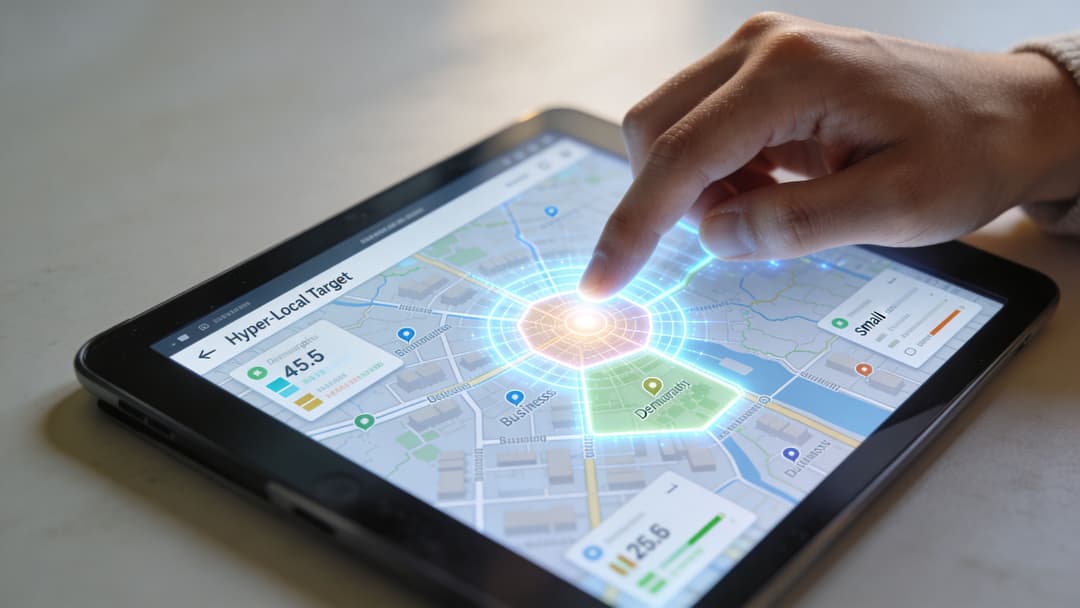
Poor targeting is expensive. Local businesses can waste up to 62% of ad spend on poor targeting, while hyper-specific behavioral and interest layering can yield 2.5x higher conversion rates compared to broad demographics alone according to Neil Patel's small business Facebook ads guide.
Start with geography that matches the business model
Radius targeting is useful, but only when it matches how far customers will realistically travel.
A coffee shop can stay tight. A pediatric dentist may cover a broader residential zone. A roofing company should map service areas, not distance from the office.
Use geography in layers:
- Core service area: The primary radius, ZIP cluster, or neighborhood set where most business should come from.
- Exclusions: Remove areas you don't serve, low-value regions, or locations that produce weak lead quality.
- Local context zones: Add targeting around event spaces, commuter corridors, or complementary business areas when relevant.
For a real estate agent, that often means building separate audiences around school districts, price bands, or neighborhoods with distinct buyer profiles.
Then add only a small amount of audience layering
The biggest mistake with local targeting isn't underthinking. It's overstacking.
If you're trying to reach likely home sellers in one neighborhood, one or two relevant audience signals are enough. Add too many and the audience gets too narrow, delivery gets unstable, and the algorithm loses room to work.
The strongest local audiences usually combine:
- Location first: Neighborhood, ZIP, or realistic radius.
- One behavioral or interest layer: Something tied to the service, not random affinity categories.
- Simple exclusions: Existing customers, out-of-area users, irrelevant age bands if needed.
If you want a plain-English refresher on the basics behind this process, what is audience targeting gives a helpful overview without getting lost in jargon.
Use customer data when you have it
Broad local targeting has its place, but customer-based audiences usually outperform generic assumptions.
For local campaigns, useful seed audiences include past customers, closed deals, booked appointments, or repeat buyers. Once uploaded properly, those audiences can support Lookalike segments that resemble your best local customers.
That matters because your best customers are often not average. They may live in specific neighborhoods, buy at specific times, or respond to specific service offers.
If you have customer data, start there. A local business knows more about its market than any interest list does.
This is also where many teams hit a workflow problem. Segmenting customer lists, building neighborhood variants, and keeping exclusions clean gets messy fast. That becomes much easier when your campaign planning is standardized around audience types. This reference on type of target audience is useful for setting those buckets up before you build.
A practical audience build for a local real estate agent
A real estate agent in a suburban market might structure targeting like this:
- One campaign per market pocket: Not one campaign for the entire county.
- Separate ad sets by neighborhood cluster: Keep audiences distinct enough to read performance.
- Creative aligned to that location: School district, home style, commute convenience, or price band.
- Lookalikes from closed clients or qualified leads: Better than generic house-hunting interests alone.
- Exclusions for overlap: Prevent multiple ad sets from chasing the same people.
Local targeting gets easier when you can see it in practice. This walkthrough is worth watching if you want a visual companion to the setup process.
The point isn't complexity for its own sake. It's control. When audience decisions reflect how people buy in a local market, campaigns stop leaking budget into the wrong ZIP codes, the wrong intent levels, and the wrong neighborhoods.
Crafting Ads That Resonate with Neighbors
A generic ad is easy to spot. Stock photo. Vague headline. Corporate copy. It says "quality service" and "trusted team" and nothing in it feels local, current, or believable.
Local prospects don't need polished branding first. They need recognition. They need to feel that the business is nearby, relevant, and used by people like them.
The ad should feel like it belongs in the neighborhood
The highest-trust local ads usually borrow from the same cues people use in real life.
A photo of the actual storefront works because residents recognize it. A team member on-site works because it lowers distance. A mention of a neighborhood, school district, or nearby landmark works because it signals familiarity.
Compare these two versions for a local gym:
Generic version
"Join the premier fitness destination for personalized training and results-driven wellness."
Local version
"West side neighbors: morning small-group training starts before work. First visit is easy to book. Come see the studio on Elm."
The second ad doesn't sound "more professional." It sounds more real. That's usually what wins.
Good local creative has three ingredients
Specific visual proof
Use the store, the office, the truck, the treatment room, the menu item, the owner, or the staff.
People don't need cinematic production. They need enough visual proof to trust that the business exists and feels familiar. In local markets, authentic usually beats polished when the polished version looks like every other ad.
Copy that names the local context
A neighborhood-specific message often outperforms a citywide one because it feels intended, not broadcast.
That can mean:
- Mentioning the area served
- Referencing a local problem
- Connecting the offer to a local habit
- Calling out convenience, proximity, or timing
A daycare ad can say "Open spots now." A stronger version says, "For parents near North Ridge, early drop-off is available before the morning commute."
An offer people can act on today
Local ads work best when the next step is clear and low-friction.
Strong examples include:
- Mention this ad for a small in-store perk
- Book this week's consultation
- Claim a neighborhood-specific service discount
- Reserve a spot for a local event
- Get a quote for addresses in a defined service area
Weak local ads ask for trust before offering a reason. Strong ones give people a reason first.
Most local ads fail because they say what the business is, not why a nearby customer should act now.
The creative problem most teams underestimate
Local advertisers often know what good creative looks like. They just can't produce enough versions of it.
If you're running one salon location, you may need variations for bridal, color, cuts, and seasonal promotions. If you're running multiple locations, every offer needs local copy, different map references, and creative that matches each store's audience. That's where manual execution starts breaking down.
A useful discipline is to build creative in modular pieces:
| Creative element | Keep stable | Vary locally |
|---|---|---|
| Brand identity | Logo, tone, colors | Light adjustments only |
| Headline | Core offer promise | Neighborhood, service area, occasion |
| Primary text | Main customer problem | Local language, urgency, context |
| Visual | Product or service proof | Storefront, staff, local imagery |
| CTA | Core action | Book, call, visit, get quote |
If you want a deeper look at how to assemble ads that are built to test cleanly instead of just looking good, this guide on designing Facebook ads is a strong next read.
Budgeting Smart and Measuring Real-World Results
A local owner checks Ads Manager and sees leads coming in. The front desk says half of them were price shoppers, two booked, and three walk-ins mentioned the promotion without clicking the ad at all. That is the budgeting problem in local paid social. Spend is easy to see. Revenue attribution usually is not.
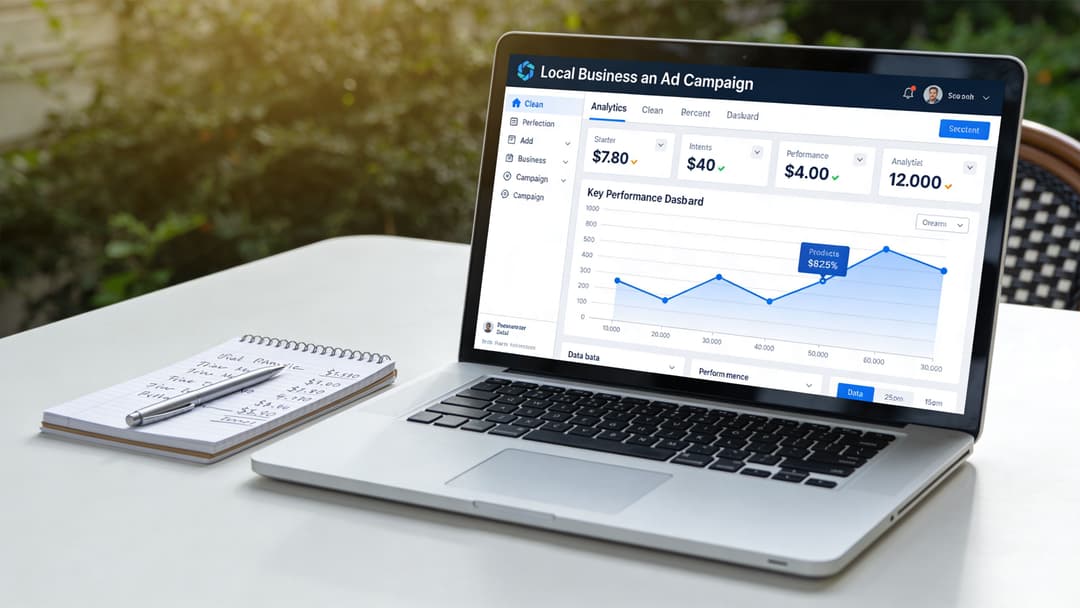
Start with a budget that can actually produce signal
Local campaigns rarely fail because the monthly number is too small in absolute terms. They fail because the budget is split across too many audiences, too many creatives, and too many goals before the account has enough data to optimize.
As noted earlier, small business Facebook budgets often sit in a modest monthly range, and CPC can vary widely by industry and market. The practical takeaway is simpler than the benchmark. A budget has to support enough impressions, clicks, and conversion volume for Meta to identify patterns. If it cannot, every change becomes a reaction to noise.
A cleaner starting model looks like this:
- One objective tied to revenue: calls, lead forms, bookings, store visits, or purchases
- A small testing matrix: a few audience and creative combinations, not a dozen
- A fixed learning window: enough time to compare results before editing
- Spend matched to customer value: a dentist, med spa, and coffee shop should not budget the same way
For many local accounts, I would rather see $40 a day behind one serious offer than $10 a day spread across four ad sets that never exit the learning phase.
Tracking quality decides whether budget decisions are smart or random
A lot of "bad Facebook performance" is really bad measurement.
The Ad Firm's Facebook ads mistakes article points to a pattern experienced media buyers see constantly. Weak Pixel setup and missing offline tracking distort optimization, increase wasted spend, and make profitable campaigns look average. Once tracking is fixed, the same offer often performs very differently because Meta is finally receiving useful feedback.
That matters even more for local businesses because a meaningful share of revenue happens off-site. Calls get answered later. Estimates are approved by text. Appointments are booked by staff. Purchases happen in-store after someone saw an ad three days earlier.
What to track for local campaigns
Track events that reflect business value
Install the Pixel on every page that matters. For local businesses, that usually means the homepage, service pages, campaign landing pages, booking flow, and thank-you pages.
Track actions that map to actual outcomes:
- Lead for form submissions
- Purchase for online orders
- AddToCart when ecommerce is part of the funnel
- Booking steps or checkout milestones when appointment completion matters
- Offline conversions for in-store sales, closed estimates, or signed contracts
If event coverage is partial, Meta optimizes against partial truth. That is how accounts scale the wrong lead source or favor the cheapest form fills instead of the highest-value customers.
Close the loop on offline conversions
Local sales often finish outside the browser, so online-only reporting will undercount real performance.
Upload closed leads, completed appointments, qualified phone calls, or in-store purchases back into Meta whenever possible. That gives the platform a stronger optimization signal and gives the business a more honest read on cost per acquisition. It also changes budgeting decisions. Campaigns that look mediocre on-platform sometimes become the clear winners once offline revenue is included.
Teams trying to tighten that feedback loop can borrow ideas from this breakdown of how Facebook AI ads use better conversion signals. The principle is the same at the local level. Better input produces better optimization.
Clean up event hygiene
Conversions API should sit alongside browser tracking for many accounts now, especially if lead quality is inconsistent or attribution looks thin.
A clean setup usually includes:
- Proper event deduplication
- Prioritized conversion events
- Verified test events
- Consistent mapping between CRM outcomes and campaign data
That work is tedious by hand, especially across multiple locations. It is also the foundation for scaling later without guessing.
Measure the metrics that affect money
A local dashboard should answer operating questions, not just report platform activity.
| Metric type | What it tells you |
|---|---|
| Leads or purchases | Whether the campaign created direct outcomes |
| Qualified lead rate | Whether those outcomes were worth sales team time |
| Cost per result | What each action actually cost |
| Offline sales linkage | Whether ads influenced real-world revenue |
| Creative and audience breakdowns | Which local combinations deserve more spend |
CTR, reactions, and comments can be useful diagnostics. They are rarely the deciding metrics.
If one ad set generates fewer leads but the booked-job rate is twice as high, that ad set usually deserves the budget. If a store-visit campaign produces weak online attribution but strong point-of-sale feedback, count that value. Local measurement has to mirror how the business gets customers, or budgeting decisions will stay disconnected from reality.
Scaling Your Campaigns with AI Automation
Local campaigns get complicated long before budgets get large.
A single-location business can still end up managing multiple audiences, seasonal promotions, service-based offers, fresh creative needs, and different landing pages. Agencies and multi-location teams multiply that complexity fast. Every neighborhood variant adds labor. Every test adds setup time. Every creative refresh adds another round of manual duplication.
That's the operating problem most content about facebook ads for local businesses ignores.
Manual testing breaks first
The strategy may be solid. The execution pipeline usually isn't.
A local advertiser wants to test:
- one offer across several ZIP codes
- two creative angles
- different service-area messages
- separate audiences for existing customers, lookalikes, and cold local prospects
That quickly turns into dozens of combinations. Built by hand, it takes time. Reviewed by hand, it takes more time. By the time the team identifies the winner, the offer may already be stale or the market may have shifted.
About 68% of local marketers report manual testing as their biggest bottleneck, and recent Meta benchmarks show AI-automated campaigns can achieve 2.4x higher ROAS in local markets due to continuous learning, according to Reporting Ninja's overview of Facebook ad strategies for local businesses.
The significance isn't just the performance lift. It's the operational relief. Automation removes the delay between idea, test, readout, and scale.
What AI should actually automate
AI doesn't replace strategy. It removes repetitive execution.
The best use cases in local advertising are straightforward:
Hyperlocal variation building
A campaign for five neighborhoods shouldn't require five separate copywriting sessions and five rounds of manual duplication. AI systems can generate location-specific copy and creative combinations from a structured base.
Bulk audience testing
When you want to compare ZIP clusters, lookalikes, customer lists, and interest-based segments, automation can create those variants much faster than a human inside Ads Manager.
Pattern detection across local campaigns
Winning combinations are often hidden in the breakdowns. One offer works in suburban family neighborhoods. Another works in high-density commuter zones. One image format wins for appointments. Another drives in-store visits. AI can surface those patterns faster than manual spreadsheet work.
The real scaling workflow
A strong local scaling process usually looks like this:
- Lock the core message
- Create location-aware variants
- Launch multiple audience and creative combinations
- Read performance by market pocket
- Pause weak combinations
- Expand spend behind the winners
- Refresh creatives before fatigue sets in
That sequence sounds manageable until it has to happen every week.
An AI workflow becomes practical, not trendy. Tools that connect directly to Meta, ingest performance history, and generate bulk campaign variants reduce the operational lag that kills local iteration. AdStellar AI is one example. It connects to Meta via OAuth, generates large sets of creative, copy, and audience combinations, and ranks performers against outcomes like ROAS, CPL, or CPA. For local teams, that means less manual assembly and faster recycling of proven patterns into new campaigns.
If you want a broader view of how AI fits into Meta campaign management, this explainer on facebook ai ads is worth reading.
Automation matters most when the team already knows what it wants to test, but can't execute all those tests fast enough by hand.
Where automation helps local businesses most
Some local advertisers need only occasional campaigns. Others need a repeatable machine.
AI tends to have the most impact when:
- You manage multiple locations
- You rotate offers frequently
- You need neighborhood-specific messaging
- You run high-variation service campaigns
- Your team spends too much time cloning ads and building reports
The trade-off is simple. Manual management gives you fine-grained control but slows testing. AI-assisted workflows preserve strategy while compressing setup, testing, and scaling time. For local advertisers trying to compete without a huge team, that's usually the better operating model.
Your Local Advertising Playbook Summarized
Local businesses don't need more random ad tactics. They need a cleaner operating system.
Start with the objective that matches how the business makes money. If revenue comes from calls, booked appointments, or purchases, the campaign should optimize toward those actions instead of vanity metrics.
Build audiences around reality, not theory. Tight geography, light but relevant layering, clean exclusions, and customer-based audiences usually outperform broad local targeting. Precision matters more than volume.
Write ads that sound local because they are local. Real photos, recognizable context, and offers tied to actual nearby behavior beat generic brand copy almost every time. A strong local ad feels familiar before it feels promotional.
Treat measurement like infrastructure. If Pixel events, offline conversions, and post-click outcomes aren't tracked correctly, budget decisions become guesses. That problem doesn't show up on launch day. It shows up later, when the account looks busy but can't prove value.
Then address the bottleneck most local advertisers eventually hit. Manual testing doesn't scale well across neighborhoods, audiences, and creative variations. That's where AI-assisted execution becomes useful. Not as a replacement for judgment, but as a way to produce, test, and expand more combinations without drowning in setup work.
The practical checklist is short:
- Pick one objective that reflects real business value
- Define local audiences with discipline
- Build creative that feels native to the area
- Track online and offline results accurately
- Use automation when manual variation management starts slowing growth
Most local accounts don't need a total rebuild. They need tighter decisions and a faster way to act on what the data already shows.
If your team is spending too much time cloning ad sets, rewriting neighborhood variants, and sorting through Meta data manually, AdStellar AI can help streamline the work. It’s built to generate, launch, and evaluate large sets of Meta ad variations quickly, which is especially useful for local campaigns that depend on constant testing across audiences, offers, and locations.