For a long time, advertising felt like a game only big companies with deep pockets could play. Small businesses were left to rely on flyers, a spot in the local paper, and word-of-mouth. While those methods still have their place, they just can’t compete with the precision, scale, and clear results you get from digital channels.
Online advertising changes everything. It’s no longer about who has the biggest budget, but who has the smartest strategy.
Why Online Advertising Is a Must for Small Businesses

Think about it this way: a local bakery can now run a targeted Instagram ad showcasing a fresh batch of croissants and drive a 30% spike in afternoon foot traffic. That’s not some hypothetical scenario—it’s the new reality for countless small businesses that have figured out how to use these tools to their advantage.
Reach Customers Where They Spend Their Time
Let's be honest, your customers are online. Right now, they’re on Google searching for "best coffee near me," scrolling through Facebook to see what their friends are up to, and discovering new products on Instagram. With online ads, you can put your business directly in their line of sight the moment they need something you offer.
More and more businesses are realizing this. Today, 45% have a paid search strategy in place and 55% are using display ads. The reason is simple: it works. On average, pay-per-click (PPC) advertising generates $2 for every $1 spent—a 200% ROI. It’s one of the most reliable ways to get new customers in the door.
Precision Targeting and Measurable Results
Unlike a billboard that everyone sees but few act on, digital ads can be aimed with laser-like focus. You can show your ads only to people based on their:
- Demographics: Age, gender, location, and language.
- Interests: Hobbies and pages they follow (like "home gardening" or "classic cars").
- Behaviors: Recent online purchases or major life events.
This incredible level of control means your ad budget is spent on people who are genuinely likely to become your next customers. Plus, every single click, view, and sale is tracked, giving you a crystal-clear picture of what’s working and what’s not.
This data-driven approach completely removes the guesswork. You can confidently put more money into the campaigns that are delivering and cut the ones that aren’t, maximizing every dollar you spend.
This guide will walk you through exactly how to put these powerful tools to work. It's time to stop just keeping up with the competition and start winning in your market.
And while paid ads are incredibly effective, it's always smart to have a mix of strategies. For ideas that don't require a big spend, check out our guide on free advertising ideas for small businesses.
Building Your Advertising Foundation Before You Spend a Dollar
It’s tempting to dive headfirst into the ad platforms, eager to see results. But jumping in without a plan is like building a house without a blueprint. You might get a few walls up, but you'll end up wasting a ton of time and money on a structure that's guaranteed to collapse.
The most successful ad campaigns don't start with a flashy creative or a clever headline. They start with a rock-solid foundation. Before you spend a single dollar, getting this groundwork right ensures your campaigns are focused, your message lands, and your budget works for you from day one.
Define Your One True Goal
First things first: what are you actually trying to achieve? "More business" doesn't count. You need a clear, specific objective to act as the North Star for your entire strategy. This one decision will dictate everything from the platform you choose to how you measure success.
Are you trying to:
- Drive Online Sales? This is a straight e-commerce play, measured by purchases and your Return on Ad Spend (ROAS).
- Generate Leads? Perfect for service businesses. You’re aiming for form fills, phone calls, or demo requests, and you’ll measure success by your Cost Per Lead (CPL).
- Increase Local Foot Traffic? A classic goal for brick-and-mortar shops. Success here is about getting people in the door, often tracked with special in-store offers or coupon redemptions.
- Build Brand Awareness? This is about getting your name out there and staying top of mind. You’ll measure this with metrics like reach, impressions, and engagement.
Pick just one primary goal for your first campaigns. Trying to do it all at once is a recipe for disaster—it dilutes your efforts and makes it impossible to know what's actually working.
Create a Simple Customer Persona
Once you know your goal, you have to know who you're talking to. You can't write an effective ad if you don't have a crystal-clear picture of your ideal customer. A simple persona helps you stop targeting broad demographics and start speaking directly to a real person's needs, wants, and worries.
Let’s say you run a residential landscaping company. A quick persona might look something like this:
"Suburban Sarah"
- Demographics: 35-50 years old, lives in a single-family home in the suburbs, household income of $150k+.
- Pain Points: She’s completely time-poor, juggling work and kids. Her yard looks neglected, and she feels overwhelmed just thinking about the upkeep.
- Goals: She dreams of a beautiful, low-maintenance outdoor space where her family can actually relax. She values reliability and a professional finish above all else.
- Online Habits: She’s on Facebook scrolling through local community groups and uses Pinterest for home and garden inspiration. When she’s ready to buy, she’s on Google searching for "landscaping services near me."
Armed with this, your ad copy immediately transforms from a generic "We do landscaping" to something that hits home: "Tired of weekend yard work? Get a beautiful, low-maintenance garden your family will love. Get a free quote today." See the difference?
Set a Realistic Starting Budget
Figuring out how much to spend on ads can feel like a shot in the dark, but it doesn't have to be. The most practical way to start is to work backward from your goal.
Let’s stick with the landscaping example. Say you make an average profit of $800 per new client. You decide you’re willing to spend up to $200 to land one new client—this becomes your target Customer Acquisition Cost (CAC).
If your goal is to get 5 new clients in your first month, your starting test budget is simply 5 clients x $200 = $1,000.
Think of your initial ad spend not as an expense, but as an investment in data. The first few months are purely about learning what works—which audience, which message, and which ad creative delivers the best results.
Your Landing Page Must Convert
Finally, you can have the best ad in the world, but it’s all for nothing if you send that hard-won traffic to a confusing, slow, or broken website. Your landing page is where the magic happens. It has one job and one job only: to get that visitor to take the action you defined in your goal.
A high-converting landing page needs these four things, no exceptions:
- A Clear Headline: It must match the promise you made in your ad.
- Compelling Copy: Talk about the benefits for the customer, not just your company's features.
- A Strong Call-to-Action (CTA): A big, obvious button like "Get Your Free Quote" or "Shop Now."
- Social Proof: Nothing builds trust faster than testimonials, reviews, or case studies.
Before you even think about launching, make sure this destination is primed and ready to turn those clicks into customers. And don't forget to install your tracking tools from the very beginning. The Meta Pixel is essential for capturing data on user actions, and you can learn more about how to set up a Facebook Pixel to get started.
Launching Your First Google Ads Campaign
Opening up the Google Ads platform for the first time can be intimidating. With all the menus, settings, and metrics staring back at you, it’s easy to feel overwhelmed. But here’s the secret: a successful first campaign isn't about mastering every single feature. It’s about nailing the fundamentals.
The real power of Google Search ads is capturing intent. You aren't trying to interrupt someone scrolling through social media; you're offering a solution to someone actively searching for one. When a person types "emergency plumber near me" into Google, they have a problem that needs solving now. Your job is to be the most obvious and helpful answer.
Keywords: The Heart of Your Campaign
Your entire campaign lives and dies by the keywords you choose. These are simply the search terms you’re willing to pay for to get your ad in front of someone. But not all keywords are built the same, and understanding match types is the key to not burning through your budget on irrelevant clicks.
Let's say you're a local plumber. Here's how you'd use match types:
- Broad Match:
plumbing services. This is the riskiest setting. Google might show your ad for searches like "how to start a plumbing business" or "free plumbing courses." You get a ton of reach, but most of it is junk. - Phrase Match:
"emergency plumber". Now we're talking. Your ad will appear for searches that include this phrase, like "best emergency plumber in brooklyn" or "how much does an emergency plumber cost." It’s a great balance between reach and relevance. - Exact Match:
[licensed plumber miami]. This is as targeted as it gets. Your ad shows only for that exact search or incredibly close variations. The traffic is highly qualified, but the volume is much lower.
My advice? Start your campaigns with a healthy mix of phrase and exact match keywords. This gives you a solid foundation of relevant traffic without the waste that comes from broad match.
Structuring Your Campaign for a High Quality Score
How much you actually pay per click isn't just about how much you bid. Google rewards advertisers who create a great user experience with something called a Quality Score. A higher score means a lower cost-per-click (CPC) and better ad positions. It’s a huge deal.
The best path to a high score is a tightly organized campaign structure. Think of it like a digital filing cabinet.
- Campaign: This is the top-level cabinet, like "Residential Plumbing Services." Here you’ll set your total budget and geographic targeting.
- Ad Groups: These are the drawers inside, each organized by a specific theme. For our plumber, we might have ad groups like "Emergency Repairs," "Drain Cleaning," and "Water Heater Installation."
- Keywords & Ads: Inside each drawer are the individual files. The "Emergency Repairs" ad group would hold keywords like
"24/7 plumber"and ads with headlines like "Fast, 24/7 Emergency Plumbing."
This structure ensures that the keyword someone searches, the ad they click, and the page they land on are all perfectly aligned. This is exactly what Google wants to see, and they’ll reward you with cheaper, higher-quality traffic for it.
Pro Tip: Don’t sleep on negative keywords. These tell Google what searches you don't want to show up for. For our plumber, adding negatives like
-jobs,-training, and-freewould immediately cut out unqualified searchers and save a lot of money.
Crafting Ad Copy That Gets Clicks
You only have a few lines of text to convince a searcher that you're their best option. The trick isn't witty or clever copy; it's about being clear, relevant, and compelling. The only way to know what works is to test it.
Create two ads in the same ad group and change just one thing, like the main headline. This is a classic A/B test.
- Ad A Headline: 24/7 Emergency Service
- Ad B Headline: Licensed & Insured Plumbers
Let it run for a week or two. You might find that "24/7" gets more clicks from people in a panic, while "Licensed & Insured" works better for those planning a project. This data is gold. It tells you exactly what your customers care about most.
This whole process—defining your goal, knowing your audience, and setting a smart budget—is the foundation for any ad campaign you’ll ever run.
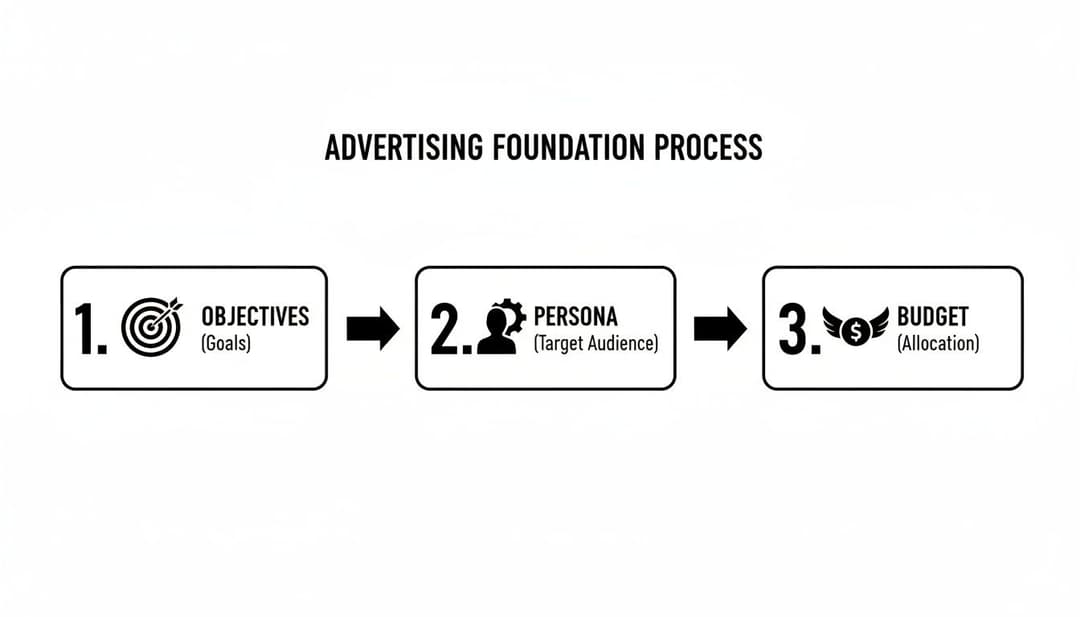
As you can see, great advertising starts long before you ever log into an ad platform. It starts with clear goals and a real understanding of who you’re trying to reach. If you want to dig deeper into the different channels where you can apply these principles, check out our guide on leading PPC advertising platforms.
Setting Up Basic Conversion Tracking
So, how do you know if any of this is actually making you money? You have to track conversions. A conversion is any valuable action someone takes on your website—filling out a contact form, making a phone call, or completing a purchase.
Setting up conversion tracking in Google Ads is non-negotiable. It’s the only way to see which keywords and ads are driving real business, not just clicks. It turns your ad spend from a blind expense into a measurable investment.
Using Meta Ads to Find Your Perfect Audience

While Google Ads is fantastic for grabbing people who are already searching for you, Meta—the engine behind Facebook and Instagram—is where you go to create demand. This is a game-changer for small businesses because it lets you find your ideal customers before they even realize they need you.
Think of it this way: with search ads, you're waiting for someone to raise their hand. With social ads, you get to walk into a room full of your perfect customers and introduce yourself. You’re proactively putting your brand in front of people based on who they are, what they love, and how they behave online.
Getting to Know Your Targeting Options
Meta’s real magic is in its incredibly deep audience targeting. This is where you can go way beyond basic demographics to connect with very specific groups of people. Nailing your targeting is what separates a campaign that falls flat from one that delivers a steady flow of new business.
You'll primarily be working with three types of audiences:
- Core Audiences: This is your foundation. You build these by hand, selecting demographics like age and location, but also layering in detailed interests (think "yoga," "meditation," or "Lululemon") and online behaviors (like "engaged shoppers").
- Custom Audiences: Here's where it gets really powerful. You can create audiences from people who have already engaged with your business in some way. This could mean targeting your email list, people who have visited specific pages on your website, or anyone who has liked a post on your Instagram profile.
- Lookalike Audiences: This is arguably Meta's most potent tool. You provide a "source" audience (like a Custom Audience of your best customers), and Meta's algorithm finds millions of new people who share similar traits and behaviors.
How to Use Lookalike Audiences in the Real World
Let's say you run a local yoga studio. You've got a customer list with your 500 most loyal members—the ones who buy class packs and always show up. You can upload this list to Meta and create a Custom Audience.
Now for the magic. You can ask Meta to create a 1% Lookalike Audience from that list. This tells the platform to find the top 1% of users in your country who most closely resemble your best customers. All of a sudden, you have a brand-new, highly relevant audience of thousands (or even millions) of potential students to show your ads to. That’s hyper-targeting.
This strategy lets you use your existing customer base to find new ones at scale. You're not just guessing who might be interested; you're using real data to point your ad budget toward people who are statistically primed to become your next best customers.
We break these strategies down even further in our guide to targeted advertising in social media if you want to go deeper.
Creating Ads That Actually Stop the Scroll
On platforms like Instagram and Facebook, your ad is just one post in an endless feed of friends, memes, and vacation photos. Your creative needs to grab attention in a split second. The trick is to design for a mobile-first, sound-off world.
Video is your best friend here, but it doesn't need a Hollywood budget. A simple, well-lit video shot on your phone showing a class in progress can feel authentic and be incredibly effective.
For static images, stick to high-quality, vibrant photos that show your product or service in an appealing, real-world context. Whatever you do, avoid generic stock photos. Authenticity sells.
A Simple Framework for Creative Testing
You'll never know what truly resonates until you test it. But don't overwhelm yourself by testing everything at once. The key is to change just one variable at a time to get clean results.
Here’s a simple process to follow:
- Start by running two different images but keep the ad copy and headline identical.
- Let the ads run for a few days until you have enough data to see a clear winner.
- Once a winning image emerges, pause the losing ad.
- Now, duplicate the winning ad and test a new headline against the original.
By following a methodical approach like this, you systematically improve your ad performance, which ultimately lowers your costs and boosts your return on investment.
You Must Install the Meta Pixel for Tracking
Honestly, none of this matters if you can't measure your results. The Meta Pixel is a snippet of code you install on your website, and it's non-negotiable for any serious advertiser.
The Pixel is what allows Meta to see what actions people take on your site after clicking your ad. Did they sign up for a trial? Buy a yoga mat from your shop? Without the Pixel, you're just flying blind.
It enables three critical functions:
- Conversion Tracking: It tells you which ads are actually driving sales and leads.
- Optimization: It feeds performance data back to Meta's algorithm, helping it get smarter about finding people who are likely to take the action you want.
- Retargeting: It lets you build those powerful Custom Audiences of website visitors so you can show them follow-up ads later.
Setting up the Pixel is the final piece of the puzzle. It’s what connects your ad spend directly to real business outcomes, giving you the data you need to know your advertising is working.
Measuring What Matters and Optimizing for ROI
Getting your ad campaigns live feels like crossing the finish line, but in reality, it's just the starting gun. The real profit for your small business isn't made on launch day—it's earned in the days and weeks that follow.
This is where you roll up your sleeves, dive into the data, and start making smart adjustments. This simple feedback loop is how you turn a campaign that’s just “okay” into a reliable profit engine for your business.
Don't let the analytics dashboard intimidate you. You only need to track a handful of key numbers to see if your ad spend is actually making you money.
The Core Metrics You Can't Ignore
Instead of getting swamped by dozens of data points, just zero in on the metrics that directly connect to your bank account. For most small businesses just starting out, these are the big three.
- Click-Through Rate (CTR): This is the percentage of people who see your ad and are compelled enough to click it. A low CTR is often the first red flag that your creative is missing the mark or your audience targeting is off.
- Cost Per Conversion (CPA): This is what you actually pay for a result, whether that’s a sale, a new lead, or a signup. Your mission is to push this number down as low as you can without sacrificing the quality of your customers.
- Return On Ad Spend (ROAS): This is the ultimate report card for your advertising. It answers the most important question: "For every dollar I spent on these ads, how many dollars did I get back in sales?"
Knowing these numbers is your starting point. For example, an average CTR for Facebook ads hovers around 0.9%, though it can swing wildly depending on your industry. If you’re looking at a 0.2% CTR, that's a clear signal that something is wrong with your ad or your audience.
Don’t just look at metrics in isolation. A high CTR is great, but if those clicks aren't turning into customers, it's just vanity. The goal is to find the perfect balance between getting attention (CTR) and driving real business results (CPA and ROAS).
As you get more comfortable, you can start digging deeper. When you're ready, check out our guide on how to calculate Return On Ad Spend for a more advanced look.
The Simple Optimization Loop in Action
Let’s walk through a real-world scenario. A local restaurant has been running Facebook ads for a month to promote a new weekend brunch special. They log into their Ads Manager to see how things are going.
1. Identify the Underperformer: They’re running three different ad sets. Two are performing beautifully, bringing in table reservations for about $15 each. But the third ad set is a money pit—its Cost Per Reservation is a staggering $45. That's their clear underperformer.
2. Diagnose the Problem: They dig into that specific ad set. The CTR is weak, and the ad’s frequency is high, sitting at 5.5. This tells them the same people have seen the ad over and over again, and they’re completely tuning it out now. This is a classic case of audience fatigue.
3. Implement a Fix: The solution here is straightforward. They immediately pause the tired ad set and build a new one. This time, they target a fresh audience—maybe a Lookalike Audience created from their most loyal customers—and they swap in a brand-new video creative showing happy diners enjoying the brunch special.
This simple "identify, diagnose, fix" cycle is the heart of optimization. By consistently making these small, data-backed tweaks, you can systematically improve your results and stop wasting your ad budget on what isn’t working.
The good news is, this process is only getting easier. The future of advertising is leaning heavily on AI, with tools embedded directly into platforms like Meta and Google. With US ad spend projected to grow by 9.5% and social channels surging 14.6%, using AI to help automate your optimization will be crucial for staying competitive and achieving that impressive 200% ROI that paid ads can deliver. You can discover more about these advertising forecasts and see how the industry is evolving.
Common Questions About Online Advertising
Once you get the hang of the big-picture strategy, the practical, day-to-day questions start popping up. It’s totally normal. We hear the same handful of questions from almost every small business owner diving into online ads for the first time.
Let's clear the air and tackle those questions head-on so you can move forward with confidence.
How Much Should a Small Business Really Budget for Online Ads?
There's no magic number here, and you should be wary of anyone who gives you one. The most realistic starting point is simply what you can afford to learn with. For many, that's somewhere between $500 to $1,500 per month. Think of this not as spending, but as buying data.
A much smarter way to set a budget, though, is to work backward from your goals. Let's say you want to land 10 new customers this month. If you estimate it costs about $50 to acquire a customer through your ads, your starting budget is a clean $500. This simple math gives you a concrete target to aim for.
Treat your initial ad spend as an investment in data. The first few months are all about finding out what works. Once you find a campaign where every $1 you spend brings back $4 (a 4x ROAS), you have a data-backed reason to start scaling your budget.
Which Platform Is Better for Me: Google Ads or Meta Ads?
This isn't really a "better or worse" situation. The right platform depends entirely on what you're trying to achieve right now. The key difference comes down to user intent.
Google Ads: This is all about capturing existing demand. You’re getting in front of people who are actively searching for a solution right now. Think of someone typing "emergency plumber near me" into their phone. Google Ads is invaluable for service businesses and anyone selling a solution to an urgent problem.
Meta Ads (Facebook & Instagram): This is for creating demand. You’re putting your brand in front of people who perfectly match your ideal customer profile but might not even know you exist yet. Meta Ads are fantastic for visual products, building a community, and making your brand memorable over time.
The best strategies almost always use both in tandem. You can use Meta to build brand awareness and then use Google to be there when those same people finally decide they're ready to buy.
How Long Does It Take to Actually See Results?
Patience is probably the most underrated skill in advertising. You'll see surface-level metrics like clicks and impressions almost instantly, but real business results—sales and qualified leads—take a bit more time.
With Google Ads, you might see leads trickling in during the first few weeks. But you should really plan for a 60-90 day optimization period. That's the time it takes to gather enough data to make smart decisions on keywords, bids, and ad copy to get consistent results.
Meta's ad platform also has a "learning phase" for every new ad set, which can take up to a week for the algorithm to find its groove and start delivering stable results.
Give yourself a 90-day window for testing and learning. This isn't wasted time or money. It's the period where you gather the critical data you need to build a predictable, long-term advertising machine.
Can I Run Ads Myself or Should I Hire Someone?
You can absolutely run ads yourself, especially when you're just starting out. This guide is built to give you the framework and the confidence to get those first campaigns launched. Going the DIY route is a fantastic option if you have more time than money and you're eager to learn how it all works.
Just be realistic about the time commitment. Managing ads effectively isn't a "set it and forget it" task; it requires constant monitoring and tweaking.
You should consider hiring help—a freelancer, an agency, or even a specialized tool—when you realize you have more money than time. A great middle-ground approach is to manage the ads yourself at first to really understand the fundamentals. Once you have a winning formula, you can bring in an expert to help scale what’s already working.
Ready to stop guessing and start growing? AdStellar AI is the AI-powered platform that helps you launch, test, and optimize your Meta ad campaigns 10x faster. Turn your best-performing ads into a predictable revenue stream. Learn more and get started at https://www.adstellar.ai.