Let's cut right to the chase: Yes, Facebook advertising absolutely works. But the game has changed. It's no longer about simply throwing money at an audience; it's about feeding Meta's incredibly powerful algorithm the right inputs so it can find your customers for you.
Success today isn't bought, it's earned through smarter strategy, compelling creative, and solid data.
The Billion-Dollar Question: Does Facebook Advertising Still Work?
Think of Facebook's advertising platform like a high-performance engine. A decade ago, you could put almost any fuel in and get decent mileage. It was forgiving. Today, after major shifts like Apple's iOS 14 privacy updates, that engine is far more sophisticated but also much more demanding.
To get a positive return, it needs premium fuel—that means high-quality creative, clean first-party data, and precise performance tracking. The old "set it and forget it" approach of manually targeting hyper-specific interests just doesn't cut it anymore.
For busy marketers who need the bottom line, here’s a quick summary.
Quick Answer At-a-Glance: Does Facebook Advertising Work?
This table breaks down the core verdict, giving you a quick reference on where Facebook ads shine and what it takes to win.
| Key Factor | Verdict & Key Insight |
|---|---|
| Overall Effectiveness | Yes, but requires sophistication. The platform is more powerful than ever, but success depends on strategy and creative, not just targeting. |
| Ideal For | E-commerce, Lead Gen, App Installs. Businesses with clear conversion events and strong offers see the best results. Works for both B2C and some B2B. |
| Key Requirement | High-Quality Creative & Data. Compelling ads and a solid data feedback loop (Pixel + CAPI) are non-negotiable. The algorithm needs good inputs. |
| Common Pitfall | Outdated Targeting Strategies. Relying on narrow, manual interest targeting is a losing game. Broad targeting with great creative is the modern approach. |
| Measurement | Crucial but more complex. Understanding your numbers and Measuring Advertising Effectiveness is the only way to prove ROI and scale profitably. |
As you can see, the platform remains a powerhouse, but the user manual has been rewritten.
From Manual Targeting to AI-Driven Discovery
This shift is fundamental. Instead of you trying to pinpoint the perfect user by manually layering interests and demographics, you now empower the algorithm to do the discovery for you. The winning approach combines broader targeting with ads that stop the scroll.
From there, the AI analyzes user behavior across its massive network, matching your ad with people who are most likely to take action based on the signals it’s constantly receiving.
Your job is to provide the right fuel for this AI engine. The most critical inputs are:
- High-Quality Creative: Your ads must be impossible to ignore. They need to be visually engaging and speak directly to a customer's pain point or desire. The algorithm uses engagement—likes, shares, clicks—as an early sign of an ad's relevance.
- Strong Audience Signals: This is where your data infrastructure becomes your biggest asset. The Meta Pixel and Conversions API (CAPI) create a feedback loop, telling the algorithm what a valuable customer looks like based on real actions like purchases or lead submissions.
- A Clear and Compelling Offer: A brilliant ad can't salvage a weak offer. Your value proposition has to be strong enough to make someone stop what they're doing and take action right now.
The Undeniable Proof in the Numbers
The platform's sheer scale is staggering and provides a massive opportunity. Meta's ad reach is approximately 2.28 billion users worldwide, a number that grew by 4.3% in the last year alone.
Crucially, it delivers ads to over 74.3% of its monthly active users. That figure alone explains why countless businesses, from brand-new startups to Fortune 500 companies, still rely on it as a primary growth engine.
Success on Meta is no longer about outsmarting the algorithm. It's about feeding it better data than your competition.
At the end of the day, the platform is a tool. And like any powerful tool, its effectiveness depends entirely on the person using it. When you focus on rigorous creative testing, build a solid data foundation, and have a crystal-clear understanding of your unit economics, Facebook advertising remains one of the most potent and scalable customer acquisition channels on the planet.
So, How Do You Know If Your Ads Are Actually Working?
Great ads don't just get likes and shares; they generate real numbers that tell a story about your business's health. But let's be honest, a dashboard full of acronyms doesn't mean much until you can connect those figures to your bottom line. Answering the big question—"does Facebook advertising work?"—is all about translating abstract metrics into tangible results.
Think of your Click-Through Rate (CTR). It’s not just a percentage. It’s a direct signal of how well your creative is landing with your audience. A low CTR is a red flag that something’s off—maybe the visual isn't stopping the scroll, the copy isn’t clear, or you’re simply talking to the wrong people. A high CTR, on the other hand, tells you you've hit on a winning combination.
This is why understanding performance is so critical. The potential audience on Meta's platforms is enormous, and you need a way to find your people within that massive pool.
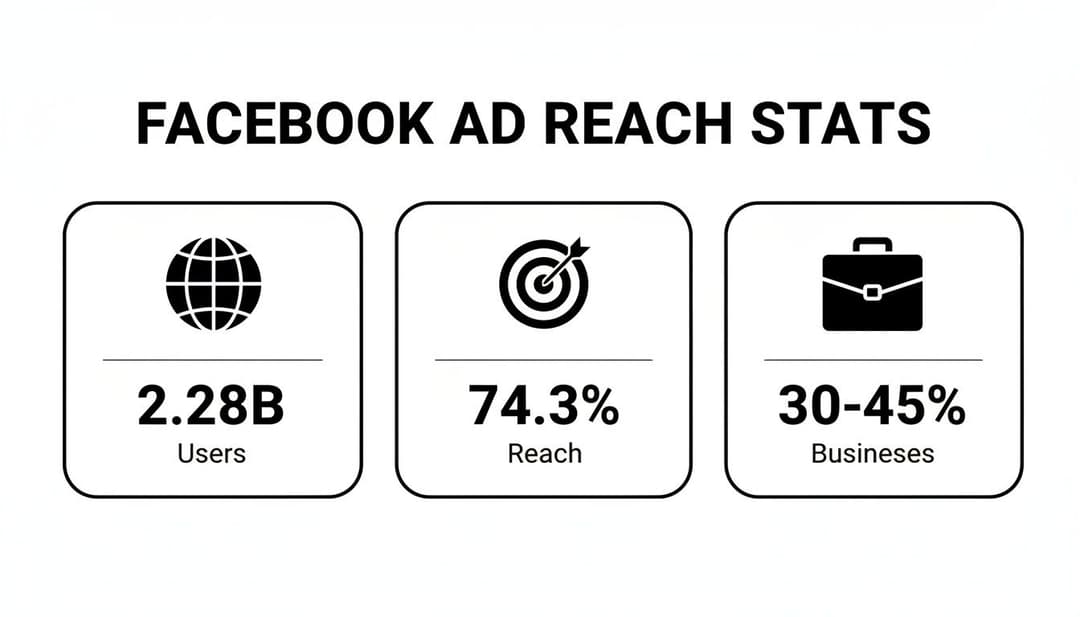
With over two billion reachable users, you can't just throw things at the wall and hope they stick. You need to measure what matters.
The Metrics That Truly Matter
If you want proof that your ads are delivering, you need to look past the vanity metrics. Likes and shares feel good, but they don't pay the bills. The real evidence is found in a few key performance indicators (KPIs).
Return on Ad Spend (ROAS): This is the king of all metrics. It answers the simplest, most important question: "For every dollar I put into ads, how many dollars did I get back?" It's the mini P&L for your campaign. We've got a whole guide that digs deeper into what is https://www.adstellar.ai/blog/what-is-return-on-ad-spend if you want to learn more.
Cost Per Acquisition (CPA): While ROAS tracks revenue, CPA tracks the cost to get a paying customer. It tells you exactly how much you have to spend to bring someone new into your world. Understanding your Cost Per Acquisition (CPA) is non-negotiable for figuring out if your business model is actually scalable.
Cost Per Lead (CPL): If you're in B2B or run a service-based business, this is your North Star. CPL tells you exactly what you're paying to get a new prospect into your pipeline, giving you a clear view of your funnel's efficiency from the very first step.
How to Use Benchmarks as Diagnostic Tools
Industry benchmarks are incredibly useful, but not in the way most people think. They aren't rigid goals to chase. Instead, treat them as powerful diagnostic tools. They give you a baseline to understand the health of your campaigns.
If your numbers are way below the average, it's a clear signal that something in your strategy—whether it's the creative, the offer, or the landing page—needs a tune-up.
The goal isn't just to meet industry averages; it's to understand them well enough to know when your campaign is healthy and when it's time to intervene.
Here's some hard data that proves Facebook ads work when you get the formula right. High-intent campaigns see much better performance. For example, lead generation ads hit an average 2.53% CTR, which is a staggering 61% higher than standard traffic campaigns.
Those clicks translate into real action. The median add-to-cart rate from landing pages hovers around 6%, and we see top-tier e-commerce brands pushing that well past 10%. These aren't just fluffy numbers; they're proof that well-executed Facebook ads drive meaningful engagement that turns into conversions.
Once you learn to decode these core metrics, you stop hoping your ads work and start knowing they do. This data-driven clarity is what separates the advertisers who struggle from the ones who consistently scale.
The Anatomy of a Winning Facebook Ads Strategy
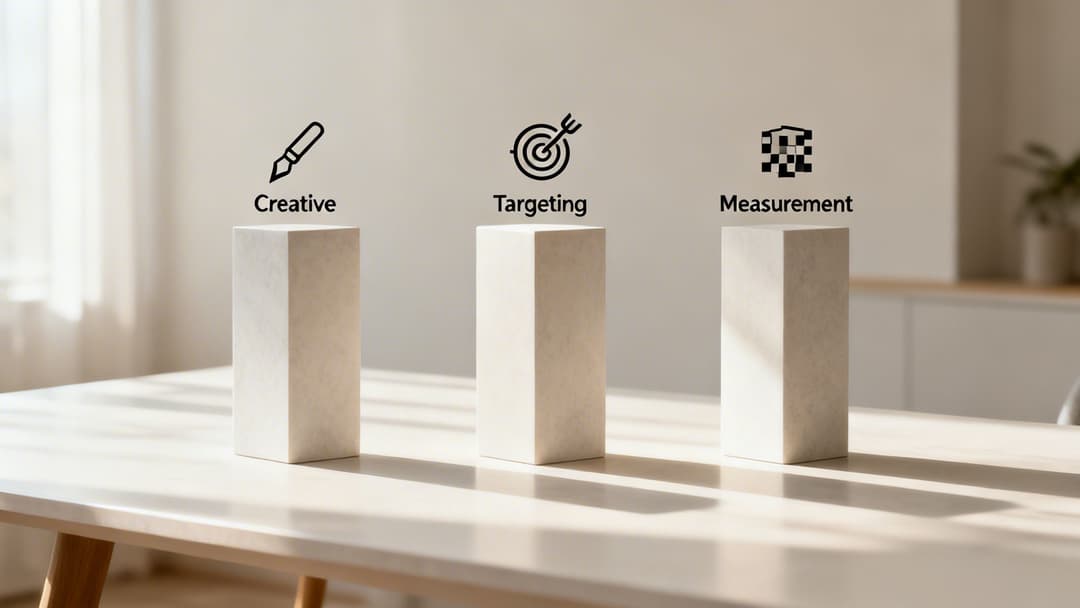
Cracking the code on Facebook ads isn’t about stumbling upon some "magic" audience or getting lucky. It's a system. A repeatable process built on three core pillars that feed Meta's powerful algorithm. When I hear someone ask, "Do Facebook ads even work anymore?", the real question is whether they've mastered these three fundamentals.
Think of it like building a high-performance race car. Your Creative is the engine, Targeting is the navigation system, and Measurement is the real-time data streaming back to the pit crew. Get one wrong, and you're not finishing the race, let alone winning it.
Let's break down each pillar so you can see exactly how they fit together and start improving your own campaigns.
Pillar 1: Creative Is the New Targeting
Years ago, the game was all about finding the perfect, hyper-specific audience and showing them a decent ad. That's completely flipped. Today, your ad creative does the heavy lifting that targeting used to.
A genuinely great ad will find its audience because Meta’s AI is wired to reward content that stops the scroll and gets a reaction. The new playbook is to show a fantastic ad to a broad audience and let the algorithm find your perfect customers for you. This means your focus has to shift from endlessly tweaking audience settings to relentlessly testing creative.
- Test Everything, Constantly: Don't get emotionally attached to one ad. A winning strategy means you're always testing new hooks, headlines, images, and videos to see what actually connects. We're not talking about testing two or three variations; the pros test dozens.
- Win the First Three Seconds: You have a blink of an eye to earn someone's attention in a crowded feed. Your ad's opening line or first visual frame has to be compelling enough to make them pause. If it isn't, nothing else matters.
- Solve One Problem at a Time: Don't cram every feature and benefit into a single ad. The ads that convert best are laser-focused. They zero in on one specific pain point and present your product as the obvious, immediate solution.
Pillar 2: Broad Targeting Empowers the AI
This one feels backward to a lot of old-school marketers, but the days of manually stacking dozens of niche interests are over. That approach just handcuffs the algorithm, drives up your costs, and shrinks your potential pool of customers.
Success now comes from giving the AI breathing room.
By using broader audiences, you’re trusting Meta’s machine learning to sift through trillions of data points and identify buying signals far more accurately than any human could. Your creative and your offer become the real filters, pulling the right people out of that larger crowd.
Your job isn't to find the customers anymore. It's to give the algorithm the right creative and clean data so it can find them for you.
This is where the magic happens—right inside Meta's Ads Manager.
The platform’s real power is its ability to connect all the dots—your ad, your audience settings, and your conversion data—to deliver results.
Pillar 3: Measurement Feeds the Machine
Your measurement setup is the feedback loop that makes the whole system work. Without accurate data, Meta's algorithm is just flying blind. It desperately needs to know which users are converting so it can find more people just like them. This is why the Meta Pixel and the Conversions API (CAPI) are absolutely non-negotiable.
Here’s a simple breakdown of how they team up:
- Meta Pixel: This is a snippet of code on your website that tracks what people do (like "Add to Cart" or "Purchase"). It then sends this info back to Facebook directly from the user's browser.
- Conversions API (CAPI): CAPI sends the same kind of data, but it sends it from your server directly to Meta’s server. This creates a much more stable and reliable connection that can’t be disrupted by things like browser privacy updates or ad blockers.
Using both the Pixel and CAPI gives Meta the clearest possible picture of your conversions, which is the fuel for both accurate reporting and powerful ad optimization. To really dig into this, you can explore some detailed Facebook ad strategies that cover the technical setup. A rock-solid measurement foundation is what turns ad spend into predictable, scalable growth.
Where Facebook Ads Thrive: The Businesses That Win Big
Let’s get one thing straight: a smart strategy can make Facebook ads work for almost any business. But some business models are just a natural fit for the platform. It's like trying to hammer a nail with a screwdriver—you might get it done, but a hammer is built for the job. For certain businesses, Meta’s advertising platform is the perfect hammer.
So, who are these businesses that consistently see massive returns? The answer is found where a business model perfectly aligns with how people actually use the platform and the ad formats Meta has spent years perfecting. The biggest winners are those that lean into visual storytelling, tap into impulse-driven behavior, and offer a crystal-clear path from ad to action.
E-commerce and Direct-to-Consumer Brands
E-commerce is the undisputed king of Facebook advertising. It's not even a fair fight. The entire ecosystem feels like it was designed from the ground up to sell physical products, especially for direct-to-consumer (DTC) brands.
The platform is a visual playground, making it the perfect stage to show off your products. People are scrolling through their feeds looking for a distraction, for something new and interesting—which is the ideal mindset for an impulse purchase. This is where Facebook’s ad formats absolutely kill it.
- Carousel Ads: These are like a mini-catalog right in the feed. You can showcase a whole product line or dive into the features of a single item, letting a customer browse without ever leaving the app.
- Video and Reels Ads: Nothing sells a product like seeing it in action. Short, snappy videos can demo your product, tell a compelling brand story, or use customer testimonials to build instant social proof.
- Collection Ads: This is a mobile-first beast. It combines a main video or image with a browsable grid of products below it, essentially creating a pop-up storefront the moment someone taps your ad.
For e-commerce brands, winning comes down to two things: stunning creative and a purchase path so smooth it's almost invisible. The goal is to get someone from "Ooh, that's cool" to "Order confirmed" in as few taps as possible. If you want to go deeper on this, our complete guide on Facebook advertising for e-commerce breaks down the entire playbook.
Lead Generation for Services and B2B
While most people think of Facebook as a B2C machine, it’s also an incredibly powerful engine for generating leads. Any business that runs on appointments, consultations, or just needs to capture contact info for a sales team can do extremely well here. We’re talking about everyone from local real estate agents and gyms to high-ticket B2B software companies.
The goal isn't an immediate sale; it's to start a conversation. The strategy is to offer something genuinely valuable in exchange for an email address or phone number. This is where Meta’s Lead Forms are a secret weapon.
Lead Forms are a game-changer because they eliminate friction. The form pre-fills with the user’s name, email, and phone number straight from their Facebook profile. All they have to do is tap twice to submit.
This is infinitely more effective than trying to send someone on a mobile device to a clunky landing page where they have to type everything out. Success with lead gen is all about making the value exchange obvious and the sign-up process ridiculously easy.
App Installs and Mobile Gaming
For anyone with a mobile app, Meta is a non-negotiable channel for user acquisition. The platform’s targeting is so granular you can get your app in front of exactly the right people based on their device, past behavior, and interests.
The objective couldn't be simpler: drive downloads. The ad formats are built for this, featuring a big, bold "Install Now" button that sends users straight to the App Store or Google Play. Better yet, the algorithm is smart enough to find users who aren't just likely to install, but who are also likely to take valuable actions inside the app, like making a purchase or completing a level.
Facebook Ads Suitability by Business Model
To make it even clearer, let's break down how different business models stack up on Meta. This table gives you a quick look at their main goals, the ad formats that work best, and the key metrics that define success.
| Business Model | Primary Goal on Meta | Top Ad Formats | Key Metric for Success |
|---|---|---|---|
| E-commerce & DTC | Drive direct online sales and repeat purchases. | Video Ads, Carousel Ads, Collection Ads | Return on Ad Spend (ROAS), Cost Per Purchase (CPP) |
| Lead Generation (Services/B2B) | Capture contact info for a sales pipeline. | Lead Form Ads, Image Ads with landing page links | Cost Per Lead (CPL), Lead-to-Close Rate |
| App Installs & Gaming | Increase app downloads and in-app actions. | App Install Ads, Video Ads | Cost Per Install (CPI), In-App Purchase Value |
| Local Businesses (Bricks & Mortar) | Drive in-store foot traffic and local awareness. | Store Traffic Ads, Event Ads, Offer Ads | Store Visits, Coupon Redemptions, Reach |
| Content Creators & Publishers | Grow audience and drive traffic to a website. | Traffic Ads, Video View Ads | Cost Per Click (CPC), Website Traffic Volume |
Ultimately, the platform's power lies in its versatility. While e-commerce and app developers might see the most direct and explosive results, businesses focused on leads or even local foot traffic can build highly profitable machines—as long as they align their goals with the right ad formats and measure the right things.
Common Pitfalls: Why Most Facebook Ad Campaigns Fail
So, you’ve heard the horror stories. Maybe you've lived one yourself. You pour money into a Facebook campaign, watch the clicks roll in, and then… crickets. It's easy to throw your hands up and declare, "Facebook ads just don't work!"
But here’s the thing I’ve learned after years in the trenches: the platform is rarely the problem. Most campaigns don't fail because of some secret algorithm change or because your competitor has a magic formula. They fail because of a handful of common, completely avoidable mistakes that kill momentum before it even starts.
Think of yourself as a campaign doctor. Your job isn't just to throw money at the problem; it's to spot the symptoms, diagnose the root cause, and apply the right fix. Let's walk through the most common ailments plaguing Facebook ad accounts.
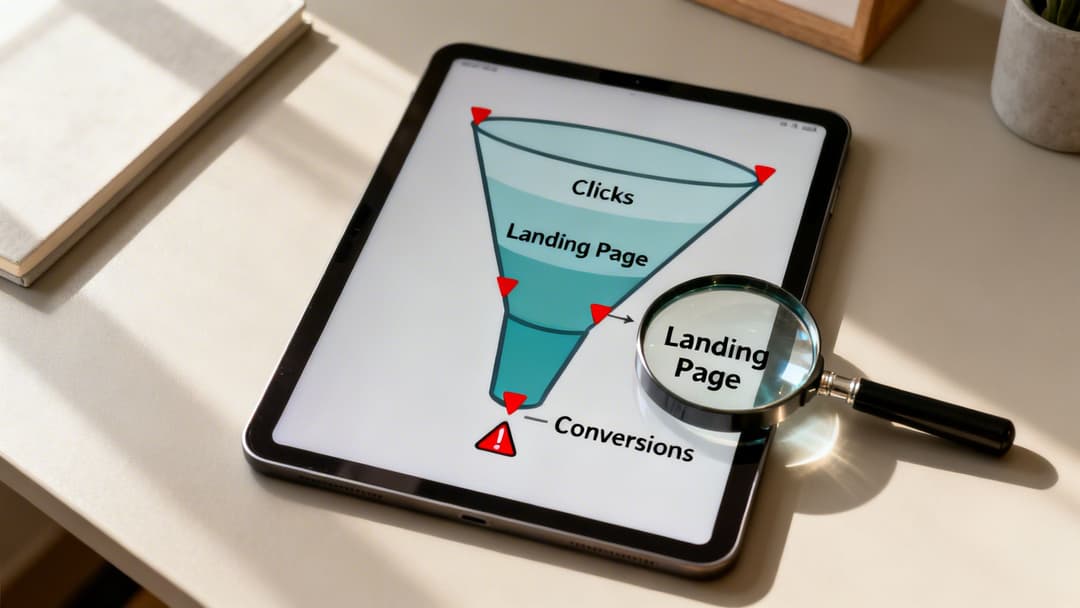
Symptom: High Clicks, But Zero Conversions
This one is maddening. Your ads are clearly working on some level—people are interested enough to click! Your creative is grabbing attention, and your headline is doing its job. But the moment they hit your website, the magic dies.
The diagnosis is almost always a broken link between your ad and your landing page. Your ad made a promise that your website couldn't keep.
- Weak Offer: The discount wasn't juicy enough, the value wasn't crystal clear, or the product just didn't feel like a must-have solution.
- Friction-Filled Landing Page: Was the page painfully slow to load? A nightmare to navigate on a phone? Did you ask for their life story on the sign-up form?
- Message Mismatch: Your ad screamed "50% Off Today!" but the landing page whispered something about a free trial. That disconnect creates instant confusion and kills trust.
The real battlefield isn't the Facebook feed; it's the post-click experience. An ad just gets someone to knock on the door. Your website has to convince them it's worth coming inside.
Symptom: Ad Costs Keep Rising While Results Tank
Ah, the classic sign of creative fatigue. You found a winning ad, and you rode that horse until its legs gave out. The first few weeks were amazing, but now your cost per result is climbing, and you're getting fewer and fewer conversions for your dollar.
Your audience has seen the ad so many times they've gone blind to it. Meta's algorithm sees this too. As clicks and engagement drop, the platform decides your ad is less relevant and starts charging you more just to show it.
The cure is simple but requires discipline: always be testing creative. You can never stop feeding the algorithm new images, videos, and copy. Even when you have a clear winner, you should already be testing its replacement.
Symptom: Your Ads Aren't Delivering or Spending the Budget
Your campaign is stuck in neutral, refusing to spend the daily budget you've set. It feels like Facebook is just ignoring you. The diagnosis here usually points to one of two things: a broken data setup or an overly restrictive audience. This is a classic frustration for anyone wondering why their Facebook ads not delivering is happening.
The algorithm is either starved for information or handcuffed by your settings.
- Bad Pixel or CAPI Setup: If your conversion tracking is broken, the algorithm is flying blind. It has no feedback loop to learn what's working, so it throttles delivery to avoid wasting your money on what it assumes is a broken campaign.
- Audience Size Is Too Small: Targeting a super-niche, laser-focused audience of a few thousand people feels smart, but it often backfires. You're giving the algorithm no room to breathe or explore. This tiny audience pool leads to rapid ad fatigue and sky-high CPMs (Cost Per Thousand Impressions).
By sidestepping these common landmines, you stack the deck in your favor. Most advertisers quit because they misdiagnose the problem and treat the wrong symptom. A truly successful campaign isn't about finding one secret hack; it's about systematically eliminating these points of failure until only profit remains.
From Guesswork to Growth: Your Playbook for Scaling Ads
Turning ad spend into predictable revenue isn’t about luck—it’s about having a system. This is where we move from hoping our ads work to building a machine that reliably finds new customers. Forget the old, complex ways of slicing and dicing audiences into tiny segments. Today, success is all about rapid creative testing.
The goal is brutally simple: find out what works as quickly and cheaply as possible, kill what doesn't, and pour fuel on the winners. This framework is designed to give Meta’s algorithm exactly what it needs to go out and find your ideal customers for you. It’s a rinse-and-repeat cycle of launching, learning, and scaling that turns your budget into a genuine growth engine.
Launching Your Test Campaign
First things first, we need a controlled environment to test our creative ideas. This isn't about throwing spaghetti at the wall to see what sticks; it's about structured experimentation. Think of it like a science fair project for your ads, where every variable is tested methodically.
Your testing campaign needs to be clean and simple. The whole point is to isolate what’s really working.
- Campaign Objective: Set your campaign to the one action that actually matters, like Conversions for purchases or leads. This tells the algorithm in no uncertain terms what you consider a "win."
- Budgeting: Always use Campaign Budget Optimization (CBO). This lets Meta do some of the heavy lifting, automatically shifting your budget to the best-performing ad sets and ads.
- Audience: Keep it broad. Seriously. Start with a single ad set targeting a large, open audience. Your creative should be doing the hard work of finding the right people, not your targeting.
This clean setup ensures that when an ad stands out, you know it's because the ad itself is powerful—not because you got lucky with some hyper-specific niche audience.
Interpreting the Results and Making Decisions
Once your test has been running for a few days, it’s time to look at the data and see what story it’s telling. The key is to ignore the vanity metrics like likes or comments and focus on the numbers that directly impact your bottom line.
There are really only two numbers you need to obsess over:
- Cost Per Acquisition (CPA) or Cost Per Lead (CPL): How much are you paying for each new customer or lead? Is that number sustainable for your business?
- Return on Ad Spend (ROAS): For every single dollar you put in, how many are you getting back? A healthy business is built on a positive ROAS.
After letting the ads run long enough to get solid data (usually 3-5 days is a good starting point), you can start cutting. Any ad that is obviously underperforming against your target CPA or ROAS gets turned off. No hesitation. This immediately frees up budget for the ads that actually have potential.
Your first goal in testing isn't to find a massive winner. It's to aggressively eliminate all the losers. What's left is where the opportunity for scale lies.
And the data shows this system works. Across over 11,000 accounts, the average ROAS for Facebook ads is a solid 2.79x, meaning every dollar spent is effectively scaling revenue. This number even jumped by 11.60% during the busy Q4 holiday season, proving just how powerful the platform can be for seasonal pushes. You can dig into more Meta benchmarks to see how the top performers are hitting these numbers.
Scaling the Winners for Predictable Growth
So, you’ve found a winning ad—one that consistently hits your target metrics. Fantastic. Now it's time to scale it. But scaling isn’t just about cranking up the budget and hoping for the best. You have to do it carefully to avoid shocking the algorithm and forcing it to reset all its hard-earned learning.
Here’s a simple process for scaling your winners:
- Increase the Budget Gradually: Start by bumping the campaign budget by 20-30% every 2-3 days. These small, steady increases help maintain stability while the algorithm goes out and finds more of your customers.
- Duplicate into a Scaling Campaign: Take your winning ad and its settings and move it into a brand new, separate "scaling" campaign with a much larger budget. This protects your original test from any volatility while giving the winner the resources it needs to fly.
- Keep Testing: A winner won’t last forever. Ad fatigue is real. While your scaling campaign is humming along, you should always have a new test campaign running, constantly trying to find the next winner to beat your current champion.
This methodical playbook for testing and scaling is how you truly find out if Facebook advertising works for your brand. To go even deeper, check out our guide on how to scale Facebook ads for more advanced strategies. It’s all about removing the guesswork and replacing it with a reliable system for growth.
Of course. Here is the rewritten section, crafted to sound like an experienced human expert, following all the provided guidelines.
Your Top Questions About Facebook Ad Performance, Answered
Even with the best strategy in hand, a few lingering questions always pop up. Let's tackle some of the most common ones I hear from marketers trying to crack the code on Facebook ads.
How Much Should I Spend on Facebook Ads to See if They Work?
There’s no magic number, but my go-to starting point for a serious test is $50-$100 per day, and you need to let it run for at least 7-10 days straight. Don't touch it. This gives Meta's algorithm enough fuel and runway to get out of its initial "learning phase."
The real goal here is to spend enough to get statistically significant results. Before you call a campaign a winner or a loser, you should be aiming for at least 50 conversions per ad set, per week. Anything less, and you're just guessing.
Is Facebook Advertising Still Effective After the iOS 14 Update?
Yes, absolutely. But the game has changed, and you can't play by the old rules. The iOS 14 update threw a wrench in tracking by making the Meta Pixel less reliable on its own.
To win now, you have to implement the Conversions API (CAPI). This sends data directly from your server to Facebook, filling in the gaps left by the Pixel. The businesses I see crushing it today are the ones combining Pixel data with a solid CAPI setup and focusing on top-tier creative. They're still pulling in excellent results and strong ROAS.
The modern answer to "does Facebook advertising work?" comes down to your data infrastructure. A strong Pixel and CAPI setup isn't a nice-to-have anymore—it's the ticket to the game. It's how you feed the algorithm the signals it needs to find your customers.
What Is a Good ROAS for Facebook Ads?
A "good" ROAS (Return on Ad Spend) is completely relative. It depends entirely on your profit margins and what you're trying to achieve. While you might hear an industry average floating around 2.79x, the only number that matters is the one that makes your business profitable.
Here’s how you figure out your number:
- Calculate your break-even ROAS: This is rock bottom. It’s the point where you aren't losing money on your ad spend.
- Set your profit goal: Where do you need to be to hit your growth targets?
- Aim to beat it: Your real job is to constantly test and optimize to push your ROAS well past that goal.
For a business with high margins, a 2x ROAS might be incredible. But if you're working with tighter margins, you might need a 4x or 5x ROAS before you're actually making money. Know your numbers first.
Ready to stop guessing and start scaling? AdStellar AI automates bulk ad creation, testing, and optimization, letting you launch hundreds of creative variations in minutes. Our platform learns from your performance data to identify winning ads and scale them for predictable growth, turning your ad spend into a reliable revenue engine. Launch, test, and scale your Meta ads 10x faster by visiting https://www.adstellar.ai.