Think of a Facebook advertising service as a specialized pit crew for your business. You're behind the wheel of a high-performance machine, but the track—Meta's advertising platform—is crowded, complex, and brutally competitive. These services handle everything from race strategy and car setup to in-the-moment adjustments, ensuring your fuel (your budget) isn't just burned, but used to win.
What Is a Facebook Advertising Service Anyway?
Let's stick with that race car analogy. Your business has a powerful engine (your product) and plenty of fuel (your budget). But to actually win, you need a team of expert mechanics and strategists in your corner. A Facebook advertising service is that team, providing the technical know-how and strategic direction to turn raw potential into real-world performance.
This is about so much more than just “running ads.” It’s a complete management solution that takes the immense workload of campaign execution entirely off your shoulders. A good service will dive deep into your business goals—whether that's filling your pipeline with leads, driving e-commerce sales, or just getting your name out there—and build a data-driven advertising plan to make it happen.
A Quick Look at Facebook Advertising Service Types
Not all services are created equal. They range from one-person shops to large-scale tech platforms, each suited for different business needs and budgets. Understanding the main types is the first step in finding the right fit for your goals.
Here’s a simple breakdown of the four main categories you'll encounter:
| Service Type | Core Function | Best For | Common Pricing Model |
|---|---|---|---|
| Agency | Full-service strategic and creative management. | Businesses needing comprehensive support and expertise. | Retainer, percentage of ad spend, or a hybrid model. |
| Freelancer | Specialized, hands-on campaign management. | Companies with specific needs or smaller budgets. | Hourly rate, project-based fee, or a monthly retainer. |
| Managed Service | A blend of software and human expertise. | Teams looking for a balance of automation and expert oversight. | Monthly subscription or fee based on ad spend. |
| SaaS/Automation | Software platforms that automate ad tasks. | Experienced marketers aiming to scale their own efforts. | Monthly or annual subscription fee. |
Each of these models offers a different level of involvement and cost. An agency might be your all-in-one pit crew, while a freelancer could be your go-to tire specialist. Managed services and SaaS tools, on the other hand, provide the advanced equipment to help your own team perform better.
Beyond Just Boosting Posts
Most businesses dip their toes into the water by boosting posts. It’s simple, but it’s like putting a standard set of street tires on your F1 car. Sure, you'll move, but you stand no chance of winning the race. A professional service unlocks the entire toolbox available within the platform, primarily through the Facebook Ads Manager.
Their work typically breaks down into a few key areas:
- Strategic Planning: They don't just ask "who should we target?" They map out your entire customer journey, define the critical KPIs, and build a full-funnel strategy.
- Creative Development: This involves writing compelling ad copy and producing eye-catching images or videos designed to stop the scroll and spark action.
- Technical Execution: They handle the nitty-gritty of building campaigns with precise audience targeting, smart bidding strategies, and optimal ad placements.
- Continuous Optimization: This is where the magic really happens. They constantly A/B test everything, analyze the performance data, and shift budget to scale what’s working while cutting what isn't.
A professional Facebook advertising service doesn't just manage your spend; it multiplies its impact. It’s the difference between driving around aimlessly and navigating with a clear, strategic map toward your destination: measurable growth.
The sheer scale of Meta's platform makes this kind of expertise non-negotiable. In 2025 alone, Meta generated a mind-boggling $196 billion in global advertising revenue, a number that underscores both the massive opportunity and the intense competition.
With an estimated 97% of the company's total income coming from ads, it's clear this is a professional-grade arena. You can see the full breakdown on Statista's advertising revenue report. In an environment this competitive, having a dedicated team to manage your investment isn't a luxury—it's essential for getting noticed.
Exploring Your Four Main Facebook Ad Service Options
So, you've decided to get serious with Facebook ads. You're ready to move past boosting a few posts here and there and start running campaigns that actually drive growth. The first major fork in the road is deciding who will manage it all. This choice will shape your budget, your day-to-day involvement, and ultimately, your results.
Think of it like getting ready for a race. If you want to win, you need a pit crew. The question is, what kind of crew do you need?
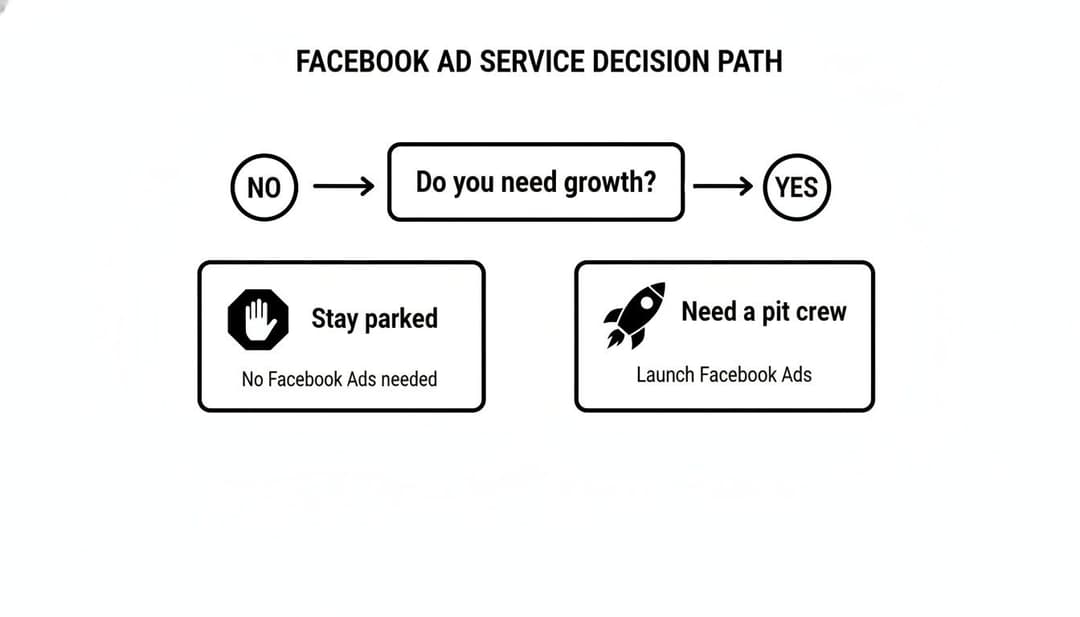
As the flowchart shows, standing still isn't really an option if growth is the goal. To get on the track and compete, you have to pick the right support model for your business. Let's break down the four main paths you can take.
1. Traditional Advertising Agencies
An agency is the full-service, all-inclusive pit crew. You're not just hiring a driver; you're getting a whole team of specialists—strategists, copywriters, graphic designers, and media buyers who live and breathe this stuff. They handle everything from the high-level race strategy down to the nuts and bolts of daily campaign tweaks.
This is a fantastic fit for established businesses that need to outsource their entire marketing function and have a significant budget to support it. Agencies typically come with hefty monthly retainers, often starting at $5,000-$10,000+, plus a cut of your ad spend, which is usually around 10-20%.
- Pros: You get a deep bench of expert talent, a comprehensive strategy, and a completely hands-off experience.
- Cons: It's the most expensive route. Communication can sometimes be slow due to layers of management, and there's always a risk your account won't get the top-tier "A-team" treatment.
2. Independent Freelancers
Hiring a freelancer is like bringing in a specialist mechanic—someone who is an absolute master of one specific thing, like engine tuning or ad creative. They are usually true experts in Facebook advertising and offer dedicated, personal management of your campaigns. This is often the perfect middle ground for businesses with clear needs and a more moderate budget.
Freelancers give you a direct line of communication and a ton of flexibility. Their pricing structures vary, from hourly rates to project fees or smaller monthly retainers that often fall in the $1,000 to $5,000 range.
- Pros: Much more affordable than an agency, you talk directly to the person doing the work, and they can adapt quickly.
- Cons: You’re entirely dependent on one person. If they get sick, go on vacation, or are just swamped, it can create a major bottleneck. Scaling up can also be tough for a one-person show.
3. Managed Services
Managed services are a hybrid, mixing the power of software with a human touch. With this model, you get access to a sophisticated platform that automates a lot of the heavy lifting, but you also have an account manager or strategist guiding you, offering expert advice, and making sure you're heading in the right direction.
This option is ideal for teams who want to stay in the loop and maintain some control but need that expert oversight to make sure their efforts are paying off. It strikes a great balance between support and autonomy.
A managed service is like having a co-pilot. You're still in the driver's seat making the big decisions, but they're right there with you, helping you navigate the complex controls and avoiding turbulence.
4. AI-Powered Platforms
The newest player on the field is the AI-powered SaaS platform, like our own AdStellar AI. This model doesn't replace your team; it gives them superpowers. Think of it as handing your in-house pit crew the most advanced diagnostic computers and robotic tools on the market.
These platforms automate the incredibly time-consuming parts of ad management—things like creating dozens of ad variations, testing countless audiences, and analyzing performance data in real-time. The AI works to spot winning ad combinations and scale them faster than any human possibly could by hand. For a deeper dive, you can explore the different kinds of Facebook advertising service options and see how they match up with various business goals.
- Pros: You get a massive boost in efficiency and testing velocity. It eliminates guesswork with data-driven insights and is far more cost-effective than paying retainers. It essentially gives your existing team agency-level capabilities.
- Cons: You still need someone on your team to operate the platform and translate the AI's recommendations into strategy. It’s a powerful tool for execution, not a substitute for a marketing strategist.
In the end, the right choice really boils down to your budget, your team's bandwidth, and how fast you want to grow. Whether you need a full-blown team, a single expert, or advanced tools for your own crew, understanding these four models is the first step to building a winning ad strategy.
The Real Benefits of Professional Ad Management
Thinking about hiring a pro to run your Facebook ads? It's a smart move, and not just because it frees up your time. Handing over the reins unlocks strategic advantages that directly boost your results, slash costs, and put a stop to wasted ad spend. While going it alone might seem doable, an expert brings a level of precision that’s almost impossible to match by yourself.
Think of it this way: anyone can toss seeds in the ground, but a master gardener knows the exact soil, water, and sunlight needed for a plant to thrive. A professional service does the same for your ads. They nurture them from a simple idea into profitable, scalable campaigns, navigating the platform's constantly shifting algorithm with proven frameworks.
Unlocking Advanced Creative and Audience Testing
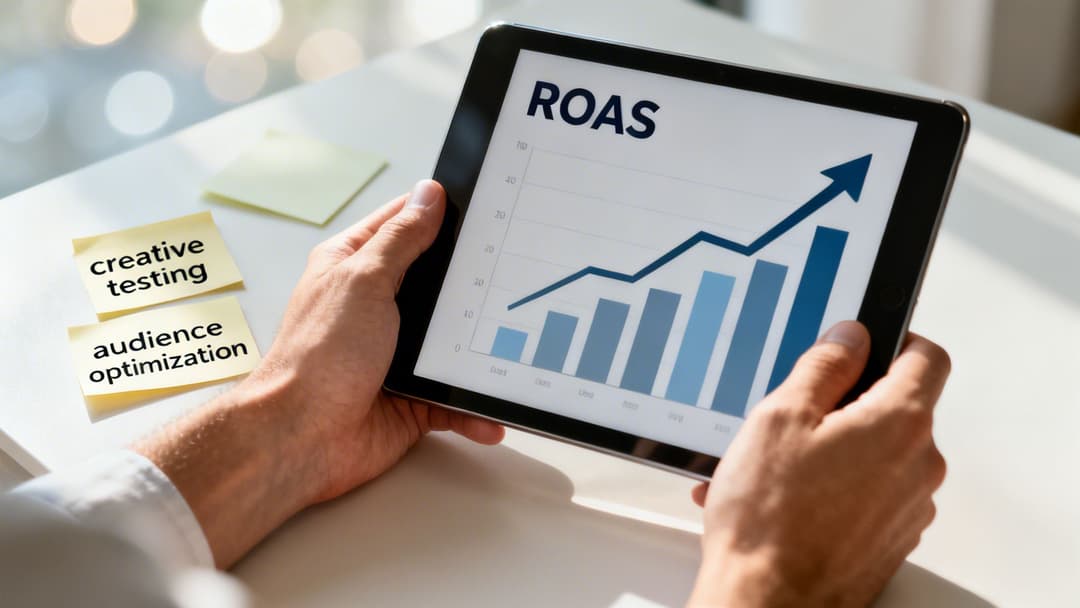
The single biggest advantage is the ability to run high-volume creative and audience tests at scale. A skilled team doesn't just throw one or two ad variations out there. They systematically test dozens, sometimes hundreds, of combinations—different images, videos, headlines, and audiences—to find the exact formula that clicks with your customers.
This methodical testing generates the hard data you need to know what’s actually driving performance. You stop guessing and start getting concrete answers about which messages deliver clicks, conversions, and a better Return on Ad Spend (ROAS).
The true value of a professional service isn't just managing ads; it's building a data-driven optimization engine. They turn your budget into a perpetual experiment that constantly finds and scales what works for your business.
This data-first mindset is what separates the pros from the amateurs. It turns your advertising from a gamble into a calculated investment, making sure every dollar is spent gathering insights and driving growth.
Achieving Superior Cost-Effectiveness
Expert management hits your bottom line directly by optimizing for pure efficiency. Professionals know exactly how to structure campaigns to get the lowest possible Customer Acquisition Cost (CAC) and Cost Per Lead (CPL). They are masters of budget allocation, bidding strategies, and audience refinement.
For instance, recent benchmarks show the average click-through rate (CTR) on Facebook is 1.44%, with a cost-per-click (CPC) of just $0.54. Now compare that to Google Ads, where the average CPC is a whopping $5.26. A professional Facebook advertising service knows how to exploit this cost advantage, especially with lead generation campaigns hitting conversion rates around 7.72% and retargeting efforts delivering up to 10x better conversions than prospecting. You can dig into these numbers yourself with the latest Facebook ad statistics on ElectroIQ.
These optimizations deliver real, tangible benefits:
- Lower Ad Costs: By quickly killing underperforming ads and tightening audience targeting, they stop your budget from bleeding out on clicks that go nowhere.
- Higher ROAS: Funneling your spend into proven creative and audience combos means your campaigns generate more revenue for every dollar put in.
- Faster Scaling: Once they find a winning formula, they have the know-how to scale the budget effectively without torpedoing your returns.
By putting these strategies into action, you're setting yourself up for success. You can dive deeper into how to polish your own efforts with our guide to Facebook campaign management best practices. Ultimately, a professional service ensures your investment gives you a competitive edge, turning the Meta Ads platform into a reliable engine for business growth.
How to Choose the Right Ad Service for Your Business
Picking the right partner to run your Facebook ads is one of those make-or-break decisions. It directly affects your budget, your growth, and whether your marketing efforts actually move the needle. You've got options flying at you from all sides—full-service agencies, slick freelancers, AI platforms—and it can feel like a lot.
The key isn't to find the flashiest or most expensive service. It’s about finding the one whose skills and approach truly line up with what your business needs to win. This isn't just about hiring a vendor; it’s about finding a partner who gets your vision and has the chops to bring it to life.
Define Your Goals and KPIs First
Before you even think about hopping on a discovery call with a potential Facebook advertising service, you need to get crystal clear on what success actually looks like for you. If you don't have a target, you'll never know if you hit it.
Start by nailing down the answers to these core questions:
- What's our number one goal? Are we trying to generate a flood of high-quality leads, drive direct e-commerce sales, or just get our brand name out there?
- What’s our target Cost Per Acquisition (CPA)? This is non-negotiable. You have to know what you can afford to pay for a new customer. For context, the average CPA in the education industry is a lean $7.85, but for technology, it can jump to $55.21. Your number will be unique.
- What's our budget for ad spend vs. service fees? Keep these two separate. You need a clear budget for what you’re paying Meta and what you're paying the people managing it.
With these Key Performance Indicators (KPIs) in hand, you have a yardstick. The conversation immediately shifts from vague promises to a real discussion about hitting your numbers.
Create Your Evaluation Checklist
Once you know your goals, it's time to build a checklist. Use it consistently to evaluate every single option, whether it's an agency, a freelancer, or a platform. This is how you make a true apples-to-apples comparison. Your list should hit on four main areas: expertise, process, communication, and price.
1. Vet Their Expertise and Track Record You need someone who has proven experience in your sandbox. An agency that crushes it for fashion brands might be totally lost when it comes to a B2B SaaS company.
- Ask for case studies that show real numbers (ROAS, CPA, CPL).
- Get references from their current or past clients and actually call them.
- Drill down on their experience with your specific business model (e.g., lead gen, subscription, DTC).
2. Understand Their Process A great partner has a system. They have a clear, repeatable process for everything from creative testing to scaling campaigns that are working. If their approach sounds vague or disorganized, that's a huge red flag.
A partner without a process is just guessing with your money. You need a team that operates with a clear, data-driven framework for building, testing, and scaling campaigns. This disciplined approach is what separates professional results from amateur guesswork.
3. Assess Their Communication and Reporting Style You have to be in the loop. Clear, transparent communication is everything. You need to know how your campaigns are doing, what they're testing, and what's coming next. Set the expectation for reporting frequency and detail right from the start.
4. Scrutinize the Pricing Model Finally, make sure you know exactly what you’re paying for. Is it a flat monthly retainer, a percentage of your ad spend, a one-time project fee, or a software subscription? Get it all in writing. No hidden fees, no surprises. This clarity is the foundation of a healthy, long-term partnership.
By working through these points methodically, you can cut through the noise and confidently pick the right Facebook advertising service for your business.
Measuring Success And Proving Your ROI
Pouring money into a Facebook advertising service without a clear way to track results is a bit like fueling up a race car but forgetting the speedometer and lap timer. You feel like you're going fast, but you have no real idea if you're winning the race. To justify your ad spend and prove its value, you have to look past the surface-level numbers and measure what actually impacts your bottom line.
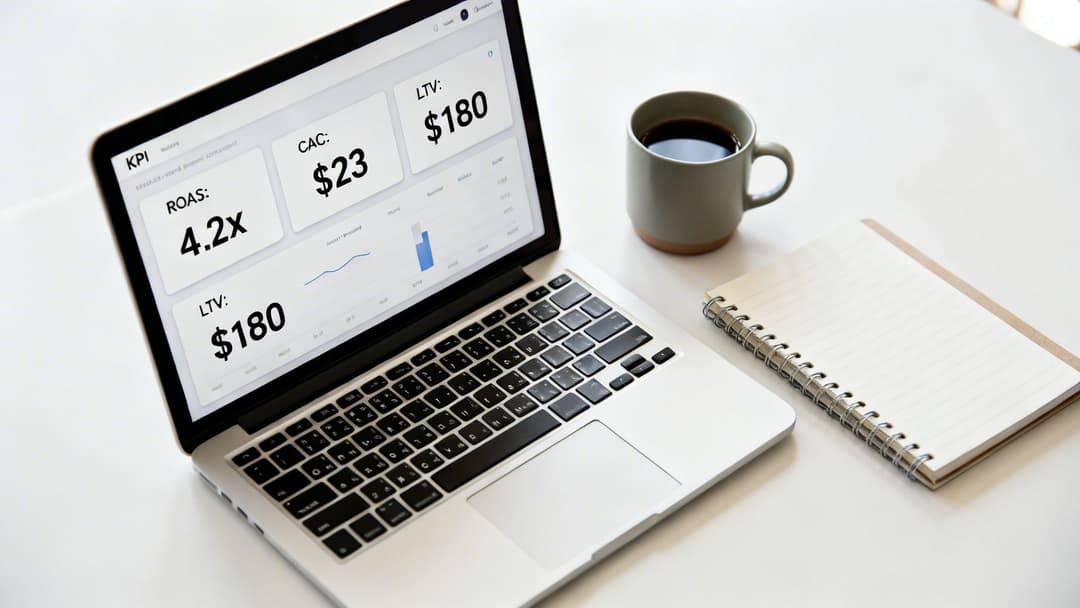
This all starts with zeroing in on a few crucial Key Performance Indicators (KPIs). Think of these not as just numbers on a dashboard, but as the vital signs of your company’s marketing health. They tell you whether your ad spend is a profitable investment or a sunk cost.
Your Most Important Performance Metrics
Sure, Meta Ads Manager is flooded with dozens of different metrics, but your success really boils down to just a few core concepts. When you look at them together, they paint a complete picture of how profitable your campaigns truly are.
- Return on Ad Spend (ROAS): This is your most direct measure of profitability. It answers the simple question: for every dollar I spend on ads, how much revenue do I get back? A 4x ROAS means you made $4 in revenue for every $1 you spent.
- Customer Acquisition Cost (CAC): This metric tells you exactly how much it costs, on average, to win a new customer through your advertising efforts. It's the key to understanding if your growth is actually sustainable.
- Customer Lifetime Value (LTV): This represents the total revenue you can realistically expect from a single customer throughout their entire relationship with your business. It gives you the long-term context needed to evaluate your CAC.
A high ROAS might look fantastic on its own, but it can be deceptive. If your cost to acquire a customer (CAC) is higher than what that customer is worth in the short term, you could be losing money on every single sale. That's why you have to analyze these metrics in tandem. For a deeper look at this, our article on how to calculate Return on Ad Spend is a great place to start.
Balancing Profitability and Growth
The real goal is to find that sweet spot where your CAC is low enough to be profitable, but your ad spend is high enough to fuel meaningful growth. A critical piece of this puzzle is knowing how to calculate marketing ROI for your Facebook campaigns.
A simple rule of thumb? Your LTV should always be higher than your CAC. Many businesses aim for an LTV:CAC ratio of at least 3:1. This ensures you're not just acquiring customers, but profitable ones who will fuel your long-term success.
Finding this balance is more important than ever. The competition on Meta is fierce—the platform's Q4 2025 advertising revenue hit an incredible $58.1 billion, a 24% jump from the previous year. With Facebook ads delivering an average 4x ROI and some retargeting campaigns boosting conversions by up to 10x, using a professional service to hit these numbers is no longer a luxury, but a necessity.
To truly understand the impact of your ad service, you need a clear view of your metrics. This table breaks down the essentials.
Key Metrics for Evaluating Your Ad Service
| Metric | What It Measures | Industry Benchmark (Example) | Why It Matters |
|---|---|---|---|
| ROAS | Revenue generated for every dollar spent on ads. | 4:1 (eCommerce) | The most direct indicator of ad profitability. Shows if your campaigns are generating immediate returns. |
| CAC | The average cost to acquire one new customer. | $50 - $100 (Varies widely) | Tells you if your customer acquisition is sustainable. A rising CAC can signal ad fatigue or market saturation. |
| LTV:CAC Ratio | The relationship between customer lifetime value and acquisition cost. | 3:1 or higher | The ultimate measure of long-term profitability. Ensures you're acquiring customers who are valuable over time. |
| Conversion Rate | The percentage of ad clicks that result in a desired action (e.g., purchase). | 2% - 5% (Retail) | Gauges the effectiveness of your ad creative, landing page, and offer. A low rate might point to a disconnect. |
Tracking these numbers gives you a concrete way to judge performance. It moves the conversation from "I think the ads are working" to "I know the ads are generating a 3.5x return."
That's where platforms like AdStellar AI come in. By plugging directly into your Meta Ads Manager, AdStellar's AI gets to work analyzing performance against the goals that matter most to you—whether that’s ROAS, CPL, or CPA. It helps you quickly spot which creatives, audiences, and messages are driving profitable results, giving you the hard data needed to prove the value of your Facebook advertising service.
The Future of Advertising Is AI-Powered
The whole world of Facebook advertising is turning a corner. We're moving away from the days of painstakingly building campaigns by hand, getting stuck in slow testing cycles and hitting creative walls. A smarter approach is taking over. The future isn’t about replacing marketers—it’s about giving them superpowers with AI.
Think of AI platforms as a new breed of Facebook advertising service, one that gives your in-house team the same firepower as a big agency. It’s the answer to the classic headaches of manual campaign management: sluggish ad creation, guesswork on creative, and a mountain of busywork. AI tackles these problems directly.
From Manual Labor to Augmented Strategy
Let's go back to our race car analogy. Your in-house team is the dedicated pit crew. In the past, they were using hand tools—a slow, labor-intensive job. An AI platform like AdStellar AI is like handing them a state-of-the-art toolkit that makes them faster, smarter, and way more precise.
AI takes the most grueling, repetitive parts of the job off your team's plate, freeing them up to focus on big-picture strategy. This creates a powerful new partnership:
- Humans for Strategy: Your team sets the destination. They define the core message, approve the winning concepts, and decide what gets scaled. They are the strategists, the brains of the operation.
- AI for Execution: The AI is the engine. It handles the high-volume, mind-numbing tasks—cranking out hundreds of ad variations, launching complex tests, and crunching performance data at a speed no human could ever hope to match.
This collaboration transforms a sluggish, manual process into a lightning-fast, data-driven machine. Those creative bottlenecks simply vanish, replaced by a system that can launch, test, and rank hundreds of ads in minutes, not weeks.
Here’s a glimpse of the AdStellar AI platform, which helps teams bring their entire campaign workflow under one roof.
The dashboard pulls everything together—campaigns, creatives, audiences—and turns scattered data points into clear, actionable insights for making decisions on the fly.
A New Framework for Your Decision
With AI in the mix, the choice is no longer a simple tug-of-war between hiring an agency and keeping everything in-house. A third, powerful option has entered the ring: empowering your existing team with an AI platform. This model truly offers the best of both worlds—you get the control and deep brand knowledge of an in-house team, but with the scale and ruthless efficiency of an agency.
To figure out the right path, think about it this way:
- Choose an Agency if: You need to completely hand off your marketing, have zero in-house expertise, and have a hefty budget ready for retainers and a cut of your ad spend.
- Stick with Manual In-House if: Your advertising needs are incredibly small and straightforward, and you have plenty of time to sink into manual campaign building, testing, and tweaking.
- Empower Your Team with AI if: You have a marketer or team who knows your brand inside and out but is drowning in manual work. You want to keep strategic control while massively boosting your testing speed and efficiency, all for a predictable subscription fee.
AI-powered platforms aren't just another tool. They represent a fundamental change in how advertising services work. They level the playing field, giving any business the power to build an in-house "pit crew" that can go toe-to-toe with the biggest agencies out there.
By automating the grunt work of ad production, these platforms let marketers get back to doing what they do best: thinking strategically. To see how you can put this into action, check out our guide on using AI for Facebook ads. At the end of the day, the future of advertising is a powerful partnership between human insight and machine intelligence.
Frequently Asked Questions
When you're ready to get serious about Facebook ads, the questions start piling up. How much will it cost? When do I see results? Let's tackle the big ones head-on so you can make the right call for your business.
How Much Should I Budget for a Facebook Advertising Service?
This is the big question, and the answer really depends on the path you take.
Going with a traditional agency usually means a significant upfront investment. Expect a monthly retainer anywhere from $2,000 to $10,000+, and that’s before they take an additional 10-20% of your ad spend. Freelancers offer a more budget-friendly route, typically charging between $500 and $5,000 a month.
Then there’s the third way. AI-powered platforms like AdStellar AI flip the script. They work on a subscription model, giving your in-house team the power of an agency without the hefty price tag. Just remember, your total budget needs to cover both the service fee and your actual ad spend—the money you give Meta to run the ads.
How Long Until I See Results from an Ad Service?
Everyone wants to see results yesterday, but great advertising takes a little patience. While you'll get initial data like clicks and impressions almost immediately, real, stable results take time. Plan for a 60-90 day runway.
This isn't dead time; it's the critical testing phase. Your service is throwing everything at the wall—creatives, audiences, offers—to see what sticks. They're gathering the data needed to build a winning formula.
Don't mistake initial testing for a lack of results. An effective service uses this period to build a data-backed foundation for long-term, scalable success. Rushing this process almost always leads to wasted ad spend.
This is another area where AI-powered platforms have a serious edge. They can launch and analyze hundreds of ad variations at once, finding your winning campaigns much faster than any human team could manually.
Can I Use an AI Platform if I Already Have an Agency?
Absolutely. In fact, it’s one of the smartest ways to get more out of your agency relationship.
Think of it as giving your agency a superpower. They can use a platform like AdStellar to massively increase their testing capacity for your brand, exploring far more creative angles without billing you for hundreds of extra hours.
Alternatively, your in-house team can use it to build and supply a huge volume of on-brand ads directly to your agency. This frees them from the tedious, time-sucking ad setup process and lets them focus on what you're really paying them for: high-level strategy, deep analysis, and growing your business. It's a win-win.
Ready to give your in-house team the power of an agency without the high overhead? See how AdStellar AI can help you launch, test, and scale winning campaigns faster than ever before. Learn more and get started at AdStellar.ai.