Monday starts with Ads Manager open in five tabs. One campaign needs fresh copy. Another has frequency climbing. A retargeting set is still spending on people who already bought. Someone exported a CSV on Friday, but the numbers no longer line up with what the account is doing today.
That is where a lot of facebook strategy marketing breaks down. The problem is rarely a lack of ideas. It is the gap between strategy and execution.
Many teams know the broad advice. Build a funnel. Test creatives. Refine audiences. Watch CPA and ROAS. The hard part is operational. How do you turn that advice into a weekly system that can launch fast, learn fast, and scale without burying the media buyer in repetitive work?
The answer is not another round of random boosts or campaign duplication. It is a full-stack workflow. One that connects funnel planning, targeting, creative testing, budget control, and optimization into a repeatable machine.
Beyond the Boost Button A Modern Framework for Meta Success
Boosting posts feels productive because it is fast. It also hides key decisions that determine account performance. You pick a post, push budget behind it, and hope the algorithm sorts out the rest. That works for basic visibility, but it is not how serious acquisition programs run.
The familiar trap looks like this. A team launches a few campaigns, sees one ad set work, duplicates it three times, swaps in slightly different copy, then spends the rest of the week comparing scattered reports. Nothing is fully broken, yet nothing is clearly under control either.
That is why mature facebook strategy marketing needs a framework instead of a stack of isolated tactics. The framework is simple in principle:
- Map the funnel: Tie campaigns to a real buyer journey.
- Engineer audiences: Use first-party data, lookalikes, and exclusions deliberately.
- Test creatives at volume: Find message-market fit through throughput, not intuition.
- Control spend: Choose budgets and bids based on the job each campaign must do.
- Optimize continuously: Cut losers, rank winners, and scale with rules.
If your current process starts with the blue boost button, it helps to understand what a boosted post on Facebook does. The limitation is not that boosting is useless. The limitation is that it collapses planning, targeting, testing, and optimization into one shallow action.
The operational win comes from reducing manual decisions at the campaign level so you can spend more time on the few strategic decisions that move results.
The rest of this playbook is built for that shift. Less reactive campaign babysitting. More structured execution.
Laying the Strategic Foundation with Funnel Mapping
The account structure should reflect the customer journey. If it does not, reporting gets muddy and budget decisions turn into guesswork.
Facebook is still too large to treat as a single-purpose channel. It has over 3 billion monthly active users and a potential ad reach of 2.19 billion users, which is why marketers use different objectives across different stages instead of forcing every campaign to sell immediately. Campaign distribution reflects that reality, with 42.4% of campaigns focused on engagement, while Brand Awareness captures 37.7% of impressions, Traffic 24.6%, and Leads 9.5% according to Hootsuite’s Facebook statistics roundup.

A practical funnel map keeps each stage focused. That matters because top-of-funnel creative, middle-of-funnel messaging, and bottom-of-funnel offers should not be judged by the same standards.
Top of funnel builds qualified attention
Top of funnel is where you earn the next click, view, or visit. This stage is not about squeezing an immediate purchase out of cold traffic.
Use awareness-oriented campaigns when you need reach and memory. Use engagement when the goal is to create interaction signals. Use traffic if you need to move people to a landing page, category page, or content asset where they can be educated further.
At this stage, strong execution usually includes:
- Clear hooks: The first seconds or first line must establish relevance fast.
- Broad but intentional messaging: Speak to pain points and outcomes, not just product details.
- Creative variety: Different angles reveal which problem framing gets attention.
A top-of-funnel campaign fails when marketers expect bottom-of-funnel efficiency from cold audiences. It also fails when they optimize solely for cheap clicks and end up filling remarketing pools with the wrong people.
Middle of funnel turns interest into intent
Middle of funnel is where a lot of ad accounts either compound momentum or waste it. Someone clicked. Someone watched. Someone visited. Now they need context, trust, and proof.
This stage is where I like to tighten message match. If the top-of-funnel ad sold the problem, middle-of-funnel should sell the mechanism. Explain how the product works. Show a demo. Use reviews, comparisons, FAQs, and objection handling.
A useful way to think about middle-of-funnel is as a filtering layer. The campaigns should help separate casual curiosity from active consideration.
Try this framework:
| Funnel stage | User state | Best message focus |
|---|---|---|
| ToFu | Problem aware or casually browsing | Attention, relevance, curiosity |
| MoFu | Comparing options | Proof, education, differentiation |
| BoFu | Ready to act | Offer, urgency, friction removal |
If your account jumps straight from cold traffic to hard-sale creative, this is usually the missing layer.
For teams building campaign plans from scratch, this Meta campaign planning process guide is a useful operational reference.
Bottom of funnel converts demand already in motion
Bottom-of-funnel campaigns should focus on people who already signaled intent. Product viewers, cart visitors, lead form openers, and high-intent site visitors belong here.
At this stage, your job is not to introduce the brand. It is to remove friction.
That often means:
- Tighter offers: Shipping, bundles, demos, trials, or a direct call to book.
- Specific proof: Testimonials, outcomes, guarantees, implementation clarity.
- Short paths: Reduce the number of clicks between ad and action.
A funnel map is useful only if each stage has a job. When every campaign tries to do everything, no campaign gets judged correctly.
The strongest facebook strategy marketing setups do one more thing well. They define what counts as success before launch. Awareness campaigns should be judged for reach and attention quality. Consideration campaigns should be judged for engagement depth and qualified visits. Conversion campaigns should be judged on the business outcome they were built to drive.
That discipline keeps the account from turning into a pile of overlapping campaigns with no clear role.
Building Your Audience Targeting Engine
Creative gets most of the credit. Audience structure decides whether that creative ever reaches the right people at the right stage.
A lot of Meta accounts still rely too heavily on basic interests plus some loose retargeting. That can work for a while. It usually stops working cleanly once spend increases, products diversify, or multiple teams start touching the account.

The audience engine should have three layers. Seed data, expansion logic, and suppression logic. Many marketers spend time on the first two and neglect the third.
Start with owned signals
First-party data is the cleanest starting point because it comes from people who already interacted with the business. That includes site visitors, email subscribers, prior customers, lead lists, and people who engaged meaningfully with your brand.
The point is not only to retarget them. It is to use them as source material for expansion.
A practical setup often includes:
- Website-based custom audiences: Visitors segmented by depth and intent.
- CRM audiences: Leads, qualified leads, active customers, churned users.
- Engagement pools: Video viewers, page engagers, and ad engagers.
When these segments are too broad, campaigns become noisy. When they are too narrow, delivery becomes unstable. The balance depends on your buying cycle and volume, but the principle stays the same. Group people by meaningful behavior, not by convenience.
Use lookalikes with a reason
Lookalikes work best when the seed audience is tied to a real business outcome. A lookalike based on purchasers, qualified leads, or high-value users usually gives you a more useful expansion path than a lookalike built from shallow engagement.
The methodology many practitioners follow starts with audience definition in Meta Audience Insights, then layers first-party data and builds 1% lookalike audiences, with the cited benchmark that these can drive a 20-50% lift in conversion rates vs. broad targeting in the referenced methodology. The same source recommends using historical data to create stronger seeds and warns against relying only on broad setup from the start. It also notes marketers can bulk-generate lookalikes from historical performance data to scale faster in execution-heavy workflows, as described in this step-by-step Facebook marketing strategy guide.
That does not mean broad targeting is wrong. It means broad targeting needs structure.
Exclusions are where wasted spend gets fixed
This is the part too many teams treat as optional. It is not optional once the account has meaningful spend.
An underserved angle in facebook strategy marketing is audience exclusion and frequency capping. AskNeedle’s discussion of Facebook ad strategies notes ad fatigue rising 15% YoY in 2025, and argues that broad targeting can work if exclusions are aggressive. That tracks with what many performance teams see in practice. Broad pools are not the enemy. Overlapping delivery and repeated exposure to the wrong users are.
Common exclusions include:
- Recent purchasers: Keep acquisition campaigns from paying to re-convert existing buyers.
- Active leads or trials: Avoid showing prospecting ads to users already in sales motion.
- Low-quality engagers: Exclude segments that consume content but rarely progress.
- Recent clickers from other campaigns: Reduce overlap between funnel stages.
Consider this trade-off. Excluding too little inflates waste. Excluding too aggressively can starve delivery and block the algorithm from learning. The right answer is not ideological. It is operational. Build exclusions around business state, not around arbitrary neatness.
If you want a more structured way to think through this, these audience segmentation strategies for Meta campaigns are a useful reference.
A quick walkthrough of audience layering helps when teams are rebuilding messy accounts:
A clean audience engine is simple to read
The strongest setups are usually not the most complicated. They are the easiest to audit.
I like to ask four questions when reviewing an account:
- Do seed audiences reflect real value?
- Do expansion audiences have a clear reason to exist?
- Do exclusions mirror the actual buyer journey?
- Can the team explain overlap without opening five spreadsheets?
If an audience strategy takes ten minutes to explain, it will be hard to maintain under pressure.
That is where disciplined naming, clear suppression rules, and fewer but smarter segments beat endless fragmentation.
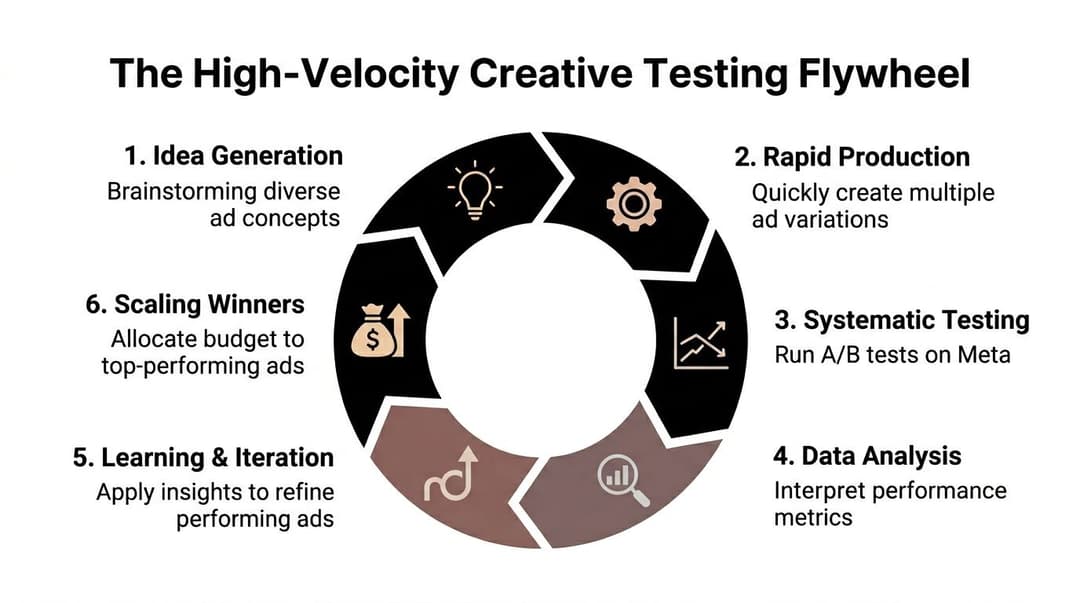
The High-Velocity Creative Testing Flywheel
Many Meta accounts do not lose because the audience is wrong. They lose because the team tests too little creative, too slowly, for too long.
That is the uncomfortable truth behind underperforming facebook strategy marketing. Teams talk about testing, but in practice they recycle three headlines, two videos, and one static image for weeks. Then they blame CPMs, seasonality, or the algorithm.
The bigger lever is message throughput.
Angles matter more than minor edits
An effective testing system starts with angles, not cosmetic variation. An angle is the core reason someone should care.
For the same product, you might test:
- Pain-point angle: What frustration does this remove?
- Outcome angle: What better result does it create?
- Social-proof angle: Who already trusts it?
- Speed angle: How fast can someone get value?
- Simplicity angle: How does it reduce effort or confusion?
Changing one adjective in a headline is not a meaningful test if the underlying angle stays the same.
Manual workflows often break down at this point. Once you start testing multiple angles across headlines, body copy, formats, and audiences, the volume gets ugly fast. Naming conventions slip. Launches get delayed. The team stops testing because the process itself becomes a bottleneck.
The flywheel is more important than the single ad
The goal is not to find one hero ad and protect it. The goal is to build a loop that keeps producing new winners.
A practical flywheel looks like this:
- Generate angles from real objections and desired outcomes
- Turn each angle into multiple creative expressions
- Launch enough variants to get signal
- Read results by angle first, asset second
- Carry winning angles into fresh formats
- Scale only after the message proves itself
Teams often reverse steps four and six. They scale first, then try to understand what worked.
That is expensive.
What high-volume testing gets right
The case for rapid testing is straightforward. AdEspresso’s piece on ad angles is useful here because it captures a real operational gap. It states that top angles can boost CTR 2.5x, while only 12% of campaigns test more than 50 combinations because manual testing creates chaos. That is exactly why throughput matters. The opportunity is not hidden. The workflow is the obstacle.
For practitioners, that leads to a few rules:
| What to test | Weak approach | Strong approach |
|---|---|---|
| Hook | Tiny wording tweaks | Different problem framings |
| Body copy | One long block reused everywhere | Short and long variants matched to intent |
| Visuals | One asset with resized crops | Different formats and demonstrations |
| Offer framing | Same CTA on every ad | CTA matched to funnel stage |
Another common mistake is judging creative too quickly by isolated metrics. A flashy ad can win clicks and still attract the wrong user. A plain ad can look average early and later become the most efficient path to purchase. Read creative in context. Which angle attracts attention, qualifies users, and keeps downstream performance healthy?
The practical workflow many teams need
If you are running this manually, keep the system brutally simple.
Use a repeatable creative worksheet with these fields:
- Audience stage
- Angle
- Hook
- Proof element
- CTA
- Format
- Landing page
Then review results in batches, not one ad at a time. You are not trying to crown every asset. You are trying to identify patterns. If three ads built around “save time” beat five ads built around “premium quality,” that is the insight. Carry it forward.
This is also one area where automation fits the job. AdStellar AI can generate large sets of creative, copy, and audience combinations from historical winners and launch them into Meta through a single workflow. In practical terms, that reduces the manual assembly work that usually slows angle testing down.
For teams refining process, this Meta ads creative testing guide offers a useful structure for organizing tests cleanly.
Winning on Meta is less about writing one brilliant ad and more about building a system that discovers brilliance through repetition.
When teams adopt that mindset, creative stops being a sporadic brainstorm and becomes an operating advantage.
Activating Campaigns with Smart Budgets and Bidding
Launch discipline shows up in the first setup decisions. If budget structure is sloppy, you do not get clean learnings. If bidding is mismatched to the objective, you end up reading bad data as if it were market truth.
A strong launch starts with business targets. The referenced methodology from Techeasify recommends defining objectives and aligning KPIs up front, with example targets like ROAS >3x and CPL <$10, while noting that poor event tracking can cause 40% attribution loss and that data-first planning can produce 15-30% higher ROAS according to Meta case studies. That same methodology is a good reminder that launch quality depends as much on instrumentation as it does on media buying logic.
Use ABO for clearer tests and CBO for stronger consolidation
I do not treat budget strategy as a doctrine. I treat it as a fit question.
ABO is useful when you need cleaner control during testing. If you want each ad set to get a fair shot, ad set budgets can help prevent one audience from soaking up all spend before you learn anything meaningful.
CBO is useful when the account already has enough signal and you want Meta to allocate more fluidly across ad sets. It often makes more sense once you know what deserves additional spend.
A simple approach:
- Use ABO when testing new audiences, fresh angles, or unproven offers
- Use CBO when consolidating proven ad sets with comparable intent and stable tracking
If your account is still in discovery mode, heavy automation at the budget layer can hide useful information. If your account already knows where value lives, over-controlling every ad set can slow scale.
Match bid strategy to the job
Not every campaign needs the same bidding logic.
For broad testing and data collection, many buyers start with Highest Volume because it gives delivery room to find results. That makes sense when you want to learn which combinations can compete at all.
For campaigns with tighter financial guardrails, a cost-controlled approach can help. The catch is obvious. If your target is too aggressive, delivery can choke.
Use this decision filter:
- Need volume and learning? Start looser.
- Need efficiency against a firm target? Tighten bidding only after events are reliable.
- Seeing unstable delivery? Check tracking and audience constraints before changing bids.
A lot of bid changes are really attempts to fix structural issues. If the pixel or CAPI setup is weak, if the audience is overcrowded, or if the creative is stale, a different bid strategy will not rescue the campaign.
Build launch structures that are easy to read
Good campaign architecture makes optimization possible later. Bad architecture forces you to guess what caused the result.
I prefer launch structures that answer these questions without effort:
- Which funnel stage is this campaign serving?
- What audience family is being tested?
- What is the primary creative angle?
- What KPI determines whether it stays live?
If those answers are hidden in vague campaign names and duplicated assets, the account becomes slow to manage.
A practical launch checklist helps:
- Check tracking first: Confirm the core events and attribution flow before any serious spend.
- Keep tests interpretable: Do not change audience, offer, and creative angle all at once if you need a clean read.
- Set budget by learning need: Give enough spend for signal, not just enough to say the campaign is active.
- Name for diagnosis: Future you should know what launched without opening every ad.
For teams that want a more operational breakdown, this Meta ads budget allocation guide is a useful planning reference.
The best launch setup is not the fanciest one. It is the one that gives you data you can trust.
Your Optimization Loop for Sustainable Scaling
Most account performance is decided after launch. Not because launch is unimportant, but because every useful signal arrives later. The question is whether the team can convert those signals into action without creating chaos.
Optimization is where facebook strategy marketing shifts from campaign management to portfolio management. You are no longer asking whether one ad looks good. You are asking where the next dollar should go and what should be shut off to protect efficiency.
Read patterns before making edits
Too many teams optimize at the row level. They open Ads Manager, spot one ugly number, and make an immediate change. That feels active. It often destroys learning.
A better loop starts with ranking patterns:
- Which angles keep producing qualified traffic?
- Which audiences produce purchases or leads without distorting cost?
- Which placements support the outcome versus pad cheap top-line metrics?
- Which frequency trends suggest fatigue rather than growing persuasion?
If you make decisions ad by ad with no pattern analysis, you end up replacing assets constantly and never learning why one family of messages worked.
Separate diagnosis from reaction
A useful optimization rhythm has two passes. First diagnose. Then react.
Here is a practical diagnostic table:
| Symptom | Likely issue | Better response |
|---|---|---|
| CTR weak across several ads | Hook or angle mismatch | Refresh the message, not just the thumbnail |
| Strong click volume but weak downstream results | Poor traffic quality or landing mismatch | Tighten angle and align page promise |
| Retargeting costs climbing | Audience saturation | Refresh creative and review exclusions |
| Spend shifts unpredictably | Structural overlap or unstable signal | Simplify setup before scaling |
The mistake is trying to solve every symptom with budget changes. Budget is often the last lever, not the first.
Scale horizontally before you overfeed one winner
A winning ad set attracts too much attention. The instinct is to pour more money into it immediately.
Sometimes that works. Sometimes it breaks the thing that was working.
Sustainable scaling usually comes in two forms:
Horizontal scaling means extending proven winners into adjacent audiences, placements, or related angles.
Vertical scaling means increasing spend on a proven setup that still has room to absorb budget without collapsing efficiency.
The order matters. Horizontal expansion often preserves stability longer because it gives the account fresh room to grow. Vertical scaling works best when the underlying audience is not already saturated and the creative still has headroom.
Scale the pattern, not just the ad. If one creative wins with a specific promise, test that promise in new formats and audiences before assuming the original asset can carry unlimited spend.
Put rules around what deserves more budget
Scaling decisions should not be emotional. They should be rule-based.
I like simple internal rules such as:
- Keep scaling candidates limited. Not every decent ad deserves more budget.
- Promote only clear winners. Borderline ads create borderline results at higher spend.
- Tie every scale action to a known reason. New audience, stronger angle, cleaner funnel fit, or stable cost trend.
This is also where account operators benefit from a performance layer that ranks combinations by business outcome instead of forcing a manual scan through dozens of reports. AI insights tools can help if they are grounded in actual historical performance and if the team still validates the logic.
The primary gain is not convenience alone. It is consistency. A repeatable loop keeps the account from swinging between overreaction and neglect.
Sustainable optimization is a cadence
Strong operators settle into a cadence instead of a panic cycle.
A healthy cadence usually includes:
- Frequent light reviews: Spot delivery issues, broken tracking, or clear fatigue early
- Structured performance reviews: Compare angles, audiences, and funnel movement in groups
- Scheduled creative refreshes: Replace stale assets before account performance erodes badly
- Planned scale windows: Increase spend when the system supports it, not because the calendar says so
When teams skip cadence, optimization becomes mood-driven. One bad day triggers aggressive cuts. One good day triggers reckless scaling. Neither is disciplined media buying.
The accounts that hold up over time usually look calm from the outside. That calm comes from process.
From Manual Grind to Strategic Growth
The old way of running Meta was manageable when accounts were smaller and creative demands were lighter. A media buyer could duplicate a few ad sets, swap some copy, and still stay on top of performance.
That is no longer enough for most serious teams. The workload now sits across audience logic, creative throughput, tracking quality, budget control, and constant optimization. Manual management does not just consume time. It narrows how much testing you can do, how quickly you can react, and how confidently you can scale.
That is why strong facebook strategy marketing is operational by design. It starts with a funnel map that assigns each campaign a job. It builds audiences with intent and exclusions. It treats creative testing as a flywheel, not a one-off event. It launches with budget logic that produces clean data. Then it runs on an optimization loop that protects efficiency while expanding what works.
The shift is mental. Stop treating Meta as a collection of ads. Start treating it as a system.
When that system is clear, the account gets easier to read. Decisions get faster. Teams spend less time on repetitive setup and more time on diagnosis, strategy, and growth.
If your team is spending more time assembling campaigns than learning from them, AdStellar AI is worth a look. It is built for launching, testing, and scaling Meta campaigns faster by automating bulk ad creation, audience and creative combinations, and performance-driven campaign workflows so media buyers can focus on strategy instead of repetitive account work.