Three weeks into Q2 and your Meta campaigns are running on fumes. You have exactly five ad creatives in rotation, the same ones you launched a month ago. CTR is dropping. CPA is climbing. Your boss wants to know why performance is slipping, but you already know the answer: you are out of fresh creative, and the design team is booked solid until next month.
This is not a budget problem or a strategy problem. This is a creative production bottleneck, and it is one of the most common barriers to scaling digital advertising campaigns today. When you cannot produce enough ad variations to test properly, refresh fatigued creatives, or capitalize on winning angles, your entire performance marketing operation stalls.
The good news? Limited ad creative resources is a solvable constraint. This article breaks down why creative bottlenecks happen, how they damage campaign performance, and practical systems for multiplying your creative output without expanding headcount or burning through your budget. Let's start with what this constraint actually costs you.
The Hidden Price of Creative Scarcity
When you run the same handful of creatives week after week, you are not just missing opportunities. You are actively degrading your campaign performance through a phenomenon every performance marketer dreads: ad fatigue.
Ad fatigue happens when your target audience sees the same creative repeatedly. The first few impressions might perform well, but by the tenth or fifteenth exposure, engagement drops off a cliff. CTR declines. CPAs rise. What started as a winning ad becomes a budget drain simply because your audience has seen it too many times. Understanding why ad creative fatigue happens so fast is the first step toward solving it.
Without enough creative variations to rotate, you cannot fight this decay. You watch your metrics deteriorate in real time, knowing that fresh creatives would solve the problem, but production timelines stretch weeks into the future. Meanwhile, your competitors with larger creative libraries keep their audiences engaged with new angles, formats, and messaging.
The testing problem runs even deeper. Proper campaign optimization requires testing multiple variables: different hooks, visual styles, ad formats, messaging angles, and calls to action. When you only have five creatives in rotation, you cannot run meaningful tests. You are essentially guessing which combination might work rather than systematically identifying winners through data.
This limited testing capacity means you miss breakthrough creative angles entirely. Maybe your audience responds better to user-generated content than polished product shots. Perhaps video outperforms static images for your offer. You will never know because you lack the creative volume to test these hypotheses properly.
Your competitors face a different reality. Marketing teams that can produce dozens or hundreds of creative variations gain algorithmic advantages in Meta's auction system. They feed the platform more options to test, which helps the algorithm find high-performing audience segments faster. They identify winning creative formulas through systematic testing while you are stuck recycling the same assets.
The performance gap compounds over time. While you wait for your next batch of creatives, competitors are iterating on winners, testing new formats, and capturing audience attention with fresh content. The cost is not just in wasted ad spend. It is in lost market share, slower learning cycles, and campaigns that never reach their performance potential.
Why Creative Production Becomes a Bottleneck
The traditional creative production process was not designed for the volume demands of modern performance marketing. It evolved from brand advertising, where a single campaign might run for months with a handful of carefully crafted assets. That model breaks down completely when you need dozens of ad variations every week.
Consider the typical workflow: a marketing manager briefs a designer, who creates mockups for review. Feedback loops stretch across days or weeks. Once visuals are approved, a copywriter develops ad copy. Then someone needs to create multiple versions for different placements and formats. Video content adds another layer of complexity, often requiring specialized editors or production teams. This is the classic creative production bottleneck that plagues most marketing teams.
Each step introduces delays. Your designer is juggling requests from product marketing, brand campaigns, and sales enablement. The copywriter is working on email campaigns and landing pages. Video editors are booked out for the next month on product launch content. Performance marketing becomes one priority among many, and creative production timelines slip.
The economics make scaling even harder. Agency retainers for ongoing creative production easily run thousands per month, and that typically covers a limited number of assets. Need fifty ad variations for a proper testing matrix? Expect the invoice to reflect that volume. Freelance designers offer flexibility but require project management overhead and quality can vary widely.
Many teams try to solve this by hiring in-house creative staff, but headcount comes with its own constraints. A talented designer or video editor can produce high-quality work, but there is a ceiling to how much one person can create in a week. When campaign demands spike during product launches or seasonal pushes, even dedicated creative teams get overwhelmed.
The mismatch between production capacity and campaign needs creates a constant tension. Marketing teams know they should be testing more creatives, refreshing fatigued ads, and exploring new formats. But the operational reality of traditional creative production makes that volume practically impossible without massive budget increases or team expansion.
This bottleneck forces uncomfortable tradeoffs. Do you invest creative resources in a new campaign or refresh existing ones? Do you prioritize video content or static images? Do you create variations for testing or focus on a single polished asset? These decisions would not feel so painful if production capacity matched strategic needs.
Creative Volume and Meta's Algorithm
Meta's advertising system is fundamentally designed to optimize through testing, and it performs better when you give it more options to work with. This is not marketing theory. It is how the platform's machine learning operates at a technical level.
When you launch a campaign with limited creative variations, the algorithm has a narrow dataset to optimize from. It tests your handful of ads against different audience segments, placements, and times, but the creative itself remains constant. You are essentially asking the system to find the best distribution strategy for a fixed set of assets.
Compare that to a campaign with dozens of creative variations. The algorithm can now test different visual styles, messaging angles, formats, and hooks across audience segments simultaneously. It identifies which creative resonates with which audience subset. A UGC-style video might crush it with one demographic while a polished product shot performs better with another. More creative options give the system more signals to learn from.
This dynamic creates a compounding advantage. As the algorithm identifies winning creative and audience combinations, it allocates more budget to those pairings. Campaigns with higher creative volume discover these winning combinations faster because they are testing more variables simultaneously. They move through the learning phase more efficiently and reach stable, optimized performance sooner. Implementing creative testing at scale is essential for maximizing this algorithmic advantage.
The format diversity matters too. Meta's platform supports image ads, video ads, carousel formats, collection ads, and more. Each format performs differently depending on audience, placement, and campaign objective. When you only have static images because that is what your design team can produce quickly, you miss opportunities where video content might dramatically outperform.
Proper A/B testing methodology requires enough creative volume to isolate variables. If you want to test whether lifestyle imagery outperforms product-focused shots, you need multiple examples of each approach to account for execution quality. Testing one lifestyle image against one product shot tells you almost nothing. You need volume to separate signal from noise.
The audience discovery aspect is particularly powerful. When Meta's algorithm has diverse creative options, it can match different ads to different audience segments you might never have targeted manually. A particular creative angle might resonate with an unexpected demographic or interest group. You only discover these opportunities when you provide enough creative variety for the system to explore.
Marketing teams that solve the creative volume problem gain a systematic advantage in Meta's auction environment. They are not necessarily smarter or more strategic. They simply give the platform more options to optimize, which leads to better performance through more thorough testing and faster learning cycles.
Multiplying Creative Output Without Expanding Teams
The solution to limited ad creative resources is not working harder or hiring more people. It is adopting workflows and tools that multiply what your existing team can produce. Let's break down practical strategies that dramatically increase creative output without proportionally increasing costs.
Start with the assets you already have. A single product photo can become a dozen ad variations through strategic repurposing. Crop it to different aspect ratios for feed, stories, and reels placements. Create versions with different text overlays highlighting various benefits or features. Add colored backgrounds or borders to create visual distinction. Test versions with and without product callouts.
This approach transforms one source file into a testing matrix. You are not creating fundamentally new content, but you are generating enough variations to identify what resonates. Maybe the square crop with a benefit-focused headline outperforms the vertical version with a feature callout. You only learn this through systematic variation testing.
AI-powered creative generation represents a fundamental shift in production economics. Modern platforms can generate scroll-stopping image ads from a product URL. Describe your offer, provide a link, and the system produces multiple creative variations exploring different visual styles, layouts, and messaging angles. No designer required.
Video content becomes equally accessible. AI can generate video ads and UGC-style avatar content without video editors or actors. You input your messaging and the system creates videos with different hooks, pacing, and calls to action. What used to require production crews and editing time now happens in minutes.
The clone functionality takes this further. See a competitor ad in Meta's Ad Library that is clearly performing well? AI can analyze the creative elements and generate variations inspired by that approach but customized for your product or offer. You are not copying. You are learning from proven creative formulas and adapting them to your needs.
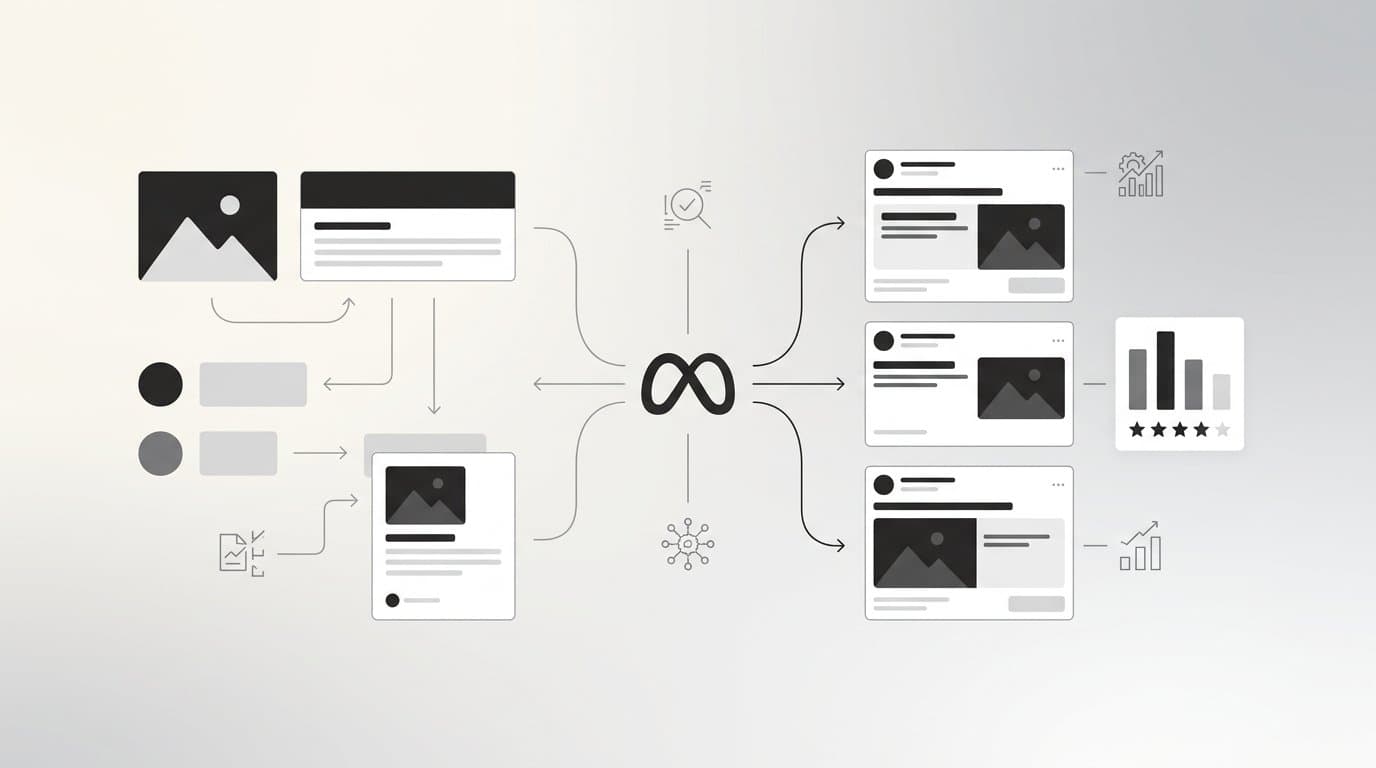
Bulk creation workflows solve the combinatorial explosion problem. When you need to test multiple creatives against multiple headlines, copy variations, and audience segments, manual creation becomes impossible. Bulk systems let you mix and match these elements systematically. Select five creatives, ten headlines, and three copy variations, and the platform generates every combination, creating 150 ad variations ready to launch.
This is not about flooding Meta with random content. It is about systematic testing at a scale that manual production cannot match. You are exploring the creative and messaging possibility space thoroughly, which helps you identify winners faster and with more confidence.
The chat-based editing capability adds flexibility. Generate a creative that is 80% right but needs refinement? Describe the changes you want in plain language and the AI adjusts the creative accordingly. This iteration speed means you can go from concept to final asset in minutes rather than days of back-and-forth with designers.
Creating Systems That Keep Working
Solving limited ad creative resources once is not enough. You need systems that continuously produce high-performing creatives without constant manual intervention. The difference between a one-time fix and sustainable creative capacity comes down to how you organize learnings and workflows.
Build a winners library that captures your best-performing creative elements with actual performance data attached. When a particular headline drives a 4% CTR or a specific visual style delivers a $15 CPA, that information should be stored and easily accessible. Not as a screenshot or a spreadsheet, but as a reusable asset you can immediately add to your next campaign. A proper ad creative library management system makes this possible.
This library becomes your creative playbook. Instead of starting from scratch each time, you begin with proven winners and create variations around them. You know that UGC-style testimonial videos work well for your audience, so you generate more in that style. You have data showing that benefit-focused headlines outperform feature lists, so you prioritize that messaging angle.
The continuous learning loop is where this gets powerful. Every campaign generates performance data about which creatives, headlines, audiences, and copy variations performed best. Feed that insight back into your next creative production cycle. The system gets smarter over time because you are building on documented successes rather than repeating experiments.
Leaderboards that rank creative elements by real metrics make this actionable. Sort your creatives by ROAS, CPA, or CTR and instantly see which visual styles are crushing it. Check headline performance to identify messaging patterns that resonate. Review audience rankings to understand which segments respond best to which creative approaches. Making data-driven creative decisions separates high-performing teams from those stuck guessing.
Goal-based scoring adds another dimension. Set your target CPA or ROAS and the system scores every creative element against those benchmarks. You can quickly identify which assets deserve more iterations and which approaches are not worth pursuing further. This prevents wasting creative resources on angles that look good but do not perform.
The workflow integration matters too. Your creative production system should connect directly to campaign launching. Generate a batch of creatives, review performance predictions, and launch to Meta without switching platforms or exporting files. This tight integration reduces friction and makes high-volume testing practical rather than theoretically possible but operationally painful.
Transparency in AI decision-making builds trust in the system. When the platform recommends certain creative elements or campaign structures, you should see the reasoning. Understanding why the AI suggests a particular audience or creative combination helps you learn strategy, not just execute tasks. This knowledge transfer makes your entire team more effective over time.
From Constraint to Competitive Advantage
The shift from creative scarcity to creative abundance is not about working longer hours or hiring bigger teams. It is about fundamentally changing how you approach ad production through AI-assisted workflows and systematic testing processes.
Traditional creative production treated each asset as a custom project requiring specialized skills and significant time investment. That model made sense when campaigns ran for months with a handful of carefully crafted ads. It completely breaks down in modern performance marketing where you need dozens of variations weekly to test properly, fight ad fatigue, and capitalize on winning angles.
AI-powered creative generation solves the volume problem by making production nearly instantaneous. Generate image ads, video ads, and UGC-style content from product URLs or by cloning competitor approaches. Create hundreds of ad variations by systematically mixing creatives, headlines, and copy. Launch everything to Meta and let the algorithm identify winners through real performance data. Implementing creative automation transforms what your team can accomplish.
The economic transformation is striking. What used to cost thousands in agency fees or require dedicated creative headcount now happens at a fraction of the cost and time. You are not cutting corners on quality. You are using AI to handle the production mechanics so your team can focus on strategy, analysis, and iteration based on performance insights.
This abundance creates new strategic possibilities. Test bold creative angles you would never have tried when each asset required days of designer time. Refresh creatives proactively before ad fatigue sets in. Run proper A/B tests with enough volume to generate statistically significant results. Explore new formats and messaging approaches without betting your entire campaign on a single creative direction.
The competitive implications extend beyond just having more ads. Teams that solve creative constraints can iterate faster, learn from data more systematically, and scale winning campaigns without hitting production bottlenecks. They move from reactive firefighting to proactive optimization because they have the creative capacity to test hypotheses and act on insights quickly.
Limited ad creative resources stops being a constraint when you adopt systems designed for volume, learning, and continuous improvement. The question is not whether you can afford to solve this problem. It is whether you can afford to keep operating under creative scarcity while competitors scale with AI-powered production workflows.
Your Path to Creative Abundance
The creative bottleneck that is holding back your Meta campaigns right now is solvable. Not through bigger budgets, larger teams, or working weekends. Through adopting AI-powered platforms that handle creative generation, campaign launching, and performance insights in one integrated system.
Modern ad platforms can generate scroll-stopping creatives from product URLs, clone competitor ads for inspiration, and produce video content without actors or editors. They launch campaigns with AI-optimized audiences and copy, then surface your winners through leaderboards and goal-based scoring. No designers, no video editors, no guesswork.
The shift from manual creative production to AI-assisted workflows is not just about efficiency. It is about unlocking strategic capabilities that were previously impossible. When you can generate hundreds of ad variations in minutes, test systematically across formats and messaging angles, and iterate based on real performance data, you are playing a fundamentally different game than competitors still constrained by traditional production timelines.
Ready to transform your advertising strategy? Start Free Trial With AdStellar and be among the first to launch and scale your ad campaigns 10× faster with our intelligent platform that automatically builds and tests winning ads based on real performance data.
The creative resources you need are not locked behind bigger budgets or expanded teams. They are waiting in AI-powered systems designed specifically to solve the production bottlenecks holding back performance marketers today. The only question is when you will make the switch.