A mobile advertising application is the conductor's podium for your entire digital marketing orchestra. Without one, you're left manually trying to sync up campaigns across dozens of different platforms—a process that quickly devolves into chaos. These applications bring a centralized ecosystem to manage, launch, and measure your ads on smartphones and tablets.
What a Mobile Advertising Application Really Is
Imagine trying to direct an orchestra where the musicians are scattered all over town. Each one is playing their own tune at their own pace. The result isn't music; it's just noise. That’s exactly what mobile advertising feels like when you don't have a central platform to coordinate everything.
A mobile advertising application is your mission control, bringing harmony to that chaos. It's not some simple, one-off tool. It’s a sophisticated system built to solve one core problem: reaching the right people in an incredibly crowded and fragmented mobile world. Whether you're targeting users scrolling a mobile website or deep inside their favorite gaming app, these platforms are the bridge between your brand and your audience.
At its core, a mobile advertising application is a strategic asset. It pulls together scattered data points, automates the tedious, repetitive tasks, and gives you the clarity to turn your ad spend into actual, measurable revenue. It's the difference between guessing and knowing.
The Role of an AI-Powered Assistant
Modern platforms are a lot more than just fancy dashboards. Today, many of the best ones act as an AI-powered assistant, especially when dealing with the complexity of major ad networks like Meta. For instance, instead of spending hours manually creating a handful of ad variations to test, an AI tool can spin up hundreds of combinations in just a few minutes.
This is precisely where a solution like AdStellar comes in. It serves as an intelligent layer on top of your ad accounts, automating the mind-numbing workflows and spitting out insights you can actually use. This frees up performance marketing teams to focus on high-level strategy instead of getting stuck in the weeds of manual campaign setup.
Think of its key functions:
- Campaign Management: It gives you a single command center to launch, monitor, and tweak campaigns across different audiences and creatives.
- Ad Execution: The application handles all the technical heavy lifting, making sure your ads show up in the right place at the right time.
- Performance Measurement: It gathers all the crucial data and serves it up in a digestible format, so you know instantly what’s working and what’s a waste of money.
By bringing these functions under one roof, a mobile advertising application transforms scattered, frantic efforts into a unified, high-performing strategy. If you're managing campaigns specifically on social media, diving into a guide on social media advertising software can offer more focused context. Ultimately, these applications empower marketers to make smarter, data-backed decisions that grow the business—turning potential chaos into a profitable, perfectly orchestrated performance.
Navigating the Mobile Ad Ecosystem
To get the most out of any mobile advertising application, you first need to get your head around the ecosystem itself. It can feel like a maze of different players and technologies, all humming along in the background. Once you understand how all the pieces fit together, you can start making smarter, more profitable decisions for your campaigns.
The mobile ad market has absolutely exploded, riding the wave of smartphone adoption and our never-ending social media scrolling. The global mobile advertising market is set to jump from $319.49 billion in 2025 to $367.6 billion in 2026—a compound annual growth rate (CAGR) of 15.1%. This isn't just a trend; it's a massive shift driven by how we live our lives.
That kind of growth means huge opportunities, but it also brings intense competition. If you want to stay ahead, you have to track competitor ads and learn from what they're doing right (and wrong).
Key Players in the Mobile Ad World
Think of the mobile ad space as a bustling city with different districts, each serving a unique function. Getting a handle on who does what is fundamental for any performance marketer.
Ad Networks: These are the original marketplaces. Ad networks are the middlemen connecting advertisers who need to run ads with publishers (like app developers) who have space to sell. They bundle up inventory from thousands of sources, making the buying process much simpler.
Software Development Kits (SDKs): An SDK is just a snippet of code, but it's the critical bridge between a mobile app and an ad network. A developer plugs the ad network's SDK into their app, which basically gives the app permission to "call" the network and ask for an ad to show. It’s the plumbing that makes it all work.
Ad Exchanges: If ad networks are like local farmer's markets, ad exchanges are the massive, global stock exchanges. These are huge automated platforms where inventory is bought and sold in real-time auctions to the highest bidder.
This is where a mobile advertising application comes in, acting as your central command center to manage campaigns, deliver ads, and measure what’s working.
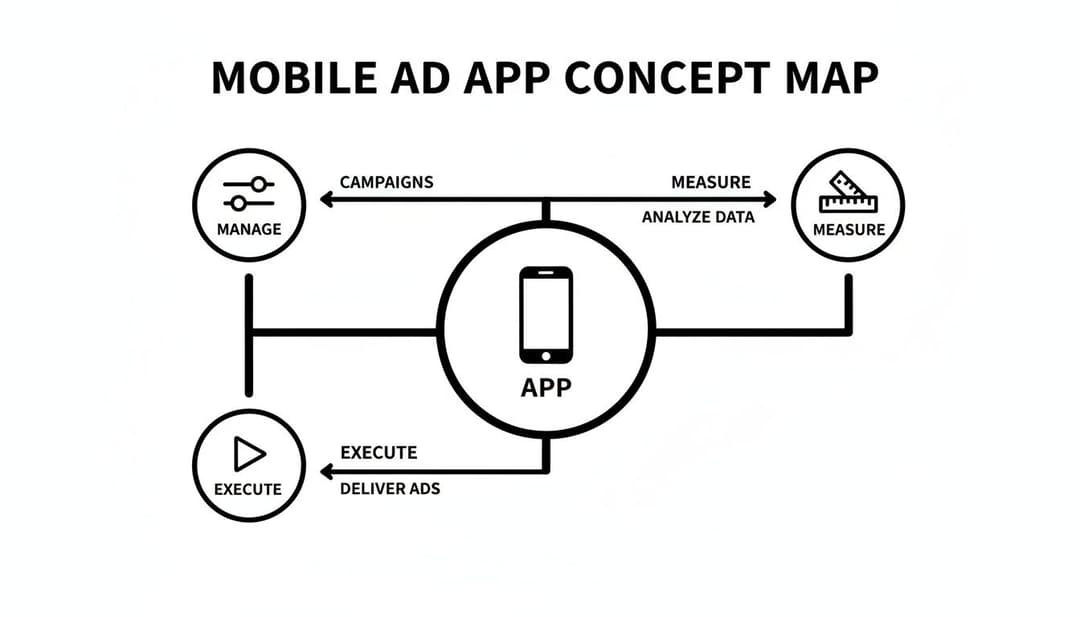
As the map shows, the right application brings all these moving parts into one streamlined view so you can see exactly what's going on.
How Ads Are Bought and Sold in Milliseconds
Today, most mobile ad space is bought and sold through a process called Real-Time Bidding (RTB). It all happens in the fraction of a second between you opening an app and an ad appearing on your screen.
Think of it like a lightning-fast stock market auction. When a user opens an app, a bid request is sent to an ad exchange, announcing, "Hey, I have an ad spot available!" Advertisers, using tools called Demand-Side Platforms (DSPs), instantly bid on that spot based on what they know about the user. The highest bidder wins, and their ad is served—all in the blink of an eye.
If you’re curious about the tech that advertisers use for this, our guide to the top Demand-Side Platforms takes a closer look at their side of the bidding war.
In-App Advertising vs. Mobile Web Advertising
Finally, it’s important to know the difference between the two main places your ads can show up: inside an app or on a mobile website.
In-App Advertising
- Environment: Ads are shown inside a native mobile app—think games, social media, or productivity tools.
- Data Richness: This environment is king for data. You get much deeper insights into user behavior, which allows for some seriously specific targeting.
- User Experience: In-app ads can be highly engaging, with formats like rewarded videos ("watch this ad for an extra life") or even playable demos.
Mobile Web Advertising
- Environment: These are the ads you see on websites you visit through a mobile browser like Chrome or Safari.
- Reach: Its biggest advantage is reach. You can connect with users without them needing to download a specific app.
- Challenges: This world is getting trickier to navigate due to privacy changes like the phase-out of third-party cookies in browsers.
Each channel has its own set of pros and cons. A solid mobile advertising application gives you the power to run campaigns across both, letting you put your budget where your audience actually is.
Measuring What Matters in a Privacy-First Era
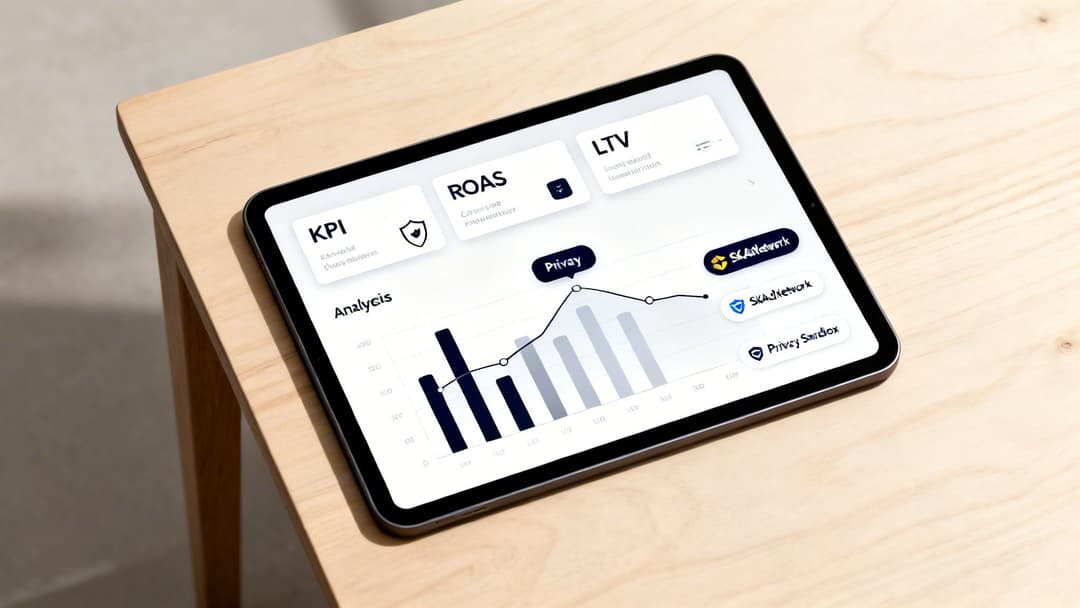
Sure, impressions and clicks can make your dashboard look busy, but they don't pay the bills. In mobile advertising, real success isn’t about vanity metrics; it's about connecting your ad spend to actual business outcomes that drive growth and profit.
The money is certainly flowing into mobile. Projections show that mobile will soak up 70% of all advertising budgets by 2028, and social ad revenue alone is on track to hit a staggering $255.8 billion that same year. With that kind of investment on the line, you can't afford to guess. You need a rock-solid focus on efficiency and a crystal-clear return on investment, which you can explore in our breakdown of the latest mobile advertising statistics and trends.
The KPIs That Actually Drive Growth
To get that clarity, savvy performance marketers zero in on a few Key Performance Indicators (KPIs) that truly matter. These are the numbers that bridge the gap between ad spend and revenue.
To make sense of it all, here's a table breaking down the metrics that should be on every performance marketer's radar.
| Essential Mobile Advertising KPIs | | :--- | :--- | :--- | | KPI (Key Performance Indicator) | What It Measures | Why It Matters for Marketers | | Cost Per Install (CPI) | The total cost of your ad campaign divided by the number of new app installs it produced. | This is your baseline cost for acquiring a new user. It’s the foundational metric for any user acquisition campaign. | | Return on Ad Spend (ROAS) | The total revenue generated from your campaign divided by the total ad spend. | This tells you if your campaign is profitable. For every dollar you put in, how many are you getting back? | | Lifetime Value (LTV) | The total projected revenue a single user will generate throughout their time with your app. | This is the north star metric for sustainable growth. Your LTV must be higher than your cost to acquire a user. |
Each of these metrics tells a crucial part of your campaign's financial story. Tracking them diligently is what separates campaigns that merely run from those that actually perform.
But knowing what happened is only half the battle. You also need to know why it happened. That’s where attribution enters the picture.
Mobile Attribution And The Role Of MMPs
Mobile attribution is the process of connecting a user action, like an install or an in-app purchase, back to the specific ad campaign that drove it. Think of it as a digital detective, piecing together clues to trace the user's journey from their first ad click all the way to a conversion.
To manage this complex process, most marketers partner with a Mobile Measurement Partner (MMP). An MMP is a neutral, third-party platform that plugs into all your ad networks and your app to act as a single source of truth for all your attribution data.
In simple terms, an MMP is like an independent referee in a high-stakes game. It makes sure every ad network gets the right credit for the conversions it drives, preventing problems like duplicate credit and giving you an unbiased view of which channels are actually working.
But just as marketers were getting comfortable, the rules of the game changed dramatically.
Navigating SKAdNetwork and the Privacy Sandbox
The old days of tracking every single user with perfect precision are over. Giants like Apple and Google have rolled out new frameworks that put user privacy first, forcing every marketer on the planet to rethink how they measure performance.
Apple’s SKAdNetwork (SKAN) is a privacy-first attribution system for iOS. When a user who has opted out of tracking installs an app after an ad click, SKAN sends a notification back to the ad network. The catch? The data is aggregated, delayed, and contains very little detail, making real-time optimization a massive challenge.
On the other side of the fence, Google’s Privacy Sandbox for Android is a collection of initiatives aimed at phasing out cross-app identifiers like the GAID. Both frameworks represent a fundamental move away from granular, user-level data and toward aggregated, privacy-safe measurement.
This new reality makes a smart mobile advertising application more critical than ever. Modern tools, including AdStellar, are built to operate within these new privacy constraints. They integrate directly with ad platforms to pull in whatever performance data is available and then use AI to spot patterns and trends that are now invisible to the human eye. To get a better handle on how this works, you can learn more about Meta's Conversions API and the part it plays in this new ecosystem.
Ultimately, winning in this privacy-first world means blending the power of MMPs, direct platform integrations, and AI-driven analysis. It’s about shifting from a reliance on perfect individual data to using smart, probabilistic models to prove the powerful ROI of your mobile ad campaigns.
Creating High-Performing Mobile Ad Campaigns

This is where the rubber meets the road. Running a killer mobile ad campaign isn't just about setting a budget and hoping for the best. It's a blend of sharp strategy and flawless execution, built on three unshakeable pillars: compelling creative, precise targeting, and relentless optimization.
Getting these right is what turns your mobile advertising application from a simple dashboard into a genuine growth engine. It’s how you cut through the noise, grab attention, and—most importantly—drive real, measurable results that actually move the needle for your business.
Design Thumb-Stopping Creative
In the blink-and-you-miss-it world of mobile feeds, you have maybe three seconds to stop someone's thumb. That's it. If your ad creative looks generic or lazy, you’ve just wasted your money. The ads that truly perform are the ones built from the ground up for the platform they're on and the person seeing them.
Think about what actually works:
- Vertical-First Video: People hold their phones vertically. So design for a full-screen, immersive experience. A badly cropped horizontal video just screams "lazy ad" and gets scrolled past instantly.
- A Crystal-Clear Value Prop: What's in it for them? Your ad has to answer that question immediately. Use bold text overlays to spell out the main benefit or a can't-miss offer.
- A Strong Call-to-Action (CTA): Don't be shy. Tell people exactly what you want them to do next. Whether it’s "Install Now," "Shop the Collection," or "Learn More," make your CTA impossible to miss.
Every detail counts in this fight for attention. This even includes platform-specific nuances like the optimal TikTok ad lengths, which can make or break engagement.
Build Precise Audience Segments
There's nothing more wasteful than showing the perfect ad to the wrong person. A powerful mobile advertising application gives you the tools to move beyond basic demographics and get surgically precise with your targeting. This is where you unlock serious performance gains.
The real magic happens when you stop targeting based on who people are and start targeting based on what they do. When you tap into behavioral data and build lookalike audiences, you're reaching people who have already raised their hand and shown they're interested.
Here's how you can get that specific:
- Behavioral Targeting: Go after users who have already interacted with your brand. Think people who have visited your website, abandoned a cart, or used your app before.
- Lookalike Audiences: This is a goldmine. You give a platform like Meta a list of your best customers—say, your highest LTV users—and its algorithm goes out and finds more people just like them.
- Interest and Intent Data: Target users based on the apps they have installed, the content they consume, and the topics they actively search for. It's a clear signal of what they care about right now.
This kind of precision ensures your ad feels relevant, not random. The result? Higher engagement and a much healthier Return on Ad Spend (ROAS).
Optimize with a Continuous Improvement Loop
The final piece of the puzzle is recognizing that no campaign is perfect on day one. Real success comes from a constant cycle of testing, measuring, and iterating. You launch, you learn, you adjust, and you go again.
For performance marketers, this creates massive opportunities, especially on platforms like Meta. It’s a perfect storm: a significant 91% of users report they've bought or plan to buy a product after seeing a relevant mobile ad, and the environment makes impulse buys 40% more likely on phones.
This is where AI-powered tools like AdStellar come in. They turn the painful, manual process of testing and optimizing into a huge strategic advantage. By automating creative testing and analyzing performance data in real-time, you can quickly identify what's working and scale your winners without drowning in spreadsheets. If your goal is app installs, you might also find our guide on advertising an app effectively helpful.
Real-World Scenarios for Performance Marketers
All this theory is great, but let's talk about what this looks like in the real world. As a performance marketer, you're not just dealing with abstract concepts; you're solving concrete business problems to drive measurable growth. A solid mobile advertising application is the tool that makes it all happen.
We’re going to walk through three everyday scenarios you’ve likely faced. For each one, we'll break down the goal, the metrics that matter, and how a smart platform can turn your strategy into actual revenue.
Launching a New E-commerce Product
Imagine a direct-to-consumer fashion brand is about to drop a new line of eco-friendly sneakers. The main objective? Generate sales and hit a profitable Return on Ad Spend (ROAS) right out of the gate. The marketing team is small, so they need to make a big splash without getting buried in manual work.
This is where a mobile advertising application becomes the command center for the entire launch.
- Objective: Drive those crucial initial sales and prove there's a market for the product with a positive ROAS.
- Key KPIs: ROAS, Cost Per Purchase (CPP), and Add to Cart (ATC) rate.
- Strategy: The team taps into a tool like AdStellar to quickly create hundreds of ad variations. They test different product shots, behind-the-scenes videos, and ad copy against several Lookalike Audiences built from their existing customer data. The platform’s AI gets to work, automatically pinpointing the winning creative and audience combos and shifting budget toward them.
What would have been a week-long manual slog becomes a task for a single afternoon. Instead of guessing which ad will land, the team gets clear, data-driven answers fast, helping them find their path to profitability much sooner.
Driving High-Quality Game Installs
Now, let's picture a mobile gaming studio that just released a new strategy game. Their success isn't just about getting downloads—it's about getting the right kind of downloads. They need players who will actually stick around and make in-app purchases.
The real challenge here is acquiring users whose Lifetime Value (LTV) will be higher than the Cost Per Install (CPI). This demands a much more surgical approach to targeting and a deep understanding of what users do after they install.
- Objective: Hit a target CPI of $2.50 while maximizing Day 7 retention.
- Key KPIs: CPI, LTV, Retention Rate, and Cost per In-App Purchase.
- Strategy: The user acquisition manager decides to focus their budget on Meta's ad platform. Using their mobile advertising application, they run App Install campaigns targeting users who’ve shown interest in similar strategy games. Crucially, they optimize their campaigns not just for installs, but for App Events like "level achieved" or "first purchase."
This is where an AI-powered platform truly shines. By analyzing historical data, it can predict which audience segments are most likely to become high-value players. This gives the studio the confidence to bid more aggressively for those valuable users while avoiding spend on players who are likely to churn after a day.
Generating Leads for a B2B SaaS Company
Finally, let's look at a B2B SaaS company trying to generate qualified leads for its new project management tool. Their target audience is made up of busy professionals who are often scrolling on their phones during their commute or between meetings.
This scenario shows just how important it is to reach business audiences in a mobile-first world. This trend is only getting stronger, especially as Asia-Pacific becomes a hotbed for mobile advertising, fueled by a boom in e-commerce and social app usage. In fact, a report from Fortune Business Insights projects China's mobile ad market will hit $25.54 billion by 2026. For agencies and scale-ups, this points to huge opportunities on platforms like Meta, where an AI tool can automate campaign tests to quickly find winning audiences. You can dive deeper into the numbers in the full mobile advertising market report.
- Objective: Generate marketing qualified leads (MQLs) at a target Cost Per Lead (CPL) of $40.
- Key KPIs: CPL, Lead-to-MQL Conversion Rate, and Click-Through Rate (CTR).
- Strategy: The marketer uses their mobile ad application to run lead generation campaigns on Meta, offering a valuable e-book in exchange for contact information. The platform's AI assembles ads using creative elements and copy from past successful campaigns. By automating A/B testing, they quickly discover the most effective messaging for each of their target personas, driving down the CPL and filling their sales pipeline faster.
Choosing the Right Mobile Ad Application
Picking the right mobile ad platform isn't just about finding a tool with a slick dashboard. Think of it as choosing a strategic partner. The right one will handle what you need today and grow with you tomorrow, while the wrong one can burn through your budget, frustrate your team, and leave a trail of missed opportunities.
This final section is your game plan for evaluating your options. We'll walk through the must-have criteria for choosing a mobile advertising application that actually fits your goals, ensuring you get the best possible return on your investment.
Core Functionality and Integrations
First things first, you need to look under the hood. A great application doesn't just simplify your workflow; it should make it smarter. And it absolutely must integrate with the ad networks you rely on, especially workhorses like Meta Ads Manager. That part is non-negotiable.
Here are the features that separate the contenders from the pretenders:
- Bulk Ad Creation: Can you spin up hundreds of creative and audience variations in minutes? Building campaigns by hand is a momentum-killer that severely limits how much you can test.
- AI-Driven Optimization: Does the tool use AI to sift through performance data and give you clear, actionable recommendations? Modern platforms should do more than just report numbers; they should help you spot winners and scale them automatically.
- Centralized Asset Management: Is there one place for all your creatives, audiences, and ad copy? A single source of truth prevents chaos and makes it easy for your team to find and reuse assets that have already proven their worth.
A top-tier mobile advertising application should feel like an extension of your team. It handles the repetitive, low-value work so your marketers can escape the spreadsheets and focus on big-picture strategy and creative ideas.
Data Security and Support
Giving a third-party tool access to your ad accounts is a serious decision, so data security has to be a top concern. Make sure the application uses secure connection methods, like OAuth, to access your data without ever seeing or storing your passwords. Your performance data is a valuable company asset—protect it.
Beyond the tech, you need to think about the practical side of things:
- Transparent Pricing: Is the pricing model straightforward and predictable? Steer clear of platforms with confusing tiers or hidden fees that make it impossible to know your true cost.
- Responsive Support: When things go sideways, can you get ahold of someone who actually understands performance marketing? Test their support before you sign a contract. It’s a great way to see how they’ll treat you when it really matters.
- Scalability and Roadmap: Does the platform have a vision for the future? You want a partner who is constantly innovating and adding features that will keep up with your growth.
Choosing the right platform is a major strategic move. Use this checklist to vet your options, and you’ll find a mobile advertising application that’s not just a tool, but a true engine for your company’s growth. For example, digging into the details of how a platform uses AI optimization for Meta ads can be the key to unlocking massive scale for your campaigns.
Frequently Asked Questions
Diving into mobile advertising always brings up a few key questions. We've gathered some of the most common ones from performance marketers to clear things up and help you move forward with confidence.
What Is the Main Difference Between an Ad Network and an Ad Exchange?
It helps to think of it this way: an ad network is like a curated retail store, while an ad exchange is like a massive, open stock market.
An ad network acts as a middleman. It gathers ad inventory from a bunch of app publishers and packages it up to sell to advertisers. It’s a more managed and straightforward environment—you’re essentially buying from a single, large supplier who has sourced everything for you.
An ad exchange, on the other hand, is the raw technology platform where the buying and selling happens in real-time. Countless publishers and advertisers connect here to bid on ad impressions through a process called Real-Time Bidding (RTB). It offers a lot more transparency and control but is also way more complex to navigate.
How Does SKAdNetwork Actually Work for iOS Attribution?
SKAdNetwork is Apple's answer to privacy-focused attribution on iOS. When someone who has opted out of tracking clicks an ad and installs your app, SKAdNetwork sends a single, anonymous signal back to the ad network.
The key thing to understand is that this signal, or "postback," contains zero user-level data. It confirms an install came from a specific campaign, but it’s deliberately delayed and bundled with other data to make it impossible to tie back to an individual. For marketers, this means tracking individual user actions is a thing of the past. You absolutely need a mobile advertising application that can make sense of this aggregated data to spot performance trends.
Is an AI Tool Useful If I Only Run a Few Campaigns?
Yes, absolutely. The real power of an AI tool isn't just in managing hundreds of campaigns at once. It’s about making the handful of campaigns you do run smarter and more effective right out of the gate.
An AI-powered tool can analyze your past performance to pinpoint the best creative and audience combinations before you spend a single dollar. This cuts out the expensive guesswork and helps you find a profitable formula much, much faster.
Even if you're working with a smaller budget, AI helps you test your ideas more efficiently and gives you the data-backed confidence you need to scale your winners. It lets you focus on high-level strategy instead of getting bogged down in manual setup, no matter how many campaigns you're running.
Ready to stop guessing and start scaling your Meta campaigns? AdStellar uses AI to help you launch, test, and optimize ads 10x faster. Discover how AdStellar can transform your workflow and boost your ROAS.