Welcome to the new playbook for advertising an app. If you think building a great product is enough to guarantee success, I've got some bad news for you. The app stores are more crowded than ever, and getting noticed requires a sharp, data-backed strategy. This isn't about generic advice; it's a real-world framework I've seen work time and again for launching and scaling app advertising campaigns that actually deliver.
Navigating the New App Advertising Landscape
The days of "if you build it, they will come" are long gone. Just getting your app onto the store is the easy part. The real challenge is breaking through the incredible amount of noise, and that takes a smart, significant investment. You're not just up against other apps in your category; you're competing for a user's finite attention and screen time.
This fight for attention is fueled by some serious cash. In 2025, global mobile ad spend is projected to hit a staggering USD 264.72 billion. And where is that money going? A massive 64% of it is pouring into in-app ads, which tells you exactly where marketers see the most value.
From Marketplace to Strategy
To win, you have to move from just participating in the marketplace to executing a focused strategy. It’s no longer about just being present—it’s about being precise.
This diagram shows how the modern app advertising process works. It's not a simple path from spending money to getting users.
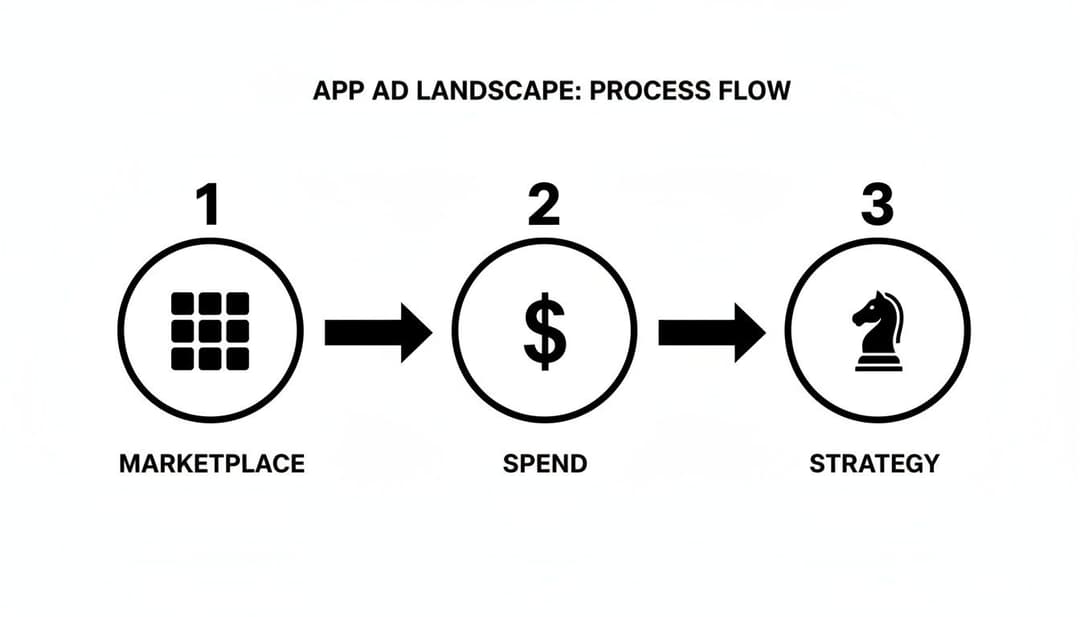
The key takeaway here is that a well-defined strategy is the bridge connecting your ad spend to real, measurable results. Without it, you're just throwing money into the wind.
To truly succeed in the current climate, it's essential to develop a comprehensive and strategic modern playbook for user acquisition. This means aligning every dollar spent with clear business objectives and audience insights.
On top of the competition, we're also dealing with a major shift in user privacy. With changes like Apple's App Tracking Transparency (ATT), the easy-access data that once powered ad targeting has vanished. This has made first-party data—the information you collect directly from your users—incredibly valuable. For a deeper dive, our guide on the decline of https://www.adstellar.ai/blog/third-party-data offers more context.
The bottom line? Your direct relationship with your users is now more critical than ever.
The Groundwork: Nailing Your App Growth Strategy Before You Spend a Dime
Before you even think about spending your first dollar on advertising an app, you need a solid plan. Just aiming to "get more users" is a surefire way to burn through your budget with little to show for it. A strong advertising foundation isn't built on vague hopes; it’s built on clear, measurable goals that tie directly back to your bottom line.
This means looking past the vanity metrics and zeroing in on the numbers that actually drive sustainable growth.
The fight for user attention is brutal. To put it in perspective, gaming apps alone funneled USD 29 billion into user acquisition in 2023. With global mobile ad spend expected to rocket past USD 400 billion by 2025, having a smart strategy isn't just a good idea—it's a matter of survival.

Defining Your Core Advertising KPIs
Your key performance indicators (KPIs) are the compass that tells you if your advertising is actually working. Instead of getting lost in a sea of impressions or clicks, let's break down the most critical KPIs for app advertising.
Here's a quick look at the metrics that should be at the heart of your strategy.
| KPI | What It Measures | Strategic Importance |
|---|---|---|
| Lifetime Value (LTV) | The total revenue a single user is expected to generate over their entire time with your app. | This is your true north. It tells you exactly how much a new user is worth to your business and sets the ceiling for your acquisition costs. |
| Cost Per Action (CPA) | The amount you pay for a specific user action, like a sign-up, free trial, or first purchase. | This is your core acquisition cost. Defining a target CPA is fundamental for managing ad spend and ensuring each action is profitable. |
| Return on Ad Spend (ROAS) | The direct measure of profitability, calculated as (Revenue from Ads / Ad Spend). | This is the ultimate bottom-line metric. It shows you how much revenue you’re generating for every dollar spent on ads. |
These KPIs aren't just numbers on a dashboard; they are the financial guardrails that keep your campaigns profitable and scalable.
Your goal is simple: LTV must be greater than your CPA. If it costs you $10 to acquire a user (CPA) who only brings in $8 in lifetime revenue (LTV), you're losing money with every conversion. This simple math should drive every budgeting and optimization decision you make.
Building Your Ideal User Persona
Once your financial targets are locked in, you need to figure out exactly who you're talking to. Great app advertising isn't about shouting into the void; it's about having a laser-focused conversation with the people who will actually love and use your app.
Forget guesswork. Your most valuable insights are sitting right inside your existing user base. It's time to dig into your first-party data and find the common threads that connect your best customers.
Here’s how to build a persona that’s grounded in real data:
- Analyze Demographics: Start with the basics—age, gender, location, language. Do clear patterns emerge? A fitness app, for example, might find its power users are predominantly women aged 25-40 living in major cities.
- Identify Behaviors: What do your best users do in the app? For an e-commerce app, this could be users who frequently use the wishlist feature or make repeat purchases within their first 30 days.
- Understand Psychographics: What are their interests, values, and pain points? A meditation app might discover its core audience values stress reduction and self-care, and they tend to follow mindfulness influencers online.
This data-driven approach gives you a rock-solid foundation for targeting. For a more detailed guide, you can check out our post on how to identify different types of target markets.
With this information, you can build powerful lookalike audiences on platforms like Meta. These audiences let the ad algorithms find new people who share the same traits as your most profitable users. It’s one of the most reliable ways to scale a campaign while keeping your ROAS strong.
Mastering Creative That Actually Converts
In the world of app advertising, your creative is everything. It's your single most powerful performance lever. While you can spend all day tweaking channels and bids, it’s the creative that actually stops the scroll, tells your story, and gets someone to tap "Install." Forget about throwing ideas at the wall and seeing what sticks; a systematic approach to making and testing ads is what separates the top-charting apps from the ones that never get off the ground.
Your creative workflow needs to be a direct extension of your audience strategy. Those user personas you built? They aren't just for targeting—they're the blueprint for every single ad you produce. Each creative concept should speak directly to a specific persona's needs, frustrations, and goals.
From Audience Insights to Creative Concepts
The best ad ideas I’ve ever seen come from a deep understanding of what the user actually wants.
Think about a fitness app. You might have one persona who's a busy professional and needs quick, 15-minute home workouts. Another could be a new parent looking for gentle, post-natal recovery exercises. Your ads for each should look and feel completely different.
- For the Professional: You'd want a fast-paced video showing how a workout can slot right into a jam-packed morning. The copy should hammer on words like "efficiency" and "energy."
- For the New Parent: The ad should be calmer, more empathetic, showcasing gentle movements. Here, the copy needs to highlight "safety," "self-care," and "regaining strength."
This is how you graduate from generic ads to ads that feel personal and incredibly relevant. When you ground your concepts in persona-driven hypotheses, you're not just making ads—you're solving a real problem for your ideal customer. For more tips on this, check out our guide on writing great advertising copy that connects with your audience.
Building a Rigorous Creative Testing System
The single biggest mistake I see growth teams make is getting complacent. They find one creative that works reasonably well and just run it into the ground. A rigorous testing system is your engine for growth, ensuring you’re always finding better ways to talk to your audience.
Start by breaking down your ad creative into its core components. From there, you can build a system to test each element methodically.
Key Creative Components to Test:
| Creative Element | Example Test Ideas |
|---|---|
| The Hook (First 3 Seconds) | User-generated content (UGC) vs. a polished animation vs. a text-based question. |
| The Core Message | Focusing on a specific feature vs. a key benefit vs. a user testimonial. |
| The Visual Style | Bright, bold colors vs. a minimalist aesthetic vs. live-action footage. |
| The Call-to-Action (CTA) | "Install Now" vs. "Start Your Free Trial" vs. "Get Your Personalized Plan." |
Here's the key: don't try to test everything at once. Isolate one variable per test. For instance, use the exact same video but test three different opening hooks. Once you find a winning hook, lock it in and move on to testing the next thing, like the call-to-action. This iterative process is how you stack small wins that turn into massive performance gains.
I once worked with a gaming app that saw a 40% decrease in their Cost Per Install (CPI) just by changing the first three seconds of their video ad. They switched from showing generic gameplay to a "fail" video of a player making an obvious mistake. That tiny tweak made the ad far more engaging and drove a huge improvement in ROAS.
Scaling Creative Production with AI
Let's be honest: building and testing hundreds of ad variations by hand is a soul-crushing task. It's slow, it's expensive, and it's almost always the biggest bottleneck for growth teams. This is where modern tools can completely change the game, allowing you to scale your creative output without having to scale your headcount.
Platforms like AdStellar AI are built to solve this exact problem. Instead of manually editing videos or designing images one by one, you can generate hundreds of ad variations in minutes.
Imagine this scenario:
- Input Your Assets: You upload a few core video clips, key messages, logos, and your CTA text.
- Define Your Angles: You tell the AI to create variations based on different angles—one focused on "fun," another on "competition," and a third on "relaxation."
- Generate & Launch: The AI automatically mashes up these elements into hundreds of unique ad combinations—different hooks, different music, different text overlays—and pushes them live to Meta with a single click.
This isn't just about moving faster; it's about getting smarter. By launching so many variations at once, you can quickly see which combinations of message, visual, and audience are the real winners. The platform's AI then analyzes the performance data, showing you exactly which creative elements are driving the best ROAS. This creates a powerful feedback loop where the data from today’s tests fuels even better creative ideas for tomorrow.
Choosing and Winning on High-Impact Ad Channels
A killer creative can’t save a campaign running on the wrong platform. Knowing where to advertise your app is every bit as important as knowing what to advertise. Let's dig into the nitty-gritty tactics for the channels that consistently deliver for mobile app advertisers.
Each platform is its own unique ecosystem with different algorithms, user behaviors, and unwritten rules. Slapping the same strategy across every channel is a surefire way to burn through your budget. Instead, you need to tailor your approach to play to each one's strengths.
Succeeding on Meta with Advantage+ App Campaigns
Meta's Advantage+ App Campaigns (AAC) have become the go-to for most app advertisers, and for good reason—they are incredibly powerful. The trick is knowing how to guide the algorithm without getting in its way. You need to give it clean, strong signals and then let it do its job.
Here’s how I recommend structuring your AAC setup:
- Consolidate Your Campaigns: Fight the temptation to create dozens of tiny, fragmented campaigns. Start with one consolidated AAC campaign focused squarely on your most important goal, whether that's in-app purchases or trial starts.
- Feed It Your Best Data: Your first-party data is gold. Upload a customer list of your highest-LTV users. This gives the algorithm a crystal-clear portrait of the exact type of person you want it to find.
- Diversify Your Creative: This is your primary lever for control. Pack the campaign with a wide mix of creative assets—user-generated content, polished animations, static images, and plenty of different aspect ratios. The algorithm will figure out what works.
A common mistake I see is over-segmenting audiences within an AAC. Advantage+ is built to find the audience for you. By adding too many targeting layers, you're just tying the algorithm's hands and stopping it from finding performance pockets you never would have thought to look for.
Winning Keywords with Apple Search Ads
Apple Search Ads (ASA) is your bottom-of-funnel workhorse. It captures users with sky-high intent, right at the moment they’re actively searching for an app just like yours. Winning here comes down to a smart keyword strategy that balances finding new users with defending your own turf.
I always structure my ASA campaigns into four distinct themes:
- Brand Campaign: Bid aggressively on your own brand name and any common misspellings. If you don't, your competitors absolutely will. This is pure brand defense.
- Competitor Campaign: Target the names of your direct rivals. This lets you get in front of users who are already weighing their options in your category.
- Generic Campaign: Bid on broad, non-branded terms relevant to what your app does (e.g., "photo editor," "meditation app"). This is how you capture new users who haven't heard of you yet.
- Discovery Campaign: Turn on Search Match and let Apple find new, relevant search terms for you. Check the search terms report from this campaign regularly and pluck out high-performing keywords to move into your other campaigns as exact matches.
This structure gives you granular control over bids and budgets. It ensures you aren't overpaying for broad discovery terms while still capturing those high-value, high-intent searches.
Mastering Google App Campaigns
Google App Campaigns (UAC) operate on a similar machine-learning-driven logic as Meta's AAC. To get great results, your job is to feed the system the right inputs and signals so it can find your most valuable users.
Your focus should be on two things: asset quality and conversion signals. Make sure you upload the maximum number of assets allowed: 20 images, 20 videos, and 5 HTML5 assets. This gives Google's algorithm enough raw material to test and find winning combinations across its massive inventory, from YouTube and Google Play to the Display Network.
Even more importantly, you have to send rich, post-install event data back to Google. Don't just optimize for installs. Optimize for the actions that actually make you money, like add_to_cart, start_trial, or level_achieved. The more high-quality event data you send, the smarter the algorithm gets at finding people who will actually perform those actions.
To get a better sense of how Google fits into the wider ecosystem, you can check out our overview of the top PPC advertising platforms. It can help you visualize where each channel shines in your overall marketing mix.
Decoding Attribution and Optimizing for Profit
If you don't know which ads are bringing in your best users, you might as well be lighting your ad budget on fire. That’s the hard truth. Accurate measurement—the science of connecting an install or purchase back to a specific ad—is what separates the pros from the amateurs in app advertising.
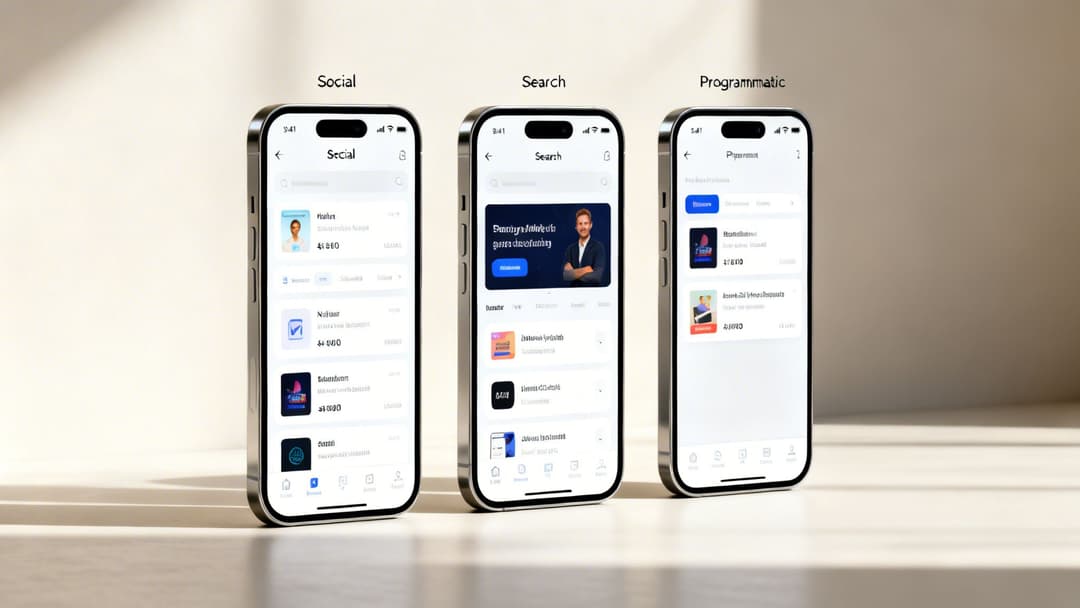
But let's be real, the game has changed. Privacy updates, especially Apple's App Tracking Transparency (ATT), completely upended the old ways of doing things. The days of perfectly tracking every user with a device ID are over. Now, we operate in a new world built around user privacy, using different signals to guide our optimizations.
Navigating the World of Modern Attribution
The biggest player in this new landscape is Apple's SKAdNetwork (SKAN). Instead of giving you granular, user-level data, SKAN sends delayed, anonymous data dumps back to ad networks. These "postbacks" tell you which campaign drove an install, but they’re intentionally fuzzy to keep individual users anonymous.
This new reality makes a couple of things non-negotiable for any serious advertiser:
- Mobile Measurement Partners (MMPs): You absolutely need a tool like AppsFlyer, Adjust, or Singular. Think of your MMP as your mission control. It collects all the messy SKAN data from every ad network, cleans it up, and presents it in a way that actually makes sense. Without one, you're just flying blind.
- Server-to-Server (S2S) Integrations: To get more reliable data, you have to set up S2S connections. This lets your app's backend talk directly to the ad platforms, cutting through some of the noise of on-device tracking. For example, if a user subscribes, an S2S event can confirm that conversion with much higher fidelity. Our deep-dive on the Meta Conversions API offers valuable insights into how this server-side tracking works.
In this privacy-first era, you're no longer tracking individual people. You're tracking patterns and cohorts. Your goal is to understand which channels, campaigns, and creatives are bringing in groups of high-value users, even if you can't tie every single dollar back to a specific person.
To truly get a handle on attribution and boost your profits, having the right tools is half the battle. You can learn more about the best mobile app analytics tools to find a platform that fits your specific needs. These tools are crucial for making sense of complex data streams from sources like SKAN.
A Practical Routine for Optimization and Scaling
Okay, so your measurement is set up. Now it's time to turn all that data into smart decisions. A solid optimization routine isn't about panicking and making huge changes every single day. It's a steady, systematic process of spotting trends and moving your budget where it will have the biggest impact.
Here's a simple yet powerful weekly routine I've used for years:
- Start High-Level: First, look at campaign performance. Are you hitting your target ROAS or CPA? I always review at least a 7-14 day window to smooth out any weird daily spikes or dips.
- Drill Down to Ad Sets: Next, identify your winners and losers at the ad set (or ad group) level. Which audiences are crushing it? This is where you'll start making real decisions.
- Analyze Your Creatives: Inside your best-performing ad sets, which ads are doing the heavy lifting? Look for patterns. Is it a specific user-generated video, a certain color palette, or a unique benefit that's catching people's attention?
This weekly check-in gives you everything you need to manage your budget with clear, data-backed rules.
Rules for Budget Allocation
This isn't about gut feelings. It's about having a playbook.
| Action | When to Do It | Why It Works |
|---|---|---|
| Scale Winning Ad Sets | The ad set's ROAS is 20%+ above your target, and it has enough daily conversions. | Bump the budget by 15-20% every 2-3 days. This gradual approach prevents you from shocking the algorithm and lets it find more high-value users efficiently. |
| Cut Underperformers | An ad set has spent 2-3x your target CPA without a single conversion. | Turn it off. Seriously. Don't fall into the trap of "just one more day." The data is telling you to cut your losses. |
| Reallocate the Budget | You've just paused a few underperforming ad sets. | Immediately move that freed-up cash to your top performers. This ensures every dollar is working as hard as it possibly can to grow your app. |
Your Questions on Advertising an App Answered
When you're first diving into app advertising, the same questions pop up time and time again. I get it. It can feel like you're trying to navigate a maze in the dark.
Let's cut through the noise. Here are my straight-up answers to the most common questions I hear from app marketers, based on years of in-the-trenches experience.
How Much Should I Budget for Advertising My App Initially?
Everyone wants to know the magic number for an initial ad budget, but the truth is, it doesn't exist. Instead, you need to think in terms of a testing budget.
Your first goal isn't to get rich overnight. It's to buy data. You need to spend enough to see what works across three to five different audience segments and at least 10-15 creative variations. For most apps just starting out, this usually lands somewhere between $5,000 and $25,000 for the first month.
Once you find a predictable CPA and a winning mix of audience, creative, and channel, you'll have the data to build a scaling budget based on your app's actual lifetime value (LTV).
What Is a Good ROAS for an App Campaign?
This is another "it depends" answer, but I can give you some solid guideposts. A "good" return on ad spend (ROAS) is completely tied to your app's business model and profit margins. An e-commerce app might need a 3:1 ROAS to be profitable, while a subscription app with high retention could thrive on a 1:1 ROAS because the long-term value is so strong.
The most important rule is that your target ROAS must be above your break-even point. A healthy initial target for many apps is a 2:1 or 3:1 ROAS, but you must calculate your own break-even point based on your unique unit economics before you start spending.
How Long Should an Ad Test Run Before I Make a Decision?
Patience is a virtue in ad testing. The right duration comes down to your daily budget and how much your conversions cost. You simply need enough data to make a statistically sound call.
For low-cost events like an app install, you might have a clear winner in just 3-5 days. But if you're optimizing for a pricier action like a first-time purchase or a subscription, you'll likely need to let the test run for 7-14 days. Don't make knee-jerk reactions based on a single good or bad day—performance always fluctuates.
A solid rule of thumb is to let an ad set spend at least 2-3 times your target CPA before you even think about touching it. This ensures you're making decisions on real patterns, not just random luck.
Ready to stop guessing and start scaling? AdStellar AI automates the entire process of launching, testing, and optimizing your Meta ad campaigns. Generate hundreds of ad variations in minutes, discover winning creatives with AI-powered insights, and let our platform scale your best performers automatically. Learn more and see how AdStellar AI works.