At its core, a mobile advertising application is simply any app on a person's phone that can show ads. Think of the endless scroll of a social media feed, the short break between levels in a game, or the articles you read in a news app. These are the modern-day billboards and town squares where brands can connect with their audience.
They’re not just passive ad slots, though. These applications are the very foundation of mobile marketing, creating a dynamic ecosystem where you can put your products directly in front of interested users.
The Digital Cityscape of Mobile Advertising

It helps to picture the entire mobile app world as a sprawling digital city. Every app on a user’s phone is a distinct neighborhood—gaming apps are the entertainment districts, social apps are the bustling public squares, and utility apps are the business centers. Mobile advertising applications are the infrastructure that lets you place billboards and interactive pop-up shops in exactly the right neighborhoods.
This isn't about blanketing the city with generic flyers. It's about precision. You can show an ad for a new pair of running shoes inside a fitness tracking app or promote a financial tool within a stock market app. It's this ability to deliver relevant messages in the right context that makes these applications so powerful.
Why Mobile Ads Are Essential for Growth
The sheer scale of this digital city is hard to overstate, and it’s growing at an incredible pace. The global mobile advertising market was valued at an astonishing $319.49 billion in 2025 and is projected to hit $367.6 billion by 2026. North America currently leads the charge with a 37.1% market share, but the Asia Pacific region is catching up fast, showing the most rapid growth. You can dive into deeper market analysis to see these global trends in action.
For anyone in e-commerce or user acquisition, these numbers are impossible to ignore. Mobile ads are expected to make up 75% of all digital ad spend by 2026. What’s more, a staggering 91% of users report making a purchase after seeing an ad they felt was relevant. Mastering mobile advertising is no longer just a good idea—it’s critical for survival.
This dominance really boils down to three simple realities:
- Ubiquitous Presence: People spend hours on their phones every single day. This creates a constant stream of opportunities to engage them where they’re already spending their time.
- Rich Data: Mobile apps offer a treasure trove of insights into user behaviors, interests, and even real-time location. This allows for incredibly personal and effective ad targeting.
- Direct Conversion: A user can see an ad and, with just a few taps, install an app or buy a product without ever leaving their device. The path from discovery to conversion is incredibly short and seamless.
For any performance marketer looking to drive real results, from brand awareness to sales, getting a handle on this ecosystem is the absolute first step.
Navigating Core Ad Formats and App Types
To get anywhere with mobile advertising, you first have to understand the language of the space—the ad formats. Think of these as the different tools in your marketing toolkit. Picking the right one is often the single biggest factor between an ad that gets scrolled past and one that actually gets a user to take action.
The secret is context. You wouldn't put a loud, flashy ad in the middle of a serious news app, just like you wouldn't use a quiet, text-heavy ad in a high-energy mobile game. Success means respecting the user's experience. This isn't just a nice idea; it's the engine driving a market that hit $352.20 billion in 2024 and is on track to reach $533.90 billion by 2029. You can get a closer look at how social platforms amplify mobile ad spend to see where this growth is coming from.
The Value Exchange of Rewarded and Interstitial Ads
Picture a gamer who just ran out of lives on a particularly tough level. An option pops up: watch a 30-second video for an extra life. They almost always say yes. That’s a rewarded video ad, and its power comes from a simple, clear value exchange. The user gets something they want, and you, the advertiser, get their undivided attention.
Then you have interstitial ads. These are the full-screen ads that appear during natural breaks in the app experience, like between game levels or articles. When they’re timed right, they can deliver a powerful brand message without feeling like a jarring interruption.
Below is an example of a common ad format, showing how it fits into the app's user interface.
This image shows a classic banner ad. It stays at the bottom of the screen, providing a constant brand presence that’s much less intrusive than a full-screen takeover.
Blending In With Native and Playable Ads
Not every ad has to feel like an ad. Native ads are the chameleons of the ad world, designed to match the look, feel, and function of the app they're in. A sponsored article in your news feed or a promoted product on an e-commerce site are perfect examples. Because they don’t shout "I'm an ad," they blend in and often see much higher engagement.
And for app marketers, playable ads are a true game-changer, especially in the gaming world. These aren't just ads; they're interactive, bite-sized demos of your app that let users try before they download.
By offering a taste of the core gameplay or functionality, playable ads attract highly qualified users who are more likely to install and remain engaged, dramatically improving return on ad spend.
Getting a handle on these formats is your first real step toward building a winning strategy. To see how these formats tie into specific campaign goals, take a look at our complete guide on advertising an app effectively. Each one has a job to do, and knowing which to use when gives you a massive advantage.
Taking a Look at the Programmatic Ad Ecosystem
To really get a handle on how mobile advertising applications work on a massive scale, you have to peek behind the curtain. What you’ll find is an automated engine called programmatic advertising. The best way to think about it is like a super-fast, completely automated stock market, but for ad space. Instead of trading shares, this market buys and sells ad impressions in the few milliseconds it takes for an app on your phone to load.
It all boils down to a few key players who make this high-speed transaction possible. For advertisers—the "buy-side"—the main tool of the trade is a Demand-Side Platform (DSP). Think of a DSP as your personal shopper, hunting down and bidding on the best ad inventory that matches your campaign goals and ideal audience.
On the other side of that deal, you have the "sell-side," which is where Supply-Side Platforms (SSPs) come in. These platforms are what app developers and publishers use to manage all their available ad space (their inventory) and sell it to the highest bidder. An SSP's entire job is to get the best price and make the most money for the app owner.
The Lightning-Fast Ad Auction
So, where do the buyers and sellers actually meet? They connect in a digital marketplace known as an Ad Exchange. This is the trading floor where the auction goes down. The moment a user opens an app, an ad request zips out, kicking off a real-time bidding (RTB) auction.
This whole journey, from a user opening an app to seeing a relevant ad and making a purchase, is mapped out below.
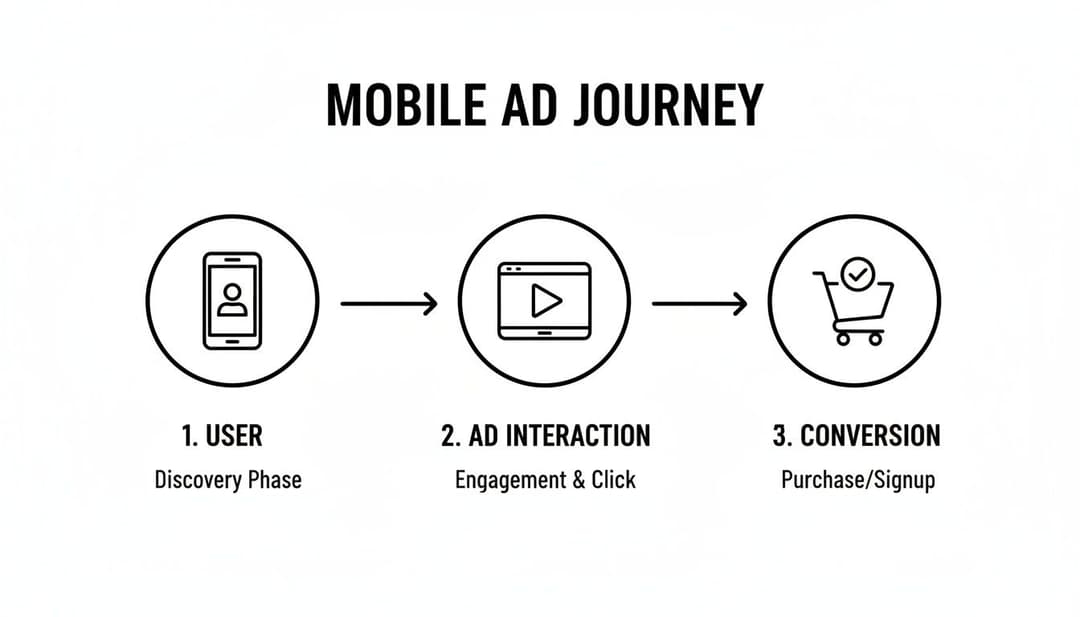
As you can see, the entire system is built for speed, designed to serve up the right ad and drive an action in an incredibly tight timeframe.
DSPs place bids on behalf of advertisers, and the one willing to pay the most wins the right to show their ad to that specific user, right then and there. The entire process, from request to the ad appearing on-screen, is over in less time than it takes you to blink. If you want to get a closer look at the tools advertisers use, check out our guide on the top demand-side platforms in the market today.
The Role of the SDK
Now, the piece of tech that actually wires an app into this massive ecosystem is the Software Development Kit (SDK). An SDK is just a small chunk of code that app developers build directly into their application.
An SDK is the communication line between the app and all the ad platforms. It’s what sends out the ad request, gets the winning ad creative back, and makes sure it displays properly on the user’s screen.
Without an SDK, an app would be completely isolated from the programmatic world. It’s the key that unlocks the door. It handles not just showing the ads but also collecting the crucial data needed for targeting, measuring results, and optimizing campaigns for better performance. Essentially, the SDK is what lets mobile apps tap into this automated, billion-dollar marketplace.
Mastering Targeting and Measurement for Performance
Simply placing an ad inside an app and hoping for the best is a surefire way to burn through your budget. The real power of mobile advertising comes alive when you get the right message in front of the right person, precisely when they’re ready to act. This is where sharp targeting and accurate measurement turn your ad spend into a predictable revenue stream.
It’s time to think beyond broad demographics. Imagine you're selling high-end coffee beans. Casting a wide net and showing your ads to everyone is not only expensive, it’s incredibly inefficient. A far smarter approach is to focus only on people who have already shown they’re interested in products just like yours.
Advanced Targeting Strategies
To get this kind of laser-focused precision, performance marketers have a few powerful techniques up their sleeves. Each one uses different signals to pinpoint users with high potential, making sure your ad budget is spent on audiences who are actually likely to convert.
Contextual Targeting: This is all about placing your ad in the perfect environment. For our coffee brand, it could mean showing an ad inside a recipe app on a page about espresso desserts. Or maybe within a news article reviewing the best boutique coffee roasters.
Behavioral Targeting: This strategy zeros in on a user's past actions. It lets you reach people who have recently browsed for coffee grinders, visited a competitor's website, or even installed apps related to home brewing.
Lookalike Audiences: This is easily one of the most powerful tools in any marketer’s arsenal. You can upload a list of your best customers to a platform like Meta and ask it to find new users who share similar traits and online behaviors. Just like that, you have a high-quality prospecting audience built from scratch.
By weaving these methods together, you create a layered strategy that makes your ads dramatically more relevant—and as a result, boosts their performance.
The goal isn’t just to find more users; it’s to find more of your best users. A well-executed targeting strategy minimizes wasted ad spend and puts every dollar to work acquiring customers who will drive long-term value.
Mobile Ad Targeting Methods Compared
To better understand how these strategies differ, let's break them down. Each method offers a unique way to find your ideal customer, and combining them often yields the best results.
| Targeting Method | How It Works | Primary Goal |
|---|---|---|
| Contextual | Places ads based on the content of the app or webpage the user is currently viewing. | Reach users who are actively engaged with relevant topics right now. |
| Behavioral | Uses historical data like browsing history, app usage, and past purchases to target users. | Find users based on their demonstrated long-term interests and habits. |
| Lookalike | Analyzes your existing customer list to find new people with similar characteristics and behaviors. | Scale your customer base by finding new prospects who resemble your best customers. |
| Demographic | Targets users based on age, gender, location, language, and other self-reported data. | Reach broad segments of the population that fit a general customer profile. |
| Retargeting | Shows ads to users who have previously interacted with your brand (e.g., visited your site). | Re-engage warm leads and guide them toward a conversion or purchase. |
While methods like demographic targeting provide a good foundation, layering in behavioral, lookalike, and contextual signals is what truly separates a decent campaign from a great one. This multi-pronged approach ensures your message is not just seen, but that it resonates.
Focusing on Performance Metrics That Matter
Once your campaigns are reaching the right people, the focus immediately shifts to measurement. A performance-first mindset means you stop obsessing over vanity metrics like clicks and impressions and start tracking the numbers that tie directly to business goals. For a deeper dive, understanding how ad attribution tracking explained is the critical first step in connecting ad views to actual conversions.
Here are the key performance indicators (KPIs) that truly matter in mobile advertising:
Return on Ad Spend (ROAS): This is the ultimate bottom line. For every $1 you put into ads, how much revenue do you get back?
Cost Per Acquisition (CPA): This metric tells you exactly what it costs to get one new customer. It’s essential for managing your budget and making sure your growth is profitable.
Customer Lifetime Value (LTV): This metric forces you to look beyond the first purchase. It helps you understand the total revenue a customer will likely generate over their entire relationship with your brand, ensuring you aren't overspending to acquire low-value users.
When you obsess over these core metrics, you transform your advertising from an expense into a scalable growth engine. This data-driven feedback loop allows you to constantly refine your targeting, test new creative, and reinvest in the strategies that deliver real, measurable results.
How AI and Automation Accelerate Mobile Advertising
The days of manually grinding through ad campaign setup, testing, and optimization are numbered. AI and automation are completely reshaping the day-to-day for performance marketers, compressing what used to be days of tedious work into mere minutes. This isn't just about speed; it's about shifting from reactive tweaks to a truly proactive, data-backed strategy.
Imagine trying to test hundreds of ad variations by hand. You'd be juggling different images, headlines, and audience segments—a logistical nightmare. AI-powered mobile advertising applications cut through this complexity by automating the entire cycle, giving teams the power to scale their efforts with incredible precision.
The Power of Automated Creative and Audience Testing
Platforms like AdStellar AI plug directly into your data sources, like Meta Ads Manager, and immediately start digesting your historical performance data. The AI then gets to work, sifting through thousands of data points to figure out what actually clicks with your audience. It pinpoints the creative ingredients and audience traits that consistently bring in results.
This isn't just about churning out combinations faster; it's about intelligent creation. The AI doesn’t just throw random elements together. It uses machine learning to build new ad variations based on what has already proven to be successful, massively boosting the odds of a new campaign hitting its mark right out of the gate.
The real game-changer here is moving from guesswork to a predictable system. Instead of running on gut feelings, marketers can use AI insights to identify winning ad combinations based on hard data tied directly to their goals, whether it's ROAS, CPA, or CPL.
For any team managing campaigns at scale, this automated analysis is a massive leap forward.
From Manual Setup to Strategic Execution
Automation tools are built to make complexity manageable. They can generate hundreds of ad variations—mixing and matching creatives, copy, and audience targets—and launch them all with a single click. This frees marketers from the repetitive slog of campaign setup, letting them focus on big-picture strategy.
The dashboard below illustrates how a platform like AdStellar organizes campaign creation visually, making it simple to oversee numerous ad sets and creatives at once.

This centralized approach gives you a clear bird's-eye view of all your campaign parts, helping your team stay consistent and scale what’s working. By automating these foundational steps, marketers can get their campaigns to market so much faster. In a similar vein, teams looking to launch new mobile experiences quickly are also exploring how AI-powered app builders can simplify the development and deployment process.
This automated method doesn't just launch campaigns faster—it optimizes them smarter. As fresh performance data comes in, the AI is always learning and flagging the top-performing ads. For an even deeper look, you might be interested in our article on how AI is transforming mobile advertising. This allows for quick budget shifts toward your winning strategies, pushing your return on investment higher and fueling sustainable growth.
Best Practices for Mobile Ad Creative and Audience Testing
Launching a mobile ad campaign without a solid testing plan is one of the fastest ways to burn through your budget. You might see some activity, but you’ll have no idea what’s actually working or why. To get real, sustainable results, you have to methodically test the two biggest levers at your disposal: your ad creative and your audience.
This isn’t about throwing ideas at the wall to see what sticks. It's about forming a clear hypothesis, isolating variables, and gathering clean data you can actually use.
For example, an e-commerce brand might believe that a raw, user-generated content (UGC) video builds more trust than a slick, polished studio ad. A proper test would mean running both ads to the exact same audience at the same time, with identical headlines and copy. The ad that brings in a lower cost per acquisition is your winner, giving you a data-backed insight to build on.
This disciplined approach ensures you're learning with every single dollar you spend.
The Champion-Challenger Model
One of the most powerful frameworks for this is the champion-challenger model. It's a simple but incredibly effective way to make sure your campaigns are always improving and never go stale.
- Identify Your Champion: This is your current top-performing ad. It’s the one that’s proven to deliver on your most important key performance indicators (KPIs), like ROAS or CPA.
- Develop Your Challenger: Now, create a new ad based on a specific hypothesis. You could test a different call-to-action (think "Shop Now" vs. "Learn More"), a new visual, or a completely different creative concept.
- Run a Controlled Test: Pit your new challenger directly against the champion. Give them the same budget, the same audience, and let them run side-by-side.
- Analyze and Promote: If the challenger beats the champion on your main metric, congratulations—it’s the new champion. Now, the process starts all over again. You’re always trying to find an ad that can beat your new best.
This iterative cycle creates a powerful feedback loop. By constantly challenging your best ads, you methodically drive down acquisition costs and boost overall efficiency. It’s how you turn good performance into great performance over time.
Key Variables to Test
So, where do you start? Focus your tests on the elements that are likely to have the biggest impact on performance. If you need help managing these tests at scale, check out our guide on how creative automation tools can help.
Creative Testing Variables:
- Ad Format: Is a video outperforming your static images? What about a carousel ad?
- Visuals: Test different styles. Try authentic product shots versus polished lifestyle photos or user-generated content.
- Headlines: Experiment with different angles. Pit a question against a benefit-driven statement or a direct offer.
- Call-to-Action (CTA): Even a small change in button copy can make a big difference. Test different phrases to see what compels users to click.
Audience Testing Variables:
- Interest Targeting: Try out different clusters of user interests to see which groups respond best.
- Behavioral Segments: Target users based on their past actions, like recent purchases or high app engagement.
- Lookalike Models: Don't just stick to one lookalike audience. Experiment with models built from different seed lists, like the top 1% versus the top 5% of your best customers.
By methodically testing these creative and audience components, you stop hoping for results and start engineering them. This data-first mindset is the absolute foundation for scaling any mobile advertising strategy.
Frequently Asked Questions About Mobile Ads
Even with a solid strategy on paper, a few nagging questions always seem to pop up right before you hit 'launch.' We get it. Let's clear up some of the most common questions we hear from performance marketers navigating the world of mobile advertising.
What Is the Most Important Metric for Mobile Advertising?
This is a trick question. There’s no single "most important" metric, because the right one depends entirely on what you’re trying to achieve. If you're just trying to get your name out there, then impressions and reach are your North Star.
But for performance marketing, it's all about the money. We're talking about metrics that directly impact your bottom line, like Return on Ad Spend (ROAS) and Cost Per Acquisition (CPA). The only real rule is to tie your metrics to a concrete business goal. That's how you know if you're actually growing or just making noise.
The metric you chase defines your entire game plan. A campaign built for brand awareness looks completely different from one laser-focused on a profitable ROAS. Settle on what success looks like before you spend your first dollar.
How Much Should I Budget for Mobile Advertising?
Mobile ad budgets can be anything from a few hundred dollars to millions. The smartest way to start isn't to go big, but to go smart. Kick things off with a modest test budget on one or two channels that look promising. Your only job in this phase is to collect data.
The goal is to quickly figure out which creative and audience pairings actually work, prove your unit economics are sound, and then scale up with confidence. That initial spend becomes incredibly efficient when you can rapidly find winning combinations, making every dollar of your test budget count. This data-first approach stops you from burning cash and builds a strong foundation for real growth.
How Do I Protect My Brand in Unsafe App Environments?
Brand safety is a very real concern, especially with programmatic buying where your ads could show up across thousands of different mobile apps. The good news is you aren't flying blind. You have several powerful tools to keep control and protect your brand's reputation.
You can steer clear of trouble by taking a few key actions:
- Use blocklists to proactively ban specific apps or entire categories you don't want to be associated with.
- Apply contextual targeting to make sure your ads only show up next to relevant, brand-safe content.
- Leverage brand safety tools that your ad platforms offer to automatically screen out questionable inventory.
Being proactive is everything when you're dealing with automated ad buying. By using these controls, you can keep your brand's integrity intact while still cashing in on the massive scale that programmatic advertising delivers.
Ready to stop guessing and start scaling your Meta campaigns with precision? AdStellar AI automates creative and audience testing to find your winning ads 10x faster. Discover how AdStellar can accelerate your growth today.