Think of a mobile advertising platform as the ultimate mission control for your marketing. It’s the central hub where you can launch, manage, and track every ad you run on the one device nobody ever puts down—their smartphone. With all eyes on mobile, getting a handle on these platforms isn't just an advantage; it's essential for any real growth.
What Is a Mobile Advertising Platform
Picture trying to run ads on thousands of different TV channels, radio stations, and websites, each with its own separate dashboard and rules. It would be pure chaos. A mobile advertising platform brings all that complexity under one roof. At its core, it's a sophisticated piece of software that automates buying, placing, and measuring ads across the entire mobile universe.
This consolidation is critical because the mobile ad market isn't just big—it's exploding. The global market was valued at a massive USD 303.90 billion in 2026 and is on track to hit USD 798.59 billion by 2033, growing at a compound annual rate of 14.8%. This surge shows just how central mobile has become, with North America alone accounting for a 37.1% market share. You can read the full research about these market trends for a deeper dive.
Core Functions and Purpose
At its heart, a mobile advertising platform is built to solve a few key problems for marketers like us:
- Where are the right people, and how do I get my ads in front of them?
- How can I manage all these campaigns without getting bogged down in manual tasks?
- Are my ads actually delivering results, and how can I prove it?
To answer these, the platform gives you access to a huge network of ad inventory available inside mobile apps and on websites. It handles all the complex background work—like real-time bidding, serving the ads, and collecting performance data—that would be impossible to do by hand. This is what allows a small e-commerce brand to get its products shown inside a top-charting game, reaching thousands of potential customers in an instant.
Think of it this way: The platform is your strategic co-pilot. You set the destination—like hitting a specific cost per acquisition (CPA)—and it uses data to find the most efficient route there. This frees you up to focus on the big picture instead of getting lost in the weeds.
To help you get a clearer picture, here’s a breakdown of the essential jobs a mobile advertising platform handles.
Core Functions of a Mobile Advertising Platform
This table breaks down the essential capabilities that define a modern mobile advertising platform, helping you quickly grasp their primary purpose and value.
| Function | What It Does | Why It's Important |
|---|---|---|
| Media Buying | Automates the purchase of ad space across thousands of mobile apps and websites. | It gives you access to a vast audience without having to negotiate with individual publishers. |
| Campaign Management | Provides a single interface to create, launch, and monitor all your mobile ad campaigns. | It centralizes your workflow, saving time and reducing the risk of errors. |
| Targeting & Segmentation | Allows you to define and reach specific audience segments based on demographics, behavior, and location. | It ensures your ad spend is focused on people most likely to convert, maximizing ROI. |
| Ad Serving & Creatives | Delivers the right ad creative to the right user at the right time. | It optimizes the user experience and ensures your message resonates with the audience. |
| Performance Analytics | Tracks key metrics like clicks, installs, conversions, and revenue in real time. | It provides the data you need to measure success, justify your budget, and optimize future campaigns. |
| Attribution | Connects ad views and clicks to specific user actions, like an app install or a purchase. | It proves which channels and campaigns are actually driving results. |
These functions work together to create a powerful, data-driven system for growth.
While most platforms are designed for in-app and mobile web ads, the same principles apply across the digital ad space. In fact, many marketers use specialized tools for different channels. If a big part of your strategy revolves around social networks, for example, you might find our guide on social media advertising software helpful. Ultimately, the goal is the same: to turn the chaotic world of digital ads into a predictable engine for your business.
Understanding the Mobile Ad Ecosystem
To really get a handle on mobile advertising, you have to look behind the curtain and understand the machinery making it all work. It’s not just about one platform; it’s a whole ecosystem. Think of it as a fast-paced, real-time stock market, but for ad space.
A mobile advertising platform doesn’t work in isolation. It’s your connection to a massive, sprawling network of buyers, sellers, and marketplaces, all working in tandem to get your ad in front of the right person, at just the right moment. This all happens in the blink of an eye.
For any performance marketer, grasping who these players are is a must. It's the only way to truly know where your budget is going and how your ad magically appears to a specific user inside a specific app.
The Key Players in Mobile Advertising
The ecosystem is really built around a few core players who make the programmatic buying and selling of ad space possible. Each one has a specific job, making sure the whole transaction works for both the advertiser (you) and the publisher.
Demand-Side Platforms (DSPs): These are the "buyers." A DSP is the tool advertisers use to buy ad space from all sorts of different sources. Your mobile ad platform either has this functionality baked in or plugs into one, acting on your behalf to find and bid on ad placements that fit your targeting.
Supply-Side Platforms (SSPs): These are the "sellers." SSPs are what publishers—the app developers and website owners—use to sell their available ad space. Their main goal is to squeeze as much revenue as possible from the ads they show their users.
Ad Exchanges: This is the "marketplace." An ad exchange is the digital trading floor that connects DSPs and SSPs, letting them trade ad inventory through real-time auctions. We're talking billions of these auctions happening every single day.
This concept map helps visualize how a good platform simplifies all these moving parts into three core functions: launch, manage, and measure.
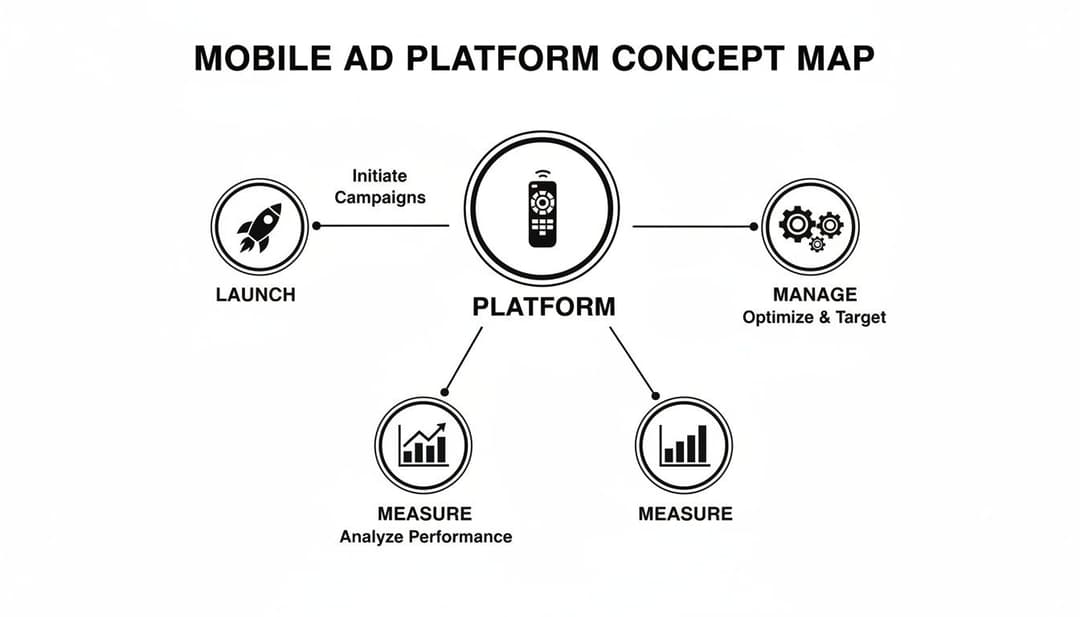
As you can see, a modern platform acts as your command center, hiding all the messy, underlying complexity of the ecosystem so you can focus on what matters.
The Unbiased Referee: Mobile Measurement Partners
Finally, there’s one more critical, independent player in this game: the Mobile Measurement Partner (MMP). It’s best to think of an MMP as the unbiased referee. Its only job is to track how users interact with ads and correctly attribute actions—like app installs or in-app purchases—back to the exact campaign and ad network that drove them.
An MMP provides a single source of truth. Without one, you’d be stuck trying to make sense of conflicting reports from different ad networks, each fighting to take credit for the same conversion. They keep your data clean and reliable.
MMPs use a Software Development Kit (SDK)—just a small snippet of code you add to your mobile app—to monitor all these events.
Getting your head around how these different platforms work together is foundational to running successful campaigns. You can see how these concepts are put into action by exploring different mobile advertising applications and strategies.
How to Choose the Right Mobile Advertising Platform
Picking a mobile advertising platform is one of those choices that will define your budget, your team's sanity, and your company's growth. The right one acts as a force multiplier for your marketing, while the wrong one quickly turns into a money pit full of frustrating dead ends. This isn't just about a checklist of features; it’s about finding a partner that fits how your team actually works and what you’re trying to achieve.
The stakes are incredibly high. In the US alone, mobile ad spend is projected to soar to USD 228.11 billion by 2025, which will make up a staggering 75% of all digital ad budgets. The real story is that in-app advertising is driving almost all of that growth, accounting for 82.3% of the total. This is exactly why performance marketers are laser-focused on what happens inside an app. With the market only getting bigger, getting this decision right is more critical than ever.
Evaluate Core Targeting and Attribution Features
First things first, you need to get under the hood and look at the platform’s targeting engine. Can you do more than just slice and dice by age and location? You’re looking for granular controls that let you build hyper-specific audience segments.
- Behavioral Targeting: Does the platform let you target users based on their in-app actions, purchase history, or how often they engage? This is non-negotiable for finding people who are ready to convert.
- Contextual Targeting: Can you place your ads inside specific app categories or next to relevant content? If you have a fitness app, you want your ads showing up in other health and wellness apps, not just thrown out randomly.
- Lookalike Audiences: One of the most powerful tools in the shed. Can the platform take your best customers and build new audiences of people who look and act just like them? Make sure it can do this effectively with your own data.
Next up, put their attribution models and analytics under a microscope. A basic last-click model just doesn't cut it anymore. A modern mobile advertising platform should offer multi-touch attribution to give you the full story of the customer journey. The analytics dashboard is just as crucial—it needs to be intuitive, customizable, and zeroed in on the metrics that actually matter to your bottom line, like Return on Ad Spend (ROAS) and Cost Per Acquisition (CPA).
Assess Integration and Workflow Compatibility
No platform is an island. It has to play nicely with the rest of your marketing stack, and that’s a dealbreaker. The most critical connection is to the big ad channels like Meta and Google Ads. Make sure the platform uses official, secure APIs for these integrations to keep your data clean and the connection reliable.
A platform’s true value is revealed during a demo. Don't just watch a generic presentation. Come prepared with specific questions about your workflow, such as: "How would I use this to test 50 different creative variations for my e-commerce campaign?"
Finally, think about how the platform will slot into your team’s day-to-day grind. Is it built for a lone media buyer or a collaborative agency team? A great platform will bring all your campaigns, creatives, and audiences into one central place, turning what used to be a chaotic mess of spreadsheets into a smooth, repeatable system. For a closer look at how different platforms stack up, check out our guide comparing AI ad platform features. This will help you pinpoint the solution that truly aligns with your needs.
Integrating and Launching Your First Campaigns

This is where the rubber meets the road. You’ve done the research and picked your mobile advertising platform, but the real work—and the real value—begins now. Getting your setup right from the start is what separates the campaigns that fly from the ones that flop.
First things first, you'll need to connect your main ad accounts, like your Meta Ads Manager. Any modern platform worth its salt will use secure, official methods like OAuth to do this. It’s a small detail, but a critical one. This process grants the platform permission to read your data and manage campaigns without you ever having to share your passwords.
Once that connection is live, the platform can start pulling in your historical performance data, giving you an immediate baseline for what’s worked in the past.
Structuring Your Campaigns for Success
A messy ad account is a money pit. Before you even think about hitting "launch," you need a game plan for organization. A consistent naming convention for your campaigns, ad sets, and ads isn't just for neat freaks—it's the secret to being able to analyze your tests and scale your wins later.
Think about your workflow in three distinct layers:
- Campaigns: Keep these high-level. Group them by a clear objective, like "App Installs" or "Lead Generation," or maybe by a specific product launch.
- Audiences: Don't rebuild your best audiences every time. Create and save key segments like "High-Intent Lookalikes" or "Past 30-Day Website Visitors" so you can deploy them in seconds.
- Creatives: Your ads are your assets. Build a central library for your images, videos, and headlines, and tag them so you can find what you need instantly.
This kind of disciplined structure is absolutely essential when you start advertising an app or a new product. It's what allows you to test aggressively without creating a chaotic, unmanageable mess.
A Playbook for Your First 30 Days
Your first month on a new platform is all about learning. Forget about perfection—your only goal is to gather data and build momentum. A simple playbook can guide you through these initial weeks and help you prove the platform's value quickly.
The biggest mistake you can make is trying to test everything at once. Start with a couple of your best guesses based on past data. Isolate one variable at a time so you know what's actually working.
Here’s a straightforward, three-step plan to get you started:
- Launch Your Initial Tests: In week one, launch a few small-budget campaigns. Pit your most promising audiences against your best creatives. The goal here isn't massive scale; it's clean data.
- Define and Watch Your Metrics: Know what success looks like from day one. For an e-commerce brand, that's probably Return on Ad Spend (ROAS). For a B2B team, it’s likely Cost Per Acquisition (CPA). Keep your eyes on the prize.
- Create a Feedback Loop: By the second week, you should have enough data to make some calls. Funnel more budget into the audience and creative combos that are working, and don't be afraid to pause the losers. This cycle—test, measure, optimize—is the very heart of successful mobile advertising.
Scaling Campaigns with AI and Automation

If you've ever tried to scale your ad campaigns manually, you know the grind. Moving from a handful of ads to a full-blown growth strategy is a huge leap, and it’s where most teams hit a wall. This is precisely where AI and automation completely change the dynamic, turning your mobile advertising platform from a management dashboard into a powerful growth engine.
Think about testing hundreds of creative and audience combinations. Manually, that’s a soul-crushing task that could take you weeks. With AI, it’s done in minutes. The right platform can automatically generate these variations, letting you test more ideas faster than a whole team of marketers ever could.
But this isn't just about moving faster; it’s about moving smarter. The platform dives into your historical data to make intelligent decisions right from the get-go.
Building Campaigns with Proven Winners
Think of an AI-powered launch feature as your most seasoned media buyer—one that never sleeps. It digs through all your past campaign data to spot what we call the "golden trio": your best-performing creatives, your most persuasive ad copy, and your highest-converting audiences.
Instead of staring at a blank screen, the platform automatically assembles new campaigns using only these proven winners. It takes the guesswork out of launching something new and stacks the odds in your favor from day one. It’s like building a brand-new car, but you’re only allowed to use the parts that have already won races.
The cross-platform and mobile advertising market is on a rocket ship, projected to grow from USD 92.5 billion in 2026 to USD 188.3 billion by 2033. To keep up, you need tools that can unify your workflow and automate testing at scale. This is where platforms that centralize everything—campaigns, creatives, audiences—and use AI to find winning combinations become indispensable.
Real-Time Optimization and Scaling
Once your campaigns are live, the real magic begins. The AI doesn’t just clock out. It continuously monitors performance in real-time, watching metrics like ROAS or CPA to see which ad variations are actually delivering results.
The goal is to let the machine do the minute-by-minute monitoring. This frees you up to focus on strategy, creative direction, and exploring new growth channels, rather than constantly checking performance dashboards.
From there, the platform automatically starts shifting your budget toward the top performers. It doubles down on what’s working without you having to lift a finger, ensuring every dollar of your ad spend is working as hard as it possibly can. This is how you turn advertising from a gamble into a predictable, scalable system.
You can see how our platform uses AI to improve your ads to get a better feel for this. For a broader look at how this technology is being applied, it’s worth exploring some of the bigger ideas around AI in business automation to see where the industry is headed.
Measuring Performance and Optimizing for Growth
In mobile advertising, you are what you measure. Kicking off a new campaign is just the first step; real, sustainable growth happens when you dig into the performance data and use it to make smarter decisions.
It's tempting to get caught up in vanity metrics like clicks and impressions. But seasoned marketers know those numbers don't pay the bills. The best in the business cut through the noise and zero in on the key performance indicators (KPIs) that connect ad spend directly to revenue. A good mobile advertising platform is built to do exactly that—turning a flood of raw data into a clear path for growth.
Focusing on Metrics That Matter
To get anywhere, your reporting has to align with your actual business goals. This means looking past the surface-level data and tracking the numbers that truly define success for your company. For most, it boils down to a handful of critical KPIs.
Return on Ad Spend (ROAS): This is the holy grail for e-commerce and direct-to-consumer brands. It answers a simple but powerful question: "For every dollar I put into ads, how many dollars am I getting back?"
Cost Per Acquisition (CPA) or Cost Per Lead (CPL): If you're in SaaS, B2B, or any business that relies on lead generation, this is your North Star. It tells you exactly how much it costs to land a new customer or a qualified lead, revealing if your campaigns are even profitable.
Customer Lifetime Value (LTV): This is a more advanced metric, but it’s a game-changer. It estimates the total revenue you can expect from a single customer over their entire relationship with your business. Knowing your LTV helps you figure out exactly how much you can afford to spend to acquire a new user in the first place.
Your platform should put these numbers front and center, making it easy to see performance for every campaign, audience, and creative. That kind of clarity lets you spot what’s working, cut what isn't, and double down on your winners fast.
Understanding Ad Attribution Models
Attribution is simply the process of giving credit for a conversion. Think about it: a user sees your ad on three different apps, then finally clicks an ad in a fourth app and makes a purchase. Which ad gets the credit? The answer depends entirely on your attribution model.
An attribution model is like the rulebook for a game. If you don't know the rules, you can't tell who's winning. Different models will give you different "winners," so you must pick the one that best reflects your customer's journey.
A solid mobile advertising platform will let you choose from multiple models, so you can align your reporting with your marketing strategy.
Mobile Ad Attribution Models Compared
Choosing the right attribution model is key to understanding how your marketing efforts translate into results. This table breaks down the most common models to help you see how credit is assigned and decide which approach fits your goals.
| Attribution Model | How It Works | Best For |
|---|---|---|
| Last-Click | The final touchpoint before the conversion gets 100% of the credit. | Short sales cycles where the last interaction is most influential, such as an immediate app install. |
| First-Click | The very first touchpoint the user interacted with gets 100% of the credit. | Campaigns focused on brand awareness and introducing new customers to your brand for the first time. |
| Linear | Credit is distributed evenly across all touchpoints in the conversion path. | Evaluating the entire customer journey and understanding which channels contribute along the way. |
| Time-Decay | Touchpoints closer to the time of conversion receive more credit. | Longer consideration phases where recent interactions are likely more impactful than earlier ones. |
Ultimately, getting your measurement right is non-negotiable. By tracking the right KPIs and applying the correct attribution model, you can transform your platform’s analytics from a confusing spreadsheet into a reliable roadmap for scaling your business.
A Few Common Questions
Alright, let's get into the practical side of things. When you're considering a new platform, a few key questions about cost, use cases, and timelines always come up. Here are the straight-up answers to what we hear most often.
How Much Does a Mobile Advertising Platform Cost?
There's no single price tag. The cost for a mobile advertising platform can swing pretty widely depending on the model. Some platforms will take a cut of your total ad spend, usually somewhere in the 1-5% range. Others work on a more predictable subscription basis, with different tiers for features or usage.
But fixating only on the price is missing the point. The real question is about the return. Think about it: if a platform automates your campaign builds, intelligently splits your budget, and dials in your ROAS, the value it delivers can easily eclipse the cost. It's about buying back your time and making your ad spend work smarter.
Can I Use a Mobile Ad Platform for B2B Marketing?
Absolutely. It’s a common misconception that these tools are just for B2C apps and e-commerce. The reality is that B2B decision-makers are glued to their phones just like everyone else, making mobile a surprisingly powerful channel for high-value conversions.
With the sophisticated targeting available on networks like Meta and LinkedIn, you can get incredibly granular. You can serve ads directly to people based on their job title, the size of their company, or their industry. This is how you drive demo requests, webinar sign-ups, and genuine leads right from their mobile feed.
The key is reaching professionals where they already are. A sharp, well-targeted B2B mobile campaign can often deliver a lower cost per lead than you'd see from a traditional desktop-only effort.
How Quickly Can I See Results After Starting?
While it always depends on your budget and industry, you can get your first dose of insight faster than you might think. If your platform can plug into your ad account and analyze historical data, you'll have a solid baseline within the first couple of days.
Once you launch your first test campaigns, you'll see new performance data rolling in within 24-48 hours. From there, you can expect to see meaningful trends in your main KPIs—like Cost Per Acquisition (CPA) or Return on Ad Spend (ROAS)—start to take shape within the first one to two weeks of consistent advertising.
Ready to stop guessing and start scaling? AdStellar AI is the AI-powered platform built to launch, test, and optimize your Meta ad campaigns 10x faster. Automate your ad creation and unlock more revenue with less spend.