Launching an app feels deceptively simple right up until the moment it's live. The product is polished, onboarding is finally stable, analytics are installed, and the team expects traffic to show up. Then installs trickle in, paid campaigns burn budget without clarity, and nobody can agree on whether the problem is targeting, creative, store listing, attribution, or the product itself.
That's where most mobile teams get stuck. They treat mobile application promotion as a channel problem when it's really an operating system problem. A few ads here, some ASO edits there, maybe a creator brief, maybe a re-engagement push. Activity goes up. Learning doesn't.
The teams that grow apps consistently don't rely on isolated tactics. They build a repeatable loop: define audience, sharpen positioning, structure measurement, test creative at volume, automate execution, and scale only what survives downstream metrics. If you need a broader primer before building that system, this app marketing guide for early planning is a useful companion.
Your Guide to App Promotion in a Crowded Market
You launch the app, switch on campaigns, and installs start coming in. A week later, the team is arguing about what those installs mean. Paid says volume is fine. Product says activation is weak. Creative says the message is stale. Analytics says SKAdNetwork is limiting visibility. Nothing is fully broken, but nothing is clear enough to scale with confidence.
That is the core challenge in app promotion. Competition matters, but operational discipline matters more.
A crowded market punishes teams that treat growth as a collection of disconnected tasks. ASO sits with one owner, paid acquisition with another, lifecycle with a third, and reporting turns into a debate instead of a decision tool. The result is familiar. Budget moves faster than learning, and every channel starts to look less efficient than it really is.
The fix is to build an operating system for promotion, not a list of tactics. That means setting up one repeatable loop for how the team forms hypotheses, tests messaging, measures post-install quality, and scales winners. If you need the broader planning layer before building that loop, this app marketing guide for early-stage promotion planning is a useful starting point.
What breaks launch momentum
Three failure patterns show up again and again:
- Paid acquisition starts before positioning is clear. Teams buy traffic before they know which audience, use case, or promise gets high-intent users to install.
- Success gets defined too high in the funnel. Install volume looks healthy while activation, trial start, purchase rate, or retention stay weak.
- Testing stays too small to teach anything useful. Two ad concepts and minor copy swaps do not produce enough signal to guide budget decisions.
I have seen apps spend months trying to fix CAC when the core issue was message-market fit. The campaigns were doing their job. The proposition was not strong enough, and the store page reinforced the wrong use case.
Practical rule: Paid media should confirm demand and scale it. It should not carry the full burden of explaining a confusing product.
What a workable promotion system includes
A repeatable app promotion system has five parts:
- Intent capture through ASO, category positioning, and clear in-store messaging
- Channel selection based on where the target user can be reached at a sustainable cost
- Creative testing at volume to identify which hooks bring in qualified users, not just cheap clicks
- Measurement architecture that connects install data to activation, revenue, and retention in a privacy-first setup
- Scaling rules that protect unit economics as spend rises
This matters even more now because mobile growth is less linear than it used to be. SKAdNetwork limits granularity on iOS. Platform algorithms reward fresh creative and enough conversion signal. AI-driven automation can improve bidding, budgeting, and audience expansion, but only if the inputs are clean. Bad event mapping, weak creative labeling, or fuzzy success metrics will train automation in the wrong direction.
Good app growth often looks plain from the inside. Clear taxonomy. Fast reporting. Creative shipped every week. Budget moved only after downstream metrics held up.
That is how teams keep learning faster than the market gets more expensive.
Build Your Promotion Foundation with ASO
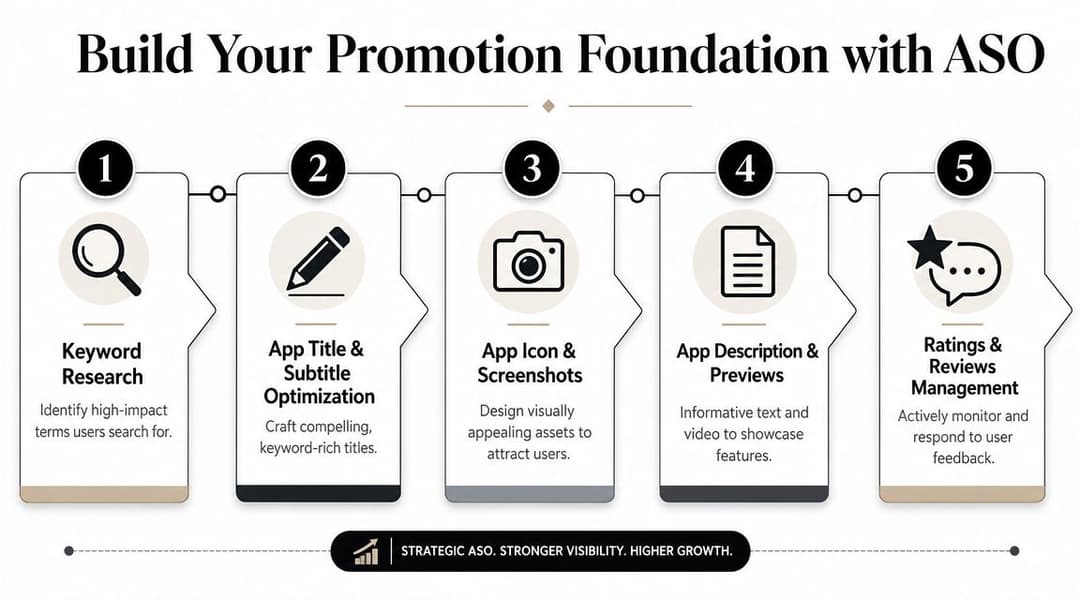
App Store Optimization is often treated like pre-launch hygiene. Write the title, add screenshots, pick a few keywords, move on. That's a mistake. ASO is where your acquisition strategy meets real user intent.
AppsFlyer's recommended workflow is straightforward: define the target audience, run competitive research, validate keywords by relevance, difficulty or competition, and search volume, then integrate those keywords naturally into the app store page. That sequence improves discoverability across awareness, acquisition, and retention, as outlined in AppsFlyer's app marketing workflow.
Start with the job the user is hiring the app to do
ASO gets sharper when you stop thinking in product categories and start thinking in user jobs.
A meditation app isn't only competing on “meditation.” It may also compete on “sleep sounds,” “stress relief,” “focus timer,” or “anxiety support,” depending on the user's moment of need. A finance app may live under budgeting, expense tracking, invoice management, or savings goals. The keyword set should reflect intent, not internal product language.
Use this sequence:
- Audience first. Define the segments most likely to install and keep using the app.
- Competitor scan. Look at how adjacent apps frame the problem, not just direct clones.
- Keyword validation. Keep terms that are relevant, realistically competitive, and searched.
- Listing integration. Place terms naturally in the title, subtitle, description, and other relevant fields.
Build listings that convert, not just rank
Ranking is only half the job. Once a user lands on the product page, your assets need to close the gap between curiosity and install.
A practical store page review usually includes:
| Element | What to check |
|---|---|
| Title and subtitle | Clear value proposition, not branded jargon |
| Screenshots | Show outcomes fast, not feature clutter |
| Preview video | Demonstrate use cases with minimal friction |
| Description | Reinforce benefits and remove confusion |
| Ratings and reviews | Surface recurring objections and trust signals |
The best store pages feel specific. They make it obvious who the app is for, what problem it solves, and why it's worth downloading now.
A paid click sent to a weak store page doesn't just waste media spend. It corrupts your read on audience quality because conversion loss gets blamed on targeting.
Keep ASO tied to the rest of the funnel
ASO isn't a silo. It shapes paid performance too. When your listing aligns with user intent, traffic from Apple Search Ads, Google campaigns, creator mentions, and social ads lands on a page that feels consistent with the promise in the ad.
That consistency matters more than is widely understood. If your ads talk about quick meal logging but the store page leads with generic wellness language, conversion drops. If your ad targets shift workers and the listing feels built for office workers, retention often suffers later even if installs come in.
ASO works best when it's updated like ad creative. Review search terms, refresh screenshots when messaging changes, and revise copy after product updates or audience shifts. Organic discovery is foundational, but it's also operational.
Choose Your App Promotion Channels Wisely
A common failure pattern looks like this. The team has ASO in place, some budget approved, and pressure to grow fast. They launch Meta, Google App Campaigns, influencer tests, content, and maybe Apple Search Ads all at once. Three weeks later they have installs, conflicting dashboards, and no clear answer on which channel is bringing in users who activate, retain, or pay.
Channel strategy needs to prevent that mess.
Once the store listing is doing its job, channel choice becomes part of your operating system for growth. The goal is not channel coverage. The goal is a setup that gives you clear learning loops, enough signal to optimize, and a path to scale without breaking measurement.
Organic and paid do different jobs
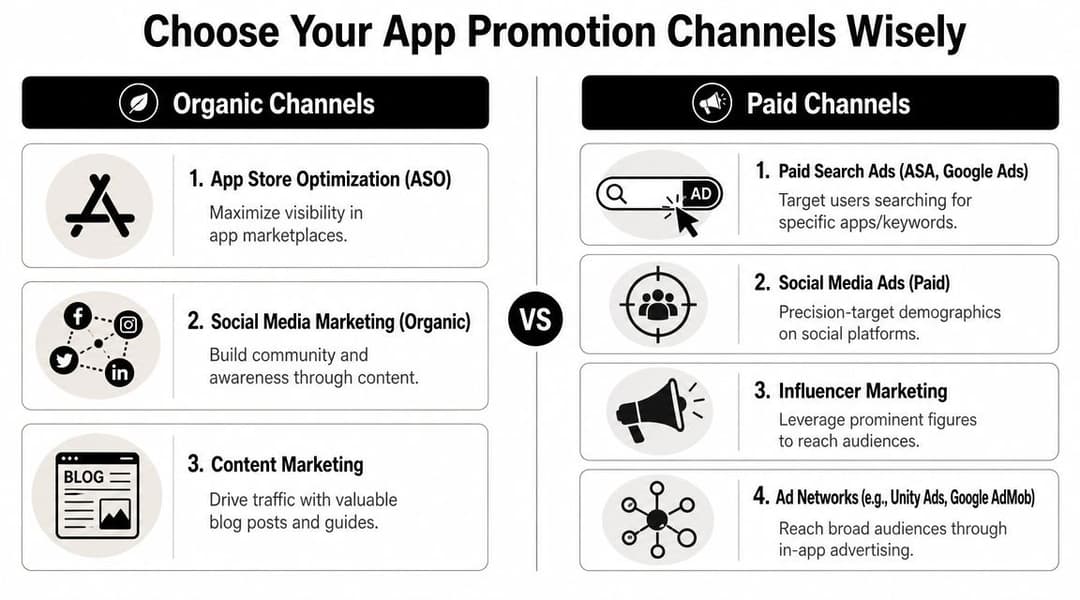
Organic channels usually build slowly and keep paying back over time. Paid channels compress feedback cycles. That difference matters because app promotion works best when every channel has a defined role in testing, measurement, or scale.
| Channel type | Best use | Common mistake |
|---|---|---|
| ASO | Capture high-intent store demand | Treating it as a one-time setup |
| Content and SEO | Build authority and support consideration | Expecting immediate install velocity |
| Organic social | Community, proof, audience learning | Posting without a clear hook or format strategy |
| Apple Search Ads | Convert explicit app-store intent | Buying broad terms before understanding conversion quality |
| Google App Campaigns | Scale across Google inventory | Letting automation run without strong creative inputs |
| Meta Ads | Audience testing, concept testing, demand creation | Scaling before post-install quality is clear |
The best early mix is usually narrower than founders expect. Start with strong ASO, one intent-rich paid channel, one scalable discovery channel, and one owned channel you control. That gives enough range to compare user quality without creating reporting chaos.
For teams using social to test audience-message fit, this guide to Meta ads for app promotion is useful because Meta behaves differently when you are validating hooks, retargeting warm users, or pushing spend.
Here's a quick overview of the broader channel environment:
Match channels to app type and buying behavior
Channel selection should reflect how demand shows up.
A utility app often wins early through store search and direct-response social because the user already knows the problem. A habit or wellness app usually needs stronger education and framing because motivation is less concrete. Gaming apps often hit a different constraint. They need creative volume fast, because concepts fatigue before media options do.
The monetization model changes the decision too. Subscription apps can afford to pay more for a user who reaches trial and converts. Ad-monetized apps often need broader reach and tighter control of retention by source. Commerce apps sit in the middle, where purchase intent and repeat usage both matter.
Use these questions to choose your first serious channels:
- Is demand already explicit? Prioritize search-led channels.
- Does the product need demonstration? Use video-first social placements.
- Is trust the friction? Put more weight on creator proof, reviews, and store-page social proof.
- Does the app monetize later? Watch channels that optimize too aggressively for cheap installs.
- Will privacy limits reduce visibility into performance? Favor channels where your event setup and post-install signals are strong enough to make decisions.
That last point gets ignored too often. SKAdNetwork, modeled reporting, and delayed conversion windows change the value of a channel. A source that looks efficient on click-through metrics can still be weak if you cannot connect it to activation or downstream revenue with enough confidence to scale it.
A channel that delivers installs without usable learning on activation, retention, or payback is not a growth engine. It is traffic.
Don't spread budget thin just to say you're diversified
Diversification only helps when every channel can be judged against the same decision framework. If one campaign is optimized for CPI, another for trial starts, and another for top-of-funnel engagement, the team usually ends up comparing noise.
A better setup is simpler. Fund one high-intent source, one scalable discovery source, and one owned or organic source that compounds. Then review them through the same operating lens: cost to get a qualified user, speed of feedback, quality of signal under privacy constraints, and capacity to scale with more creative and automation.
That is how channel selection stops being a media checklist and becomes a repeatable system.
Develop a High-Volume Creative Testing Strategy
Creative usually becomes the bottleneck long before media buying does. Not because teams don't have ideas, but because they don't have a system to turn ideas into structured tests.
Most losing ad accounts don't suffer from a lack of effort. They suffer from low test density. A handful of polished ads go live, performance is judged too early or too emotionally, and the team keeps recycling the same angle with minor edits.
Build hypotheses, not random variations
A strong creative pipeline starts with a hypothesis matrix. Each concept should answer a real question about the audience.
Examples:
- Problem angle. Does “stop forgetting your meds” outperform “stay on top of your health routine”?
- Outcome angle. Does the user respond more to time saved, money saved, or reduced stress?
- Format angle. Does a creator-style walkthrough beat a polished product demo?
- Objection angle. Does explicitly addressing setup complexity improve click-to-install quality?
The point isn't to test everything. The point is to test intentionally.
A simple matrix might combine:
- three audience motivations
- three hooks
- two visual styles
- two calls to action
That already creates enough variation to learn whether your message is broken, your format is weak, or your promise is mismatched to the user.
Use different formats for different jobs
Not every ad format should carry the same burden.
UGC-style creative is useful when the app needs relatability, social proof, or a quick “why I use this” frame. Polished product demos work better when the interface itself sells the value. Benefit-led statics can still perform when the promise is simple and the visual hierarchy is clean.
A practical format mix often looks like this:
| Format | Best for | Watch out for |
|---|---|---|
| UGC video | Trust, relatability, pain-point framing | Weak scripting disguised as authenticity |
| Studio demo | Product clarity, feature walkthroughs | Overproduced assets that feel like brand ads |
| Static image | Fast message testing, simple value props | Generic design and vague headlines |
| Motion graphic | Explaining flows or transformations | Too much information too quickly |
Good creative testing isolates variables. If you change the hook, format, offer, and audience all at once, you don't learn what caused the result.
Judge creative by what happens after install
Many teams often go wrong. They pick winners based on thumb-stop rate, CTR, or even CPI alone. Those metrics matter, but they're upstream.
A creative that drives curiosity but attracts the wrong user can look strong in platform reporting and weak in the business. The better approach is to connect creative themes to downstream signals: onboarding completion, early engagement, trial starts, purchase behavior, or whatever activation means in your app.
For teams running Meta at any meaningful scale, a structured Facebook ad creative testing methodology helps keep testing disciplined. The main value is consistency. Same naming. Same angle taxonomy. Same success criteria.
When creative testing works, it doesn't just produce winners. It teaches the team how the market interprets the app.
Automate Your Paid Acquisition Engine
Manual campaign building breaks as soon as test volume rises. One buyer can launch a few campaigns by hand. A scaled app program needs dozens of combinations across audiences, hooks, formats, and offers. Without automation, ops work starts swallowing strategy.
That's why paid acquisition has shifted toward machine-assisted execution. Platforms like Meta and Google already automate parts of targeting, bidding, and delivery. The missing layer for many teams is workflow automation around creative generation, bulk setup, launch, and analysis.
Where manual processes fail
The warning signs are obvious once you've seen them:
- Creative backlog grows because launch setup takes longer than concept production
- Naming gets messy, so analysis by angle or audience becomes unreliable
- Winning themes don't get redeployed fast enough into fresh variations
- Buyers spend time publishing ads instead of interpreting data
None of that is a media strategy problem. It's an operating problem.
Automation should remove repetition, not judgment
The best use of automation is mechanical work that doesn't require strategic debate.
That includes:
- Building large sets of ad variations from approved components
- Reusing proven campaign structures across new tests
- Applying consistent naming and taxonomy
- Surfacing which combinations of audience, message, and asset are working
Here's what that looks like in practice with a workflow tool:
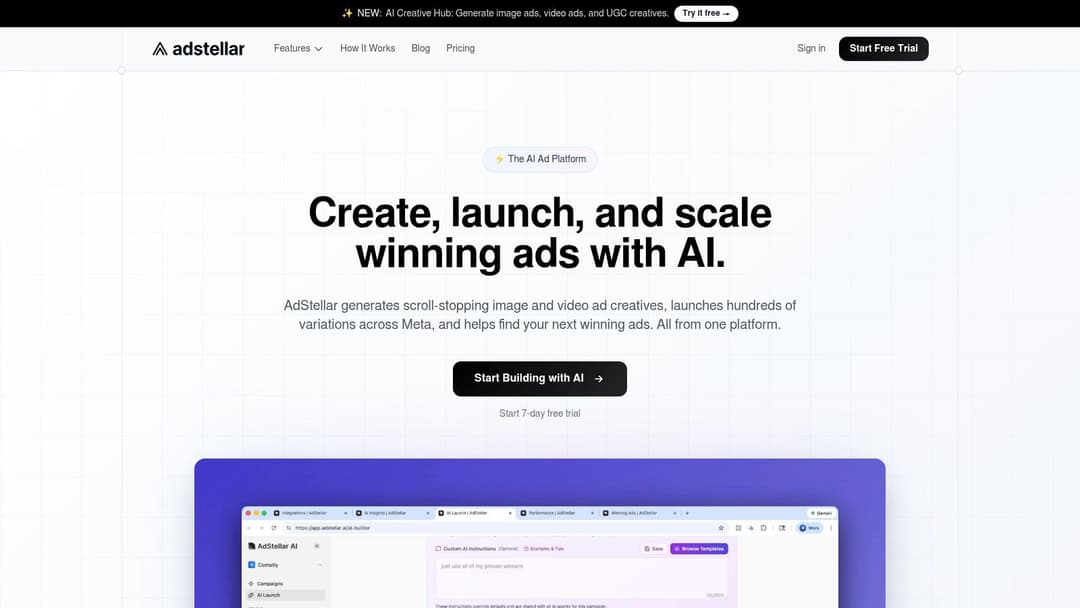
AdStellar AI is one example of that category. It generates and launches large numbers of Meta ad combinations, connects through secure OAuth, ingests historical performance, and ranks creatives, audiences, and messages against goals such as ROAS, CPL, or CPA. That kind of setup is most useful when a team needs campaign launch speed and repeatable variation testing, not just a nicer dashboard. If you want the workflow details, this overview of Facebook ads automation shows the execution model.
Use AI to expand tests, then tighten around signal
A practical automation loop looks like this:
| Stage | What the team does | What automation handles |
|---|---|---|
| Input | Define angle families, audience segments, KPI targets | Assemble combinations |
| Launch | Approve structure and constraints | Bulk-build and publish ads |
| Read | Evaluate performance patterns | Aggregate results by asset, audience, and message |
| Iterate | Choose what to expand or kill | Rebuild fresh variants from winners |
Automation is worth it when it increases learning velocity. If it only increases ad count, you've created noise faster.
There's also a strategic reason this matters now. Privacy constraints and platform automation have reduced the value of micromanaging every lever. Teams win by feeding platforms better inputs, better creative variation, cleaner events, and clearer business goals. That's where automation belongs. Not as a replacement for strategy, but as the infrastructure that keeps strategy moving.
Measure What Matters in a Privacy-First World
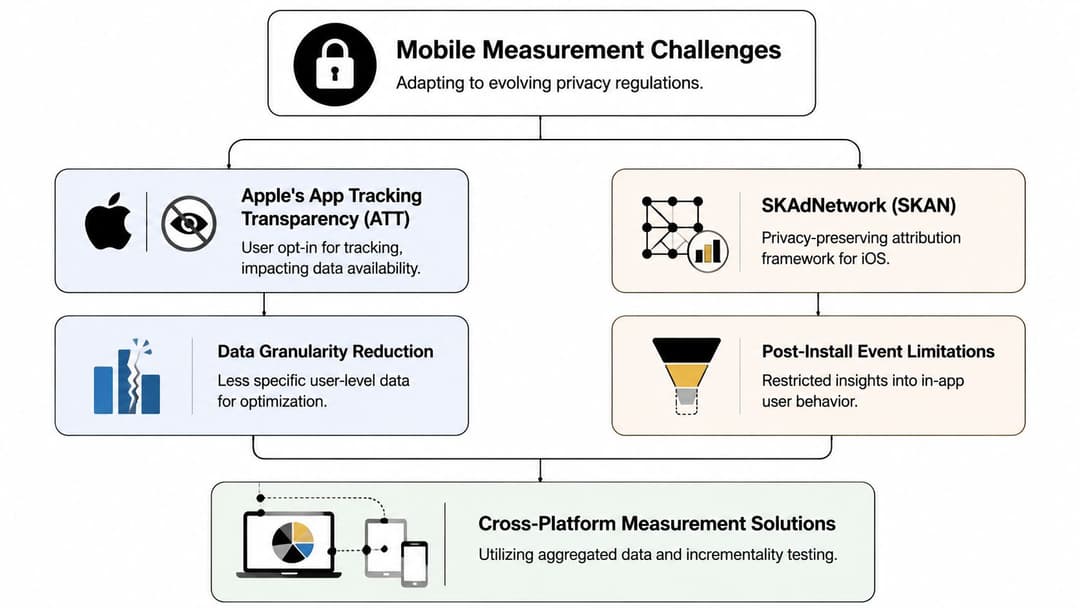
Attribution used to feel cleaner than it really was. Now the limitations are impossible to ignore. On iOS especially, privacy changes have pushed app marketers away from user-level certainty and toward aggregated, delayed, and modeled data.
That doesn't mean measurement is broken. It means your measurement system needs to answer different questions.
What SKAN changes operationally
SKAdNetwork, usually shortened to SKAN, is Apple's privacy-preserving attribution framework. In plain terms, it limits the kind of user-level post-install visibility marketers used to expect on iOS. You still get signal, but it's more aggregated and less flexible for campaign-by-campaign diagnosis.
That changes behavior in three ways:
- You rely more on modeled or aggregated performance reads
- You care more about event design, because limited post-install signals need to be meaningful
- You need stronger experimentation discipline, since attribution won't explain every result neatly
This is also why server-side data flows and resilient tracking setups matter. For teams working through Meta's measurement gaps, understanding the Facebook Conversion API helps create a sturdier reporting foundation.
Track business KPIs, not reporting comfort metrics
Adjust recommends tying app promotion to business KPIs like installs, retention, engagement, revenue, and LTV, while also emphasizing continuous A/B testing and multivariate testing. The reason is simple: user acquisition metrics alone won't tell you whether poor onboarding, low activation, or app instability is eroding ROI, as explained in Adjust's mobile app marketing guide.
That means your KPI stack should include more than top-of-funnel numbers.
A useful framework looks like this:
- Acquisition: CPI, conversion rate from click to install
- Engagement: DAU/MAU, session quality, feature usage
- Retention: short-term and ongoing retention patterns
- Revenue: ARPU, LTV, attribution-based ROAS
- Technical health: crash behavior, load time, funnel drop-offs
The technical layer matters more than many growth teams admit. If an app crashes during onboarding or loads slowly on key screens, paid media can't fix the downstream loss.
Why churn analysis belongs in promotion
Many teams separate promotion from retention and end up learning too late why their installs don't compound.
That gap matters. Research on fitness app use found that people often stop using apps within the first few weeks because of lack of motivation, poor UX, or unrealistic expectations. The same review notes that goal setting, continuous monitoring, and feedback improve loyalty. In a study of adolescents, 48.4% said the main reason for stopping use was a lack of practical utility, and 18.8% disliked notifications, according to this review on digital health app retention.
The install is a hypothesis. Retention is the verdict.
That's why measurement in mobile application promotion has to include product reality. If users don't find the app useful, if reminders become annoying, or if activation takes too long, the campaign didn't really work. It only filled the top of the funnel.
Mastering the Optimization and Scaling Loop
Once acquisition, creative, and measurement are in place, the job becomes repetition with judgment. Not endless tweaking. A disciplined loop.
The strongest growth teams I've seen use a simple cycle: analyze, form a hypothesis, test, scale, and then restart before the account goes stale. They don't wait for perfect certainty. They work from structured evidence.
Run the loop weekly, not emotionally
A lot of accounts suffer because decisions are made by mood. One bad day pauses spend. One strong day triggers scaling. That creates turbulence and weakens signal.
A steadier loop looks like this:
Analyze the current cohort
Review performance by campaign, audience, creative angle, and post-install behavior. Look for patterns, not isolated spikes.Write one clear hypothesis
Example: “Users from creator-led demo ads activate better than users from direct feature ads because the setup process feels less intimidating.”Test with constraints
Change one meaningful variable. Don't rebuild the whole account at once.Scale proven patterns
Increase budget, expand placements, or clone the message into adjacent audiences only after the downstream KPI supports it.Refresh before fatigue forces you to
Waiting until performance collapses is too late. Replace or adapt concepts while they still have signal.
Know what to scale and what to leave alone
Not every winner deserves a budget increase. Some deserve more creative around the same angle. Others deserve a landing-page or store-page adjustment. Some need audience expansion. Others are already close to saturation.
Use this quick decision table:
| If you see this | Do this |
|---|---|
| Strong install volume, weak activation | Audit onboarding and message match |
| Good retention from one angle | Build adjacent creatives around the same promise |
| Stable economics, limited reach | Test new audiences or placements |
| Fast creative fatigue | Keep the angle, swap hooks, visuals, and first frames |
| Channel-specific quality gaps | Compare user behavior by source before reallocating budget |
Scaling works when you preserve the reason something won. Most teams scale by changing too much at once.
Growth gets stronger when it reaches overlooked users
One of the most practical expansion opportunities is better promotion for underserved users. Research on workplace health apps and low-income populations shows that adoption barriers often include smartphone availability, bugs, trust, language, and lack of personal contact. The implication is clear in this review on app barriers in underserved populations: promotion has to address access and support, not just messaging.
That changes execution.
If you're entering a new audience segment, don't just translate ads. Rework onboarding language. Reduce assumptions about device quality. Make support visible. Clarify why the app is practically useful. In some categories, trust cues matter more than persuasion cues.
That's also why the optimization loop shouldn't be limited to ad metrics. Sometimes growth comes from making the product easier to adopt for people the original campaign architecture ignored.
Mobile application promotion gets easier when you stop treating each launch, channel, or creative batch as a standalone effort. Build the system once. Improve it every week. Let measurement shape creative, let creative shape audience expansion, and let product feedback shape all of it.
If your team is spending too much time building and launching ad variations by hand, AdStellar AI can help operationalize the testing side of mobile app promotion by automating bulk Meta campaign creation, variation launch, and performance analysis around the KPIs you already use.