Trying to run a real estate PPC campaign using generic advice is like trying to fit a square peg in a round hole. It just doesn't work. Success in this game isn't about getting the most clicks; it’s about building a predictable pipeline of genuinely interested buyers and sellers. That requires a specialized playbook built for long sales cycles and fierce, hyper-local competition.
Why Generic PPC Strategies Fail in Real Estate
Let's be honest—most of the standard pay-per-click advice you read online is a terrible fit for the real estate market. The typical e-commerce model of "click, buy, done" falls apart when the "product" is a half-million-dollar home and the sales cycle stretches over months, not minutes. This fundamental disconnect is exactly why so many agents burn through their ad spend with almost nothing to show for it.
The real estate industry has its own unique set of hurdles that generic, off-the-shelf strategies simply can't clear. Unlike selling a t-shirt or a gadget, selling a home involves deep emotional investment and a massive financial commitment. Your ads aren't just competing for clicks; they're fighting for trust in an incredibly crowded, localized market.
The Hyper-Local Battleground
At its core, real estate is a local business. A "one-size-fits-all" campaign blasted across an entire city is just a waste of money. An agent in Austin, for instance, isn't just up against every other agent in Austin. They're competing for specific neighborhoods like Zilker or Travis Heights, each with its own unique vibe, demographic, and property values.
This means your targeting has to be surgically precise. You’re not trying to reach anyone searching for "homes for sale." You’re trying to connect with the person looking for a three-bedroom craftsman in a specific school district. Get specific or go home.
Navigating a Complex Customer Journey
The path from a curious click to a closed deal is long and winding. A potential lead might be six months or more away from seriously considering a move. Generic PPC funnels aren't built to handle that kind of prolonged nurturing process.
The core challenge is that a "conversion" in real estate isn't a sale—it's the start of a relationship. Your PPC campaign has to be designed to initiate that conversation, not just grab an email address and hope for the best.
This guide goes beyond the surface-level tips to give you a clear, actionable framework for real PPC management for real estate. We’ll dive into the specific challenges faced by advertisers in this space and equip you with the strategies to build a system that generates qualified leads, consistently.
Building a High-Intent Campaign Foundation

A profitable PPC account is built long before you ever write a single line of ad copy. It starts with an almost architectural approach to how you structure your campaigns. I’ve seen it time and again: agents throw all their keywords into one big bucket, and it becomes a surefire recipe for wasted ad spend and murky, unusable data.
The whole point is to build an account that’s not just organized but primed for profitability from the get-go.
The most effective way to do this in real estate is to separate campaigns by user intent. Think about it—the mindset of someone looking to sell their home is completely different from someone looking to buy. Their search terms, what drives them, and the information they need are worlds apart. Your campaigns have to reflect that reality.
Structuring for Intent: Buyer vs. Seller
The first and most critical split you should make in your account is between buyer-focused and seller-focused campaigns. This fundamental separation gives you precise control over your budgets, messaging, and the landing pages you send people to.
- Seller Campaigns: These are often your highest-value leads, but also the most competitive to win. You can—and should—allocate a larger budget here. Your ad copy needs to speak directly to homeowner pain points, like getting a fast, fair cash offer or finally understanding their property's true market value.
- Buyer Campaigns: These can be sliced and diced even further. You might have separate campaigns for first-time homebuyers, luxury property seekers, or people specifically looking for condos or townhomes. Each audience is on a different journey and needs a unique message.
This granular approach ensures that when someone searches for "how much is my house worth," they see an ad for a free home valuation—not a generic "homes for sale" ad that completely misses the mark. It’s this level of relevance that dramatically improves click-through rates and, more importantly, the quality of your leads.
Mastering Real Estate Keyword Research
With a solid structure in place, it’s time to find the keywords that signal serious intent. Generic terms like "real estate" are not only expensive but attract a ton of low-quality clicks from people who are just browsing. The real gold is in long-tail keywords—those longer, more specific search phrases that people use when they know what they want.
Consider the difference in intent here:
| Keyword Type | Example Keyword | User Intent |
|---|---|---|
| Broad | "austin homes" | Low - Could be a renter, a researcher, or just curious. |
| Specific | "3 bedroom homes for sale austin tx" | Medium - Actively looking but still casting a wide net. |
| Long-Tail | "luxury condos for sale downtown austin" | High - Knows exactly what they want and where. |
Long-tail keywords might have lower search volume, but they convert at a much higher rate because they capture users who are deep into their decision-making process. Use tools like Google Keyword Planner to uncover these gems. Focus on search queries that include neighborhoods, zip codes, specific property features ("pool," "waterfront"), or clear actions ("sell my house fast").
Geotargeting for Hyper-Local Precision
Finally, a powerful campaign foundation relies on surgical geotargeting. Real estate is inherently local, and your ads need to be, too. Don't just target an entire city; use advanced location settings to focus your budget exactly where it will have the most impact.
Here are a few practical geotargeting tactics I use all the time:
- Radius Targeting: Got a new listing or an open house? Target a tight 1- to 3-mile radius around the property address to reach the most relevant neighbors and local prospects.
- Neighborhood Targeting: Create campaigns specifically for the high-value neighborhoods you specialize in. This helps residents see you as the local expert.
- Demographic Layering: Combine your location targeting with demographic data. For example, you can target higher-income zip codes with ads for your luxury properties.
By combining a granular campaign structure, intent-driven keywords, and precise geotargeting, you create a foundation that stops budget waste before it starts and attracts the right clients from the very first click. This isn't just about organizing your account; it's about building a predictable lead generation machine.
As you build out these campaigns, remember that tracking user behavior on your website is non-negotiable. Setting up tracking pixels correctly is what allows you to measure conversions and build powerful retargeting audiences down the line. For a deeper dive, our guide on how to set up the Facebook Pixel is a great resource, as the core principles apply across most platforms.
Crafting Ad Copy That Actually Converts Real Estate Leads
Once you've got a solid campaign structure, it's time to focus on what actually earns the click: your ad copy. Think of your ad copy as the bridge connecting a potential client's search to your landing page. If that bridge is flimsy, even the most brilliant campaign architecture will collapse.
In real estate, this means ditching the generic slogans. You have to speak directly to the real, specific motivations of buyers and sellers. Your messaging needs to be hyper-relevant to what they're looking for, which your granular campaign structure has already helped you define.
For a seller campaign, the ad copy has to hit on their main questions: "What's my home worth?" or "How do I sell my house fast?" For buyers, it’s all about painting a picture of the life they could have.
Speak Their Language, Not Yours
The single biggest mistake I see agents make is writing ad copy that's all about them. "Award-Winning Realtor" or "Top Producer" sounds great to you, but it means very little to a potential client.
Your copy needs to be about them. It has to answer their silent question: "What's in it for me?"
Focus on the benefits, not just the features. A feature is a "newly renovated kitchen," but the benefit is "hosting unforgettable dinner parties in a stunning, modern space." See the difference?
Here are a few practical ways to make your copy connect:
- Spotlight Unique Features: Don't just say "beautiful home." Call out the specifics that people crave, like "panoramic city views," "huge fenced-in backyard," or "dream walk-in closets."
- Create a Sense of Urgency: Use phrases like "Open house this Saturday only" or "Hot new listing—it won't last long" to nudge people into acting now.
- Hit on Pain Points: For seller ads, copy like "Get a Fair Cash Offer in 24 Hours" is incredibly powerful for someone who needs a quick, stress-free sale.
Your ad copy isn't just a description; it's a conversation starter. The goal is to make the user feel understood and confident that clicking your ad will get them closer to their goal. This is a key part of successful PPC management for real estate.
Using Dynamic Elements for Hyper-Local Ads
One of the most powerful tools in your copywriting toolkit is Dynamic Keyword Insertion (DKI). This feature is a game-changer. It automatically updates your ad text to include the exact keyword that triggered the ad, making it feel incredibly personal and relevant.
For example, if you're targeting several neighborhoods, you can set up a headline like "Homes for Sale in {KeyWord:Your City}". When someone searches for "homes for sale in Greenlake," your ad will instantly show "Homes for Sale in Greenlake." This simple trick can seriously boost click-through rates because it perfectly mirrors what the user is already thinking.
Beyond keywords, you can use ad customizers to automatically insert other details, like the number of listings available in a specific zip code or a countdown timer for an open house. These little touches make your ads pop in a sea of static, boring listings.
Mastering these techniques is a big step, but there's always more to learn. For a deeper look into the fundamentals of messaging, check out our guide on writing great ad copy that connects with audiences.
A Framework for Never-Ending Improvement
Listen, you're not going to write the perfect ad on your first attempt. Nobody does. The secret to long-term success is committing to a system of A/B testing. It doesn't have to be complicated. The key is to test one thing at a time so you get clean, usable data.
Here’s a simple framework to get you started:
- Test Headlines First: Your headline carries the most weight. Pit a question against a statement. For example, does "Thinking of Selling?" outperform "Find Your Dream Home"?
- Then, Move to Descriptions: Next, test your calls-to-action (CTAs). Does "View Listings Now" get more clicks than "Schedule a Tour"?
- Finally, Experiment with Visuals: On platforms like Meta, test your images. A crisp exterior shot of a home versus a stunning interior photo of the kitchen can produce wildly different results.
By constantly testing and refining, you turn pure guesswork into a data-driven process. You systematically improve your click-through rates and, more importantly, your conversion rates, making sure every dollar you spend is working as hard as possible to bring in high-quality real estate leads.
Designing Landing Pages That Convert Traffic into Clients
Getting someone to click your ad is a win, but it’s only half the battle. The real work in PPC management for real estate starts the second a potential client hits your page. This is the make-or-break moment where you either turn a flicker of interest into a solid lead or just watch your ad spend burn.
A landing page that converts isn't about flashy graphics; it's about psychology. It’s about creating a seamless path from their problem to your solution. The absolute most important piece of this puzzle is message match.
Think about it: the promise you made in your ad needs to be the very first thing they see on the page. If your ad dangled a "Free Home Valuation in Austin," your landing page headline can't be a generic "Find Your Dream Home." It has to shout, "Here's Your Free Austin Home Valuation!" This simple act of reinforcement instantly tells visitors they’re in the right spot, builds a sliver of trust, and stops them from smashing the back button.
Core Elements of a Winning Real-Estate Landing Page
To turn that expensive click into a client, your landing page needs to be a well-oiled machine, pushing visitors toward one single, obvious action. Every element—from the headline to the color of your CTA button—has to work together.
Here’s what you absolutely need:
- A Compelling Headline: This is your digital handshake. Make it about them and make sure it mirrors your ad copy. Something like, "Discover What Your Denver Home is Really Worth" works wonders.
- Trust Signals: Real estate is a trust-based business. You need to show you’re a real, credible professional. A great headshot, glowing client testimonials, and logos from associations like the NAR are non-negotiable. Hard numbers, like "Over 50 Homes Sold in 2023," add a powerful dose of social proof.
- An Irresistible Call-to-Action (CTA): Ditch the boring "Submit" button. Your CTA needs to be specific and scream value. Use action-focused phrases like "Get My Free Valuation" or "Schedule My Private Tour."
If you’re struggling to visualize this, spend some time looking at the best landing page examples out there. You’ll start to see these patterns emerge.
Optimizing for User Experience and Conversions
A clunky, slow, or confusing experience is a lead-killer. Period. Your landing page has to be designed for the user, and more importantly, for the device they’re holding in their hand.
Take a look at this example. It nails the essentials: a clear value proposition right at the top and a dead-simple form. They’re making it as easy as possible for someone to become a lead.
The big lesson here is simplicity. A strong headline, a can’t-miss CTA, and the fewest possible form fields—that’s the recipe for reducing friction and boosting your conversion rate.
Here’s a quick audit you can run on your own pages:
- Is it built for mobile? With over 72% of buyers searching for homes on their phones, your page absolutely must work flawlessly on a small screen.
- Does it load instantly? Every second of load time costs you potential leads. Use a tool like Google's PageSpeed Insights to find and squash any speed issues.
- Is your form too long? Only ask for what you absolutely need right now. Name, email, and phone number are usually plenty to get a conversation started. Each extra field you add is another reason for them to give up.
The reality of real estate PPC is tough. You’re looking at a 1-5% lead conversion rate over a sales cycle that can last one to two years. Your landing page is your single most powerful weapon for beating those odds.
It gets tougher. First-year closing rates can be painfully low—often below 1%—and only improve with relentless follow-up. This is partly because the competition is so fierce that the average cost-per-lead can top $87.
This is why you can’t just "set it and forget it." You have to be testing constantly. Rigorous monthly A/B tests on your headlines and CTAs are the bare minimum for maximizing every single click.
Constant testing is the only way to systematically improve your results. You can start with simple A/B tests, but if you really want to level up your optimization game, our guide on what is multivariate testing is the perfect next step. This process transforms your landing page from a static digital brochure into a dynamic, data-driven machine that consistently generates leads.
Managing Bids and Budgets to Maximize Your ROI
You can have the most brilliant, perfectly structured real estate PPC campaign on the planet, but it's doomed to fail if the financial engine isn't tuned just right. Getting your budget allocation and bidding strategy dialed in isn't just about spending money—it's about investing it where it will generate the highest possible return.
This is the critical step where you shift from simply buying traffic to strategically acquiring clients.
At the core of this financial strategy is your approach to bidding. Platforms like Google Ads give you a choice: you can put your hands on the wheel with manual bidding, or you can let their algorithms take over with automated strategies. There's no single "best" choice here. The right one depends entirely on your campaign's maturity, your goals, and how much data you have to work with.
Choosing the Right Bidding Strategy
When you're launching a brand new campaign, especially for something as competitive as seller leads, starting with manual bidding gives you invaluable control. It lets you set a hard maximum cost-per-click (CPC) you're willing to pay, which is crucial for preventing the algorithm from overspending while it's in its learning phase. Think of it as your chance to gather initial data without blowing your entire budget.
Once your campaign has a steady stream of conversion data—a good rule of thumb is 15-30 conversions over a 30-day period—it's time to start thinking about automated bidding. Strategies like Maximize Conversions or Target CPA (Cost Per Acquisition) can use machine learning to find leads far more efficiently than a human ever could. The algorithm crunches thousands of signals in real-time to predict which clicks are most likely to turn into a form fill or a phone call.
Expert Tip: Don't jump the gun on automated bidding. The algorithm needs a solid foundation of historical data to make smart decisions. Feeding it too little data is like asking a chef to cook a gourmet meal with an empty pantry—the results will not be pretty.
Before you spend a dime, though, your landing page has to be ready to convert. This quick audit is something I run through constantly to make sure every dollar is being put to good use.
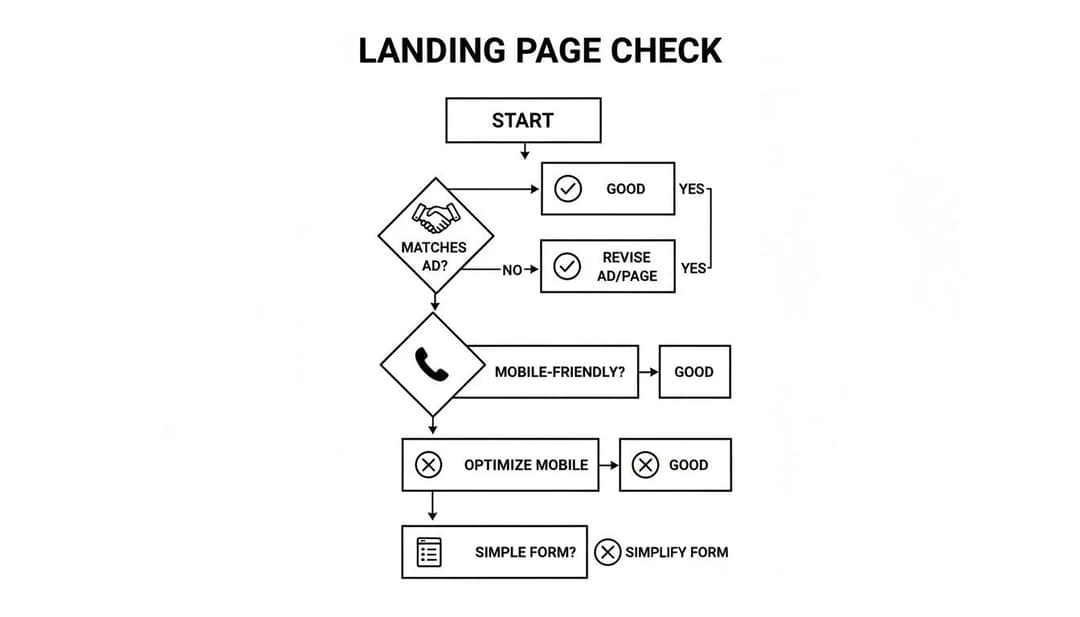
This visual just hammers home the point that a successful conversion path requires a seamless link between your ad, a great mobile experience, and a form that's easy to fill out.
Deciding on the right bidding strategy can feel overwhelming, so I've put together a quick comparison table to break down the most common options and where they fit in a real estate context.
Real Estate PPC Bidding Strategy Comparison
| Bidding Strategy | Best For | Key Consideration | Real Estate Example |
|---|---|---|---|
| Manual CPC | New campaigns, small budgets, maximum control. | Time-intensive; requires constant monitoring and adjustments. | Launching a new "sell my home fast" campaign and wanting to control initial click costs. |
| Maximize Clicks | Driving as much traffic as possible within a set budget. | Focuses on volume, not quality. Can attract low-intent clicks. | A branding campaign to get your agency's name in front of everyone in a new zip code. |
| Maximize Conversions | Campaigns with consistent conversion history (15+ per month). | Requires conversion tracking to be set up perfectly. Can be volatile initially. | An established buyer campaign for "homes for sale in [City]" that's already generating leads. |
| Target CPA | Mature campaigns where you know your ideal cost-per-lead. | Needs significant conversion data (30+ per month) to work well. | A high-performing seller lead campaign where you know you can't pay more than $150 per lead. |
Ultimately, the goal is to start with more control (Manual CPC) and then, as you gather reliable data, graduate to more sophisticated, automated strategies that let the platform's AI do the heavy lifting for you.
Allocating Your Budget for Maximum Impact
Your budget should never be a single, monolithic number. Think of it as a pool of capital you need to strategically deploy across different campaign priorities. These priorities will naturally shift with the seasons and your immediate business needs.
Here's a practical way I like to segment my clients' budgets:
- Seller vs. Buyer Leads: Let's be honest, seller leads are the bigger prize. It's standard practice to allocate a larger slice of the pie, often 60-70%, to campaigns targeting homeowners who are thinking about selling.
- Property Types: If your specialty is luxury homes and high-rise condos, you shouldn't lump them together. Create separate campaigns for each and divide your buyer-focused budget accordingly. This makes sure your high-margin listings get the visibility they deserve.
- Market Seasonality: Real estate has its peaks and valleys. Be ready to ramp up your spending during the hot spring and summer months and strategically pull back during the slower winter season to protect your ROI.
For a more advanced look at spending your money wisely, our guide on how to optimize ad budget allocation offers some deeper insights.
Tracking True Return on Investment
Here it is: the single most important part of PPC management for real estate is moving beyond vanity metrics. Cost-per-lead is a fine health indicator, but it doesn’t pay the bills. The only number that truly matters is your cost-per-closed-deal.
To get this number, you absolutely have to bridge the gap between your ad platform and your CRM. By using tracking parameters and integrating your systems, you can follow a lead's journey from the first click all the way to a signed contract. This is what "closing the loop" means. It unlocks real business intelligence and finally lets you answer the ultimate question:
"For every dollar I put into this campaign, how many dollars in commission did I get back?"
This is where your return on ad spend (ROAS) becomes your north star. In the hyper-competitive world of real estate PPC, the average ROAS is a sobering 1.40—meaning agents typically make just $1.40 for every $1 spent. But you can do better. By focusing on long-tail keywords that slash wasted spend by 20-30%, skilled PPC managers can push that ROAS toward a much healthier 2.5x.
Answering that ROAS question with hard data is what transforms your advertising from a business expense into a scalable, predictable investment in your growth.
Scaling Your Campaigns with Smart Automation

Let's be honest: there’s a hard ceiling on manual campaign management. You can only tweak so many bids or pause so much ad copy before it becomes your entire job. That time suck pulls you away from what actually grows your real estate business—connecting with clients and closing deals.
If you want sustainable, long-term growth from your PPC efforts, you have to shift from constant hands-on tinkering to a more strategic, automated approach. This isn't just a "nice-to-have" anymore. For ambitious agents, smart automation is now a must-have for outperforming the competition and getting your time back. The great news is that powerful tools are baked right into the ad platforms you're already using.
Leaning into the Platform’s Built-in Tools
Google and Meta have poured millions into machine learning to help advertisers like you get better results. The modern way to manage PPC for real estate is to work with the algorithms, not against them. Feed them the right data, give them clear goals, and let them handle the heavy lifting.
Here are a few practical ways to get started:
- Automated Rules: These are simple "if-this-then-that" commands that run 24/7. For example, set up a rule to automatically pause any ad that spends over $50 without a single conversion. No more discovering wasted spend the next morning.
- Performance Max (PMax): Got a new luxury development to promote or want to drive open house sign-ups? PMax campaigns can be incredibly powerful. You just provide the assets—images, videos, text—and Google’s AI scours its entire network to find your perfect customer.
- Dynamic Ads: On platforms like Facebook, you can connect your property feed to automatically create ads for new listings. This keeps them updated with the latest pricing and photos without you lifting a finger.
The goal is to automate the repetitive decisions so you can focus on high-level strategy. Think of yourself as the architect, not the bricklayer. You design the blueprint, and automation builds the house.
The Real Game-Changer: AI-Driven PPC Platforms
While the native tools are a fantastic starting point, dedicated AI-driven platforms are where the real magic happens. Tools like AdStellar are built from the ground up to automate ad creation, testing, and optimization at a scale that's physically impossible to do by hand. Imagine testing hundreds of ad copy and creative combinations in minutes instead of weeks.
This is where the industry is moving. In 2025, PPC management costs for real estate agents are hitting $30-$50 per lead, with agencies charging $500-$3,000 a month just for oversight. The reason? Rising complexity. A recent study shows 49% of PPC pros find campaigns harder to manage than they did just two years ago. For a growth-focused agent, that complexity doesn't scale well.
AdStellar AI flips this on its head by launching campaigns 10x faster, centralizing all your creative assets, and using AI to instantly rank what works. We’ve seen agencies report 2x the efficiency and slash those hefty fees by bringing smart automation in-house.
Ultimately, embracing automation frees you up to focus on what you do best: building relationships and making deals. And to handle all those new inbound leads seamlessly, think about solutions like leveraging virtual receptionists for real estate success. When you automate both your lead generation and your initial lead response, you create a powerful, scalable system for unstoppable growth.
Your Top Real Estate PPC Questions, Answered
Jumping into the world of paid ads always kicks up a lot of questions. To help you get your footing, I’ve put together some straight-to-the-point answers for the most common things real estate pros ask us. This is your quick guide to building a smarter, more effective PPC strategy from day one.
How Much Should I Actually Spend on Real Estate PPC Ads?
There's no one-size-fits-all answer here, but a solid starting point for most agents is somewhere between $500 and $1,000 per month. This gives you enough runway to collect real data and figure out what’s actually moving the needle.
The real focus shouldn't be the budget itself, but your return on ad spend (ROAS). A great campaign will bring in commissions that make the ad costs look tiny. Once you find a winning formula, you can start reinvesting your profits to scale things up. Remember, individual leads can cost anywhere from $30 to over $100, so your budget needs to be big enough to generate some real volume. Otherwise, you'll never have enough leads to properly test your follow-up game.
Is Google Ads or Meta Ads Better for Real Estate?
This is a classic question, but it's not really about which one is "better." The smart play is to understand how they work together as part of a complete PPC management for real estate strategy. Each platform has a unique job to do.
- Google Ads is all about capturing people who are actively looking for a home or an agent right now. This is what we call demand capture. They're raising their hand, and you just need to be there.
- Meta Ads (that's Facebook and Instagram) is fantastic for creating that demand in the first place. You can reach potential buyers and sellers long before they even think about typing "realtor near me" into a search bar. This is demand generation.
The best strategies use both. You build your brand and nurture an audience on Meta, and then you're right there on Google to catch them when they're finally ready to take action.
The most powerful approach combines both platforms. You use Meta to build an audience and stay top-of-mind, then capture that interest with Google when they're finally ready to make a move.
How Long Until I Start Seeing Results from PPC?
You can start pulling in raw leads almost the moment your campaigns go live. That’s the easy part. But seeing a real, tangible return on your investment? That’s a long game.
The real estate sales cycle is notoriously long—it can be anywhere from 3 to 12 months from that first click to a closed deal.
It’s absolutely crucial to track your short-term wins, like your cost-per-lead and how many appointments you're setting. These early metrics tell you if your campaigns are healthy. But the ultimate measure of success, the commission checks in your bank account, will take time. Patience and consistent tweaking are your best friends here.
Ready to stop the guesswork and scale your campaigns with precision? AdStellar AI automates ad creation, testing, and optimization, letting you launch winning campaigns 10x faster. Discover how AdStellar AI can transform your Meta ad performance today.