Your paid social account probably already has the raw material for better creative testing. Product photos. UGC clips. Lifestyle images. Old winners that still have the right message but look tired. The bottleneck usually isn't ideas. It's turning one solid asset into enough distinct, on-brand variations to test before the market moves again.
That's where Style Transfer AI gets practical.
Many first encounter style transfer as an art trick. Upload a photo, add a painterly reference, get something that looks gallery-ready. That's interesting, but it undersells the value for marketers. In a campaign workflow, style transfer AI is a way to keep the same core message while changing the visual treatment fast enough to support A/B testing, audience segmentation, localization, and fatigue management.
If you run Meta, display, or creative-heavy acquisition campaigns, this matters because visual style often changes how people interpret the same product. A minimalist look signals premium. A grainy handheld aesthetic feels more native to social. A bold graphic treatment can make a retargeting ad feel fresh without changing the offer or headline.
Understanding Style Transfer AI Concepts
Style transfer AI is easiest to understand if you think about a skilled art director briefing a painter.
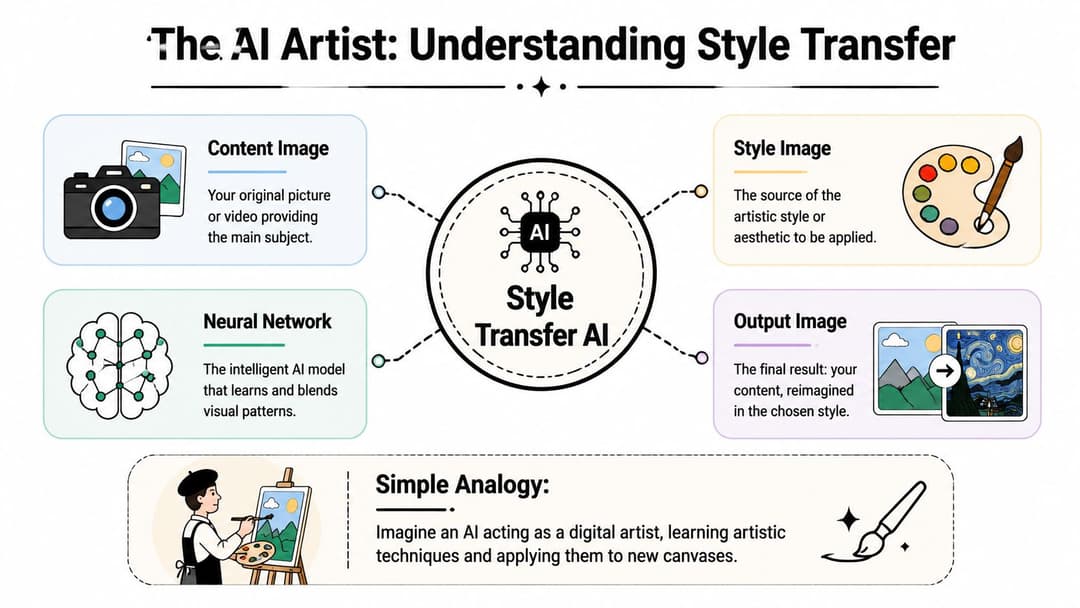
You hand over one image for subject matter and another image for visual treatment. The subject image says, “keep this product, this room, this person, this composition.” The style image says, “borrow this color logic, texture, mood, brushwork, or design language.” The system then creates a new image that tries to preserve the subject while reworking its appearance.
Content and style are different jobs
This split between content and style is the big mental model to keep.
- Content is the structure of the image. Think product shape, face position, room layout, object placement.
- Style is the visual language layered onto that structure. Think texture, color relationships, surface feel, and overall mood.
- Output is the hybrid. Same core subject, different look.
- Control comes from balancing how much of each side you want to keep.
If you've worked with audio AI, the analogy is similar to voice cloning and transformation. You can keep the words or melody while changing the voice character and tonal identity. Style transfer does that visually. It keeps the “what” and changes much of the “how it feels.”
Why the 2015 breakthrough matters
Modern neural style transfer became a major AI milestone after Gatys et al. introduced the deep-learning approach in 2015, showing that a pretrained convolutional network could separate content and style using feature maps and Gram-matrix style statistics, with an optimization loop that updates only the synthesized image. A later survey describes that framework as the foundation of the field and calls it the first of three major leaps in style transfer research, followed by real-time generators, adversarial methods, and then diffusion-based methods in 2022 to 2025, as described in this survey of style transfer research.
That sounds technical, but the business takeaway is simple. Marketers gained a machine process that could treat visual identity as something modular instead of fixed.
Practical rule: If your team can describe an image as “keep the product, change the vibe,” you already understand the core of style transfer AI.
What content loss and style loss mean
The classic setup works by minimizing a weighted mix of content loss and style loss, often starting from random noise and gradually updating the image until it preserves the original structure while adopting the new style, as explained in this neural style transfer walkthrough.
You don't need the math, but you do need the intuition:
- Increase content weight when you care about product accuracy, packaging details, or layout fidelity.
- Increase style weight when you want a stronger mood shift, richer texture transfer, or more dramatic visual differentiation.
- Balance both when the campaign needs recognizability and novelty at the same time.
Often, many marketers get confused. They expect a style transfer tool to behave like a filter. It's not just applying a preset on top. It's rebuilding the image according to competing objectives. That's why some outputs feel subtle and others feel heavily transformed.
For teams that want a stronger foundation in how machines detect and reuse visual structure, AdStellar's explanation of pattern recognition in AI is a useful companion read. It helps connect the creative result back to the underlying visual analysis.
A Practical Guide to Style Transfer Methods
Not all style transfer systems behave the same way. Some are slow but instructive. Some are built for speed. Some handle broad mood shifts better than fine brand consistency. If you're choosing tools for a campaign workflow, the right question isn't “which method is smartest?” It's “which method matches the production job?”
The main families of methods
The classic neural style transfer approach is iterative. It refines one image over repeated optimization steps. Early versions often needed hundreds to thousands of optimization steps per image, while later fast methods and diffusion models were developed specifically to reduce computation and add flexibility, according to NVIDIA's discussion of faster style transfer systems and scalable generation in its post on artistic combinations with AI style transfer.
That matters in a marketing setting because iterative systems are great for learning and for one-off hero visuals, but they're less convenient when your designer needs a pile of variants before the afternoon review.
Then came faster generator-based approaches, GAN-style workflows, and more recently diffusion-era pipelines. Each one shifted the tradeoff between speed, control, and stylistic depth.
Style Transfer Technique Comparison
| Technique | Speed | Quality & Control | Best For Marketing |
|---|---|---|---|
| Classic neural style transfer | Slower, because it iteratively refines each image | Strong conceptual control over content vs style balance, but less convenient for bulk production | Hero images, creative exploration, learning how stylization behaves |
| Feed-forward CNN methods | Faster once trained or packaged into tools | Good for texture-heavy and repeatable transformations | Rapid testing of many visual treatments across the same product set |
| GAN-based transfer | Often efficient for specific domains and unpaired image translation | Useful when you want a domain shift rather than a painterly effect | Turning one visual world into another, such as polished studio into lifestyle-like treatment |
| Diffusion-based transfer | Designed for lower computation than early iterative workflows and broader conditioning options | Flexible and strong for complex prompts, multi-modal guidance, and broader creative direction | Campaign variation, video restyling, style-guided concept generation |
| Transformer-based stylization pipelines | Varies by implementation | Better at modeling global context and higher-level style relationships | Brand-sensitive campaigns where coherence across complex scenes matters |
CNNs versus Transformers
One technical distinction is worth knowing because it directly affects output quality. CNN-based methods tend to capture local cues such as color and texture, while Transformer-based methods can model global context and deeper stylistic structure. A comparative study reports that Transformer approaches better grasp higher-level style relationships than earlier convolutional models, as detailed in this comparison of CNN and Transformer style transfer approaches.
For marketers, that changes the brief.
- If you want fast, texture-first changes, CNN-style systems can work well.
- If you need semantic coherence across a busy composition, Transformer-based systems often make more sense.
- If your brand team cares about overall scene logic, not just surface treatment, global modeling matters.
The quickest workflow isn't always the cheapest one if it produces off-brand assets your team can't approve.
One useful way to think about it is to match the model to the decision being tested. If your test is about texture, tone, or color feel, a simpler pipeline may be enough. If your test is about premium perception, lifestyle polish, or visual narrative, you'll usually want stronger global control.
If your team is already experimenting with synthetic creative production more broadly, AdStellar's guide to the AI marketing image generator landscape helps place style transfer inside the larger set of image-generation workflows.
Inspiring Style Transfer Examples for Ad Creatives
A product team rarely needs “turn this into a painting.” They need “make this same asset feel native to three different campaigns.”
That's where style transfer becomes useful.
One product photo, multiple campaign angles
Take a clean photo of a smart home thermostat on a wall. The content stays fixed. The product remains recognizable. Then the visual treatment changes.
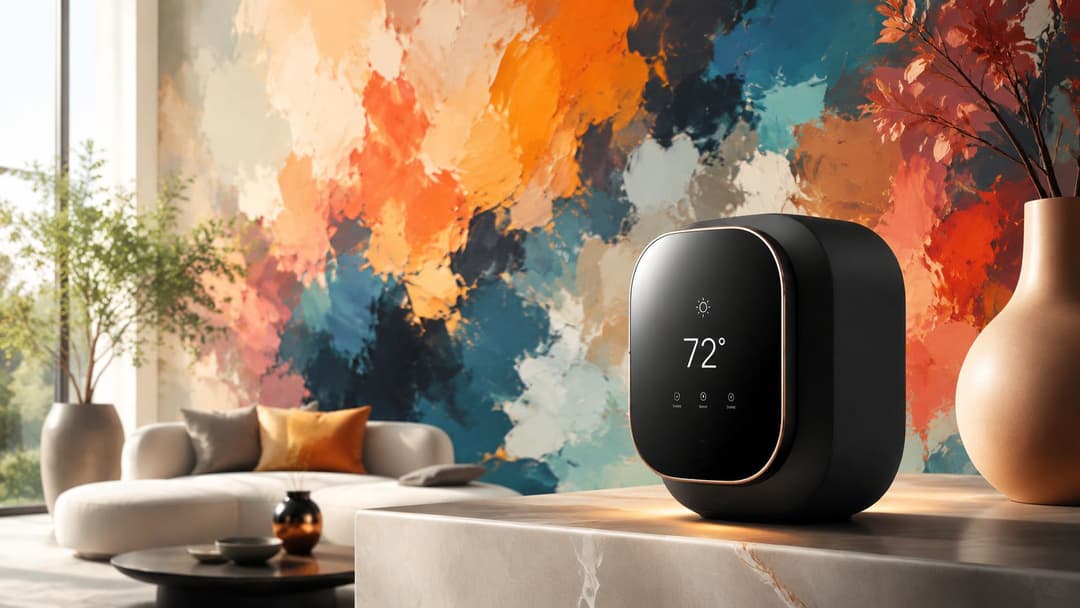
A few campaign-ready directions might look like this:
- Graphic and youthful. The same thermostat gets bold contrast, punchy accent colors, and sharper edges that feel closer to poster art or creator-led social ads.
- Warm and seasonal. The scene shifts toward softer textures and a cozy color palette, making the same device feel better suited for a winter comfort message.
- Minimal and premium. Background clutter drops away visually, surfaces feel cleaner, and the image starts to align with luxury DTC creative.
- Editorial lifestyle. Lighting and texture move toward magazine-style photography, giving the ad a more aspirational tone.
- Localized aesthetic. The same product shot can be adapted to feel more aligned with a regional campaign without reshooting the asset.
Existing media gets more mileage
Stock photos are another strong use case. A generic image of someone using a laptop can feel unusable because it doesn't match brand style. Style transfer can turn that into something closer to your visual system without rebuilding the entire scene from scratch.
This helps in three common situations:
- You need more variants from an old winner.
- You have decent source media but weak stylistic consistency.
- You want to test aesthetic hypotheses before scheduling a full shoot.
A smart use of style transfer isn't replacing art direction. It's compressing the path from concept to testable creative.
If you want a benchmark for what strong paid social creative looks like before you start restyling assets, this collection of great Facebook ad examples is useful because it shows how visual treatment changes perceived intent.
Driving Campaign Performance with Style Transfer
Performance marketers shouldn't treat style transfer as a novelty layer added after strategy. It can become part of the testing engine itself.
The reason is simple. Most campaigns fail to learn fast enough because teams can't generate enough meaningful variation. They change headlines and CTAs, but the visual language remains static. Audiences then keep seeing the same aesthetic logic, even when the offer changes.
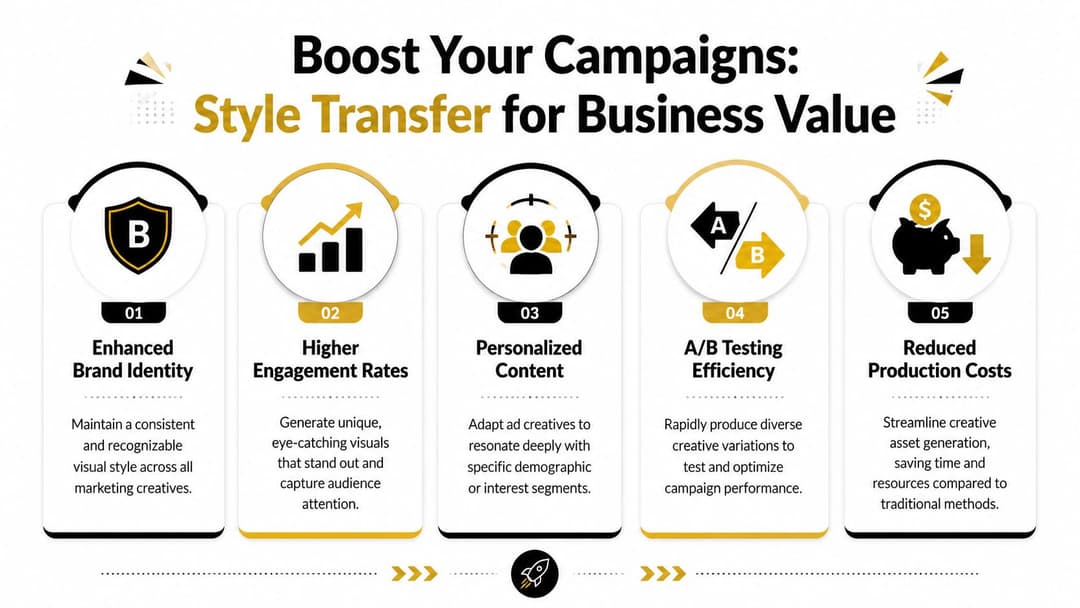
Creative iteration gets faster
Style transfer helps when the message is already working but the ad is losing freshness. Instead of replacing the whole asset stack, teams can restyle proven source images into new visual families.
That opens up a more disciplined testing cycle:
- Hold the offer constant and test visual mood.
- Hold the product image constant and test audience-fit aesthetics.
- Hold the landing page angle constant and test native-feeling ad treatments by placement or platform style.
This is especially useful in paid social because fatigue often shows up visually before it shows up in messaging. The audience has seen the asset too many times, even if the copy is still serviceable.
A better way to run aesthetic A B tests
Many teams run weak creative tests because they compare assets that differ on too many variables at once. One image is brighter, a different crop, a new headline, a new CTA, and a different background. If performance changes, nobody knows why.
Style transfer gives you cleaner experiments.
A stronger structure looks like this:
| Test variable | Keep fixed | Change |
|---|---|---|
| Premium vs casual feel | Product, headline, CTA, audience | Visual style treatment |
| Creator-native vs polished brand look | Offer, format, landing page | Aesthetic language |
| Regional fit | Core image subject, product details | Style cues aligned to local taste |
| Retargeting refresh | Existing winner's subject and copy | Surface treatment and mood |
The result isn't guaranteed performance lift. No visual method can promise that. But it does give you more controlled hypotheses, which means your team can learn faster from each round.
Brand consistency without repetitive ads
A hidden problem in scaled acquisition is inconsistency. Teams produce dozens of ads across agencies, freelancers, internal designers, and AI tools. The output volume grows, but visual identity starts drifting.
Style transfer can help standardize creative direction when you define a small set of reference looks. Instead of briefing every asset from scratch, you can use style references as reusable visual anchors.
That's one reason the technology has moved beyond art experiments. An independent source notes that style transfer can be effective for data augmentation, while NVIDIA describes style-transfer research as computationally efficient, flexible across many styles, and effective for stylizing both images and videos, pointing to broader scalable use cases across formats, as summarized in this practical overview of style transfer applications.
That broader point matters for campaign operations. A style system can span still images, motion assets, and even transformed video footage, which makes the creative library easier to manage.
Here's a visual walkthrough that shows how style changes can alter the feel of generated output in practice.
Where marketers get real value
The strongest use cases tend to cluster around four jobs.
- Refreshing winners. Keep the same proven asset structure but change visual treatment enough to reduce sameness.
- Segment-specific creatives. Match visual tone to audience expectations without changing the core product story.
- Localization. Adjust aesthetic cues for regional markets when full reshoots aren't practical.
- Training data support. In some workflows, stylized variants can support augmentation and experimentation around visual models.
What to watch out for
Style transfer can also create noise if your team uses it without a decision framework.
Ask these questions before launching stylized variants:
- Does the new look support the message, or distract from it?
- Will the product remain clearly recognizable at ad size?
- Is the style aligned with audience expectations for this funnel stage?
- Can your design and media teams label the test clearly enough to learn from it?
If you're building a broader operating system for testing and scaling creative decisions, AdStellar's perspective on performance marketing with AI is a helpful frame because it connects creative variation to campaign learning loops rather than isolated design tasks.
Accessible Tools to Start Using Style Transfer Today
You don't need a research team to start experimenting with style transfer AI. You need a small test set, a clear creative question, and tools that match your production comfort level.
No-code options for quick experiments
If your goal is fast ideation, start with browser-based style transfer and image editing tools. These are useful when you want to compare visual directions in minutes and decide whether a concept deserves deeper production work.
For teams that want a low-friction sandbox, you can try GPT Uncensored's creative tools to explore style transfer on existing images and get a feel for how different references affect the output. The value at this stage isn't perfection. It's seeing how quickly a product shot can move from one aesthetic lane to another.
A practical starter workflow looks like this:
- Choose one source asset that already performs decently or communicates the product clearly.
- Collect several style references from past campaigns, brand moodboards, editorial sources, or design systems.
- Generate a small set of variants with one visual difference at a time.
- Review for brand fit first, then decide which directions deserve testing.
Tools for teams with more technical depth
If you have designers working with advanced AI interfaces or developers supporting creative operations, you can go further with open-source libraries and model pipelines in ecosystems like PyTorch or TensorFlow. Those setups are more flexible when you want custom automation, repeatable style presets, or style transfer embedded into a broader asset pipeline.
You may also want tools that combine image generation, editing, and ad production workflows. One example is AdStellar's AI image ad generator guide, which is useful if your team is thinking beyond single images and into scalable ad asset production.
Start with one narrow use case
Don't begin with a full rebrand or a hundred-asset batch.
Start with one of these:
- A fatigue refresh for a current paid social winner
- A premium versus casual visual test on the same product
- A localized aesthetic pass for one market
- A stock image rescue project where the composition works but the style doesn't
Keep the first experiment small enough that your team can judge output quality by eye and test logic by campaign results.
Conclusion Integrating AI into Your Creative Workflow
Style transfer AI sits in a useful middle ground. It's more strategic than a filter and lighter-weight than a full production cycle. For performance marketers, that makes it valuable.
The core idea is simple. Keep the content that already works. Change the visual treatment fast enough to learn what audiences respond to. That can support cleaner A/B tests, fresher retargeting assets, stronger brand consistency, and more productive use of existing media.
The most important shift is mental. Don't treat style transfer as an art experiment looking for a business use. Treat it as a creative operations tool that helps your team produce, test, and refine visual hypotheses with less friction.
As AI workflows mature, the advantage won't come from generating more assets at random. It'll come from generating the right variations, tying them to a clear testing plan, and learning faster than competitors.
If you want to turn creative variation into a repeatable campaign system, AdStellar AI helps teams generate, launch, and test large sets of ad combinations while keeping performance data connected to what gets made next.