Let's get right to it and tackle the big question: what does impressions mean on Instagram?
In simple terms, impressions are the total number of times your content—any post, Story, or Reel—has been shown to users. It’s a raw count of views. If a single person sees your Reel in their main feed and then sees it again on the Explore page, that’s logged as two impressions.
Decoding Instagram Impressions
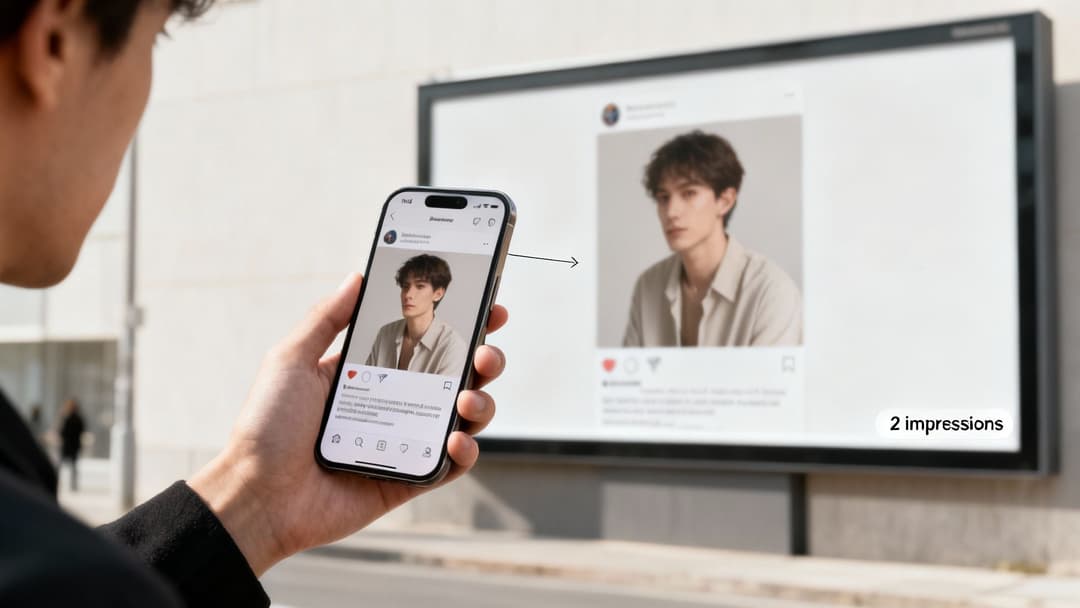
It’s easy to get tangled up in the web of social media metrics, but impressions are one of the most fundamental. Think of it as a measure of total visibility, not unique eyeballs. This is a critical distinction, and it’s where most of the confusion comes from.
Let me paint a picture. Imagine your Instagram post is a billboard on a busy highway. Every single time a car drives past it, that’s one impression. If the same person drives past that billboard on their way to work and again on their way home, that one driver just generated two impressions. Simple, right?
How Impressions Differ From Reach
This is where another key metric, reach, enters the conversation. Using our billboard analogy, reach counts the number of unique cars that passed by—in this case, just one driver. Impressions, on the other hand, count the total number of times the billboard was seen, which was two.
This core difference is everything when you're trying to figure out how your content is performing. If one of your followers scrolls past your Reel three separate times—once in their feed, once when browsing a hashtag, and a third time on your profile—that single person accounts for three impressions but only one person reached.
To make this crystal clear, here’s a quick side-by-side comparison.
Impressions vs Reach At a Glance
| Metric | What It Measures | Example Scenario | Primary Use Case |
|---|---|---|---|
| Impressions | The total number of times content is displayed on a screen. | One person sees your post 3 times = 3 impressions. | Measuring total visibility and ad delivery frequency. |
| Reach | The number of unique users who saw your content. | One person sees your post 3 times = 1 reach. | Understanding the unique size of your audience. |
Wrapping your head around this distinction is the first step toward a smarter marketing strategy. It's the foundation for everything else.
Why This Metric Is Foundational
So, why should you care about this raw number? Because impressions are the first domino to fall. They help you gauge:
- Content Visibility: Are your posts actually making it into people’s feeds, Explore pages, and hashtag results? A low impression count means you have a distribution problem.
- Ad Delivery: For paid ads, impressions are proof that your campaign is running and your ad is being shown to your target audience. No impressions, no results.
- Message Stickiness: When your impressions are way higher than your reach, it means the same people are seeing your content over and over. This can be a sign that your content is compelling enough for the algorithm to keep showing it.
Impressions are the raw measure of your content's exposure. While not a direct indicator of engagement, a high impression count is the necessary foundation for achieving likes, comments, and shares.
Before we dive into how to analyze this data, it's helpful to understand the broader context of what are impressions on social media across different platforms. For now, we'll focus on turning these Instagram numbers into real, actionable insights for your growth.
Impressions vs. Reach vs. Frequency: The Golden Triangle of Ad Metrics
Getting a handle on impressions is a great start, but it's only one piece of the puzzle. The real magic happens when you see how impressions work together with two other key metrics: reach and frequency. Think of them as a trio that, when combined, gives you a crystal-clear picture of your content's visibility and how it’s landing with your audience.
Let's use a classic example. Imagine you’re running a TV ad for a new energy drink.
- The total number of times your ad is shown on screen is your impressions.
- The number of unique households that actually saw your ad at least once is your reach.
So, if your ad airs 10 times (10 impressions) but is only seen by 5 unique households (5 reach), what does that really tell you? It shows that, on average, each household saw your commercial twice. And that average number? That’s your frequency.
The Simple Formula That Explains Everything
This isn't just a loose concept—it's a straightforward formula that every performance marketer should have burned into their brain. It works the same for a high-budget TV spot as it does for a scrappy Instagram ad.
Impressions ÷ Reach = Frequency
This simple equation unlocks a much deeper level of analysis. It shifts the question from "How many times was my ad seen?" to the far more insightful "How many times was my ad seen per person?"
Let's plug in some numbers from a real-world Instagram campaign:
- Impressions: 50,000
- Reach: 10,000 unique accounts
- Frequency: 50,000 ÷ 10,000 = 5.0
Boom. Right there, you know that the average person in your target audience saw your ad five times. This single number is incredibly powerful for diagnosing your campaign's health at a glance.
Finding the Sweet Spot
The balance between these three metrics tells a story, and a high frequency isn't automatically a good or bad thing. It all comes down to your campaign goals. A frequency of 5.0 might be absolutely perfect for a retargeting campaign trying to build brand recall, where repetition is exactly what you want.
But what if that same frequency is paired with cratering engagement and a dropping click-through rate? That's a huge red flag. It’s a classic sign that your audience is seeing the ad way too often and has started to tune it out. This is called ad fatigue, and it can burn through your budget with nothing to show for it. If that sounds familiar, we have a guide full of practical solutions for ad fatigue to help you get things back on track.
On the flip side, a very low frequency (say, close to 1.0) means you’re reaching lots of new people but not really reinforcing your message. This could be great for a massive brand awareness push where maximizing reach is the only goal. But it's far less effective if you're trying to drive a specific action, which almost always requires multiple touchpoints.
Mastering this interplay isn't just a "nice to have"—it's a non-negotiable skill for making smart decisions and successfully scaling your campaigns.
How to Find and Analyze Impressions in Your Insights
To really get a feel for what your impressions are telling you, you first need to know where to dig up the data. If you have an Instagram Business or Creator account, this treasure trove is waiting for you in your native analytics dashboard, which Instagram calls Insights.
Getting there is simple. Just head to your profile and tap the "Professional dashboard" button. From there, you can jump into "Account insights" for the big-picture view. But for the real nitty-gritty, tap on any individual post, Reel, or Story and select "View insights." This is where you'll find a detailed performance breakdown, including exactly where your impressions came from.
This simple diagram really clarifies how these core metrics—impressions, reach, and frequency—all work together.
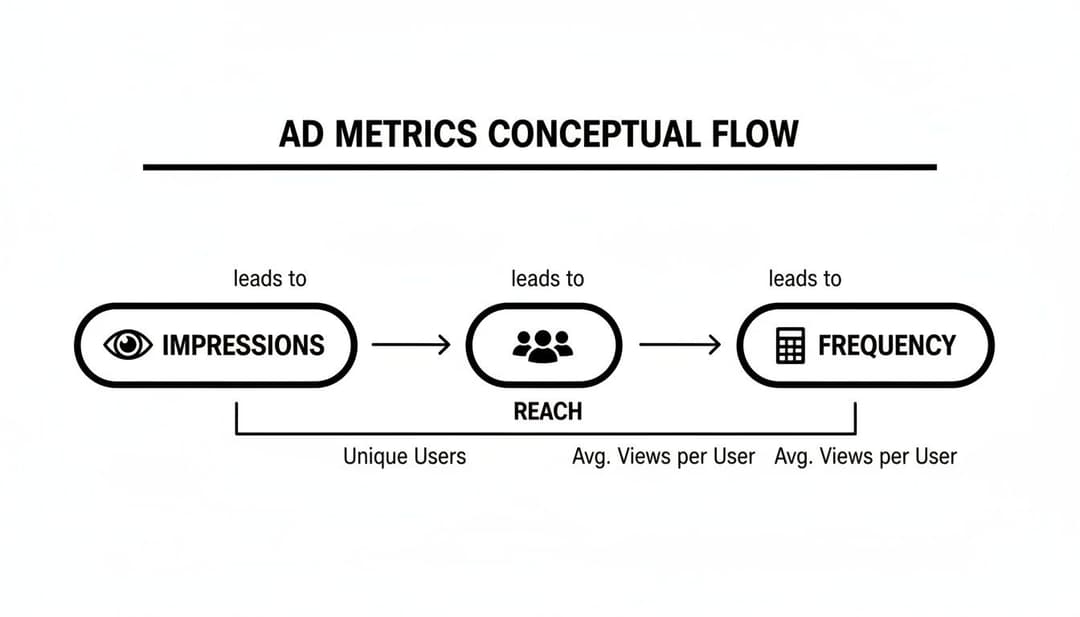
Think of it this way: your total views (impressions) are spread out among a certain number of unique people (reach), which gives you the average number of times each person saw your content (frequency).
From Organic Staple to Paid Specialist
Now, it's important to understand how the role of impressions has evolved on the platform. After a recent update, Meta started using the term "views" for a lot of organic content to make the analytics feel a bit simpler. But don't be mistaken—the concept of impressions is still absolutely critical for paid ads, and your historical data is a goldmine of lessons.
Before this shift, impressions were the go-to metric for measuring the depth of your visibility. For example, a study looking at 500 e-commerce accounts found that posts hitting 50,000+ impressions actually drove 3.2x more website traffic than posts with under 10,000. And the kicker? A massive 62% of that traffic came from people seeing the post more than once. This really drives home just how powerful repeat exposure can be.
Breaking Down Your Impression Sources
Once you're in the insights for a specific post, you’ll find a section that breaks down your impressions by their source. Understanding where your views are coming from is the key to refining your content strategy and figuring out what’s actually working.
This breakdown tells a story:
- From Home: High numbers here are a great sign. It means your content is landing well with your existing followers in their main feed.
- From Hashtags: This is your proof that the hashtags you're using are effectively pulling in new people who are searching for that topic.
- From Explore: Seeing a lot of impressions from Explore is a huge win. It means the Instagram algorithm likes your content enough to push it out to a broad new audience that doesn't follow you yet.
To get an even clearer picture, you can pair this data with tools that offer deeper Audience Insights. When you combine impression sources with demographic data, you start to build a complete profile of who is seeing your content and how they found it. And if you're looking to make your cross-platform strategy more efficient, you might find our guide on how to post from Facebook to Instagram helpful.
Why Impressions Are a Goldmine for Paid Ad Campaigns
If you're running paid ads on Instagram, impressions are way more than just a vanity metric—they're the bedrock of a winning campaign. While organic content is all about building community and engagement, paid advertising is a game of strategic visibility. Impressions are the fundamental unit of that visibility, counting every single chance your ad has to make an impact.
Think of it this way: your target audience is a huge field, and each impression is like planting a seed. One seed might not sprout, but scattering thousands of them dramatically boosts your odds of a successful harvest. A high volume of impressions directly fuels brand awareness, making your logo, message, and products feel familiar and memorable over time.
Building Your Retargeting Pool
Every single impression also serves a critical behind-the-scenes purpose: it populates your retargeting audiences. Each time your ad is shown to a user, you're building a valuable pool of people who have been exposed to your brand. This is the foundation for the powerful, high-conversion campaigns you’ll run later.
A large impression count means you're creating a robust audience of warm leads to hit again with different messaging, special offers, or customer testimonials. Without a steady stream of initial impressions at the top of your funnel, your sales pipeline will quickly run dry. This is exactly why campaigns optimized for reach or impressions are so crucial for long-term, scalable growth.
High Instagram impressions directly fuel business outcomes for performance marketers. A recent analysis of 10,000 global campaigns showed brands averaging 100,000 monthly impressions per post achieved 2.7x higher engagement rates and 41% more profile visits. Explore the full Hootsuite research about the power of the Instagram algorithm.
The data makes the connection crystal clear: more visibility leads to more interaction and, ultimately, more growth. Impressions are the very first domino to fall in that profitable chain reaction.
Impressions as a Diagnostic Tool
Keeping a close eye on your impressions is also your best defense against one of the biggest budget killers in advertising: creative fatigue. When you notice your impression count is holding steady but your click-through rate (CTR) or conversion rate starts to tank, that’s a classic sign your audience has seen the ad too many times and is starting to tune it out.
This is where the relationship between impressions and frequency becomes so important. Modern ad platforms use AI to test dozens of creative variations on the fly. By feeding the algorithm a constant stream of fresh ads, you can sustain high impression counts without burning out your audience. The system learns which visuals and copy perform best, optimizing delivery to keep engagement high and costs low. Understanding your Instagram advertising prices and how they connect to impression volume is key to maximizing your return on ad spend (ROAS).
By treating impressions as both a growth driver and a diagnostic metric, you can build more resilient, scalable, and profitable ad campaigns on Meta. They truly are the starting point for every dollar you make.
Turning Impression Data into Strategic Ad Decisions
Knowing what Instagram impressions mean is a great start, but it’s only half the battle. The real magic happens when you turn that raw data into smart, profitable decisions that actually move the needle for your ad campaigns.
Data without a game plan is just noise. But once you have a practical playbook, your impression data becomes one of the most powerful tools in your growth arsenal.
The most direct way to act on this data is by getting serious about A/B testing. When you launch multiple ad creatives and keep a close watch on how they perform, you can quickly figure out which visuals and messages are getting you the most eyeballs for the lowest cost. This isn't just about chasing the highest impression count; it's about finding the most efficient ad.
Use Impression Data to Test and Optimize
A metric you’ll want to live and breathe here is CPM (Cost Per 1,000 Impressions). Your mission, should you choose to accept it, is to find the ad variations that consistently nail a low CPM without tanking your engagement or conversions.
Here’s a simple framework to get you started:
- Launch with Variations: Kick things off by running three to five different ad creatives, all targeting the same audience. You can mix it up with different images, headlines, or video styles.
- Monitor Early CPM: For the first 48 hours, keep a close eye on the CPM for each ad. The ones with a noticeably higher CPM are probably not hitting the mark and are just eating up your budget.
- Iterate and Scale: Don’t be afraid to be ruthless. Shut down the high-CPM underperformers and funnel that budget over to your winners. This simple step ensures every dollar you spend is working as hard as possible to maximize your visibility.
When you're ready to get more advanced, creative testing tools like those used for AI UGC ads can automate much of this process, letting you test at a scale that would be impossible to manage manually.
Refine Audiences and Prevent Ad Fatigue
Your impression and frequency data are also giving you vital clues about the health of your audience. If you see your frequency creeping up past 4.0 or 5.0 with a cold audience, and your click-through rate starts to dip, you're looking at a classic case of ad fatigue.
Simply put, the same people are seeing your ad over and over, and they’re starting to tune it out.
The fix is to be proactive with your audience management. Don't wait for your campaign performance to fall off a cliff. When you spot an audience segment showing signs of burnout, exclude them from that campaign for a while—maybe 30 days—to give them a break.
This keeps your campaigns feeling fresh and stops you from throwing money at an audience that’s no longer listening. It also protects your brand from becoming that annoying ad people can't wait to scroll past.
To get a better handle on managing your ad spend, you can explore our guide on understanding cost per impression rates. By actively managing your ad delivery based on real data, you build a scalable system that turns insights into results and drives sustainable growth.
Common Mistakes to Avoid When Analyzing Impressions
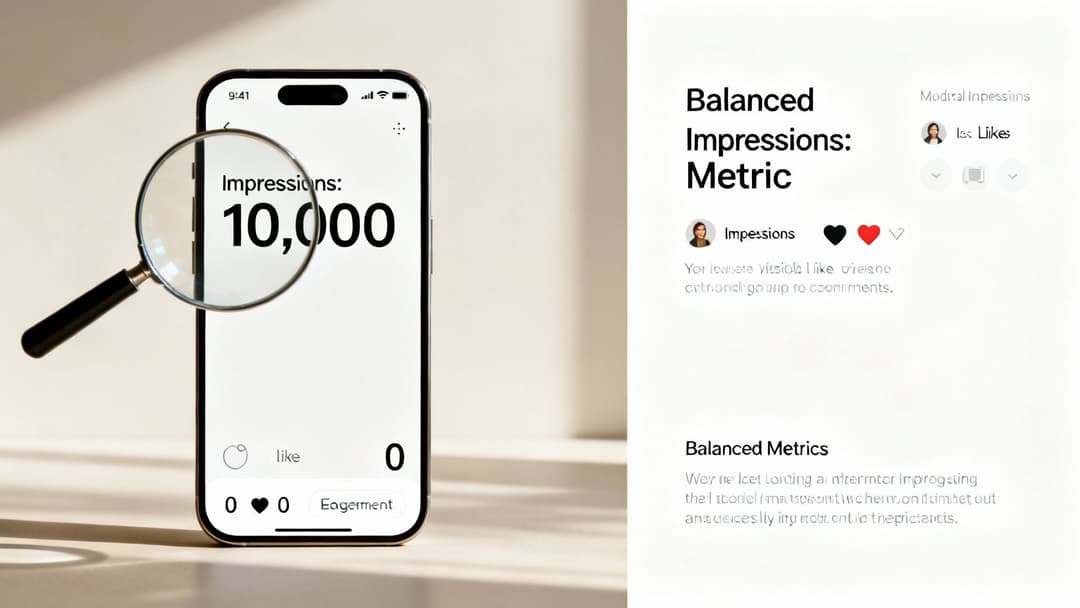
Knowing what impressions mean is one thing. Actually interpreting them correctly is where a lot of marketers stumble, often leading to wasted ad spend and bad conclusions about what’s working.
The most common trap? Treating impressions as a pure vanity metric. It feels great to see a post hit 100,000 impressions, but if it only scraped together a few clicks or comments, what did it really achieve? High visibility without meaningful action is like throwing a huge party where nobody talks to each other.
Remember, impressions measure exposure, not impact. Always pair this metric with engagement rates and conversion data to understand the true value of your content's visibility.
This mistake almost always goes hand-in-hand with another big one: ignoring the rest of the story your data is trying to tell you.
Failing to Look Beyond the Surface
To get real value from your impression data, you have to look at it in context. A high impression count is just the opening line; the rest of your metrics fill in the plot.
Here are a few classic mistakes I see all the time:
Neglecting Frequency: Seeing impressions skyrocket without checking your frequency is a recipe for disaster. If the average person sees your ad 10 times in a week, you’re not building brand love—you’re causing ad fatigue. That kind of burnout can annoy your audience, hurt your brand, and drive up your ad costs.
Ignoring Engagement Metrics: Impressions show you how many times your post was seen, but likes, shares, and saves tell you if anyone actually cared. A post with a ton of impressions but crickets in the comments suggests your creative missed the mark or your targeting was way off.
Forgetting to Segment by Placement: Not all impressions are created equal. An impression in an Instagram Story is a completely different experience from one in the Feed or on the Reels tab. If you don't break down performance by placement, you’re missing out on crucial clues about where your content truly shines.
By sidestepping these common errors, you can turn impressions from a simple number into a powerful tool for making smarter, more effective marketing decisions.
Got Questions About Instagram Impressions? We've Got Answers
Even after you get the hang of what impressions are, a few common questions always seem to pop up. Let's run through them so you can put this knowledge to work with total confidence.
Think of this as the practical side of the coin—moving from "What does this mean?" to "What do I do with this?"
What Is a Good Number of Impressions on Instagram?
This is the million-dollar question, but the honest answer is: it depends. There’s no magic number that works for everyone because it’s all relative to your follower count, your niche, and what you’re trying to achieve.
Instead of chasing a vanity metric, focus on your impression rate (impressions divided by followers) or the ratio of impressions to reach. A healthy ratio often falls between 1.5 and 2.5, which tells you your content is sticky enough for people to see it more than once. For paid ads, your north star is CPM (Cost Per 1,000 Impressions)—that’s your true measure of cost-efficiency.
Do My Own Views Count as Impressions on Instagram?
Nope, you can breathe easy on this one. Instagram is smart enough to know when you're looking at your own stuff.
Your views on your own posts, Reels, or Stories don't get added to the impression count in your professional dashboard. The numbers you see are purely from other accounts, giving you a clean look at your audience's activity.
Why Are My Impressions Higher Than My Reach?
This is completely normal and, in many cases, a very good sign. It’s not a glitch in the matrix; it just means people are seeing your content multiple times.
Think about it. This happens when:
- Your content is so good that Instagram's algorithm keeps showing it to the same engaged users.
- Someone sees your post in their Feed, then sees it again on the Explore page.
- You're running an ad campaign designed to show your creative to a specific audience several times (this is measured by frequency).
Ultimately, seeing more impressions than reach is a signal of strong visibility within a targeted group of people.
Ready to turn those impressions into measurable campaign success? AdStellar AI automates bulk ad creation and uses AI to identify your top-performing creatives, audiences, and messages. Launch, test, and scale your Meta ads 10x faster. Learn more and get started at AdStellar.ai.