You're probably looking at two dashboards that tell two different stories.
In Google Analytics or your ecommerce reports, Meta looks weak. Branded search, direct traffic, and retargeting seem to “close” the sale. In Meta Ads Manager, your prospecting campaigns keep finding purchasers, view-through activity, and engaged audiences that later convert. The temptation is obvious. Cut the campaigns that don't get the last click. Push more budget into whatever appears at the bottom of the funnel. Move fast.
That's where a lot of wasted spend starts.
If you want a practical answer to what is last click attribution, you need more than the textbook definition. You need to understand why it keeps showing up in reporting, why teams still rely on it, and why it becomes dangerous when you use it to judge Meta campaigns. Meta's system isn't built around a simplistic final-touch view of the world. It optimizes across patterns, signals, and user behavior that often begin well before the last tracked click.
The Last Click Attribution Model Explained
A marketer sees this path in a report: Meta prospecting ad, blog visit, email click, branded search ad, purchase. The report gives all the credit to branded search. The obvious conclusion is that search drove the sale and the earlier touches didn't matter much.
That conclusion comes from last click attribution.
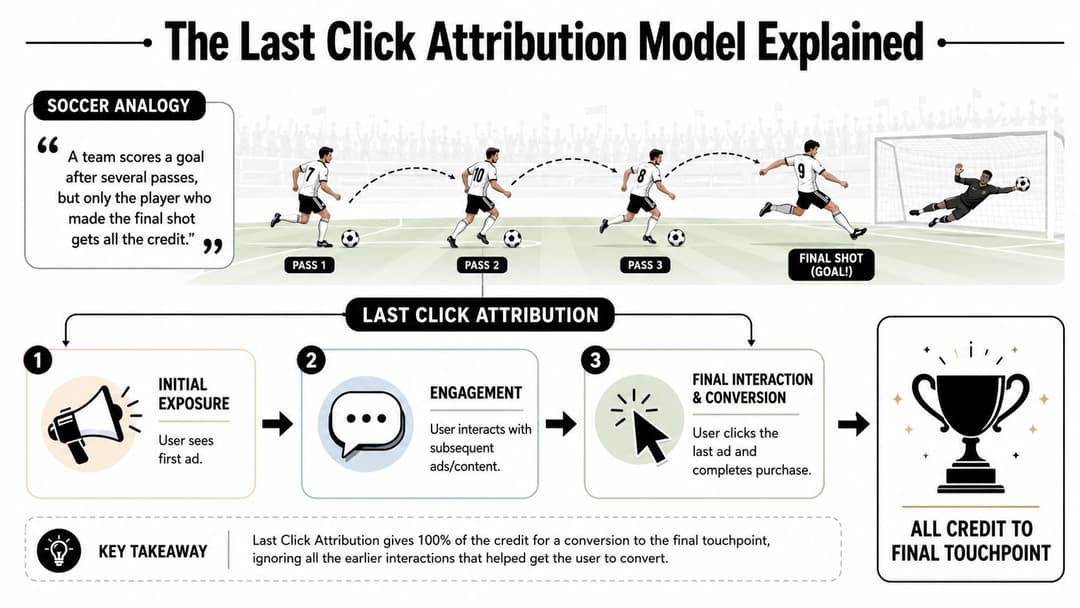
It's a single-touch model that gives 100% of conversion credit to the final tracked interaction before conversion, while every earlier touchpoint gets 0% credit, as explained in Kleene's overview of last click attribution. That's why the model is easy to read and easy to report. It answers one narrow question well: what happened right before the conversion?
A simple way to think about it
Think about a soccer team scoring a goal after a long build-up. One defender starts the play. A midfielder carries the ball forward. Another player makes the key pass. The striker takes the final shot.
Last click attribution gives the trophy only to the striker.
That's useful if your only goal is to know who touched the ball last. It's misleading if you're trying to understand how the goal happened in the first place.
How it looks in a real customer journey
A typical path might look like this:
- First touch from Meta: A shopper sees or clicks a prospecting ad and visits the site.
- Mid-funnel follow-up: They come back later after reading a blog post or opening an email.
- Final touch: They search the brand name, click a paid search ad, and buy.
Under last click attribution, only the branded search ad gets credit. The Meta ad, the content visit, and the email all disappear from the conversion story.
Practical rule: Last click tells you who closed the door. It doesn't tell you who opened it.
That's why the model creates trouble for paid social teams. Meta often does the work of introducing the product, shaping demand, or nudging a user back into consideration. If your reporting only values the final interaction, you'll miss that role entirely.
For a broader breakdown of how different Facebook measurement approaches work, this guide to Facebook ads attribution models is a useful companion.
The Allure and Dangers of Last Click Thinking
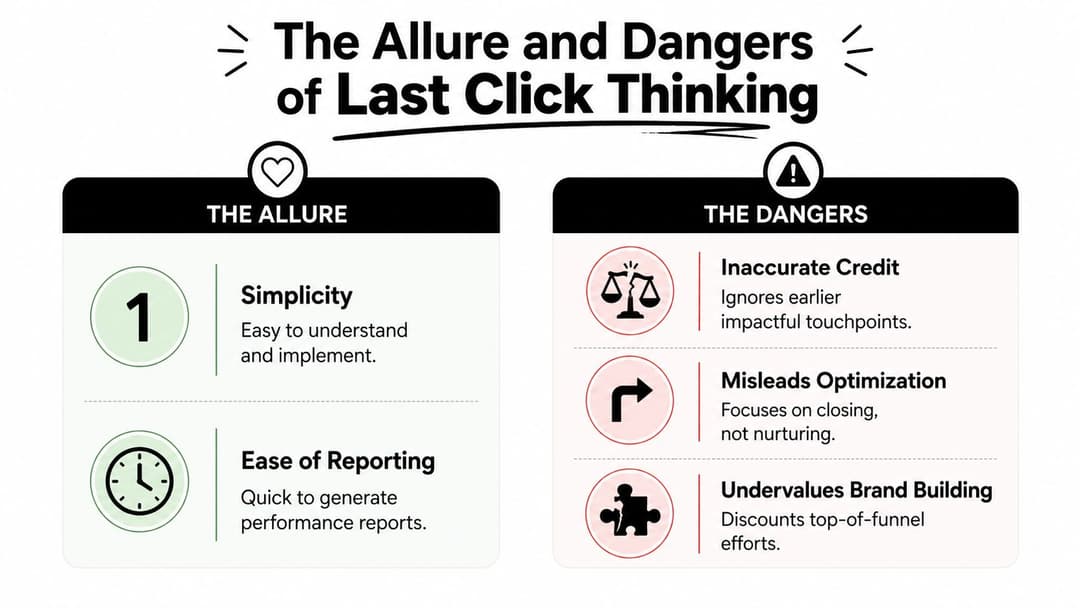
Last click survives for one reason. It's convenient.
Marketing departments don't start with a philosophical commitment to bad measurement. They start with the reporting they have. Last click is simple, cheap to operationalize, and often baked into existing workflows. eMarketer reported that 78.4% of marketers used last-click attribution and web analytics to measure media efficacy, while only 21.5% said they were confident in it, according to eMarketer's reported measurement data. That gap says a lot. Teams use it because it's available, not because they trust it.
Why marketers keep using it
There are legitimate reasons:
- Simple reporting: A conversion gets assigned to one channel. Finance and leadership can read it quickly.
- Fast implementation: It doesn't require a complex identity graph or an advanced analytics setup.
- Clear operational ownership: Paid search owns paid search conversions. Email owns email conversions. That feels clean.
In short buying journeys, this can be “good enough.” If someone clicks an ad and buys right away, a last-click report may not be wildly wrong.
Where it goes off the rails
Problems start when teams confuse closing with causing.
A branded search ad often shows up at the end because the buyer already knows the brand. Retargeting often gets the final click because it appears after earlier awareness has already done its job. Last click doesn't distinguish between the channel that harvested demand and the channel that created it.
That creates three common mistakes:
| Pattern | What the report says | What often happens in reality |
|---|---|---|
| Branded search wins | Search is the hero | Earlier channels created the intent to search |
| Retargeting looks efficient | Retargeting is driving growth | It's often converting people already persuaded |
| Prospecting looks weak | Top-of-funnel spend should be cut | Prospecting is feeding future conversions |
If you optimize only for what gets the final click, you train your team to overvalue harvest channels and undervalue demand creation.
That's why last-click thinking causes a slow budget drift. More money moves into retargeting, branded search, and other bottom-funnel activity. Less money goes into creative testing, audience expansion, and top-of-funnel messaging. The short-term report can look cleaner while the pipeline underneath starts to thin out.
If you're trying to get a truer read on channel contribution than a final-click report can provide, AdStellar's piece on measuring true ad attribution is worth reading.
How Last Click Distorts Your Meta Ad Performance
Meta doesn't optimize the way a last-click spreadsheet thinks.
When you run campaigns in Meta Ads Manager, the platform is looking for patterns tied to your optimization goal, your conversion signal, your audience behavior, and your creative response. It's trying to find people likely to convert, not merely people likely to be the final tracked click before conversion.
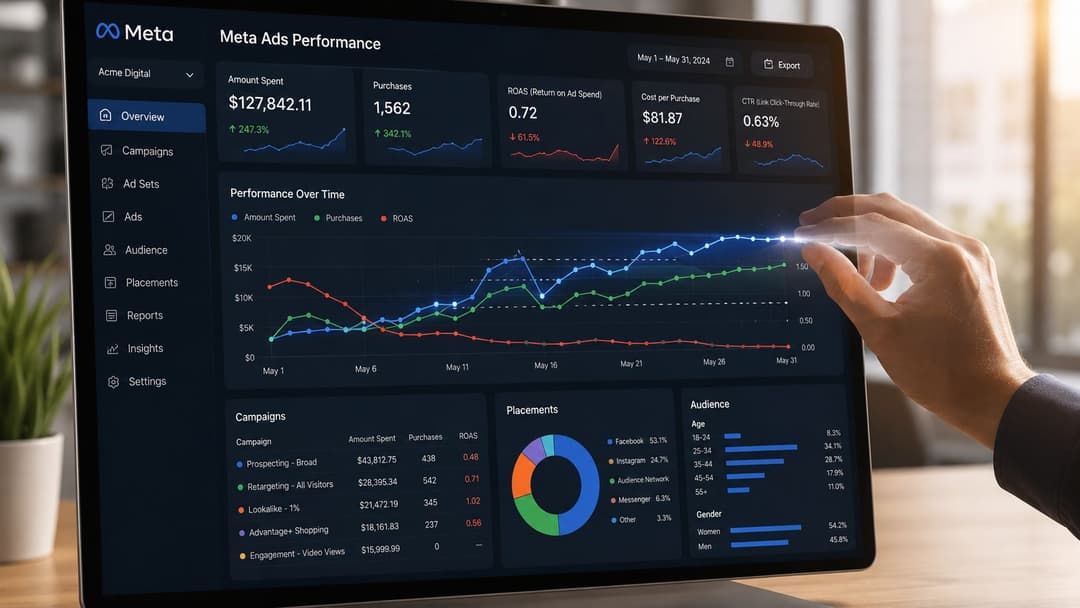
That creates a direct conflict. Your analytics tool may say a Meta prospecting campaign underperformed because it didn't receive the last click. Meta may still be using that campaign to introduce eventual buyers into the system, build qualified traffic pools, and generate conversion paths that finish elsewhere.
The common budget mistake
It usually plays out like this.
A team launches prospecting video, broad audience conversion campaigns, and retargeting. A few weeks later, the last-click report shows retargeting and branded search cleaning up conversions. Prospecting looks weak by comparison. The team cuts prospecting and shifts budget down-funnel.
At first, the account can look more efficient. Then acquisition gets harder. Costs rise. Creative fatigue sets in faster. Retargeting audiences shrink because fewer new people are entering the funnel.
The underlying issue is that last-click attribution can lead to 30% higher CPA over time when used for budget reallocation, because marketers cut top-of-funnel campaigns that drive 60% to 75% of eventual conversion value, based on data from Google and Meta included in the verified data for this article. That's the hidden tax of overreacting to the wrong report.
Why Meta prospecting gets undervalued
Prospecting campaigns are rarely built to “win” the final touch every time. Their job is often to do one of these things:
- Create familiarity: A user sees the product before they're ready to buy.
- Qualify interest: Creative filters in people who care and screens out people who don't.
- Seed later demand: The user comes back through search, email, direct traffic, or retargeting.
Last click ignores that path. It rewards the visible closer, not the earlier influence.
Here's a practical breakdown:
| Campaign type in Meta | How last click tends to treat it | What it may actually be doing |
|---|---|---|
| Broad prospecting | Weak or inconsistent | Introducing future buyers |
| Video views or awareness creative | Low direct conversion credit | Building recall and consideration |
| Retargeting | Strong | Capturing users already warmed up |
| Dynamic product ads | Very efficient | Closing high-intent traffic already created elsewhere |
Campaign diagnosis: If retargeting always looks like your top performer, ask whether it's generating demand or merely collecting it.
A lot of marketers make cuts at the wrong layer. They pause the audience or campaign that started the buying journey because a bottom-funnel ad got the final click.
Here's a useful explainer before you go deeper into setup and data quality:
The tracking layer makes this worse
Last-click logic depends heavily on recorded clicks. If your tracking is incomplete, the model gets even more biased toward whatever touchpoint happened to be captured cleanly. That's one reason server-side signal quality matters so much in Meta measurement. If you're tightening your event flow and match quality, this overview of the Facebook Conversion API gives the practical setup context.
The key point is simple. Meta can be doing the right optimization while your last-click report tells you to stop it. If you follow the report blindly, you'll often cut the campaigns that were helping the algorithm find tomorrow's buyers.
Comparing Attribution Models Beyond Last Click
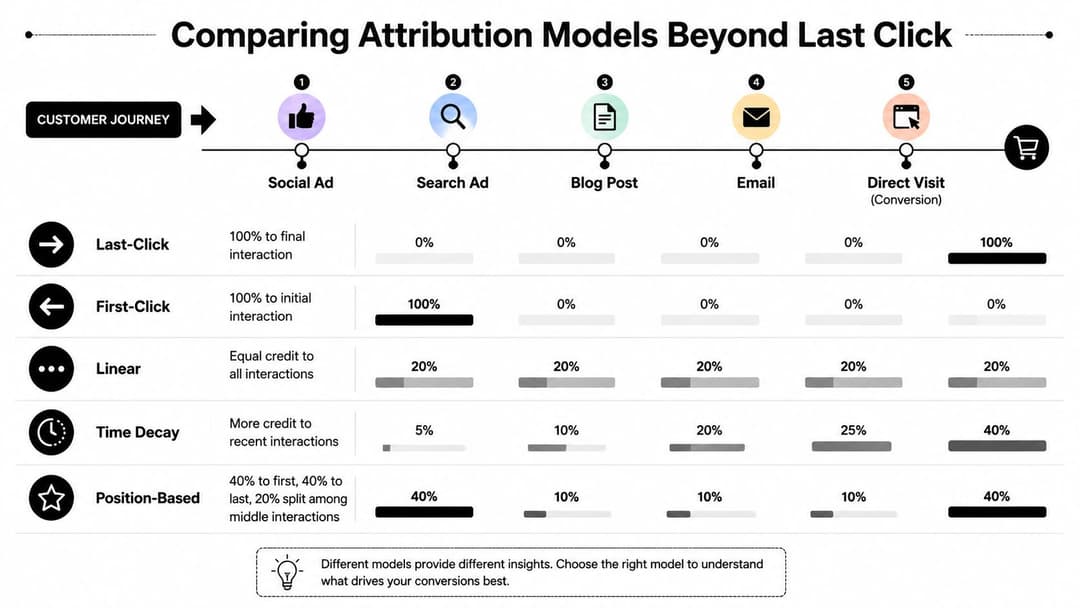
A single customer journey can produce very different stories depending on the model you use.
Say a buyer sees a social ad, returns through search, reads a blog post, clicks an email, and then converts. Last click gives all the credit to the final touch. Other models spread that credit differently, which changes how you evaluate each channel.
How the main models differ
| Model | Basic logic | Strategic bias |
|---|---|---|
| Last click | Gives all credit to the final tracked interaction | Favors closers |
| First click | Gives all credit to the first interaction | Favors discovery |
| Linear | Splits credit evenly across touches | Treats all touches as equally important |
| Time decay | Gives more credit to interactions closer to conversion | Favors recent influence |
| Position-based | Weights the first and last touch most heavily, with the middle sharing the rest | Balances discovery and closing |
| Data-driven attribution | Uses observed path data to assign fractional credit across touchpoints | Adapts to actual patterns in the dataset |
If you work with longer journeys, especially in B2B or high-consideration ecommerce, it helps to understand broader B2B multi-touch attribution models so you can see where rule-based models break down and where more flexible approaches become useful.
Why data-driven models matter more now
This isn't just a theory debate anymore. Google Ads made Data-Driven Attribution the default in 2023, and Meta began integrating cross-channel DDA in 2024. A 2024 Meta internal study also found that 45% of marketers still use last-click, leading to a 20% underestimation of Meta's role in multi-touch conversions, based on the verified data provided for this article.
That doesn't mean every team should flip a switch and trust every modeled number immediately. It does mean the industry has moved beyond treating last click as the only serious way to measure performance.
What each model is good for
Different models answer different questions:
- Use last click when you need a simple operational read on what closed the sale.
- Use first click when you want to understand what introduced new users.
- Use linear when you need a neutral view of shared contribution.
- Use time decay when recency matters and buying journeys are compressed near conversion.
- Use data-driven attribution when your goal is to estimate contribution based on actual path behavior rather than a fixed rule.
Last click is easy to explain. Data-driven models are harder to explain, but they're often closer to how buyers actually move.
For teams trying to go beyond channel-by-channel reporting, media mix modeling is also part of the conversation. This guide to what media mix modeling is is useful because it tackles the bigger question that attribution alone can't solve, which is overall channel impact at the business level.
Your Actionable Playbook for Smarter Attribution
If you're stuck with last-click reporting, don't treat it like a truth machine. Treat it like one lens.
That shift changes how you manage Meta. You stop asking, “Which campaign got the final click?” and start asking, “Which campaigns are introducing qualified traffic, moving people deeper into consideration, and showing up repeatedly in the paths that lead to sales?”
Start with tracking discipline
Last-click attribution is heavily dependent on clean click tracking and consistent UTM and campaign tagging, which is one reason it can work in shorter journeys but distort budget allocation in more complex paths, as noted in Prescient AI's explanation of last-touch attribution. If the final recorded touch is messy, missing, or mislabeled, the whole report gets worse.
The first operational fix is boring but critical:
- Standardize UTMs: Keep source, medium, campaign, and content naming consistent across Meta, email, influencers, and paid search.
- Audit links weekly: Broken parameters and inconsistent naming create false winners.
- Align naming with reporting views: If Meta campaign names don't map cleanly into your analytics stack, your attribution analysis gets noisy fast.
If your team needs a refresher on the mechanics, this guide to UTM tracking covers the setup basics clearly.
Read Meta with two lenses, not one
Don't judge Meta prospecting from one report.
Use a split view:
- Closing view: What channels are earning the final touch?
- Influence view: Which campaigns repeatedly appear before conversion, drive engaged sessions, or feed retargeting pools?
- Platform view: What does Meta's own conversion reporting suggest about campaign contribution inside the delivery system?
You don't need perfect attribution to improve decisions. You need a process that keeps you from over-cutting the wrong campaigns.
A practical workflow looks like this:
| Question | Bad last-click reaction | Better operator response |
|---|---|---|
| Prospecting shows few direct conversions | Pause it | Review assisted paths, audience quality, and downstream retargeting health |
| Retargeting looks most efficient | Shift more budget into retargeting | Check whether retargeting volume depends on prospecting reach |
| Branded search keeps winning | Credit search alone | Ask what created the branded demand |
Separate optimization from explanation
One of the biggest mistakes I see is using a reporting model to make optimization decisions it was never designed for.
Last click can explain who got credit at the end. It's weak at explaining why Meta's algorithm is spending where it's spending. Those are different jobs.
Operator mindset: Don't let a simplistic reporting model override platform learning without checking the full path first.
That means you should be cautious about pausing top-of-funnel creative, broad audiences, or awareness-heavy campaigns solely because they don't show strong last-click ROAS or CPA.
Build your internal case for better measurement
If leadership is attached to last-click dashboards, don't start with a lecture about attribution theory. Start with business risk.
Show them the pattern:
- Bottom-funnel channels look stronger under last click because they appear near purchase.
- Meta prospecting often gets under-credited because it influences earlier stages.
- Budget shifts based only on final-touch reports can reduce future conversion volume even if near-term efficiency looks better.
Then propose a practical next step, not a full rebuild. That might mean comparing last-click reports against platform-reported trends, running holdout-style tests where possible, or introducing a second measurement layer through your analytics stack. If you're managing a high-volume creative program on Meta, tools like AdStellar AI can also help centralize performance patterns across campaigns and creatives while you compare outcomes under different optimization and reporting views.
What works in the real world
If you can't replace last click tomorrow, do this instead:
- Keep it for finance-friendly reporting: It's still useful as one stable benchmark.
- Stop using it alone for budget cuts: Especially for prospecting and creative testing.
- Review path roles by funnel stage: Ask whether a campaign introduces, nurtures, or closes.
- Use platform data carefully: Meta's own reporting isn't perfect, but neither is your analytics tool.
- Favor evidence over instinct: If a campaign supports conversion paths consistently, don't kill it because it rarely gets the final click.
That's the practical middle ground. Better decisions don't require perfect attribution. They require fewer lazy assumptions.
Moving Beyond Last Click to Drive Real Growth
Last click survives because it gives a clean answer. The problem is that clean answers are often incomplete answers.
If your job is reporting what happened immediately before purchase, last click still has a place. If your job is scaling Meta efficiently, it's too narrow on its own. It over-rewards closers, undercounts influence, and pushes teams toward the exact budget moves that make acquisition harder later.
The smarter approach is to treat attribution as decision support, not a scoreboard. Use last click as one reference point. Layer in path analysis, platform signals, cleaner tracking, and testing. Look at what introduces demand, not just what captures it. If you want a good example of this broader mindset in practice, this resource on how to optimize conversion rate by traffic source is useful because it forces you to evaluate traffic quality and post-click behavior, not just final-touch credit.
That's the shift growth teams need to make. Stop asking which channel got the last click. Start asking which combination of channels moved the buyer from cold to convinced.
Meta performs best when you let the platform find and shape demand across the journey. Your measurement approach should be advanced enough to recognize that. Otherwise, you'll keep cutting the campaigns that are doing the hard part of growth.
AdStellar AI helps Meta advertisers move beyond simplistic last-click thinking by organizing campaign, creative, audience, and performance data in one place. If you're trying to scale faster while making better measurement decisions, you can explore AdStellar AI to see how its workflow and AI insights fit into a more complete Meta optimization process.