Ever seen an ad for a new pair of sneakers on Instagram, scrolled right past it, but then found yourself searching for that exact brand a few days later to make a purchase?
That’s a view-through conversion (VTC) in action. It’s the invisible thread connecting the memory of your ad to a future sale, even when no one ever clicked.
The Hidden Influence of Ads You Only See
In digital marketing, we're obsessed with clicks. They're tangible, immediate, and easy to measure. But the click-through conversion (CTC) only tells part of the story. Its quieter cousin, the view-through conversion, reveals a much deeper narrative about your brand's influence.
A VTC happens when a customer sees your ad, doesn't click it, but later navigates to your site on their own and completes a conversion. It captures the subconscious impact of your creative—how an ad impression plants a seed that blossoms into a sale days or even weeks later.
The Real Difference: Passive vs. Active
The distinction is all about user intent. A click-through conversion is an active, deliberate engagement. A user saw your ad and decided, "Yes, I want to learn more right now."
A view-through conversion, on the other hand, is passive. The user was simply exposed to the ad. Maybe they were casually scrolling their feed or browsing a news site. The ad registered, but it didn't trigger an immediate action.
Ignoring VTCs means you're flying blind to a huge chunk of your ad performance. You might kill a campaign with a low click-through rate, completely missing that it’s silently driving significant revenue through brand recall. This is especially true for ad formats designed for impression, not interaction:
- Display Ads: Think banner ads on websites that build brand familiarity over time.
- Video Ads: Engaging content on platforms like YouTube or Meta that leaves a lasting mental footprint.
- Social Media Feeds: Here, users are in a "lean-back" mode, scrolling for entertainment, not actively looking to click away.
For those just looking for a quick breakdown, this table sums it up.
Quick Guide to View-Through Conversions
| Concept | Simple Explanation |
|---|---|
| What is it? | A conversion that happens after someone sees your ad but doesn't click on it. |
| User Action | Passive viewing of an ad impression. |
| Attribution | Links a later conversion back to an earlier, non-clicked ad view. |
| Why it Matters | Measures the branding and memory-building power of your ads. |
| Common Platforms | Display networks, social media (Meta, TikTok), and video platforms (YouTube). |
Understanding this metric is crucial for grasping the full impact of your campaigns.
Why VTCs Are a Game Changer for Marketers
Relying only on clicks is like judging a movie by its two-minute trailer—you miss the whole story. VTCs give you a complete picture of your ad performance, revealing the true influence of your campaigns.
The numbers don't lie. View-throughs can account for a massive portion of your total conversions, often between 30-50% in display and video campaigns. One e-commerce brand running Meta ads, for instance, discovered that while clicks drove 55% of their purchases, VTCs drove the other 45%. That accounted for over $2.5 million in revenue that would have otherwise gone uncredited.
A view-through conversion isn't just a vanity metric; it’s proof that your branding is working. It shows your creative is memorable enough to influence a purchase without needing an immediate click, demonstrating the long-term value of your ad spend.
Learning where to find ad performance data like this in your ad platforms is the first step toward a more sophisticated advertising strategy. It helps you justify spend on upper-funnel awareness campaigns and proves that even an ad that isn't clicked can deliver tremendous value.
How Ad Platforms Connect a View to a Purchase
So, how does a platform like Meta or Google actually know that someone who scrolled past your ad yesterday is the same person buying your product today? It might seem like digital magic, but it’s really just a clever system of digital breadcrumbs left behind by tracking pixels and browser cookies.
Think of a tracking pixel—like the Meta Pixel—as a tiny, invisible security camera you install on your website. When a user sees your ad on Instagram, a different digital marker, called a cookie, is quietly placed in their browser. This cookie doesn’t hold personal info; it’s more like a unique, anonymous ticket number assigned to that person’s device for that specific ad view.
This creates a silent handshake, waiting for the loop to be closed. The user carries on with their day, maybe forgetting they ever saw your ad. But when they later decide to visit your website directly or through a Google search, your pixel (the security camera) wakes up. It scans their browser for any familiar ticket numbers and finds the cookie left by the ad.
That’s when the pixel sends a message back to the ad platform, saying, “Hey, the person with ticket #12345 just bought something!” The platform connects the dots, and voilà—the conversion is credited to the original ad view.
It’s a simple, powerful process that shows how a passing glance can lead directly to a sale, no click required.
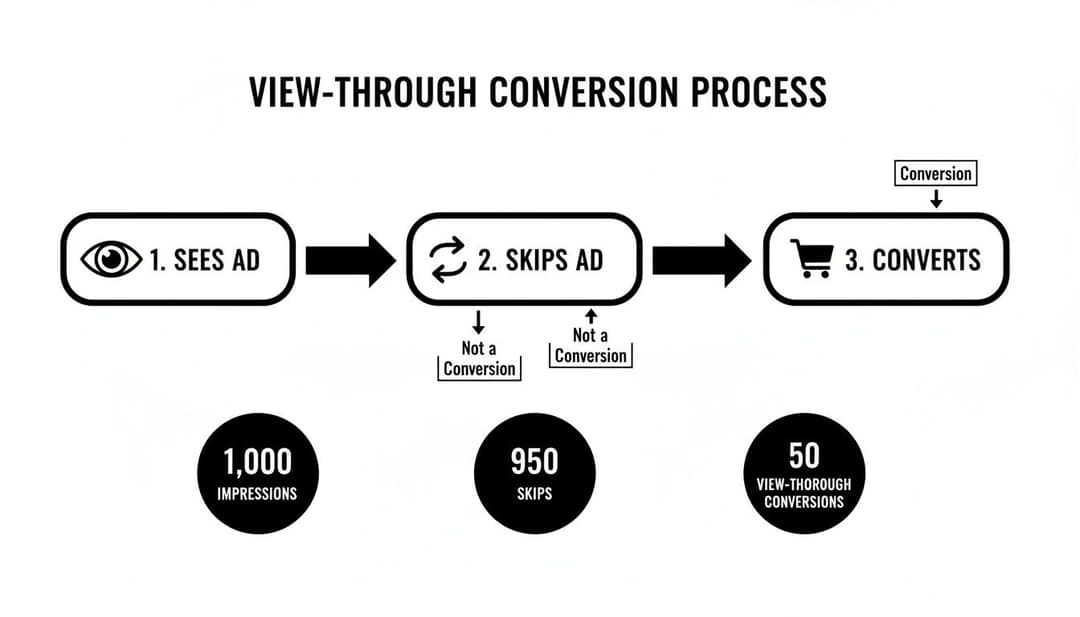
This flow really drives home why VTC tracking is so crucial. The overwhelming majority of impressions never get a click, and without this measurement, you’d be blind to their true impact.
Introducing the Attribution Window
Of course, an ad someone saw six months ago probably didn’t influence today’s purchase. This is where ad platforms draw a line in the sand. That line is called the attribution window, sometimes known as a lookback window.
Think of it as a time-stamped receipt for every ad view. The attribution window is the specific period during which a conversion can be credited back to that impression. If the purchase happens inside this window, the ad gets the credit. If it happens a minute too late, it doesn’t.
An attribution window is the timeframe set by an ad platform to determine if a specific ad view or click should receive credit for a conversion. It's the mechanism that prevents a brief ad glance from getting credit for a sale made a year later.
Platforms have different default windows, but you can often customize them. For example:
- A 1-day view window means only purchases made within 24 hours of seeing an ad will be counted as VTCs.
- A 7-day view window extends that period to a full week, giving you a better read on influence that takes a bit longer to sink in.
Choosing the right window really depends on your sales cycle. A low-cost, impulse-buy product might be fine with a short window. But for a high-ticket item like a car or a B2B software subscription, you’d want a much longer window—maybe 30 days or more—to capture that longer consideration period. Getting a handle on how platforms attribute sales is non-negotiable, which is why setting up robust Google Ads conversion tracking is such a critical first step.
The Technical Steps of VTC Tracking
The whole journey, from ad view to credited purchase, happens automatically in milliseconds. But if we slow it down, we can see a few key stages that show exactly how view-through conversions are measured.
Ad Impression is Recorded: A user is scrolling their feed, and your display or video ad pops up. The platform logs this as an impression and, as long as it meets viewability standards (like 50% of the ad on screen for at least one second), a tracking cookie is dropped into their browser.
User Leaves the Platform: The user keeps on scrolling without clicking. They might close the app, switch tabs, or get distracted by something else entirely.
The Return Journey: A day or a week later, your brand pops back into their head. Maybe they Google your company name, type your URL directly into the address bar, or click a link from an email newsletter.
Pixel Fires and Matches: As soon as they land on your site and complete a key action (like a purchase), the pixel you installed fires. It talks to the user's browser, finds the cookie from the ad view, and sends that data back to the ad platform. The platform makes the match and officially logs a view-through conversion.
Clicks vs Views: Understanding the Full Customer Journey

To really understand what your ads are doing, you have to look past the click. Sure, click-through conversions (CTCs) are the low-hanging fruit—easy to see and measure. But view-through conversions (VTCs) tell a much more interesting story about how your brand actually sinks into a customer’s mind.
Think of it like this: a CTC is a direct conversation. Someone sees your ad, loves what you’re offering, and clicks to buy right away. It’s an immediate, active response.
A VTC, on the other hand, is more like a subtle suggestion. A potential customer scrolls past your ad, doesn't click, but the image or message sticks with them. A few days later, they remember your brand and decide to search for you directly. That’s the delayed magic of brand recall at work.
Why You Can’t Afford to Ignore Views
If you only pay attention to CTCs, you’re getting a dangerously narrow view of your ad performance. It’s like throwing a party and only counting the people who RSVP’d "yes" immediately, completely ignoring everyone who showed up because they remembered the invite and decided to come later. You’d think your party was a flop when it was actually a hit.
This is especially true for brand awareness campaigns. The whole point isn’t always to get an immediate click; it's to build a mental footprint and stay top-of-mind. VTCs are the metric that proves this strategy is paying off, showing you the value of impressions that lead to revenue down the line. To truly grasp how to measure ad effectiveness, you have to treat both metrics as essential pieces of the same puzzle.
The data backs this up. An analysis from MetaRouter found that VTCs can be responsible for 35-50% of conversions for e-commerce brands on social display ads. And a massive StackAdapt report covering over 10,000 campaigns found that VTCs lifted total conversion values by 28%. For video ads, a whopping 65% of their influence came from views alone.
VTC vs CTC A Head-to-Head Comparison
To really nail down the difference, it helps to see these two metrics side-by-side. The table below breaks down how they capture completely different user behaviors and fit into different parts of your marketing strategy.
| Attribute | View-Through Conversion (VTC) | Click-Through Conversion (CTC) |
|---|---|---|
| User Action | Passive (sees the ad) | Active (clicks the ad) |
| User Intent | Low to moderate (often browsing) | High (actively seeking info) |
| Measurement Point | Ad impression to conversion | Ad click to conversion |
| Marketing Funnel Stage | Top-of-Funnel (Awareness) | Mid-to-Bottom-of-Funnel (Consideration, Conversion) |
| Primary Goal | Measures brand recall and influence | Measures direct response and engagement |
| Attribution Complexity | Higher (infers connection) | Lower (direct connection) |
A smart measurement strategy doesn’t treat VTCs and CTCs as competitors. It sees them as partners, working together to paint a complete picture of your advertising’s real impact on your bottom line.
In the end, it’s simple: CTCs tell you who acted now, while VTCs show you whose mind you changed over time. By tracking both, you graduate from simply counting clicks to genuinely understanding the entire customer journey—from that first fleeting glance at your ad to the final purchase. That comprehensive view is what lets you make smarter decisions and build a brand that lasts.
Decoding Your VTC Data to Avoid Common Pitfalls
Getting your view-through conversion data is one thing; knowing what to do with it is where the real magic happens. If you just take these numbers at face value, you risk misreading the signals and making some pretty costly decisions. To really get a handle on your VTCs, you have to look past the surface and understand the nuances.One of the biggest mistakes I see is treating every VTC like a slam dunk. We've all seen it—an ad that flashes on the screen for a split second as someone scrolls, or a banner ad buried at the bottom of a page they never even reached. That kind of accidental exposure can easily muddy your data, which is why digging into the mechanics of attribution isn't just a good idea—it's non-negotiable.
The Role of Attribution Windows and Viewability
Think of attribution windows as the official rules for how long an ad view can get credit for a conversion. Every platform has its own take on this. Meta, for instance, typically defaults to a 1-day view and 7-day click window. On the other hand, Google Ads is more flexible, letting you set custom windows up to 30 days.
This isn't just a minor detail—it's a game-changer. A tight 1-day window gives credit only to views that lead to an almost immediate purchase. A longer 30-day window can capture the slow-burn effect of an ad on someone who needs more time to think things over. The right choice here depends entirely on your product's typical sales cycle.
Beyond the timeframe, we need to talk about viewability. In other words, did anyone actually see the ad? To stop marketers from paying for impressions nobody laid eyes on, the industry created some clear standards.
- Display Ads: The Interactive Advertising Bureau (IAB) says at least 50% of the ad's pixels have to be visible on the screen for at least one continuous second.
- Video Ads: For video, the bar is a bit different. At least 50% of the player must be in view for a minimum of two continuous seconds of playback.
Impressions that don't hit these benchmarks shouldn't even be in your reports. Sticking to these standards helps filter out the noise from accidental views and ensures you’re working with data that actually means something. If you want to go deeper on how different platforms track performance, you might find this comparison of ad tracking tools helpful.
Avoiding Over-Attribution and Misinterpretation
Even with viewability standards in place, you can still give an ad way too much credit. Someone might see your ad, but what if their decision to buy was really sparked by a text from a friend, a perfectly timed email, or a quick Google search? VTCs don't prove causation; they simply show a correlation.
A common mistake is treating every VTC as a guaranteed sale driven solely by one ad impression. Instead, view this data as a powerful indicator of your creative's memorability and its ability to keep your brand top-of-mind.
When you look at the numbers, VTCs are clearly a massive piece of the omnichannel puzzle. For many brands, they effectively double the perceived impact of their display and video ads. One deep dive into over 500 e-commerce accounts found that VTCs drove 42% of all conversions on average, and that number jumped to 60% for video campaigns.
Consider a real-world example: one DTC fashion brand ran a campaign that generated 1.2 million impressions. This led to 15,000 VTCs in just 28 days, adding up to $1.8 million in revenue. That dwarfed the 8,000 click-through conversions they saw in the same timeframe. You can discover more insights on VTC performance and see just how big this impact can be.
This proves that while a single ad view might not seal the deal on its own, the cumulative effect of those impressions is a huge revenue driver you can't afford to ignore. The key is to look for trends, not just individual numbers. By putting your VTC data under the microscope and considering attribution windows and viewability, you can start making smarter, more confident decisions with your ad spend.
Using VTC Insights to Optimize Your Meta Campaigns

Knowing what a view-through conversion is puts you ahead of the pack. But the real competitive advantage comes from turning that knowledge into a smarter Meta advertising strategy. VTC data isn't just another number on your dashboard—it's a direct peek into the subconscious impact of your ads, showing you which creative choices actually stick.
Ever seen a campaign with a high VTC rate but a low click-through rate? That’s not a failure. It’s a powerful signal that your ads are memorable. The visuals, the copy, or the core message resonated enough to plant a seed in your audience's mind, prompting them to look you up later on their own terms. This insight is your green light to invest confidently in top-of-funnel campaigns designed to build awareness, not just chase immediate clicks.
Pinpoint Your Most Memorable Creative
Think of your VTC data as a creative goldmine. By digging into which specific ads, images, or videos are driving the most view-through conversions, you can pinpoint the exact elements that grab attention and refuse to let go.
Is it a particular color palette? A certain type of product shot? Maybe a specific headline style? Analyzing VTCs by ad creative lets you move beyond simple click-based A/B tests and start optimizing for something much more valuable: memorability. This helps you build a library of proven creative assets that deliver long-term results. For a closer look at tracking these actions, our guide to the Meta Events Manager can fill in the gaps.
Justify Upper-Funnel Ad Spend
One of the oldest headaches for marketers is proving the ROI of awareness campaigns. Stakeholders love to see direct, click-based results, making it tough to defend the budget for branding plays. VTCs are your secret weapon in these conversations.
A high volume of view-through conversions provides concrete evidence that your top-of-funnel ads are doing their job. They show that even without a click, your campaigns are successfully planting the seeds of brand awareness that blossom into direct traffic and sales down the road.
This data shifts the conversation from "How many clicks did we get?" to "How much influence are we building?" It gives you the hard numbers to validate your investment in a strong brand presence that pays dividends over time.
Refine Your Audience Targeting
Different people respond to ads differently. Some audiences are quick to click, while others prefer to see an ad, mull it over, and convert later. Segmenting your VTC data by audience helps you uncover these subtle behavioral patterns.
You might find that your lookalike audiences rack up tons of VTCs, showing strong brand recall, while a colder, interest-based audience needs a click to take action. This kind of insight allows you to tailor your campaign goals and messaging to each specific group.
- For high-VTC audiences: Double down on bold, memorable creative that builds brand affinity.
- For high-CTC audiences: Stick with strong, clear calls-to-action that push for an immediate response.
This nuanced approach means you’re meeting different segments of your audience where they are, making every ad dollar work harder.
Automating Optimization with AI
Let's be honest: manually sifting through endless creative, audience, and placement data to connect the dots between ad views and eventual conversions is a massive time sink. This is exactly where an AI-powered platform like AdStellar changes the game.
Instead of getting lost in spreadsheets for hours, an AI tool can analyze your VTC performance at scale automatically. It identifies the subtle patterns in your best-performing view-through ads, pinpointing the exact recipe of imagery, copy, and audience that creates the most lasting impact. The platform can then use these insights to launch new campaign variations, effectively turning your manual analysis into an automated optimization engine that learns, improves, and scales your best ideas faster than any human ever could.
Your Secret Weapon for Proving Ad Value
Throughout this guide, we've pulled back the curtain on the ads people see but don’t immediately click. We’ve gone way beyond a simple definition of what is view through conversion to really understand how these interactions reveal the quiet, subtle influence of your campaigns. Think of it less as another metric and more as a new lens for seeing the complete customer journey.
From the tracking pixels that connect a passive glance to a future purchase, to the attribution windows that help assign credit where it's due, you now have the tools to measure what your ads are really doing. VTCs give you the hard evidence to justify spending on those upper-funnel, brand-building campaigns that are crucial for long-term growth.
Using VTCs to Get Ahead
When you start paying attention to VTC data, your marketing strategy shifts from just reacting to clicks to building a brand that people remember. Instead of chasing that immediate click, you can focus on creating memorable experiences that drive conversions long after someone has scrolled past your ad. This deeper understanding leads directly to smarter budget decisions and creative that actually resonates.
View-through conversions are the proof that your branding is working. They bridge the gap between awareness and action, demonstrating that a memorable ad is one of your most valuable assets for driving sustainable revenue.
To truly grasp the full picture of your marketing impact and show the value of VTCs, it’s essential to master the art of measuring social media ROI effectively. When you combine that knowledge with solid VTC insights, you get a much more complete and honest view of your performance.
Ultimately, getting a handle on this metric means you can make decisions with more confidence. If you're ready to get a more accurate picture of your campaign success, our guide on how to calculate marketing ROI is the perfect next step. Start using VTC data today to uncover the hidden value in every single one of your ad campaigns.
Still Have Questions About View-Through Conversions?
Even as you start to see the potential of VTCs, a few common questions always pop up. Getting straight answers here will give you the confidence to start using VTCs to make much smarter marketing decisions.
Are View-Through Conversions Even Accurate?
This is the big one, and the answer isn't a simple yes or no. The truth is, they're directionally accurate and incredibly valuable, but they’ll never be as concrete as a click. Think of it like this: a VTC is a strong, educated guess, while a click is a signed confession.
The accuracy really boils down to two things: viewability standards and the attribution model you're using.
Platforms don’t just count every ad that loads as a valid "view." For an impression to even get a chance at VTC credit, it has to meet industry standards. A common one is having at least 50% of the ad’s pixels on-screen for a minimum of one second. This simple rule helps weed out ads that were technically served but never actually seen.
Still, a VTC infers a connection; it doesn't prove causation. Someone might have seen your ad, but what really pushed them to buy was a recommendation from a friend later that day. That's why you shouldn't treat VTCs as absolute proof. Instead, see them as a powerful signal of your ad's memorability—its ability to keep your brand top-of-mind. They're an essential piece of the full measurement puzzle.
What's a Good View-Through Conversion Rate?
Sorry to disappoint, but there's no magic number here. Chasing a universal "good" VTC rate is a fool's errand because the metric swings wildly depending on a few key factors:
- Your Industry: A $20 t-shirt brand with a quick sales cycle will have a completely different VTC profile than a B2B software company selling a $10,000 annual subscription.
- Campaign Goal: A top-of-funnel brand awareness campaign is designed to generate VTCs. On the other hand, a bottom-funnel retargeting campaign should be getting more direct clicks.
- Audience Temperature: You're much more likely to see VTCs from cold audiences who are just learning about your brand. Warm audiences who already know you are more likely to click and buy directly.
Instead of obsessing over a specific number, focus on the trends. Is your VTC rate for a specific campaign climbing over time? How does it stack up against your click-through conversions and overall Return on Ad Spend (ROAS)? That’s where the real insights are hiding.
How Do I Track VTCs on Meta?
Thankfully, Meta makes this part incredibly easy. As long as you have the Meta Pixel installed correctly on your site and you’ve set up your conversion events (like 'Purchase' or 'Add to Cart'), the platform does all the heavy lifting for you.
You don't need to flip a switch or enable a special setting. The Pixel tracks both clicks and views by default. The real control comes from how you report on that data.
Inside Ads Manager, just go to your reporting columns and click 'Customize Columns'. This is where you can play with different attribution windows (like 1-day view or 7-day view) to see how many conversions were credited to someone seeing your ad within those timeframes. Try to align these windows with your typical sales cycle—it’ll give you a much more realistic picture of your ad's true influence.
Ready to stop guessing and start scaling your Meta campaigns with data-driven precision? AdStellar AI automates VTC analysis, identifies your most memorable creative, and launches optimized campaigns in minutes. Discover how AdStellar AI can unlock more revenue from your Meta ads today.