When you hear that the average price per click is about $2.69 on Google Search and just $0.44 on Meta, it’s easy to think you have the full picture. But that simple number is hiding a much more complex story.
The truth is, your ad costs can swing wildly depending on who you’re targeting, what industry you’re in, and which platform you’re using.
What Is Average Price Per Click, Really?
Think of your average price per click (CPC) like bidding for a prime storefront in a massive digital shopping mall. A spot right in the middle of a crowd of eager, high-intent shoppers is always going to cost more than one tucked away in a quiet corner.
Your CPC isn't just a number on a dashboard. It’s a direct reflection of how well you're targeting your audience, how compelling your creative is, and how fierce the competition is at that exact moment.
In the simplest terms, CPC is what you pay every single time someone clicks your ad. The math is straightforward:
Average CPC = Total Cost of Clicks / Total Number of Clicks
This is the bedrock metric of pay-per-click (PPC) advertising. It tells you exactly how much it costs to drive one visitor to your website or landing page. A lower CPC means you get more chances to make a sale for the same amount of money.
Why Your CPC Is the First Metric to Master
Getting a handle on your average price per click is the first real step toward building a profitable ad strategy. It helps you answer the critical questions that shape your budget and tactics.
- Is my campaign efficient? Comparing your CPC to industry benchmarks tells you instantly if you're paying a premium for traffic.
- Which channels are the most cost-effective? Knowing the CPC for Google, Meta, and LinkedIn shows you where to put your money so it works harder.
- Are my ads actually working? A stubbornly high CPC can be a sign that your ads aren't relevant enough to earn those cheaper clicks that platforms reward for high quality.
Ultimately, mastering your CPC isn’t just about saving a few bucks. It’s about making every dollar you spend an efficient investment toward winning new customers.
To give you a quick lay of the land, let's look at what you can generally expect to pay on the major platforms.
Average CPC Benchmarks Across Major Ad Platforms
The price of a click is a whole different ballgame from one platform to another. This is mostly because of the user's mindset and why businesses use each network in the first place. For instance, the professional focus of LinkedIn means you're reaching decision-makers, which naturally results in a higher average CPC than the broader, consumer-driven audiences on TikTok or Pinterest.
Here’s a high-level look at what you might expect to pay.
Average CPC Benchmarks Across Major Ad Platforms (2026 Estimates)
| Ad Platform | Estimated Average CPC (All Industries) |
|---|---|
| Google Search Ads | $2.69 |
| Meta Ads (Facebook/Instagram) | $0.44 - $1.50 |
| LinkedIn Ads | $5.26 |
| TikTok Ads | $1.00 |
| Pinterest Ads | $0.10 - $1.50 |
| Twitter (X) Ads | $0.50 - $2.00 |
These numbers are just a starting point—your own results will depend heavily on your industry, audience, and ad quality. But they give you a solid baseline for what's considered "normal" out in the wild.
How Ad Platforms Actually Calculate Your CPC
Ever felt like you're just throwing money at an ad auction, hoping for the best? It's a common feeling, but the reality is much more nuanced. Winning an ad placement isn't a simple case of the highest bidder taking all. It’s more like a lightning-fast "relevance contest" where the platform’s main goal is to show the best possible ad to the user.
Your bid is just one piece of the puzzle. Platforms like Google and Meta blend your bid with several other factors to decide who wins the ad spot and, crucially, how much they actually pay. This entire system is built to reward quality and relevance, not just deep pockets.
The whole process comes down to a core concept called Ad Rank. It's a score that determines your ad's position, and while the exact formula is a closely guarded secret on each platform, the principle is a simple multiplication.
Maximum Bid × Quality Score = Ad Rank
What does this mean for you? An advertiser with a lower bid but a killer Quality Score can actually leapfrog a competitor who was willing to pay more. This is the secret lever you can pull to get a handle on your average price per click.
The Hidden Power of Quality Score
So, what is this all-important Quality Score? Think of it as the platform’s rating of your ad's overall quality and relevance. It looks at your ads, your keywords, and your landing pages to see if you're providing a good experience. A high score is your signal to the platform that you deserve to be shown, and they'll reward you for it.
Your Quality Score is typically built on three main pillars:
- Expected Click-Through Rate (CTR): The platform’s prediction of how likely someone is to click your ad when it appears.
- Ad Relevance: A measure of how well your ad's message aligns with what the user is looking for.
- Landing Page Experience: How useful, transparent, and easy to navigate your landing page is for people who click through from your ad.
This flow chart breaks down how the process works, from the initial bid to the final cost you pay.
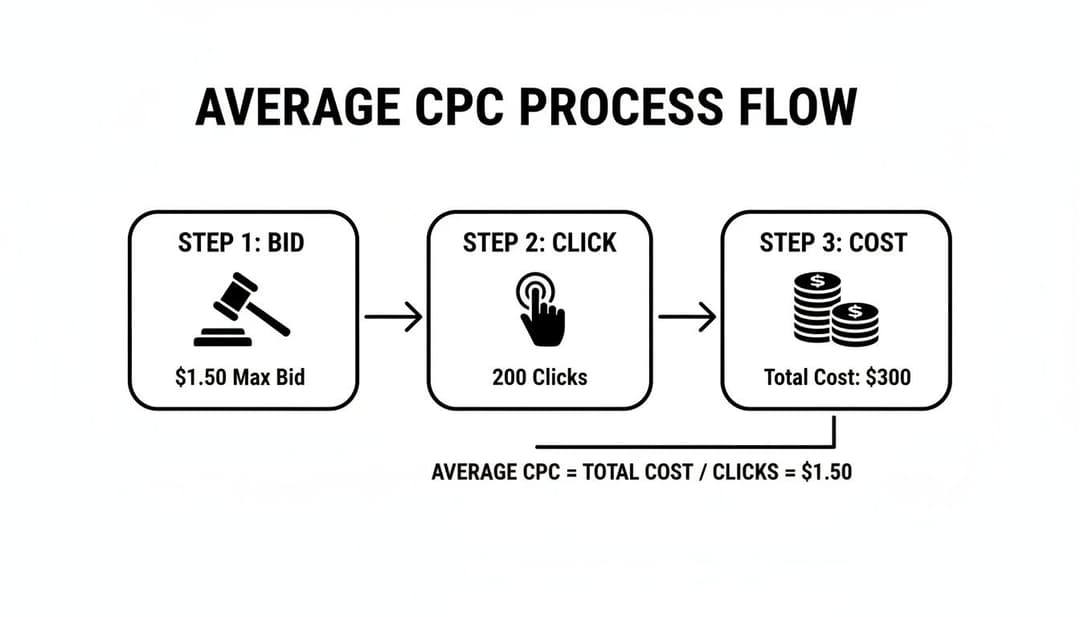
The biggest takeaway here is that your final cost isn't your max bid. It’s the result of a competitive auction where the quality of your ad directly influences how much you spend.
Paying Just Enough to Win
Here’s where it gets really interesting: you almost never pay your maximum bid. The actual price you pay for a click is based on the Ad Rank of the advertiser directly below you in the auction.
The formula for your actual CPC often looks something like this:
(Ad Rank of the Person Below You / Your Quality Score) + $0.01 = Your Actual CPC
This is precisely why improving your Quality Score is one of the most powerful things you can do. A higher score acts like a discount, directly lowering what you have to pay to keep your ad position. For instance, if you have a stellar 10/10 Quality Score, you could pay significantly less per click than a competitor with a 3/10 score, even if they're bidding more than you.
If you'd like to explore this topic further, many advertisers have found success by reviewing different https://www.adstellar.ai/blog/ppc-advertising-platforms to see how their auction models vary.
To really get a grip on how platforms like Google calculate your costs, you can also dive into the specifics of Google paid search cost. Understanding this system shows that you have far more influence over your average price per click than you might think. By focusing on creating truly relevant ads and a seamless landing page experience, you're directly telling the platform that you deserve a lower CPC.
The Key Levers That Control Your Ad Costs
Ever feel like your ad costs are just a number the platforms dictate? The good news is, you have way more control than you might think. Your average price per click isn't set in stone; it’s a dynamic price tag you can directly influence.
Think of it like a soundboard with a few critical sliders. By knowing which ones to adjust, you gain real control over how much you spend to get each click.
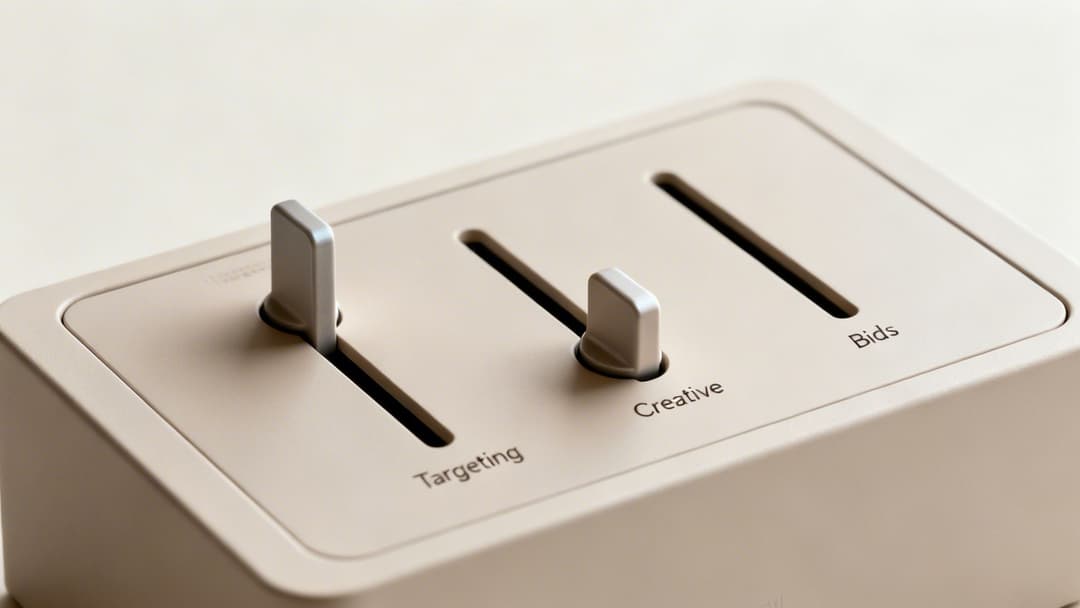
The three primary levers at your disposal are your audience targeting, your ad creative, and your bidding strategy. Understanding how these pieces fit together is what separates simply paying for traffic from strategically investing in growth. Let's break down how to master each one.
Lever 1: Audience Targeting
Who you show your ads to is easily the biggest factor driving your costs. It all boils down to the simple economics of supply and demand. Some audiences are incredibly valuable and, as a result, far more competitive—which pushes the price to reach them sky-high.
For instance, targeting "CFOs in the tech industry" on a platform like LinkedIn is going to have a much higher average price per click than targeting "general business enthusiasts" on Meta. The reason is obvious: the potential value of landing a CFO as a customer is massive, and plenty of companies are willing to pay a premium for that shot.
Your audience choice sets the cost floor for your entire campaign. A super-specific, high-value audience will always have a higher starting CPC than a broad, general one. The trick is making sure that audience's value justifies the cost.
This doesn’t mean you should just chase the cheapest audience available. It’s all about finding that sweet spot where the audience's potential value aligns with your ad cost to deliver a profitable return. The goal is to be specific enough to find relevant users without making your audience so narrow that the competition sends your CPC into the stratosphere.
Lever 2: Ad Creative and Relevance
This is where you have the most direct, hands-on control to lower your costs, even when you're in a crowded auction. As we’ve covered, ad platforms reward advertisers who create a great user experience. A killer, relevant ad creative is your best tool for earning that reward.
A strong creative drives a higher click-through rate (CTR), which is a massive component of your Quality Score or relevance score on any platform.
- High CTR: This tells the platform your ad is a great match for the audience. They find it engaging and relevant.
- Low CTR: This signals a mismatch between your ad and what users want to see, leading to a lower Quality Score and higher costs.
Imagine two advertisers are bidding on the exact same audience. Advertiser A bids $5 but runs a boring, uninspired ad that gets a dismal CTR. Advertiser B only bids $3, but their creative is fantastic and people can’t help but click. The platform’s algorithm will almost always favor Advertiser B, giving them better placement and a lower final CPC because they’re making the platform better for its users.
This is why relentless creative testing isn't just a "best practice"—it's an economic necessity. Continuously iterating on your images, headlines, and calls to action helps you discover the combinations that send your CTR soaring. For a deeper dive on this, check out our guide on how to improve click-through rate.
Lever 3: Bidding Strategy
Your bidding strategy is the final lever, and it's all about how you show up to compete in the ad auction. This goes way beyond just setting a maximum bid and crossing your fingers. Modern ad platforms give you sophisticated bidding options that can be tailored to different business goals.
Here are a few of the most common approaches:
- Manual CPC Bidding: You set the absolute maximum you're willing to pay for a single click. This gives you total control but requires you to be in the weeds, constantly monitoring and tweaking your bids.
- Automated Bidding (Maximize Clicks): You let the platform's algorithm do the heavy lifting, automatically adjusting your bids to get as many clicks as possible within your daily budget. This is a solid choice for driving sheer traffic volume.
- Cost Cap or Target CPA: You tell the platform the maximum you’re willing to pay per conversion (CPA). The algorithm then focuses on winning auctions that it predicts will lead to a conversion at or below your target cost.
Which strategy is right for you? It really depends on your objective. If your goal is pure brand awareness, a "Maximize Clicks" strategy can work wonders. But if profitability is your north star, a Target CPA strategy is usually more effective, since it directly links your ad spend to real business results.
Setting Realistic CPC Benchmarks for Your Industry
Trying to compare your cost per click to a global average is a recipe for frustration. It's like judging the price of a coffee in rural Nebraska against one from a cafe in Times Square. Sure, it’s the same product, but the context makes the comparison completely pointless.
What’s considered a "good" CPC for an e-commerce brand could spell disaster for a B2B SaaS company. To set goals that actually make sense, you have to get specific. Factors like your industry’s competition, customer lifetime value (LTV), and the length of your sales cycle all play a huge role in what you should expect to pay.
Why Industry Averages Vary So Much
So, why the huge difference in click costs from one industry to the next? It all boils down to one word: value. Industries with high-value conversions can afford to pay a lot more for a single click because the potential payoff is so much greater.
Think about it. A law firm might land a single client worth tens of thousands of dollars. For them, paying an average CPC of $6.75 on Google Search is a smart investment. On the flip side, an online apparel store selling t-shirts has a much lower average order value. A CPC over $2 could sink their profitability in a heartbeat, so they have to keep their click costs low to maintain a healthy return.
The higher the potential revenue from a single customer, the more advertisers are willing to bid for a click. This competitive bidding is what drives up the average price per click in high-stakes industries like legal, finance, and B2B services.
This dynamic is true on every ad platform. Knowing where your industry falls is the first step in building a smart budget and a winning strategy. To see how this principle affects other critical metrics, check out our guide on calculating your ideal cost per lead.
Average CPC by Industry and Ad Channel (2026 Data)
Seeing the numbers side-by-side really brings these differences to life. A B2B company might be surprised to find Meta Ads is a cost-effective channel for building awareness, while a law firm will almost always concentrate its budget on high-intent Google Search campaigns, where the CPC is steep but entirely justified.
Here’s a look at how average CPCs stack up across a few key industries and the most popular ad channels.
| Industry | Google Search Ads CPC | Meta Ads (Facebook/Instagram) CPC | LinkedIn Ads CPC |
|---|---|---|---|
| Legal | $6.75 | $1.00 - $2.50 | $8.00+ |
| Finance & Insurance | $3.44 | $1.00 - $3.00 | $7.50+ |
| B2B | $3.33 | $0.75 - $2.00 | $6.50+ |
| Technology | $3.80 | $0.80 - $2.25 | $7.00+ |
| Health & Medical | $2.62 | $0.70 - $1.75 | $4.00 - $8.00 |
| E-Commerce | $1.16 | $0.45 - $1.25 | $2.50 - $5.00 |
| Travel & Hospitality | $1.53 | $0.50 - $1.50 | $3.00 - $6.00 |
Data compiled from recent industry reports.
This data tells a clear story. High-stakes industries like Legal and B2B pay a premium on platforms where professional intent is strongest, like Google Search and LinkedIn. At the same time, consumer-focused sectors like E-Commerce and Travel find their most efficient clicks on Meta's platforms, where visual ads and impulse decisions rule.
Using these benchmarks helps you set realistic goals and avoid the trap of chasing an irrelevant, one-size-fits-all "average."
How to Actually Lower Your CPC (Without Tanking Your Results)
Knowing what levers control your ad costs is one thing. Having a system to pull them consistently is something else entirely. Driving down your average price per click isn't about finding a single magic trick; it's about building a repeatable process of continuous improvement across your campaigns.
Forget the generic advice. This is our playbook for turning wasteful ad spend into efficient, scalable growth. We're going to focus on three core areas that truly move the needle: relentless creative testing, intelligent audience refinement, and smarter bidding.
Master Relentless Creative Testing
Your ad creative is the single greatest lever you have for lowering CPC. Why? A high click-through rate (CTR) is a massive signal to ad platforms that your ad is relevant. They reward that relevance with a lower cost per click. The only way to find what truly grabs your audience is to test, learn, and iterate—constantly.
Test One Variable at a Time: To get clean data, you have to isolate your tests. Pit one headline against another while keeping the image and body copy identical. This is the only way to know for sure what element drove the change in performance.
Vary Your Angles and Hooks: Don't just test a blue button versus a green one. Test completely different psychological angles. Does your audience respond better to a fear-based hook ("Stop wasting money on...") or a benefit-driven one ("Unlock savings with...")?
Embrace the "Ugly" Winners: Let go of your personal design preferences—the only thing that matters is what the data says. I've seen countless campaigns where an ad that looked unpolished or used a weird image absolutely crushed a slick, corporate-style design. Be open to being wrong.
The goal of creative testing isn't to find one "perfect" ad. It's to build a library of high-performing elements—images, headlines, and hooks—that you can combine to consistently produce better results and a lower average price per click.
Graduate to Advanced Audience Targeting
Broad, interest-based targeting is where most advertisers start, but it's also where costs can quickly get out of hand because of all the competition. If you want a better CPC, you have to get much more specific about who sees your ads.
This means climbing the targeting ladder from general interests to more powerful, high-intent audience segments. The mission is to find pockets of people who are far more likely to click and convert, which boosts your relevance and tells the platform you deserve lower costs.
Here’s a simple progression we use to dial in audiences:
- Start with Broad Interests: This is your baseline. Begin with defined interests related to your product (e.g., "digital marketing," "fitness and wellness").
- Layer Interests and Demographics: Start narrowing the field by adding layers. For example, target users interested in "digital marketing" AND who are also "small business owners." Relevance goes up, and costs often come down.
- Build Lookalike Audiences: This is where the magic really starts. Create lookalike audiences from your best customers, like a list of past purchasers or your most qualified leads. Platforms will find new users who share their characteristics, giving you a highly relevant audience right out of the gate.
- Retarget Engaged Users: Finally, create audiences of people who have visited your site, watched your videos, or engaged with your social profiles. These warm audiences already know you and almost always have a much lower CPC and a higher conversion rate.
This progression takes you from guessing who your audience is to knowing who they are, all based on your own data. And remember, CPC is just one piece of the puzzle. To see the full picture of cost efficiency, it helps to understand how to reduce your overall customer acquisition cost.
Implement Smarter Bidding Strategies
Your bidding strategy is how you tell the ad platform what you value most. While setting a manual CPC gives you direct control, it's incredibly inefficient once you start to scale. Leaning into the platform’s automated bidding can help you achieve a lower average price per click by letting the algorithm hunt down the cheapest clicks for your specific goal.
Beyond the ad itself, the destination experience is critical. A bad landing page can kill an otherwise great campaign. Rigorous split testing your landing pages can drastically improve conversion rates, which in turn improves your Quality Score and has a direct, positive impact on your effective CPC.
Ultimately, by methodically working on your creative, audience, and bidding, you create a powerful feedback loop that continually drives down costs while pushing performance up.
Automating CPC Reduction with AdStellar AI
We’ve covered the strategies for lowering your average price per click, but knowing what to do is a world away from actually doing it. The reality is, manually creating and testing hundreds of ad variations across different audiences is a massive operational headache. It’s slow, expensive, and just about impossible to manage when you’re trying to scale.
This is exactly where automation flips the script. Instead of burning days building test campaigns by hand, performance marketers can use AI to run complex testing frameworks in minutes. It’s about turning good theory into a data-driven system built for profit.
Generate and Test Creatives at Scale
The secret to a lower CPC has always been relentless creative testing. The problem? Manual effort caps most advertisers at just a handful of variations, which barely scratches the surface. AdStellar AI’s bulk ad creation tools blow those limits wide open, letting you generate hundreds of creative and copy combinations from your existing assets in an instant.
This lets you test more ideas, faster. You accelerate the learning process, figuring out which messages and visuals truly connect with your audience. More tests mean more data, which is the quickest path to a higher click-through rate and a lower CPC.
Take a look at how AdStellar AI lays out performance data to make the winning combinations obvious.
This kind of dashboard view instantly shows you which ad elements are pulling the most weight, taking all the guesswork out of your optimization workflow.
Automatically Identify and Launch Winners
Once your tests are running, the next hurdle is figuring out what all the data means. Poring over spreadsheets to find the top-performing ads is not only tedious but also a recipe for human error. AdStellar’s AI Insights engine automates this entire analysis for you.
Our platform plugs right into your Meta Ads account and gets to work analyzing performance data around the clock. It then ranks your best ads, audiences, and creative elements based on the business goals you actually care about, like Return on Ad Spend (ROAS) or Cost Per Acquisition (CPA).
By zeroing in on your main success metric, the AI makes sure you aren’t just chasing a low CPC for its own sake. It pinpoints the ad combinations that are both cost-effective and profitable, drawing a straight line between lower ad costs and business growth.
This approach transforms optimization from a chore you do once in a while into a proactive, always-on system. The AI doesn’t just tell you what worked—it helps you act on it.
A Real-World Example in Action
Let's make this real. Imagine an e-commerce brand trying to bring down its $1.16 average CPC on Meta. Doing it manually, they might get around to testing 10 ads in a week. With AdStellar, they generate 200 variations—mixing 10 images, 5 headlines, and 4 audiences—and launch them all with a single click.
The AI Insights engine quickly spots that a specific user-generated image paired with a "free shipping" headline is crushing it, delivering a 35% lower CPC and a 20% higher ROAS than any other combo. From there, the AI Launch module automatically takes that proven winner and uses it to build out new, fully optimized campaigns.
This automated flow condenses a week of painful manual work into a few hours of focused, strategic effort. The brand systematically drives down its average price per click and scales its most profitable ads without ever getting lost in the weeds of campaign setup. If you want to see how this could plug into your own workflow, you can explore the specifics of AI-driven optimization with AdStellar and see it for yourself.
Common Questions About Average Price Per Click
Once you get the hang of the basics, a few tricky questions about average price per click always seem to pop up. Let's tackle them head-on, because getting these answers right is what separates good campaign managers from great ones.
Is a High CPC Always a Bad Thing?
Absolutely not. It’s easy to get fixated on a low CPC, but sometimes, a high cost per click is a sign you're doing something very right.
Think about it: paying $15 for one click feels steep, right? But what if that click came from someone actively searching for a high-ticket service, and it landed you a $10,000 contract? Suddenly, that $15 looks like an incredible bargain.
A "high" CPC is only a problem when it doesn't lead to a profitable outcome. The focus should always be on the return on ad spend (ROAS), not just the upfront cost of the click.
How Long Does It Take to Lower CPC?
Bringing down your CPC is a marathon, not a sprint. While you might find some quick wins—like hitting pause on a disastrously bad ad—making real, lasting improvements takes patience. You should plan on it taking at least 30-90 days to see significant, stable results.
Why so long? This timeframe gives you enough runway to:
- Gather enough data from your creative and audience tests to make smart calls.
- Let the platform's algorithm actually learn from the changes you're making.
- Move past the simple tweaks and start digging into more advanced strategies.
What Is the Difference Between CPC and CPM?
This is a classic question, and the answer comes down to what you're trying to achieve with your campaign.
CPC (Cost Per Click) means you pay only when someone actually clicks your ad. This is your go-to metric when you want to drive a direct action, like getting traffic to your site, collecting leads, or making sales.
CPM (Cost Per Mille) means you pay for every 1,000 times your ad is shown (an impression). You'll want to focus on this when your main goal is brand awareness. It's all about getting your message in front of as many eyeballs as possible, whether they click or not.
Ready to stop guessing and start systematically lowering your ad costs? AdStellar AI automates the entire testing and optimization process, helping you find your most profitable ad combinations 10x faster. Discover how AdStellar AI can reduce your CPC and scale your results today.