Your Meta account is spending. The ads are live. Early results looked fine, then CTR softened, frequency climbed, and every new concept started to feel like a remix of the last one.
That is usually the moment teams overcomplicate the problem. They add more copy. More hooks. More offers. More audience slicing. Meanwhile, the simplest creative structure in direct response still does its job: show the change.
Before after ads work because they compress the promise into a format people understand instantly. Not as a gimmick. As evidence, contrast, and narrative in one frame. The best operators use them carefully, measure them rigorously, and package them in ways that fit both platform rules and business goals.
This is the playbook I’d use for Meta today if I needed before after ads to produce consistently, survive review, and scale without turning the account into a compliance mess.
Why Before After Ads Still Dominate in 2026
Creative fatigue usually shows up before teams admit it. Product shots stop pulling their weight. Lifestyle ads blend together. Testimonials work for warm traffic but struggle to grab cold attention in-feed.
Before after ads solve a different problem than standard product creative. They reduce explanation. A viewer does not need to decode what the product is supposed to do. The ad shows the gap between the old state and the improved state.
That matters because contrast sharpens perceived value. In a controlled study, consumers rated products shown in a before-after format as more capable than products shown in single-appeal ads, largely because the transformation became more vivid through contrast (research summary). That aligns with what performance teams already see in practice. When the outcome is visual, the creative should make the outcome obvious.
The format is older than most ad teams treat it
Before after ads are not some short-lived social tactic. They have been part of advertising for decades. The reason they persist is simple. Transformation is easier to process than abstraction.
For service businesses, this is often even more useful than it is for product brands. A cleaner driveway, a redesigned kitchen, a repaired smile, a reorganized closet, a staged room. The visual delta does the selling before the headline gets a chance. If you want a practical gallery of how local brands use this idea without overproducing it, Postful’s guide to Before-and-After Photos is a useful reference.
Key takeaway: Before after ads do not win because they are flashy. They win because they remove ambiguity.
What still makes them hard to beat
Three things keep this format relevant.
First, it matches how people evaluate improvement. They compare states, not features.
Second, it works across categories. Physical products, services, software workflows, home upgrades, beauty, organization, training, and education can all borrow the same transformation logic.
Third, the format adapts well to modern production systems. A team can generate multiple visual treatments of the same transformation concept, test them across segments, then scale only the versions that convert.
The mistake is assuming any side-by-side image qualifies as a good before after ad. It does not. Weak versions look staged, confusing, or risky from a policy standpoint. Strong versions are disciplined. They show one believable change, frame it clearly, and make the viewer feel the result without overselling it.
The Art and Science of High-Impact Creative
A buyer stops for less than a second, sees the "after" result, and decides whether the change feels real. That is the standard your creative has to meet.
High-performing before after ads are engineered for that moment. Framing, contrast, sequence, context, and pacing all shape whether the viewer believes the transformation fast enough to care. In an analysis tied to millions in DTC ad spend, before-after creative outperformed standard product shots on purchases, and high-contrast color schemes improved click-through rate, as noted in this AdXpert analysis.
Start with the transformation
Creative gets stronger when the brief starts with the visible change instead of the product SKU.
That shift sounds small. It changes everything in production. The team picks scenes, crops, props, and shot order based on what the buyer wants to experience after the purchase, not what the brand wants to display.
If you sell skincare, show clearer-looking skin in a believable setting. If you sell a posture device, show the routine or stance change. If you sell a service, show the space, workflow, or outcome after the work is complete.
Use this filter before anything gets shot:
- Visible outcome: Can someone identify the change almost instantly?
- Single promise: Does the ad communicate one improvement clearly?
- Believable scope: Does the result fit what the category can reasonably deliver?
- Context: Does the result appear in use, not in a sterile setup?
Here, stronger operations also separate from random creative testing. Clear briefs produce cleaner variables, and cleaner variables make AI testing systems like AdStellar more useful because the model is evaluating meaningful differences instead of messy production noise.
Choose the right structure for the feed
The format should match the speed of the scroll and the amount of explanation the offer needs.
| Format | Best use | Risk |
|---|---|---|
| Side by side | Fast comparison, obvious visual difference | Can feel repetitive or trigger skepticism if the contrast looks exaggerated |
| Sequential reveal | Reels, Stories, UGC-style edits | The viewer may miss the setup if pacing is too slow |
| Carousel progression | Services, home improvement, multi-step transformations | Loses force if every card shows the same scene |
| Context-first after shot | Policy-sensitive categories or education-led offers | The transformation can feel less direct |
Side by side still wins when the difference is clear and immediate. Sequential reveal often performs better in crowded feeds because it creates motion and gives the "after" state more payoff. Carousel progression works best when the buyer needs proof of process, not just proof of outcome.
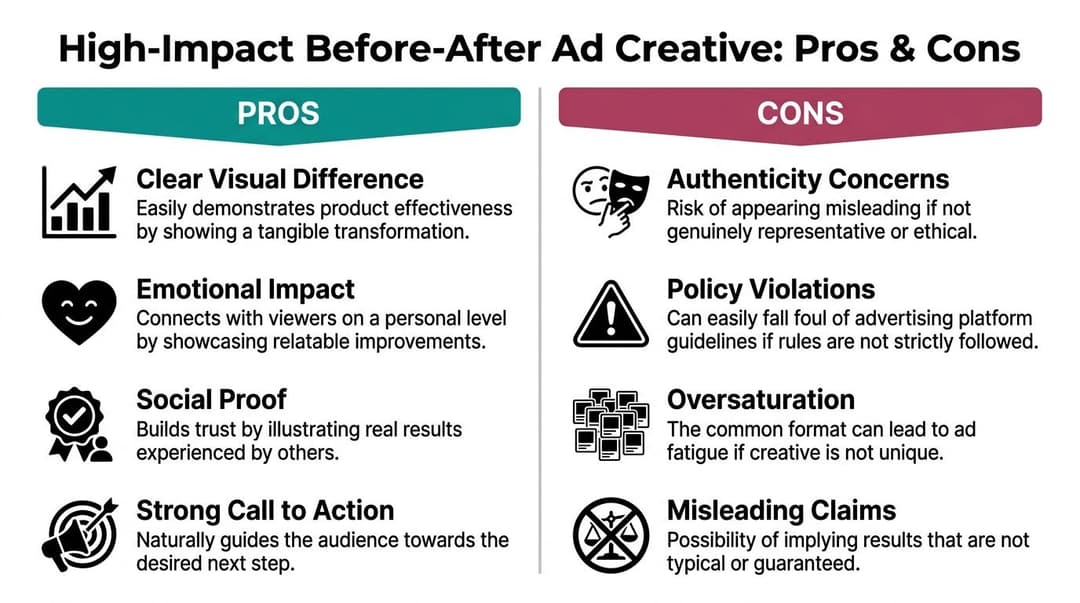
Execution details that change results
Creative reviews often get stuck on concepts. Production quality usually breaks performance first.
The patterns are consistent across accounts. Ads perform better when the before and after shots feel comparable, the improvement is easy to scan, and the environment supports the claim instead of distracting from it.
Use this checklist:
- Keep framing consistent: Similar crop, distance, and subject position make the transformation easier to trust.
- Use clean contrast: Separate the main subject from the background so the eye finds the change quickly.
- Cut decorative clutter: Props, badges, heavy text overlays, and busy backgrounds weaken the main idea.
- Show real context: A result in use usually converts better than an isolated product image.
- Preserve continuity cues: The same person, room, or object should still look like the same person, room, or object.
Standardized shoot briefs help more than another brainstorm session. Fixed shot lists, repeatable crops, and consistent lighting create cleaner test inputs. That matters once you start scaling because platforms like AdStellar can route spend and surface patterns faster when your creative variables are controlled.
Angle changes perceived value
Camera perspective affects trust, clarity, and perceived quality.
Front-on shots work best when the visual delta is the whole pitch. Slight angle shots are better when shape, depth, texture, or premium feel influence the sale. Tight crops can highlight detail, but they also remove context and can make the result feel clinical. Wide shots add realism, yet they often hide the actual improvement.
It means avoiding casual angle choices. Test perspective on purpose.
If the viewer has to search for the change, the ad is not ready.
Native beats generic
The best before after ads often look more like proof than polished brand creative. They still need clean composition and clear storytelling. They just cannot feel overdesigned.
That usually means using customer-style documentation, creator demos, technician walkthroughs, founder explanations, or quick handheld footage that shows the result in a believable setting. For video teams building multiple variations fast, the ShortGenius AI UGC ad generator helps prototype creator-style scripts and delivery angles without waiting on a full production cycle.
Teams running Meta at scale should also keep a tighter creative QA loop. This breakdown of Facebook ad creative formats and review standards is a useful reference when you need to pressure-test concepts before launch.
What usually underperforms
Poor before after ads fail in familiar ways:
- Overproduced studio visuals: They disconnect the transformation from real use.
- Artificially worsened before states: They kill trust fast.
- Tiny visual differences: They ask the viewer to work too hard.
- Multiple claims in one frame: They confuse the message and weaken belief.
- Repeated templates across every campaign: They create fatigue and flatten results.
Good before after creative is disciplined. It makes one improvement easy to see, easy to believe, and easy to test at scale. That last part matters more in 2026 than it did a few years ago. Creative quality is no longer just a design problem. It is an operating system problem, where the best teams connect concept, production, testing, measurement, and scale.
Crafting Copy for Transformation Narratives
A weak before after ad often fails in the copy, not the visual. The image gets attention. The words decide whether that attention turns into belief.
The job of copy is not to repeat what the image already says. It should explain the shift, add emotional relevance, and move the viewer from “I see it” to “I want that.”

Use copy to connect the two states
The cleanest structure is simple:
Before state What was frustrating, inefficient, messy, unclear, or inconvenient?
Turning point What changed in the routine, decision, product use, or service setup?
After state What feels easier, cleaner, calmer, faster, or more confident now?
That sequence works because it mirrors how buyers think. They do not just want results. They want a believable path from problem to improvement.
Copy formulas that fit this format
You do not need heavy brand copy here. You need disciplined direct response language.
PAS for obvious pain points
Problem “My desk looked organized for about an hour, then the mess came back.”
Agitate “Cords, chargers, and random tools turned a small problem into daily friction.”
Solution “One simple setup made the space usable again.”
This works well for home, organization, productivity, cleaning, and service offers.
Outcome-led headline with grounded body copy
Headline: From cluttered counter to clean routine Body: A small storage change made mornings easier and kept everything in reach.
This is strong when the visual difference is already doing most of the work.
Testimonial-style narration
Headline: “I stopped dreading the mirror” Body: The routine felt simple enough to stick with, and that consistency changed everything.
Use this carefully. It should feel like a person talking, not an invented dramatic monologue.
Three examples by category
Skincare
Bad copy: “Fix damaged skin fast.”
Better copy: “A simpler routine helped make my skin look calmer and more even.”
Why it works: It describes a journey without sounding aggressive or absolute.
Fitness equipment
Bad copy: “Get shredded now.”
Better copy: “The difference came from training consistently at home, not waiting for perfect timing.”
Why it works: It shifts the focus to process and use case.
Home services
Bad copy: “Your yard is embarrassing.”
Better copy: “A clean-up and fresh layout made the whole front entrance feel finished.”
Why it works: It sells improvement without attacking the customer.
Key takeaway: The strongest copy for before after ads sounds like observed progress, not courtroom evidence.
Headline patterns that pull their weight
Keep these short. If the image is strong, your headline should not fight it.
- From X to Y: From spare room to workable office
- One change, big difference: One routine change that made mornings easier
- Result without hype: Cleaner layout. Less daily hassle.
- Use-case first: For anyone tired of wasted counter space
- Process-driven: What happened when we simplified the setup
CTA language should match the maturity of the click
Do not jump from transformation image to hard-close language unless the audience is already warm.
For colder traffic, use softer CTAs:
- See how it works
- View the process
- Get the details
For warmer traffic:
- Start your routine
- Book your quote
- Shop the setup
For teams building copy variations at scale, this guide on copy ads for Facebook gives a solid framework for matching message style to audience intent.
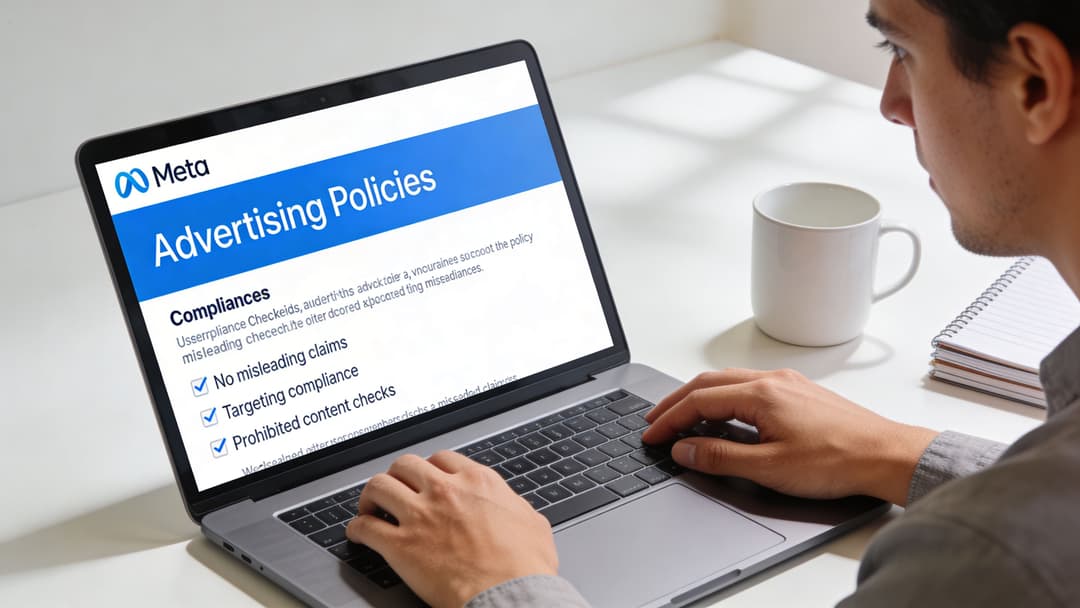
Navigating Meta's Ad Policies Without Getting Banned
Many marketers treat before after ads as if the format itself is banned. That is not the main issue. The core issue is how the transformation is framed.
A lot of rejections happen because the ad implies personal deficiency, shame, diagnosis, or unrealistic correction. The fix is not to abandon transformation creative. The fix is to stop writing and designing like a bad infomercial.
The safest framing is progress, not judgment
If your ad says or implies “you have this flaw,” you are already inviting trouble.
Safer framing sounds like this:
- A routine that helped someone feel more confident
- A service that improved a space
- A process that made something easier to manage
- A fitness context showing effort and progress
- A cosmetic or care routine described neutrally
Riskier framing sounds like this:
- Calling out defects
- Zooming in on a “problem area”
- Suggesting embarrassment
- Implying guaranteed correction
- Making extreme or absolute promises
The most resilient before after ads use positive framing. They let the result speak without insulting the viewer on the way there.
A simple compliance filter before launch
Run every concept through these questions:
| Question | If yes | If no |
|---|---|---|
| Does it shame the viewer? | Rewrite the angle | Keep reviewing |
| Does it imply a personal attribute or condition? | Remove that language | Keep reviewing |
| Does the image exaggerate the before state? | Replace the asset | Keep reviewing |
| Does the claim sound guaranteed or medical? | Soften and substantiate | Keep reviewing |
If you need a tighter reference point before submitting creative, review this summary of Facebook ads policy.
Copy choices that lower risk
This is usually where teams save or sink the ad.
Use:
- progress
- routine
- experience
- setup
- improvement
- support
- confidence
- consistency
Avoid:
- humiliating
- ugly
- disgusting
- fix this
- get rid of
- cure
- guaranteed result
- direct personal callouts
The fastest upgrade is removing accusatory phrasing. Speak about the product, the process, or the user story. Do not speak at the viewer as if diagnosing them.
A short explainer can help your team spot the difference between compliant and risky transformation framing:
What to do when a good ad still gets rejected
This happens. Do not assume the first rejection means the concept is dead.
Try this sequence:
- Swap the visual treatment: Move from explicit split-screen to a softer progression or contextual after shot.
- Remove loaded copy: Cut anything that sounds corrective, diagnostic, or guaranteed.
- Simplify overlays: Busy text on image often makes the ad feel more aggressive.
- Separate categories: What works for home improvement may fail in health-adjacent offers.
- Resubmit only after the core issue changes: Minor edits rarely change the outcome.
Tip: The most scalable policy strategy is not “beat review.” It is building concepts that look compliant before they ever reach review.
A Modern Framework for Testing and Measurement
Teams lose money on before after ads when they confuse early engagement with commercial value. A creative that spikes CTR can still drag down efficiency if it attracts curiosity instead of intent.
Measure these ads in two stages. First, identify which creative earns attention from the right audience. Then evaluate which version improves account economics over enough time to trust the result. Those jobs belong in the same workflow, but they should not share the same success standard.
Separate creative testing from business evaluation
Creative testing answers a narrow question. Which angle gets qualified users to stop, click, and explore?
Business evaluation answers the harder one. Which angle keeps conversion quality high and supports profitable scale?
That distinction matters with before after ads because strong visual contrast can inflate top-of-funnel metrics. If the transformation story is too aggressive, the ad can win the click and lose the sale. I treat that as a messaging mismatch, not a creative win.
What to test first
Control one variable at a time. Before after ads are sensitive to small changes in framing, so messy test design creates false winners.
Start with these variables:
- Format: side by side versus sequential reveal
- Visual context: isolated result versus result in daily use
- Headline style: outcome-led versus process-led
- Proof style: founder demo, customer story, or UGC-style walkthrough
- CTA intensity: learn more versus buy now
Once one variable shows a clear pattern, move to the next. If results stay mixed, the concept usually needs more work before the account needs more spend.
For a tighter process on validation and test design, use this guide on how to test ad creative effectively.
Metrics that matter more than vanity indicators
Review performance in tiers so the team does not overreact to surface-level signals.
Tier one signals
These indicate whether the ad earns attention.
- CTR
- Thumb-stop behavior
- Landing page visit quality
- Hook retention for video
Tier two signals
These show whether the traffic is commercially useful.
- CPA
- CPL
- ROAS
- Conversion rate by audience segment
Tier three signals
These show whether the ad contributes beyond the first reporting window.
- Efficiency over time
- Performance after creative refreshes
- Assisted conversions
- Lift against your baseline
A before after ad should win more than attention. It has to hold up under paid distribution, audience fatigue, and conversion scrutiny.
Use baseline measurement, not platform reporting alone
Platform dashboards are useful, but they are incomplete once budgets shift, other campaigns stay live, and audience overlap muddies attribution. In live accounts, I want a baseline before launch and a comparison window after launch so the team can judge change in context.
Pre-post analysis helps with that. It gives you a way to compare performance before the new creative enters the account and after it starts spending. It also helps explain delayed impact. As Cassandra explains in its discussion of pre-post analysis and adstock, advertising can keep influencing future periods after the first click or conversion window closes.
For before after ads, this is important because transformation creative often builds memory and consideration before it captures action. Cutting an ad the moment direct response softens can hide the carryover value it is still producing.
Key takeaway: Judge before after ads on incremental business impact, not just the first spike in clicks.
A practical measurement cadence
Use a review rhythm that matches how these ads perform in-market.
- Daily: Check spend pacing, delivery health, and obvious outliers.
- Twice weekly: Compare creative variants on qualified traffic and conversion efficiency.
- Weekly: Review audience-level performance, fatigue patterns, and post-click quality.
- Monthly: Run baseline comparisons and look for carryover effects that short windows miss.
Here, the operational side separates good teams from scalable ones. Strong creative matters, but repeatable measurement is what lets you feed results back into testing, train better variants, and give systems like AdStellar cleaner signals for what to scale next.
Automating and Scaling Your Winners with AdStellar AI
The hard part is not finding one good before after ad. The hard part is operationalizing the whole system so winners keep emerging without your team drowning in production.
Manual workflows break first. Creative requests pile up. Naming conventions drift. Testing gets messy. The account ends up scaling whichever ads were easiest to launch, not whichever ads were best.
What scale should look like
A scalable before after ads workflow has four traits:
- Repeatable inputs: standard briefs, consistent asset tagging, and clear transformation angles
- Fast variation output: multiple versions of the same core concept without days of manual setup
- Centralized ranking: one place to see which combinations of visual, copy, and audience are winning
- Continuous learning: new performance data shapes the next round of variants
That is where AI tooling changes the economics of execution. Instead of treating every ad as a custom build, the team turns strong patterns into a production system.
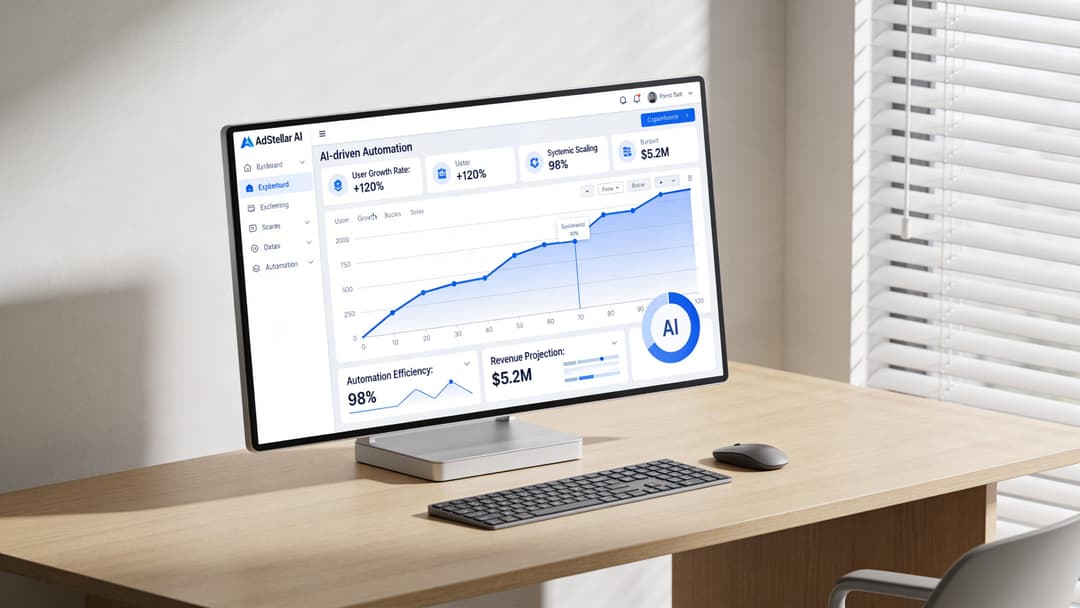
How the loop works in practice
A useful AI workflow for before after ads usually follows this path:
- Historical account data is connected and organized.
- The system identifies which visual patterns, hooks, and audience pairings perform best.
- New variants are generated from those patterns.
- Tests go live in bulk instead of one by one.
- Fresh data feeds the next round of ranking and scaling.
This is the operational gap many teams never close. They know what a good before after ad looks like, but they do not have infrastructure to produce, compare, and relaunch fast enough.
For teams that want automation on the optimization side, AdStellar’s AI optimization page shows how that kind of loop can be structured around performance signals instead of guesswork.
Where AI helps most
AI is not a substitute for judgment. It is a force multiplier for disciplined marketers.
It helps most when you need to:
- produce many variants of one concept
- keep testing velocity high
- identify repeatable winner traits
- cut manual setup work
- reallocate attention toward strategy instead of asset wrangling
The best use of AI here is not “make infinite ads.” It is “turn clear creative principles into a faster, cleaner testing engine.”
That is how before after ads stop being a one-off tactic and become part of an account-wide growth system.
Frequently Asked Questions about Before After Ads
Can service businesses use before after ads?
Yes. Service brands often have the clearest transformations. Think cleaning, landscaping, remodeling, dental, organization, restoration, or design work. The key is showing a visible improvement without exaggerating the starting point.
Do before after ads need to use customer photos?
No. They can use brand-created assets, creator content, product demos, or staged examples if they are truthful and compliant. If you use UGC, get clear usage rights and make sure the result shown is representative of what you can support.
How much time should pass between the before and after?
There is no universal rule. The gap should be realistic for your category and defensible if questioned. If the transformation would normally require sustained use, the ad should not imply instant change.
What if the result is hard to show visually?
Use a process-led version. Show the “before” problem context, then the simplified workflow, environment, or routine that leads to the improved state. This works well for SaaS, education, and systems-driven offers.
Should I use static images or video first?
Start with whichever format helps the transformation read fastest. Static often works well for immediate comparison. Video works better when the process or reveal adds credibility.
If you want to launch, test, and scale before after ads without getting buried in manual setup, AdStellar AI gives performance teams a faster way to build variants, learn from historical Meta data, and push winning combinations into market with less friction.