You launch a campaign that should work. The audience is familiar. The creative is solid. Meta Ads Manager shows healthy historical signals. Then performance starts sliding.
At first it looks like normal volatility. A few days later, the pattern is clear. Costs drift up, click quality softens, and your old targeting logic stops giving you the same edge. The problem is not creative fatigue alone. It is that the machinery behind many digital campaigns was built for a tracking-rich internet that no longer exists.
Performance marketers are adjusting in real time. The shift is uncomfortable because behavioral targeting trained teams to think in terms of user history first. Context in advertising flips that order. It asks a simpler question: what is the person paying attention to right now, and does your message belong there?
That change matters on the open web, in programmatic, and even inside walled gardens where you do not get clean contextual controls. It also matters for teams trying to prove ROAS, not talk about relevance in abstract terms.
The End of an Era for Digital Ads
A lot of paid media teams are living through the same sequence.
They built reliable acquisition systems on historical user data. Then privacy rules tightened, third-party signals weakened, and attribution got noisier. Campaigns did not stop working overnight, though they got harder to steer. The old advantage became less durable.
What breaks first
The first thing to go is confidence.
You have audiences. You have dashboards. But the connection between audience definition and actual buyer intent gets fuzzier. Someone who looked like a great prospect last week may be in a completely different mode today. Behavioral targeting can help, but it does not always tell you what the person cares about in the moment of impression.
That is why more teams are revisiting context in advertising as a practical operating model, not as a fallback tactic. If you need a refresher on how the broader data environment is changing, this overview of third-party data is useful background.
The strategic pivot
Contextual advertising is described as privacy-safe, which is true. But that framing is too narrow for a performance team.
The stronger reason to care is operational. Context gives you a way to align message and environment when user-level tracking becomes unreliable. Instead of chasing a person around the web based on what they did before, you place a relevant offer into the content experience they are currently in.
Key takeaway: Behavioral targeting helped teams find people. Context helps teams find moments.
That does not mean all old methods are obsolete. It means the center of gravity is moving. Teams that keep treating context as a brand-only concept will miss one of the most usable levers left in a cookieless environment.
What Context in Advertising Means
The simple way to understand context in advertising is to ignore ad tech for a minute and think like a retailer.
If you sell protein bars, you do not put them in the candy aisle and hope motivation appears. You put them near gym gear, health food, or checkout areas where the shopper already has a fitness or convenience mindset. The product has not changed. The placement has.
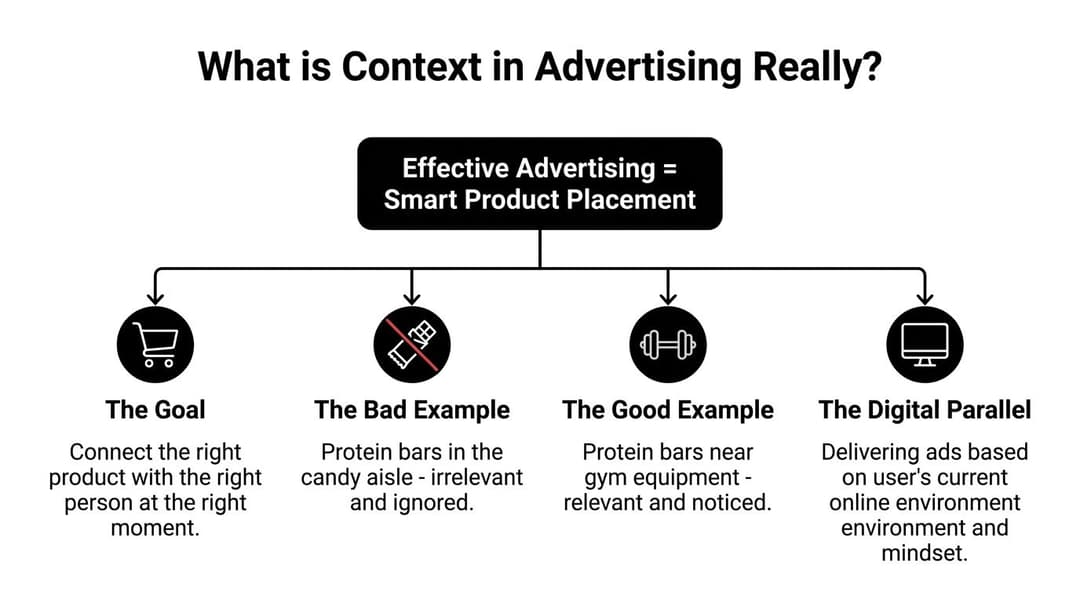
That is the core of context in advertising. You are matching the ad to the surrounding environment and the mindset it creates.
The basic layer
At the simplest level, contextual targeting looks at keywords and categories.
A camping brand might target pages about hiking, trail gear, or national parks. A B2B SaaS company might align with articles on pipeline management, CRM workflow, or sales reporting. This layer is useful, but it is also where many teams get into trouble because keywords alone can be blunt.
A page can mention a word without reflecting the intent you want. That is why basic keyword matching is a starting point, not the full system.
Topic matters more than isolated words
Modern contextual systems try to understand the broader topic of the content.
That difference sounds small, but it changes placement quality. "Apple" can refer to fruit or a technology company. "Training" can mean marathon preparation, employee onboarding, or machine learning model work. Topic modeling helps the system avoid obvious mismatches by interpreting clusters of meaning instead of isolated terms.
For marketers, context starts becoming useful rather than decorative at this stage. It is no longer "find pages with these words." It becomes "find environments that reflect this category of need."
Tone changes performance
The next layer is sentiment.
A page about skincare ingredients can carry a positive, educational tone or a negative, alarming one. A finance article can be optimistic planning content or panic-driven coverage of losses. The same product may perform differently in those settings.
Teams usually talk about sentiment as a brand safety feature, but it also affects conversion quality. An ad can be topically relevant and still feel wrong if the emotional tone clashes with the message.
Practical tip: Relevance without tone fit often looks fine in a placement report and underperforms in actual buying behavior.
Semantic understanding is where the gains are from
The most advanced layer is semantic analysis.
That means the system is trying to understand actual meaning, not labels alone. It looks at structure, language, entities, relationships, and other content signals to determine what the content is about. In video environments, it can also use metadata and transcripts.
Here is how that plays out in practice:
- Keyword targeting: A running shoe ad appears on a page that says "shoes."
- Topic targeting: The ad appears on a page about marathon preparation.
- Sentiment targeting: The page has a motivating and instructional tone, not injury news.
- Semantic targeting: The page is helping people compare training gear before a purchase decision.
That last step is where context moves closer to intent.
What context is not
Context is not website adjacency alone. It is not keyword lists alone. It is not blocking unsafe categories alone.
Used well, context in advertising is a way to infer the user's current frame of mind from the environment itself. That is why it matters more important now. Historical behavior can age rapidly. Current attention is fresh.
Contextual vs Behavioral Targeting Explained
Marketers frame this as a winner-take-all debate. That is the wrong lens.
Both methods can be useful. The question is which one gives you the cleaner signal for the job you are trying to do.
Contextual vs. Behavioral Targeting at a Glance
| Attribute | Contextual Targeting | Behavioral Targeting |
|---|---|---|
| Data source | The content, category, tone, and environment around the ad impression | Historical user actions, browsing patterns, and prior engagement |
| Core signal | What the user appears interested in right now | What the user has done before |
| Privacy posture | Generally does not rely on personal tracking | More exposed to privacy restrictions and signal loss |
| Strength | Captures current mindset and moment-level relevance | Useful for retargeting, sequenced messaging, and audience history |
| Weakness | Can miss a strong prospect if the environment signal is weak | Can feel stale when past behavior no longer reflects current intent |
| Best fit | Prospecting, brand alignment, privacy-first scale, content-driven placements | Retargeting, CRM-informed campaigns, known-audience follow-up |
| Failure mode | Topic match without true intent or tone fit | Over-targeting based on old or incomplete user history |
The key trade-off
Behavioral targeting asks, "Who is this person based on past actions?"
Contextual targeting asks, "What is this person likely thinking about right now based on the environment?"
That distinction matters more than is acknowledged. A user who researched office furniture two weeks ago may not be buying today. A user reading side-by-side chair comparisons at this moment is giving you a much stronger active signal, even if you know nothing else about them.
Why this matters inside paid social
On social platforms, this comparison is complex because the environment is not as transparent as a webpage category in programmatic.
You are often approximating context through content themes, placements, audience interests, post tone, and creative-message fit. That is why sharp audience segmentation remains important. You need a structure that separates broad persona assumptions from the signals that suggest immediate relevance.
Use both, but stop treating them as equals
For years, many teams let behavioral targeting carry a significant portion of the workload.
That was fine when third-party tracking was stronger and user histories were simpler to stitch together. In a privacy-first environment, contextual methods become more resilient because they do not depend on the same fragile signal chain.
Rule of thumb: Use behavioral data when you have a legitimate reason to act on known history. Use contextual logic when you need scalable relevance without leaning on personal tracking.
The strongest teams do not abandon one for the other. They reset the hierarchy. Context becomes the primary lens for prospecting and message fit. Behavioral data becomes a supporting layer where consent, platform access, and signal quality permit it.
Why Context is the Future of Performance Marketing
A prospect opens Instagram after searching for a problem, not a brand. If the creative, placement, and message match that moment, the campaign has a chance. If they do not, even a well-built account wastes spend.

Privacy changed the operating model
Privacy rules and platform restrictions did more than limit tracking. They changed how performance teams find efficiency.
User-level signals are less stable, attribution windows are tighter, and prospecting audiences decay faster than they used to. That forces a shift from "who is this person based on past behavior?" to "what is this person engaging with right now, and what message fits?" Context holds up better under those constraints because the strategy does not depend on stitching together a long personal history.
That shift also affects workflow inside tools. In Meta Ads Manager, context shows up through creative-message fit, placement choices, audience framing, and fast testing around themes. In platforms such as AdStellar, AI helps teams sort those combinations faster so context becomes something you can test and scale, not just discuss in strategy decks.
Better fit usually beats broader reach
Performance teams do not need another abstract argument for relevance. They need campaigns that convert at an acceptable CAC.
Research from IAS and Tobii Pro Insight on contextual relevance found that ads in contextually relevant environments drove higher purchase intent and much stronger unaided brand recall than the same ads shown out of context. That matters in practice because paid social rarely fails from lack of impressions. It fails when the message shows up in the wrong setting, with the wrong format, or at the wrong level of intent.
Creative format plays into this more than many teams admit. Several best ad innovations in digital marketing work because they mirror how people already consume content in-feed, which improves message absorption before the click.
A useful visual explainer on the shift is below.
Context closes the gap between theory and ROAS
Context sounds smart in principle, but the main challenge is operational. Teams still need to turn a contextual hypothesis into spend decisions, creative variants, and measurable return.
That means testing context the same way you test bids, hooks, and offers. Build ad sets around distinct content environments or message angles. Map each angle to a creative concept. Watch whether one context produces cheaper qualified traffic, stronger add-to-cart rates, or better post-click behavior. Then scale the combinations that hold margin.
AI makes that cycle faster. It can identify patterns across placements, creative types, and audience clusters that a buyer working manually in Meta Ads Manager will spot too late or not at all. That is why context is becoming a performance discipline, not a brand-only idea.
For teams reworking their acquisition model, context belongs alongside the rest of your performance marketing strategy framework. The upside is not theoretical relevance. The upside is faster testing, less wasted spend, and a more durable path to ROAS as tracking gets weaker.
Measuring the Impact of Contextual Strategies
A familiar failure mode looks like this. Meta Ads Manager shows a healthy CTR, spend is pacing, and the team calls the contextual test a win. Two weeks later, CAC is flat, conversion quality is weaker, and nobody can explain which context helped.
That happens because contextual strategy gets judged at the campaign level instead of the decision level. Measurement needs to answer a narrower question. Which environment, message, and placement combination produced better business outcomes?

Start with operating metrics that affect margin
Earlier benchmarks on contextual performance are useful as directional proof, but they do not justify budget on their own. A finance team cares about whether context changed unit economics. Did it lower wasted impressions? Did it improve post-click behavior? Did it raise revenue per session or shorten payback?
That is the standard to use.
In practice, I look at context the same way I look at any acquisition variable. It has to earn its place in the account. If a context-led setup gets cheaper clicks but sends lower-intent traffic, that is not a performance gain. It is a reporting illusion.
Build a KPI stack that isolates context
Use a funnel view, but segment every layer by context category, placement cluster, or creative-context pairing. If those cuts are missing, the report is too blended to be useful.
| Funnel stage | What to watch | What it tells you |
|---|---|---|
| Upper funnel | Engaged view quality, thumb-stop rate, ad recall lift | Whether the environment creates attention and message resonance |
| Mid funnel | CTR by context, landing page engagement, cost per engaged visit | Whether the message fits the setting well enough to pull qualified interest |
| Lower funnel | Conversion rate by context, ROAS, CAC, CPA by placement cluster | Whether contextual relevance is improving acquisition efficiency |
One warning here. Averaged placement data hides the true signal fast, especially in social. A broad ad set can make one strong context carry three weak ones. The account looks stable, but scale goes into the wrong inventory.
Keep the test design simple enough to defend
You do not need a measurement team with custom modeling to validate contextual lift. You need cleaner comparisons.
Use one of these setups:
- Geo split: Hold budget, offer, and creative family as steady as possible, then compare regions running context-led placements against regions using the standard media mix.
- Placement split: Keep the same message and offer, then compare context-qualified inventory against broader inventory.
- Creative-context split: Pair one offer with different contextual hooks and compare downstream metrics such as add-to-cart rate, lead quality, or blended CAC.
A good rule is simple. If the test cannot be explained to a CFO in two minutes, the setup is too messy.
Social platforms need a stricter read
On open-web programmatic, context is easier to define because page-level signals are explicit. On paid social, context is more indirect. You are often inferring it through creative angle, engagement pattern, placement behavior, and post-click quality.
That is why platform screenshots are not enough. In Meta, compare CTR with bounce rate, assisted conversions, conversion lag, and cost by creative theme. In AdStellar or any reporting layer that joins campaign and site data faster, look for the combinations that hold up after the click, not just before it.
If your team needs a cleaner reporting model beyond native platform metrics, this guide on how to measure social media roi is worth reviewing.
You also need one shared definition of success across media, finance, and growth. This breakdown of how to measure advertising effectiveness helps teams align metrics with actual business goals instead of chasing whichever platform number looks strongest that week.
Putting Contextual Advertising into Action
Most guides get thin here. They describe context well, then stop right before execution gets hard.
In practice, the challenge is not understanding why context matters. The challenge is turning it into repeatable buying decisions across display, programmatic, and paid social without drowning in manual setup.

Programmatic is the cleanest place to start
On the open web, contextual execution is straightforward.
DSPs can evaluate page-level signals before the bid. That includes topic, sentiment, entities, language, content structure, and exclusion criteria. In stronger setups, you define both what you want and what you want to avoid.
A workable programmatic process looks like this:
Define buyer moments Build categories around moments of evaluation, comparison, education, or urgency. These are more useful than broad affinity buckets.
Set inclusion and exclusion logic Include high-intent content clusters. Exclude pages whose topic is adjacent but commercially weak or emotionally misaligned.
Map creative families to context groups A comparison-page environment should not receive the same message as an introductory explainer environment.
Review performance by context bucket Do not optimize at campaign level alone. Optimize at the context-family level.
The upside of programmatic is speed. The downside is that teams often overtrust automation. If your keyword and semantic rules are sloppy, the DSP will scale bad logic efficiently.
Where contextual campaigns usually fail
Most underperformance comes from one of four issues.
- Shallow keyword logic: The campaign targets terms that are related but commercially weak.
- No tone control: The placement is topically relevant but emotionally wrong for the message.
- Creative mismatch: The environment says "comparison and decision," but the ad says "generic awareness."
- Weak feedback loops: Teams review total campaign outcomes and miss which contexts are driving waste.
The downside of mismatch is real. Prose on contextual intelligence and ad mismatch notes that while contextual intelligence can yield 14% higher purchase intent, 49% of users disengage from mismatched ads, lowering brand perception by 43%.
That gap is the whole game. Good context helps. Bad implementation punishes you.
Key takeaway: Context is not a strategy until your exclusions, creative mapping, and reporting structure are disciplined enough to catch mismatch fast.
Meta is harder, but not impossible
Meta does not give you page-level contextual targeting the way a DSP can. That does not mean context disappears. It means you work with proxies.
In Meta Ads Manager, contextual execution usually comes from a combination of:
- Interest structures that approximate content environments
- Placement choices that affect how the ad is experienced
- Creative angles aligned to the likely feed mindset
- Audience segmentation based on stage, pain point, or product category
- Post-click continuity so the landing page matches the message that matched the feed moment
This is less precise than open-web contextual targeting, but it is actionable.
For example, a fitness product can run different creative packages depending on whether the campaign is aligned to training advice, body transformation inspiration, or product comparison behavior. The audience may overlap. The context signal does not.
Treat creative as part of the context system
Many teams isolate targeting from creative. That is a mistake.
If the surrounding environment implies urgency, your copy should speak to action. If the environment is educational, a hard-sell CTA can feel out of place. If the tone is aspirational, feature-dense copy can undercut attention.
A simple way to operationalize this is to build creative by context family:
| Context family | Better creative approach | Weaker approach |
|---|---|---|
| Educational content | Explainer hooks, proof, clear product framing | Aggressive discount-first messaging |
| Comparison content | Side-by-side claims, objections answered, demos | Broad lifestyle creative with no decision support |
| Inspirational content | Visual storytelling, identity fit, aspiration | Dense technical copy |
| Problem-aware content | Direct pain-point language, urgency, solution clarity | Generic brand slogans |
Many Meta campaigns stall here. The targeting is acceptable, but every audience sees the same message. That flattens contextual gains before they can show up in ROAS.
What AI should do here
A lot of people hear "AI for contextual advertising" and think magic targeting layer. That is not the practical use case.
The better use of AI improves workflow. It should help teams:
- generate many context-aware creative variations quickly
- organize those variations against message families and likely feed environments
- ingest historical results and identify which combinations perform under which conditions
- surface winners early enough for a buyer to scale them before the opportunity passes
That is the bridge between theory and measurable ROAS. Not more dashboards. Faster testing with tighter feedback loops.
A realistic workflow for teams
If I were setting this up for a growth team from scratch, I would use this operating rhythm:
Week one. Build a context map. List the core environments where your product makes sense. Include high-intent information states, emotional tone, and stage of awareness.
Week two. Create distinct creative packages for each environment. Do not swap headlines alone. Change the promise, proof, visual hierarchy, and CTA when needed.
Week three. Launch in controlled clusters. Keep naming clean so reporting can isolate context family from audience and creative.
Week four onward. Cut mismatches aggressively. Scale only combinations that show efficient downstream behavior, not cheap clicks alone.
This is not glamorous work. It is disciplined work. But context in advertising starts paying off when teams treat it as a repeatable operating system rather than a one-time targeting tweak.
From Guesswork to Growth with Context
A buyer opens Instagram after reading reviews, sees a generic ad, and scrolls past. Ten minutes later, the same buyer sees a message that matches the problem they are trying to solve and clicks. That gap is what context changes, and on Meta it often decides whether a campaign stalls or scales.
Context in advertising matters now because it helps teams match message to moment without relying so heavily on unstable user-level tracking. It also gives operators a more practical way to improve acquisition economics. The question is no longer whether context matters. The question is whether the team can turn it into a testing system that produces measurable ROAS.
That is where many guides stop too early. They explain the theory, then skip the operational gap between a good contextual idea and a repeatable win inside Meta Ads Manager. Performance teams need a way to test more combinations, read results faster, and shift budget with discipline.
What the winning teams do differently
Winning teams treat context like a performance variable, not a brand guideline. They group ads by environment, tone, and buyer state. They read results at that level, then cut weak matches before they absorb more spend.
They also get stricter about ad spend optimization, because contextual relevance only improves performance when budget moves toward the combinations that prove they can convert.
The advantage is speed with judgment. A team that can launch 20 context-aware variants, identify which message works for which situation, and scale the right cluster by Thursday will beat a team still debating one broad concept on Monday.
That shift also changes how AI should be used. On Meta, AI is most useful when it helps teams produce variations, connect them to clear context hypotheses, and rank winners fast enough to act. AdStellar fits that workflow. It helps performance teams generate and launch large sets of creative, copy, and audience variations quickly, use historical performance through a secure Meta connection, and identify what is driving ROAS, CPL, or CPA. For teams tired of running contextual tests through spreadsheets and slow manual setup, explore AdStellar AI.