So, what are you actually paying for when you run an ad campaign? You’re paying for eyeballs. Specifically, you’re paying for every thousand pairs of eyeballs that see your ad. That, in a nutshell, is cost per 1000 impressions, or CPM.
Think of it like renting a digital billboard on the busiest highway on the internet. You aren't paying for every person who calls your number from the sign, but for the sheer volume of traffic that passes by it. CPM is the fundamental metric for measuring the cost of that visibility.
What Is Cost Per 1000 Impressions And Why It Matters

Let's make it even simpler. Imagine you're handing out flyers for your new coffee shop. Your CPM is the total cost for every 1,000 flyers that people actually saw. It's the go-to metric for figuring out the cost of your ad's visibility, making it the heartbeat of any brand awareness campaign.
Whether you're a new DTC brand trying to make a splash or a B2B company trying to build authority, CPM answers one simple, critical question: How much am I paying just to get noticed?
The Core Purpose of CPM
Keeping a close eye on your CPM is non-negotiable. It gives you a standard way to compare how cost-effective different ad platforms, campaigns, or even specific ad creatives are. Without it, you’re flying blind with your budget.
Before we get into the details, here's a quick look at the core concepts that make up CPM and why they're so important for advertisers.
CPM At A Glance Key Concepts
| Concept | Brief Explanation | Primary Use Case |
|---|---|---|
| CPM | The price an advertiser pays for 1,000 views or impressions of an ad. | Measuring the cost-efficiency of brand awareness and reach campaigns. |
| Impression | A single instance where an ad is displayed on a user's screen. | The basic unit of measurement for ad visibility. |
| Total Cost | The full amount spent on an ad campaign. | The numerator in the CPM calculation. |
| Total Impressions | The total number of times an ad was displayed during a campaign. | The denominator in the CPM calculation, divided by 1,000. |
This table lays out the building blocks, but understanding the why behind tracking CPM is what gives you a real edge.
Tracking this metric helps you:
- Manage Your Ad Budget: Know your CPM? Then you can accurately forecast how much money you'll need to reach a certain number of people.
- Gauge Campaign Health: If your CPM suddenly shoots up, it could be a sign of new competition or that your ad isn't resonating anymore. It’s an early warning system.
- Benchmark Your Performance: CPM lets you see how your costs stack up against industry and platform averages. Are you getting a good deal on attention, or are you overpaying?
CPM isn't about tracking sales; it's about tracking the cost of opportunity. It puts a number on what you spend to earn a moment of your audience's time—the very first step in any customer's journey.
Why A Low CPM Isn't Always The Goal
It’s easy to fall into the trap of chasing the lowest CPM you can find. But be careful—a super-low CPM can mean your ads are being shown to a low-quality audience that has zero interest in what you're selling. An impression there is practically worthless.
A higher CPM to reach a hyper-targeted group of qualified buyers is almost always a better investment than a rock-bottom CPM for a broad, uninterested crowd. The real goal is to find the sweet spot: an efficient price for reaching the right people. You can learn more by exploring our guide on what impressions are on social media and what they mean for your strategy.
Ultimately, CPM is just one piece of a much larger puzzle. It works hand-in-hand with other metrics to give you a full picture. For example, your cost per acquisition (CPA) tells you what you're paying for a conversion, not just an impression. A profitable ad strategy depends on balancing all of these metrics together.
How To Calculate CPM With Real-World Scenarios
Figuring out your cost per 1,000 impressions is a lot less intimidating than it sounds. The math is simple, but what that number tells you about your campaign's health is incredibly powerful. Once you get the hang of this formula, you're on your way to truly understanding your ad spend.
Here’s the core calculation you’ll need:
CPM = (Total Ad Spend / Total Impressions) x 1,000
This little formula reveals exactly what you paid to get your ad in front of a thousand pairs of eyes. But the number itself is only half the story. To really see it in action, let's walk through a few scenarios that every marketer knows all too well.
Scenario 1: The Scrappy Startup
Imagine a new e-commerce brand dipping its toes into the advertising world with its very first brand awareness campaign on Meta. They're working with a tight budget and need to make every dollar count.
- Total Ad Spend: $500
- Total Impressions: 150,000
Here's the math: ($500 / 150,000) x 1,000 = $3.33 CPM.
For just $3.33, the startup got their ad shown one thousand times. For a brand new company, that’s a fantastic result. It shows they're getting their name out there efficiently without burning through their limited cash, maximizing their initial visibility.
Scenario 2: The High-Stakes Agency
Now, let's switch gears to a marketing agency running a huge national campaign for a major client. The goal is massive reach to a premium audience, and they’ve got a hefty budget to work with.
- Total Ad Spend: $15,000
- Total Impressions: 2,400,000
Plugging that in: ($15,000 / 2,400,000) x 1,000 = $6.25 CPM.
A $6.25 CPM is higher than the startup's, but that’s completely expected. They're almost certainly targeting a much more competitive and valuable audience, which naturally costs more at auction. For an agency, this figure is a key benchmark to show the client, justifying the spend with impressive reach. If you need a hand estimating these kinds of costs, our guide on using a Facebook ad cost calculator can help you plan your campaigns.
Scenario 3: The E-commerce Giant
Finally, picture an established e-commerce store in the thick of a Q4 holiday promotion. Competition is through the roof, and every brand is bidding aggressively to win over the same holiday shoppers.
- Total Ad Spend: $1,500
- Total Impressions: 750,000
Let’s run the numbers: ($1,500 / 750,000) x 1,000 = $2.00 CPM.
A $2.00 CPM during the chaotic holiday season might look surprisingly low. This could mean a few things. Perhaps the brand’s creatives are so engaging that ad platforms are rewarding them with better reach, or maybe they’ve cleverly found an untapped, cheaper audience to target.
As you can see, calculating your CPM is just the first step—interpreting it is where the real strategy begins. This is especially true on platforms like Meta, where costs can swing wildly. You can learn more about how publishers price their ad space and see historical trends on Wikipedia.
Understanding CPM Benchmarks Across Industries And Platforms
So you know your campaign’s CPM. That’s a great start, but it’s only half the story. The real question is: is that number good?
A "good" CPM isn't a fixed target. It’s a moving one, changing dramatically based on where you’re running ads, who you’re trying to reach, and even what time of year it is. A $10 CPM might be an absolute steal in a cutthroat industry like finance, but it could be a total waste of money in another. Without context, you’re just staring at numbers on a screen.
This is the simple math that puts it all into perspective.
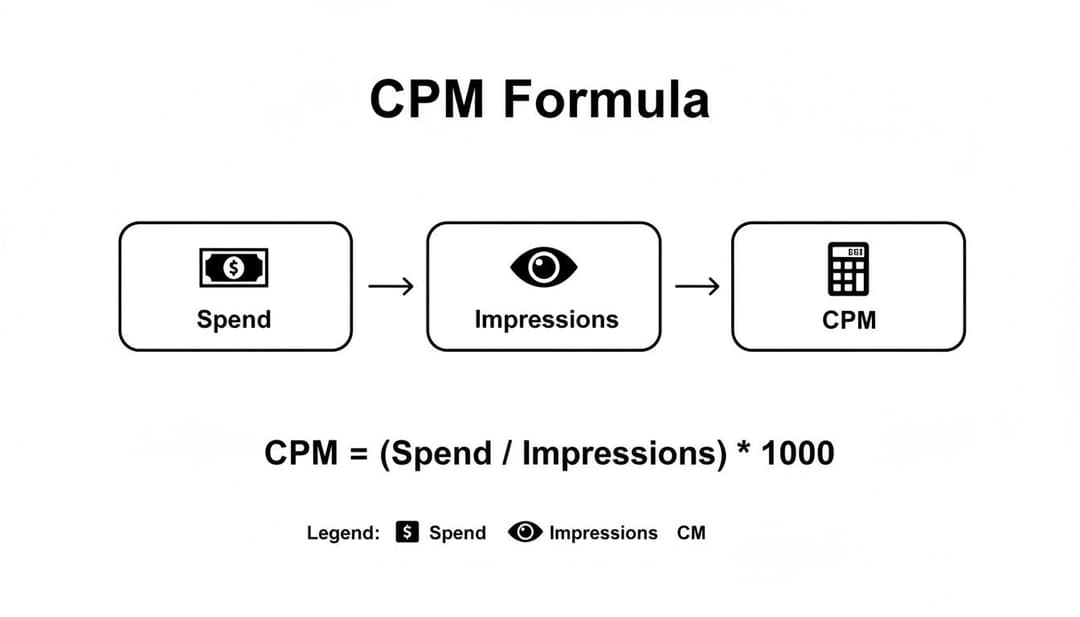
This formula is your starting point for figuring out if your ad spend is actually translating into visibility or just vanishing into thin air.
2026 Average CPM Benchmarks By Industry And Platform
To give you a clearer picture, we’ve put together a table showing what you can expect to pay across different channels and sectors. Think of it as a cheat sheet for spotting whether your costs are in the right ballpark.
| Category | Platform/Industry | Average CPM |
|---|---|---|
| Platform | Desktop Display | $2.50 |
| Platform | Meta (Social) | $7.58 |
| Platform | In-App Video | $9.00 |
| Platform | Mobile Video | $11.10 |
| Industry (Mobile) | Finance | $6.52 |
| Industry (Mobile) | Travel | $7.12 |
| Industry (Mobile) | Food Delivery | $7.63 |
As you can see, the price for a thousand eyeballs varies wildly. A simple display ad offers wide reach for a low price, while an immersive video ad on a mobile device will cost you a premium because it commands more attention.
What Drives These CPM Differences?
So, why does a financial services ad on Meta cost so much more than a generic banner ad? It comes down to a few key factors that create a dynamic, ever-shifting auction for ad space.
Fierce Competition: Are you targeting a high-value audience? So is everyone else. If you're trying to reach "high-income individuals interested in investing," you're bidding against a sea of other financial firms. This is the single biggest driver of high CPMs.
Timing is Everything (Seasonality): Ad costs are not static. They spike dramatically in the run-up to major holidays like Black Friday and Christmas as brands fall all over themselves to grab consumer attention. One report noted that while the average social media CPM was $6 in Q4 2024, the holiday rush pushed that number significantly higher.
Location, Location, Location (Ad Placement): Even on a single platform like Meta, where your ad shows up matters. An ad in the main feed is prime real estate and costs more than an ad in Stories or the Audience Network.
The Popularity Contest (Ad Relevance): Platforms like Meta and Google want to show people ads they actually like. If your creative is engaging and relevant to the audience, the platform will reward you with a lower CPM to encourage you to keep showing it.
These factors explain why costs are always in motion. For example, recent data showed Meta CPMs peaking at $8.28 in November, plummeting to $6.21 in January after the holiday dust settled, and then leveling out. These swings are a perfect reminder that understanding your industry’s benchmarks is a great starting point, but it's not the end of the story. For a closer look at industry trends, our complete guide on the average cost per impression provides a much deeper dive.
Ultimately, if you're in the finance industry and hitting a $5.00 CPM, you’re crushing it. But if you're in a less competitive space and paying $8.00, it’s probably a sign that something in your strategy needs a second look.
Why Location Matters For Your Ad Costs

When you’re setting up an ad campaign, it’s easy to treat your audience’s location as just another demographic box to check. But in reality, where your ads are shown is one of the single biggest factors that will determine how much you spend. The cost to reach 1,000 people can swing wildly from one country to the next.
Think of it like buying real estate. An ad impression in a mature, high-income market is like buying a storefront in Manhattan—it's expensive, fiercely competitive, and everyone wants a piece of it. An impression in a developing economy is more like buying land in a rural town—far cheaper, with way less competition.
Understanding Tier 1 Versus Emerging Markets
In the advertising world, we often group countries into "tiers" based on their economic muscle. These tiers are a surprisingly accurate predictor of your ad costs, especially your CPM.
- Tier 1 Countries: This group includes places like the United States, the UK, Canada, and Australia. They’re characterized by high consumer spending power, crowded digital ad markets, and intense competition.
- Tier 2 and 3 Countries: These are regions with typically lower disposable incomes and much less ad competition, which translates to significantly lower CPMs.
This economic split creates some truly massive differences in what you pay. For instance, recent benchmarks for Meta campaigns show a global average CPM of $6.59. But that number doesn't tell the whole story. The average CPM in the United States skyrockets to $23.00, while in Nigeria, it’s just $1.50.
To put that in perspective, your budget could reach over 15 times more people in Nigeria than in the US. The reason is simple supply and demand. In the US, countless brands are locked in bidding wars for the same valuable audiences, driving prices through the roof.
Crafting a Balanced Global Strategy
For any brand with an international presence, these cost differences are both a challenge and a huge opportunity. If you only target Tier 1 countries, you can burn through your budget in a flash. But if you focus only on low-cost regions, you might not see the revenue you want because of lower purchasing power.
A smart global strategy isn't about choosing one or the other. It's about blending your approach to balance cost and opportunity, building an efficient media plan that drives both reach and revenue without letting your ad spend spiral.
Here’s how you can build a more profitable global media mix:
- Test and Diversify: Don’t be afraid to carve out a piece of your budget to test campaigns in lower-cost Tier 2 or 3 countries. You might just stumble upon an untapped market with an enthusiastic audience and a surprisingly strong ROI.
- Segment Your Campaigns: Create separate campaigns for different geographical tiers. This lets you set bids and budgets that actually make sense for each market's cost structure, rather than trying a one-size-fits-all approach that satisfies no one.
- Localize Your Creatives: This is critical. Don't just translate your ads—truly adapt them. An ad that hits home in the US might completely miss the mark in Japan or Brazil. Proper localization improves your ad’s relevance, which in turn helps lower your CPM.
By strategically mixing campaigns across high-cost and low-cost regions, you create an advertising engine that's far more resilient and efficient. To go even deeper on this, check out our guide on the role of geographics in marketing.
Actionable Strategies To Lower Your CPM
Watching your CPM climb while your budget drains is a frustrating spot for any advertiser. It’s a fast track to disappointing results. The good news? You have far more control over your ad costs than you might realize.
By getting hands-on with your campaigns, you can boost efficiency and make every dollar in your ad spend work harder. It’s not about finding some secret "magic button," but about making a series of smart, strategic tweaks. From who sees your ads to what those ads look like, every adjustment plays a part in bringing down costs. Let’s get into the practical steps you can take right now.
Refine Your Audience Targeting
One of the biggest culprits behind a high CPM is fierce competition. If you're targeting a huge, valuable audience like "parents in the US," you're essentially jumping into a bidding war with thousands of other brands for the same eyeballs. The trick is to get more specific to sidestep some of that noise.
Instead of aiming for all parents, dial it in. On a platform like Meta Ads, you could target "parents of toddlers who are also interested in organic baby food." This smaller, more niche audience is almost always less competitive, which directly translates to a lower cost per 1000 impressions.
Here’s why this works so well:
- Less Competition: You’re no longer fighting every major brand going after the same broad demographic. This instantly lowers the auction price for your impressions.
- Higher Relevance: Your ads are much more likely to connect with this specific group, which boosts your ad quality scores. Ad platforms reward high relevance with lower costs.
A hyper-specific audience might seem small, but reaching 1,000 genuinely interested people for a $5 CPM is miles better than reaching 10,000 uninterested people for a $2 CPM. The real goal is efficient reach, not just cheap reach.
Elevate Your Ad Creatives
Ad platforms are businesses, and their product is user attention. They want to show people content they actually enjoy. If your ad is engaging and relevant, you get rewarded with better placement and a lower CPM. On the flip side, an ad that people scroll past—or worse, hide—will see its costs shoot up as the platform penalizes it for poor performance.
Start by digging into your current ads. Which images or videos have the highest click-through rates (CTR)? A strong CTR is a clear signal to platforms like Meta that your ad is a good fit for the audience. Double down on what’s working and get into a rhythm of A/B testing new variations. You'd be surprised how much a small tweak to a headline or call-to-action can impact your costs.
Be Strategic With Ad Placements
Not all ad placements are created equal. An ad in the main Instagram Feed is premium real estate and naturally costs more than one in the Audience Network or Facebook Stories. By default, platforms often push for automatic placements, which can spread your budget thin across spots that just aren't delivering.
It's time to take back control. Dive into your placement data.
- Open your Meta Ads Manager and pull up the "Breakdown" report by "Placement."
- Look for the placements with a high CPM but low engagement or conversions.
- Manually edit your ad set to exclude these underperformers.
This simple move forces your budget into the placements that drive the best results for the lowest cost, giving you an immediate efficiency boost. While tweaking your bidding is critical, remember that another powerful way to improve your ad budget's effectiveness is through dedicated Conversion Rate Optimization Shopify tactics. This holistic approach ensures you aren't just buying cheaper impressions, but also getting more value from every single one.
How AdStellar AI Automates CPM Optimization
If you've ever spent an entire day just tweaking audience targeting, split-testing creatives, and poring over placement reports, you know the grind. While all that manual work is a proven way to lower your cost per 1000 impressions, it's a massive time sink. For fast-moving growth teams, that manual process quickly becomes a bottleneck, holding you back from scaling effectively.
This is where automation stops being a "nice-to-have" and becomes the key to unlocking real efficiency. Think of it as putting all the tedious, repetitive parts of CPM optimization on autopilot. That’s exactly what AdStellar AI is built to do. Instead of getting bogged down in campaign setup, the platform translates optimization theory into action, freeing you up to think about strategy.
From Manual Labor To Smart Automation
One of the biggest drains on any media buyer's time is the cycle of creating and testing ad variations. AdStellar AI hits this problem head-on by automating bulk ad creation. You can literally generate hundreds of combinations—testing different creatives, copy, and audiences—and launch them all in minutes with a single click.
This isn't just about moving faster; it's about gathering data at a scale that's impossible for a human to manage. The platform quickly finds the most cost-effective ad combinations by testing a massive volume of variables simultaneously.
Here’s how it works:
- Generate Ad Variations: Automatically mix and match your headlines, body copy, images, and videos to create a huge pool of ads for testing.
- Build Audience Sets: Simultaneously create and test multiple audience segments to uncover those less competitive, lower-CPM pockets.
- Launch in Bulk: Push hundreds of ad variations live to Meta without the mind-numbing, one-by-one setup inside Ads Manager.
Using AI Insights To Cut Wasteful Spending
Getting a low CPM is one thing, but it’s completely meaningless if those cheap impressions don't lead to actual business results. A low CPM is only valuable when it's tied to an ad that drives conversions or a healthy Return on Ad Spend (ROAS). This is where AdStellar’s AI Insights module connects the dots.
The platform is constantly analyzing your campaign data, digging deeper than surface-level metrics like CTR. It ranks your creatives, audiences, and messaging against the goals that really move the needle, like ROAS or Cost Per Acquisition (CPA).
AdStellar's dashboard makes it crystal clear which creatives are actually driving performance at an efficient cost.
This view lets you instantly spot the winners and identify the ads that are just burning through your budget. By automatically flagging the top-performing combinations, the platform empowers you to cut wasteful spending and double down on what’s proven to work. You can explore AdStellar's AI optimization features to see exactly how it works.
By automating the discovery process, AdStellar AI ensures you're not just optimizing for a lower cost per 1000 impressions, but for a lower cost per valuable impression. It connects top-of-funnel efficiency with bottom-of-funnel results.
Ultimately, the goal is to swap hours of manual campaign management for smart, repeatable, data-driven execution. When AI handles the heavy lifting of testing and analysis, your team can achieve lower CPMs and drive more revenue with a fraction of the effort.
Frequently Asked Questions About CPM
Once you start digging into cost per 1,000 impressions to track your campaign performance, a few common questions always surface. Let's tackle them head-on to clear up any lingering confusion and give you some final, practical takeaways.
Is A High CPM Always Bad?
It’s easy to assume that a high CPM is a sign of trouble, but that's not the case. In fact, a high CPM can often be a signal that you're doing something right.
Think of it this way: a high CPM usually means you're competing for a valuable, in-demand audience. For instance, getting your ads in front of CEOs or new homeowners will always cost more than targeting a broad, general audience. The competition for their attention is fierce because they are high-value potential customers, and advertisers are willing to pay a premium for that access.
The goal isn't just a low CPM; it's a strong Return on Ad Spend (ROAS). A high CPM that leads to profitable conversions is a win. On the other hand, a rock-bottom CPM that generates zero sales is just money down the drain, no matter how cheap the impressions were.
How Does CPM Relate To CPC And CPA?
Understanding how these three metrics fit together is crucial for seeing the whole picture of your marketing funnel. Each one tells you a different part of the story, from initial awareness to the final sale.
CPM (Cost Per 1000 Impressions): This is your top-of-funnel metric. It measures the cost of getting your brand seen and is all about visibility and awareness.
CPC (Cost Per Click): This is a mid-funnel metric. It tells you what you're paying when someone is interested enough to click your ad. This is the price of engagement.
CPA (Cost Per Acquisition): This is your bottom-of-funnel metric. It shows the final cost to get a customer to complete an action, like making a purchase or signing up. This is the price of conversion.
A truly successful campaign is one where these metrics work in harmony. For example, a killer ad creative might lower your CPM (since platforms reward engaging ads). This can lead to a lower CPC (as more people click), and ultimately, a lower CPA because you're driving more efficient, high-intent traffic.
How Often Should I Check My CPM?
There’s no need to obsessively refresh your ad dashboard every hour. The right frequency for checking your CPM really depends on the scale and budget of your campaign.
For most active campaigns, checking in once a day or every few days is a good rhythm. This gives you enough data to spot any worrying trends, like a sudden cost spike, without overreacting to the normal day-to-day fluctuations. If you're running a massive, high-spend campaign, a daily check-in is non-negotiable. For smaller, more stable campaigns, looking at your CPM twice a week might be plenty.
Ready to stop guessing and start optimizing? AdStellar AI automates the tedious work of A/B testing and analysis, helping you find your most efficient ad combinations to lower CPM and boost ROI. See how our platform can transform your Meta campaigns at https://www.adstellar.ai.