When you hear advertisers talking about cost per impression (CPM), they're usually throwing around numbers anywhere from $2 to over $15. But what does that actually mean?
Think of it like renting a digital billboard on the side of a busy highway. You're paying for the potential eyeballs that drive by—not for the number of people who actually pull over and visit your store. Understanding this fundamental metric is the first step to getting a real grip on your ad spend.
What Is Cost Per Impression and Why It Matters

Cost Per Impression, better known by its classic marketing acronym CPM (Cost Per Mille), is simply the price you pay for one thousand people to see your ad. The "Mille" is Latin for thousand, in case you were wondering.
It’s one of the most basic but powerful ways to measure your campaign's visibility relative to what you're spending. While other metrics are all about actions (clicks, leads, sales), CPM is purely about exposure.
The math is refreshingly simple. You take your total ad spend, divide it by the number of impressions you got, and multiply the result by 1,000.
CPM Formula: (Total Ad Spend / Total Impressions) x 1,000 = Cost Per Mille
So, if you spent $200 on a campaign that was seen 50,000 times, your CPM would be $4.00. That means it cost you four bucks for every thousand pairs of eyeballs that saw your ad.
Decoding Your CPM Number
It’s incredibly tempting to see a low CPM and celebrate a win, or see a high one and panic. But the number itself doesn't tell the whole story. In fact, that kind of thinking can lead you way off track.
A super-low CPM might just mean you're showing your ad to a massive, cheap, and completely uninterested audience. On the flip side, a high CPM could be a fantastic sign that you're reaching a very specific, valuable, and high-intent group of people who are much more likely to buy.
The real magic happens when you use CPM to understand two critical parts of your campaign:
- Ad Spend Efficiency: Are your ad dollars stretching as far as they can? Watching your cost per impression average over time shows you whether your optimizations are actually working to get you more visibility for your budget.
- Audience Quality: Is there a connection between a higher CPM and better results, like more engagement or sales? If so, you're not just spending more; you're likely paying a premium for a better audience, which is almost always a smart move.
The Strategic Value of Tracking CPM
At the end of the day, CPM is a foundational metric. It gives you the context you need to evaluate everything else your campaign is doing. It helps you set realistic budgets, see how you stack up against industry averages, and spot problems early.
For instance, if your click-through rates are in the gutter but your CPM is high, it tells you that plenty of people are seeing your ad—they just aren't interested enough to click. That's a clear signal that your creative or your offer needs work.
To really get a handle on it, every marketer should have a solid grasp of what is CPM in advertising. This isn't just about tracking a number; it's about making smarter decisions that actually grow your business. As you start fine-tuning your campaigns, you'll see that costs can swing wildly from one platform to another, which is something we explore in our guide to different cost per impression rates. This sets the stage for a much deeper conversation about how to truly control and lower your ad costs.
To really get a handle on today's ad costs, you have to rewind the clock a bit. The cost per impression average we see now didn't just pop up out of nowhere—it’s the result of a massive shift in how we all connect, scroll through content, and interact with brands online. For any performance marketer, knowing this backstory is key to building strategies that actually work.
Think back to the early days of social media ads, what many of us now look back on as a kind of 'golden era.' The platforms were still tinkering with their ad models, and the digital world was a lot less crowded. This created a huge opportunity for anyone who got in early.
In the early 2010s, Facebook was just starting to hit its stride as an advertising machine. The average cost per thousand impressions (CPM) was ridiculously low by today's standards, often sitting somewhere between $0.50 to $1.00 for a lot of campaigns. From 2010 to 2020, CPMs bounced around a lot, partly because of new ad formats like carousels and smarter copywriting, which ramped up competition but kept things manageable for marketers who knew their way around the Meta ecosystem. If you're curious about the nitty-gritty, you can explore the evolution of Facebook advertising costs for a deeper dive.
From Open Frontier to Crowded Marketplace
So, what happened? A few big things came together to steadily push that cost per impression average higher, turning the digital ad space from a wide-open frontier into a packed, competitive marketplace.
The first major shift was the explosion in mobile phone use. As smartphones became the center of our universe, our attention got sliced up into a million tiny pieces across different apps and feeds. This meant more places to put ads, sure, but it also made grabbing someone's attention exponentially harder—and more expensive.
The move to mobile didn't just change where we saw ads; it changed our behavior completely. Attention spans got shorter, and we started expecting instant, super-relevant content. This forced advertisers to step up their game and create much better, more engaging creative just to get noticed.
At the same time, the ad platforms themselves got way more sophisticated. They rolled out advanced formats like video, carousels, and interactive story ads. These were powerful tools, no doubt, but they also raised the creative bar and fueled the competition for the best ad spots.
Why Yesterday’s Tactics No Longer Work
This whole evolution is exactly why the strategies that crushed it a decade ago completely fall flat now. The days of throwing a simple image ad at a broad audience and watching the sales roll in are long gone. Today, the auction systems on platforms like Meta and Google are brutally competitive.
You're not just running an ad; you're bidding against thousands of other advertisers for the same person's eyeballs. That intense competition is the number one reason costs keep climbing. As more and more businesses poured their money into digital, the simple laws of supply and demand took over, pushing impression prices up and up.
Understanding this journey is so important. It shows why modern, data-driven optimization isn't just a "nice-to-have"—it's a requirement. To win in this environment, you need more than a good offer. You need sharp targeting, relentless creative testing, and smart budget management. For a broader look at the numbers, check out our complete guide on the costs of advertising online. It helps frame why today’s average cost per impression is what it is and sets you up to master the modern ad auction.
Current CPM Benchmarks Across Major Ad Platforms
Knowing the theory behind CPM is one thing, but to really know if you're getting a good deal, you need to see how your numbers stack up in the real world. The average cost per impression isn't some fixed number; it's constantly shifting based on the platform you're using, your industry, and even the time of year.
Getting a handle on these benchmarks gives you a realistic baseline for setting your ad budgets and performance goals.
This graph really drives home how much digital ad costs have climbed over the past decade. We've moved from a relatively cheap ad space to today's hyper-competitive market.
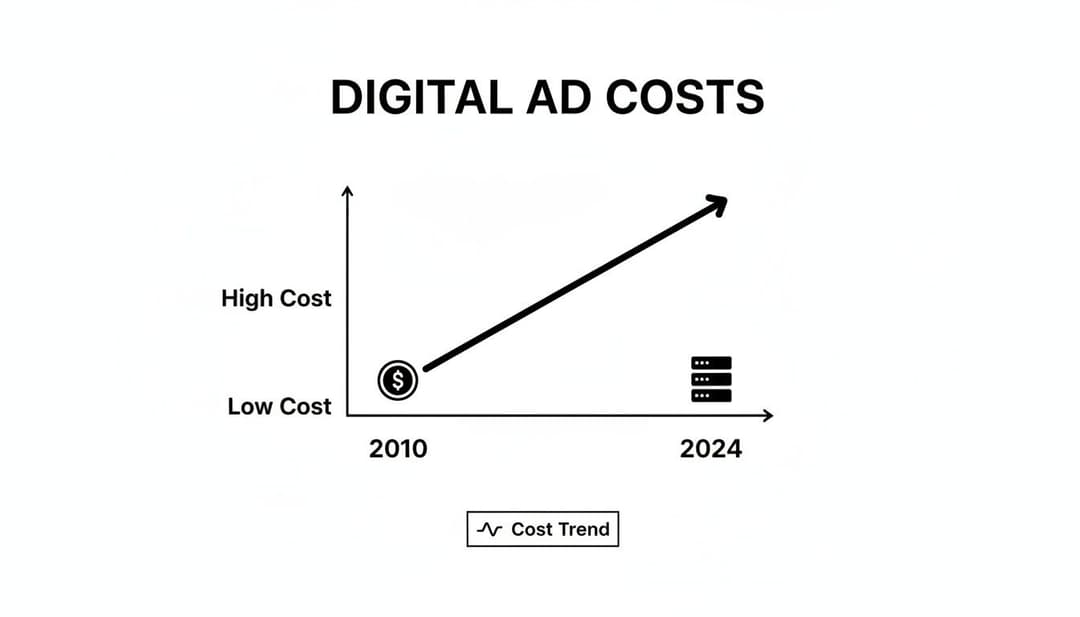
What this shows us is that the days of cheap digital reach are long gone. You have to be smarter and more efficient with your ad spend now more than ever.
To give you a better idea of what to expect, we've compiled some current benchmarks. The table below breaks down typical CPM ranges you might see across major ad platforms and within different industries.
Average CPM Benchmarks by Platform and Industry
This table provides estimated average Cost Per Thousand Impressions (CPM) across popular advertising platforms and key industries, reflecting typical market rates.
| Platform / Industry | Average CPM Range | Key Influencing Factors |
|---|---|---|
| Meta (Facebook & Instagram) | $7.00 - $15.00 | High competition, audience granularity, ad placement (e.g., Stories vs. Feed) |
| Google Display Network | $2.00 - $4.00 | Broad reach, lower user intent, targeting precision, website quality |
| $6.59+ | Professional targeting, B2B focus, high-value audiences, job function/seniority | |
| TikTok | $10.00 (approx.) | High user engagement, younger demographic, ad format, creative performance |
| Finance & Legal | High | High customer lifetime value, intense competition for affluent clients |
| Retail & E-commerce | Medium to High | Product margins, seasonality (especially Q4), competitive landscape |
| Food & Beverage | Low to Medium | Lower price points, broad audience appeal, brand awareness goals |
Keep in mind that these are just averages. Your actual costs will swing based on a bunch of different factors, from your audience targeting to the quality of your ad creative.
Why Your Industry and the Calendar Matter So Much
The industry you're in has a massive impact on your ad costs. Think about it: sectors with high-value customers, like finance or legal services, are always going to see higher CPMs. A company in one of those fields might pay upwards of $3.89 per click, which naturally pushes their impression costs way up compared to a local restaurant or grocery brand.
Seasonality creates predictable price swings, too, and the most dramatic example is the fourth quarter (Q4).
During peak shopping seasons like Black Friday and Cyber Monday, advertising costs can easily double or even triple. This happens because every e-commerce and retail brand floods the ad auctions, all bidding for the same holiday shoppers' attention.
This trend isn't new, but it's getting more intense. Social media CPMs have been on a steady climb. One industry tracker showed an average of $6.80 in February, which was up from $6.01 in January and hit a peak of $11.84 by September. This upward trend gets even more pronounced during Q4, where December CPMs hit $8.85.
The competition among DTC marketers, e-commerce brands, and agencies fighting for prime real estate in user feeds is fierce. For context, the global social media CPM in Q4 of the previous year was $6.06. That figure has since ballooned, partly because privacy changes have made targeting less precise, forcing advertisers to bid higher for quality impressions.
Understanding these benchmarks is your first step. To dig deeper, check out our detailed analysis of the average cost per impression. This knowledge helps you anticipate your budget needs and figure out if your campaign performance is on par with industry standards or if it's time to start optimizing.
Key Factors That Influence Your CPM

Your cost per impression average isn't some random number an ad platform pulls out of thin air. It’s the result of a live, dynamic auction where a handful of key variables are constantly duking it out. Getting a handle on these drivers is the first real step toward taming your ad spend.
Think of it like bidding on a house. The final price tag is never just about the house itself. It’s about the neighborhood (your audience), the home's condition (ad quality), how many other buyers are at the table (competition), and even the time of year (seasonality). Your CPM works almost exactly the same way.
Let’s pull back the curtain on the five core factors that really move the needle on the price you pay for every thousand eyeballs.
Audience Targeting and Competition
Who you’re trying to reach is, without a doubt, the single biggest factor dictating your CPM. The more valuable and specific your target audience, the more you should expect to pay. It’s a classic case of supply and demand.
Say you’re selling high-end golf clubs. If you target users interested in "luxury goods," "golf," and who fall into a high-income bracket, you're stepping into a very competitive auction. You're not just bidding against other golf brands; you're up against every premium company trying to reach that same affluent group. That fierce competition drives the cost per impression average through the roof.
On the flip side, a fast-food chain targeting a massive demographic like "adults aged 18-49" in a major city will probably enjoy a much lower CPM. The audience pool is huge, meaning there’s far less of a dogfight for each individual impression.
The rule of thumb is simple: the narrower and more sought-after your audience, the higher the price. A highly refined audience can be a goldmine for conversions, but you'll pay a premium for that visibility.
Ad Quality and Relevance Score
Ad platforms are obsessed with user experience. They want to show people content they actually find interesting, not annoying ads they’ll rush to close. To make this happen, they reward advertisers who create high-quality, engaging ads with lower costs, often measured by a "quality score" or "relevance score."
This score isn't arbitrary. It’s a blend of a few key things:
- Estimated Engagement Rate: How likely are people to click, like, or comment on your ad compared to all the other ads targeting the same audience?
- Ad Relevance: Does your ad’s message, visuals, and landing page actually make sense for the people you’re targeting?
- User Feedback: Are people actively hiding or reporting your ad? Nothing jacks up your costs faster than negative feedback.
An ad with a high relevance score is essentially getting a discount from the platform. It’s a signal that your creative is a great match for the audience, which makes for a better experience all around. This is precisely why relentless creative testing is one of the most powerful levers you can pull to lower your CPM.
Bidding Strategy and Campaign Objective
How you tell the ad platform to spend your money has a direct impact on your costs. For instance, choosing a "brand awareness" or "reach" objective often leads to a lower CPM. Why? Because you’re telling the platform its only job is to get your ad in front of as many people as possible for the cheapest price.
But if you select a "conversions" or "lead generation" objective, the algorithm starts thinking differently. It begins to hunt for users within your target audience who are most likely to actually take that action. These high-intent users are more valuable, and therefore, the impressions needed to reach them cost more. The average CPC for a conversion campaign can run anywhere from $0.42 to $3.89, which naturally inflates the CPM for those highly-coveted placements.
Your bidding strategy matters, too. An "automatic" or "lowest cost" bid lets the platform find the cheapest impressions available. A manual bid cap, on the other hand, gives you more direct control over costs but might limit your reach if your bid is too low.
Ad Placement Choices
Not all ad real estate is created equal. An impression in the main Instagram Feed is like a storefront on Fifth Avenue—it's prime, and it’s expensive. An impression in the Facebook Audience Network or a Messenger ad is more like a billboard on a side street—still visible, but much cheaper.
Here’s a quick way to think about it:
- Premium Placements: Instagram Feed, Facebook Feed, Instagram Stories. These are highly visible, highly competitive, and come with higher CPMs.
- Standard Placements: Facebook Marketplace, Video Feeds. These tend to offer a good middle ground between visibility and cost.
- Lower-Cost Placements: Audience Network, Messenger Ads. These can get you cheap reach, but engagement might be lower.
When you choose "Automatic Placements," you’re letting the platform’s algorithm figure out the most cost-effective mix to hit your goal. If you manually restrict your ads to only the most premium spots, you're pretty much guaranteed to see your cost per impression average skyrocket.
How Programmatic Bidding Reveals The Wild Swings in CPM
While platforms like Meta run their own internal ad auctions, the world of programmatic advertising gives us a raw, unfiltered look at just how volatile the cost per impression average can get. Think of it as the stock market for digital ad space, where prices for the exact same digital real estate can spike or plummet in the blink of an eye.
Programmatic advertising runs on high-speed, automated auctions known as real-time bidding (RTB). Here’s how it works: every single time a user with a specific profile loads a webpage with ad space, an auction happens in milliseconds. Advertisers from all over the web place bids to show their ad to that specific user, at that specific moment.
This process uncovers the true, moment-to-moment value of an impression. An ad space might be worth pennies when shown to a casual browser, but it could command hundreds of dollars when shown to someone who just added a high-ticket item to their online shopping cart.
The Wild West of Real-Time Bidding
The sheer range of bids in these auctions is staggering, and it's a perfect illustration of raw supply and demand. Data from programmatic exchanges paints a vivid picture of just how extreme things can get.
For example, one study of over 10,000 auctions found bids ranging from a minuscule $0.01 to a jaw-dropping $113.32 for the same thousand impressions. In this high-stakes environment, major players like Google averaged a $37.60 CPM, while other large companies bid closer to the $11-$12 range to reach valuable audiences. The data clearly shows how fiercely e-commerce and DTC brands compete for premium spots on high-value websites. You can discover more insights about these CPM bid fluctuations to see the full scope.
This variance isn't just numbers on a page; it reveals that a staggering 95% of bids lose the auction. This intense competition is the engine driving the volatility of the cost per impression average.
The lesson from programmatic bidding is universal: the value of an impression is not fixed. It is determined by the perceived value of the audience seeing it, and the intensity of the competition to reach them at that exact moment.
Why This Matters for Every Marketer
Even if you never touch a programmatic campaign, this dynamic is humming along behind the scenes on every platform you use, from Meta to Google. The same principles that cause massive price swings in RTB auctions are influencing your costs inside those "walled garden" ecosystems, too.
Understanding this volatility brings a critical risk into focus: bidding without intelligent data is basically gambling. You could be massively overpaying for low-value impressions or, even worse, consistently losing the auctions for the high-intent audiences that actually grow your business. It also reinforces why a deep understanding of different ad models is so important, a topic we dive into in our breakdown of PPC vs. programmatic advertising.
Ultimately, this high-speed, competitive environment makes a powerful case for using smarter tools. Manual management simply can’t keep pace, which is why AI-powered platforms are becoming essential for navigating such a complex and fast-moving market.
Using AI to Lower Your Cost Per Impression Average

Let's be honest: trying to manage modern ad campaigns by hand just doesn't cut it anymore. Manually testing a few ad variations, tweaking bids, and shifting budgets around is like trying to direct rush-hour traffic with a single stop sign. It's slow, inefficient, and you're bound to get overwhelmed. This is exactly where AI-driven platforms come in to solve the problem of rising ad costs.
Imagine going from launching a handful of ads to deploying hundreds of creative, copy, and audience variations all at once. That's the real power of using an AI platform like AdStellar. It completely automates the testing process, gathering performance data on a scale that’s simply impossible for a human to manage.
You stop relying on gut feelings and start letting real-time data make the calls. This approach hits the biggest challenges driving up your cost per impression average head-on, finding winning ad combinations faster and with far more accuracy.
Moving Beyond CPM to True Performance
One of the biggest traps performance marketers fall into is optimizing for the wrong metric. A super low CPM doesn't mean a thing if it isn't leading to sales or sign-ups. AI platforms help you reframe this by focusing on what actually matters to your business—your Return on Ad Spend (ROAS), Cost Per Acquisition (CPA), or whatever your key goal is.
The AI sifts through all the incoming data to figure out which specific ad elements are driving actual conversions. Is it a certain headline? A particular image? A unique audience segment? The system pinpoints these winners and automatically pushes your budget toward them.
An AI platform doesn't just find cheaper impressions; it finds the most valuable impressions. It pinpoints the users most likely to convert and optimizes your spend to reach them, even if it means a slightly higher CPM for a much better business outcome.
While you work on bringing down your CPM, it's just as crucial to know how to increase ROAS for maximum profitability. This double-sided focus on cost efficiency and real return is where AI shines, building a much more sustainable growth engine for your campaigns.
How AdStellar Automates Optimization
Platforms like AdStellar are built to take the most complex and time-sucking parts of campaign management off your plate, which naturally leads to a lower cost per impression average over time.
Here’s a look at how it works:
- Bulk Ad Creation: You can generate hundreds of ad variations in minutes by mixing and matching different creative assets, headlines, and copy. This lets you test way more ideas about what actually connects with your audience.
- AI-Powered Insights: The system pulls performance data directly from your ad account and ranks every single creative, audience, and message against your main goal (like CPA). All the guesswork is gone, replaced by a clear view of what’s working.
- Automated Scaling: Once the AI spots the winning ad combinations, it automatically scales the budget for them. At the same time, it pulls spend away from the underperformers, making sure every dollar is working as hard as possible.
The key takeaway is clarity. Instead of drowning in spreadsheets, you can see at a glance which creative elements are driving results. This creates a constant cycle of testing, learning, and optimizing that consistently pushes costs down while making your campaigns more effective. To see more on this, check out our guide on applying AI for Facebook Ads to streamline your workflows.
A Few Common Questions About CPM
As you get deeper into managing ad costs, a few questions always seem to pop up. Think of this as the "what if" section, where we can tackle some of the most common points of confusion head-on. My goal here is to clear things up and give you some final, practical advice for handling your cost per impression average.
Let's dig into the questions I hear most often from marketers.
Is a Low CPM Always a Good Thing?
Not necessarily. It's tempting to celebrate a rock-bottom CPM, but it can actually be a red flag. More often than not, it means you're reaching a super broad, low-quality audience that couldn’t care less about what you're selling. They're cheap to reach for a reason—they'll never convert.
The smarter play is to balance your CPM with metrics that actually grow the business. A slightly higher CPM that gets your ads in front of a highly relevant, engaged audience is almost always more valuable than a dirt-cheap one that just burns through your budget with zero results.
Remember, the goal isn't just to get cheap impressions; it's to get valuable impressions. Keep your eyes on the real prize: metrics like Return on Ad Spend (ROAS) and Cost Per Acquisition (CPA). That's where you'll see the true impact of your campaigns.
How Can I Quickly Diagnose Why My CPM Is So High?
If your costs are suddenly spiking, don't panic. You can usually figure out what’s wrong by looking at three key areas of your campaign. This little audit will help you pinpoint the cause of an inflated cost per impression average and get you back on track.
Start your investigation here:
- Audience Targeting: Is your audience too small or stuck in a super competitive niche? Getting too specific with targeting can send auction prices through the roof. Try carefully broadening your criteria or testing some lookalike audiences to find a more cost-effective group.
- Ad Creative: Are your ads boring? Platforms penalize irrelevant or low-engagement ads by making them more expensive to run. You need to systematically test new images, videos, and headlines to find what actually grabs people's attention and boosts your engagement rates.
- Ad Placements: Did you manually limit your ads to only the most expensive spots, like the main Instagram feed? Switch over to automatic placements. This lets the platform's algorithm do the heavy lifting, finding cheaper, high-performing impressions across its entire network for you.
How Does Creative Testing Impact CPM?
Creative testing is, without a doubt, the most powerful tool you have for slashing your CPM. Ad platforms are built to reward content that people actually like. When your ads are engaging, you get better performance in the ad auction, which directly translates to cheaper impressions.
By systematically testing different visuals, headlines, and calls-to-action, you stop guessing and start learning what really connects with your audience. This data-driven approach is the fastest way to predictable cost reduction. This is also where AI-powered tools completely change the game, letting you test hundreds of ad variations at once to find the perfect creative that delivers the lowest CPM to the highest-quality audience.
Ready to stop guessing and start optimizing? AdStellar AI automates creative testing and scales your winning ads, helping you reduce your cost per impression average while boosting ROAS. Discover how AdStellar can transform your campaigns.