Of course. Here is the rewritten section, crafted to sound like it was written by an experienced human expert, not an AI.
Yes, Facebook (Meta) ads absolutely work. But let’s be clear: their success isn’t about luck. It’s about strategy.
For businesses that truly understand the platform, Meta ads are a powerful engine for growth, consistently delivering a strong Return on Ad Spend (ROAS) and driving real, measurable conversions.
The Final Verdict on Facebook Ad Performance
When people ask if Facebook ads are still effective, the data gives a pretty resounding "yes." The platform's massive scale and proven performance metrics really settle the debate. It's less about if they work and more about how you make them work for your specific business.
A huge part of Meta's power is its sheer global footprint. With an ad reach hitting around 2.28 billion users worldwide—a figure that jumped 4.3% in the last year alone—the platform offers incredible access to major markets. This massive audience, which covers 74.3% of its monthly active users, translates directly into business results. On average, advertisers see a ROAS of 2.79, meaning they earn nearly $2.80 for every dollar spent. For a deeper dive, you can explore more detailed Facebook ad statistics on Uproas.io to see the full picture.
Key Performance Benchmarks
To really get a grip on performance, you have to look at the key metrics that successful marketers live and breathe. These benchmarks shift depending on what you’re trying to achieve—whether it's getting your name out there, generating leads, or closing sales.
Knowing what a "good" result looks like is the first step toward optimizing your own campaigns and figuring out why something isn't working.
The core of successful Facebook advertising isn't just launching campaigns; it's about understanding the numbers. A strong grasp of metrics like ROAS, CTR, and conversion rates separates a thriving ad account from one that's just burning cash.
This understanding is what lets you set realistic goals and make smart, informed decisions. An e-commerce brand will measure success differently than a local service business, but both need a data-driven framework to win.
To give you a clearer idea, here’s a quick look at what success can look like across different campaign goals. Think of this table as a handy guidepost for your own strategy.
Facebook Ads Performance at a Glance
This table summarizes key performance benchmarks for different Facebook ad campaign objectives, offering a baseline to compare your own results against.
| Campaign Objective | Average CTR | Average ROAS | Best For |
|---|---|---|---|
| Brand Awareness | 1.5% - 2.5% | N/A | Reaching new audiences and building brand recognition. |
| Lead Generation | 1.0% - 1.5% | Varies | Capturing contact information for future marketing. |
| Conversions (Sales) | 0.8% - 1.2% | 4:1+ | Driving direct sales and e-commerce purchases. |
| App Installs | 0.5% - 1.0% | Varies | Encouraging users to download and install a mobile app. |
Ultimately, these numbers aren't just stats; they're the language of the platform. Learning to speak it is how you turn your ad spend into predictable revenue.
How the Meta Advertising Engine Actually Works
To really get why Facebook ads are so effective, you need a peek under the hood. Think of Meta's ad algorithm as a hyper-intelligent matchmaker. Its entire job is to connect your product with its perfect customer from a crowd of nearly three billion people—and do it in a fraction of a second.
This isn't just random guesswork. It’s a seriously sophisticated system built on three core pillars: laser-focused audience targeting, a huge arsenal of ad formats, and a smart auction that rewards quality over just having the biggest budget. It’s a world away from simply "boosting" a post; you’re tapping into a powerful conversion engine.
This map shows how Meta's massive global reach, potential for high returns, and knack for driving conversions are all intertwined.
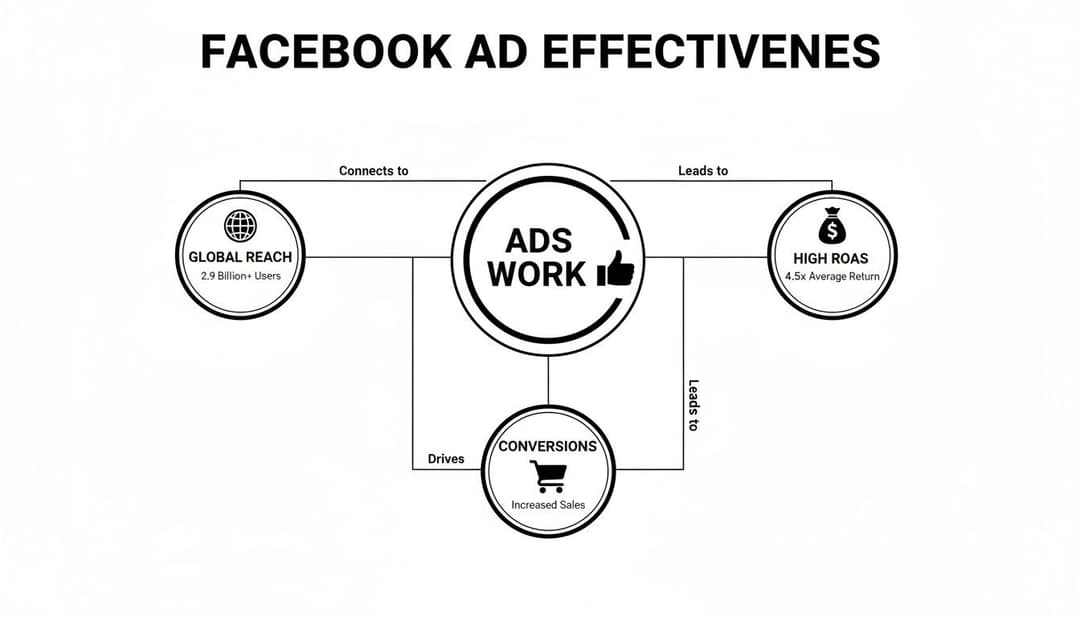
The big takeaway? Success isn't about mastering just one of these elements. It's about how they all work together to create an environment where ads just flat-out perform.
The Power of Precision Targeting
The foundation of Meta's advertising muscle is its deep understanding of its users. The platform collects trillions of data points from user activity, which lets advertisers build incredibly specific audiences.
We're talking way beyond simple demographics like age and location. You can target users based on:
- Interests: What pages they like, topics they engage with, or hobbies they follow. Think "organic skincare" enthusiasts or "marathon running" fanatics.
- Behaviors: Actions they take both on and off the platform, like online shopping habits, how often they travel, or even the type of phone they use.
- Custom Audiences: You can upload your own customer lists to retarget people who already know you or build powerful Lookalike Audiences to find new people who are just like your best customers.
This level of detail means you aren't just shouting into the void. You're putting your message right in front of the people most likely to actually care, which dramatically boosts your odds of getting a click, a lead, or a sale.
Meta's targeting capabilities transform advertising from a speculative expense into a calculated investment. You’re not paying to reach everyone; you’re paying to reach the right one.
The Ad Auction Rewards Relevance
A lot of people think the advertiser with the deepest pockets always wins the best ad spot. Not true. Meta's ad auction is designed more like a meritocracy. Your bid matters, sure, but it’s only one piece of the puzzle.
Meta calculates a Total Value for every ad competing in the auction. This value is determined by three main things:
- Your Bid: The maximum amount you're willing to pay for your desired outcome.
- Estimated Action Rates: How likely the algorithm thinks a user is to take the action you want (like a click or purchase), based on your ad's history and quality.
- Ad Quality: A score based on how relevant and engaging your ad creative is. High-quality ads with low negative feedback get a major boost.
What this system means is that a super relevant, engaging ad with a lower bid can actually beat out a boring, irrelevant ad with a higher bid. Meta wants to show users content they'll enjoy, so it rewards advertisers who create good experiences. This focus on quality is a huge reason why well-crafted Facebook adverts work so well for businesses of all sizes.
Machine Learning and Optimization
Finally, the whole system is fueled by a continuous machine-learning feedback loop. As soon as you launch a campaign, the algorithm kicks into a "learning phase." During this time, it's actively testing your ad with different slices of your target audience to figure out who responds best.
It gathers data on clicks, conversions, and engagement, constantly tweaking its delivery to find the most cost-effective way to hit your goal. This is where tracking tools like the Meta Pixel become absolutely critical. If you want to dive deeper into this topic, you can learn more about what the Facebook Pixel is in our detailed guide.
The more conversion data you feed the algorithm, the smarter it gets. Over time, it learns to predict who is most likely to buy your product and prioritizes showing them your ads. It essentially automates the optimization process for you, driving down your acquisition costs along the way.
Decoding the True Cost and ROI of Your Ads
Beyond impressive reach and engagement numbers, the ultimate question for any business is simple: are my ads actually making money? Answering this means getting crystal clear on the financial side of Facebook advertising. We need to move past vanity metrics and focus on pure, unadulterated profitability.
Think of it like investing in real estate. You wouldn't just count how many people walk past a property; you'd calculate the rental income versus the mortgage and upkeep costs. In advertising, we do the same thing with a few key metrics. The most fundamental are Cost-Per-Click (CPC), which tells you what you pay for each click, and Cost-Per-Action (CPA), which measures the cost of a specific outcome, like a lead or a sale.
These numbers give you an immediate pulse on your campaign's financial health. Are you paying too much for a click? Is the cost to acquire a new customer sustainable? Nailing down these baseline costs is the first step toward financial clarity.
Putting Facebook Ad Costs in Context
So, are Facebook ads expensive? It's all relative, of course, but the data shows they are remarkably cost-efficient. The powerful blend of affordability and conversion power is one of the most compelling pieces of evidence that Facebook adverts work.
The average CPC on Facebook hovers between $1.06 and $1.72. That’s a bargain compared to the average $3.35 you might pay on the Instagram Feed. Even better, conversion rates are strong, ranging from 2% to 14% across different industries.
For e-commerce and B2B SaaS teams chasing profitability, the median purchase conversion rate from a click is a solid 2.5%. This often climbs above 4% with well-tuned retargeting and high-quality landing pages. And for advertisers on a tighter budget, placements like Reels can offer 10-30% cheaper CPMs (cost per 1,000 impressions) than the main Feed, giving you a cost-effective playground for testing new creative. For a deeper dive, WebFX offers a comprehensive breakdown of Meta's performance metrics.
This efficiency makes Facebook a powerful channel for businesses of all sizes, allowing smaller brands to compete without needing a massive war chest.
The Ultimate Metric: Return on Ad Spend
While CPC and CPA are crucial for diagnosing campaign health, the ultimate measure of success is Return on Ad Spend (ROAS). This single metric tells you exactly how much revenue you generate for every dollar you put into your ads.
The formula couldn't be simpler: Total Revenue from Ads / Total Ad Spend = ROAS.
A 4x ROAS, for example, means you're generating $4 in revenue for every $1 you spend. This number cuts straight through the noise and tells you if your advertising is a profitable investment or a financial drain.
Let's say a small online retailer spends $2,000 on a Facebook campaign and tracks $10,000 in sales directly from those ads. Their ROAS is an impressive 5x ($10,000 / $2,000). This tangible result moves the conversation from "Are people seeing my ads?" to "How much money did my ads make?" For a complete walkthrough, check out our guide on how to calculate Return on Ad Spend.
What Is a Good ROAS for Your Business?
There’s no magic number here. A "good" ROAS is entirely dependent on your business model, profit margins, and overall financial goals. What's fantastic for one company might be a disaster for another.
Here’s a rough guide for different business types:
- E-commerce Brands: For most direct-to-consumer brands with physical product costs, a 4x ROAS is often the gold standard. This typically covers the cost of goods, ad spend, and other operational overhead, leaving a healthy profit.
- SaaS Companies: A Software-as-a-Service business might be thrilled with a 2x or 3x ROAS on the initial subscription. Why? Because they're playing the long game with Lifetime Value (LTV). A new customer might only bring in $50 on their first purchase (a 2.5x ROAS on a $20 ad spend), but if they remain a subscriber for two years, their total value skyrockets.
- High-Margin Businesses: Companies selling digital products, online courses, or luxury goods can thrive on a lower ROAS. A 3x ROAS might be incredibly profitable if their cost of delivery is close to zero.
Ultimately, defining success starts with knowing your break-even ROAS—the point at which your ad spend is fully covered by the revenue it generates. Anything above that is profit. Once you know that number, you can set realistic goals and confidently scale the campaigns that prove their financial worth.
Common Reasons Facebook Ad Campaigns Fail
When advertisers tell me Facebook ads don't work, my first thought is almost never that the platform is broken. More often than not, the real problem is a disconnect in their strategy. A campaign can feel like a money pit when the core pieces aren’t working together, but here's the good news: these issues are almost always fixable.
Seeing poor results isn't a sign to give up on Meta. It's a signal flare telling you that a specific part of your approach—your creative, your audience, or what happens after the click—needs a tune-up. By figuring out where the friction is, you can turn a failing campaign into one that actually drives results.

Uninspired Creative and Weak Messaging
In the endless scroll of a social media feed, your ad has maybe three seconds to grab someone's attention. If your visuals and copy are generic, boring, or just plain confusing, people will scroll right past without a second thought. This is hands-down one of the most common reasons campaigns completely flatline.
Your ad has one job: to instantly answer the user's silent question, "What's in it for me?"
Some of the most frequent creative mistakes include:
- Low-Quality Imagery: Using blurry, unappealing, or generic stock photos that scream "I'm an ad!" instead of looking authentic.
- Vague Copy: Writing headlines and text that don't clearly spell out the benefit or solve a real problem for the viewer.
- No Clear Call-to-Action (CTA): Leaving people guessing what to do next. You have to tell them exactly what you want, whether it’s "Shop Now," "Learn More," or "Sign Up."
Think of your creative as your frontline sales pitch. Without a strong one, even the most perfectly targeted campaign is set up to fail.
Mismatched Audience Targeting
Another classic mistake is putting a great offer in front of the wrong people. This usually goes wrong in one of two ways: you either target way too broadly or you get way too specific. Casting a massive net might feel safe, but showing ads for high-end hiking gear to people who’ve never shown an ounce of interest in the outdoors is just burning cash.
On the flip side, an audience that's too niche can send your costs through the roof and choke your campaign's ability to scale. The sweet spot is finding a relevant audience that's big enough for Meta's algorithm to work its magic and find you customers efficiently.
The goal isn't just to reach people; it's to reach the right people. A brilliant ad shown to the wrong audience will always fail, while a decent ad shown to the perfect audience can deliver incredible results.
If this sounds like it might be your problem, it's worth taking a deeper dive to learn more about why your Facebook ads are not delivering and how you can start troubleshooting your targeting.
Poor Post-Click Experience
Your job isn't over once you get the click. Far from it. The experience on your landing page is just as critical to your success. If someone clicks on an exciting ad only to be dumped on a slow, confusing, or broken website, they're going to bounce—fast.
The ad is the promise, and the landing page is the follow-through. A disconnect between the two erodes trust and absolutely tanks your conversion rates. This covers everything from page load speed—every second really does count—to making sure the page actually looks and works great on a phone.
Even with challenges like iOS privacy changes, Meta's platform is constantly getting smarter. Recent data shows conversion-focused campaigns have actually boosted their click-through rate by +0.14% to 1.38%, largely thanks to Advantage+ updates and the all-important Conversions API (CAPI). And with mobile CTR at 1.34% versus desktop's 1.01%, a killer mobile experience isn't just nice to have; it's essential. You can dig into more current Facebook ad benchmarks from Focus Digital to see how your own numbers compare.
Actionable Strategies to Maximize Your Ad Performance
Knowing why a campaign went sideways is one thing. Turning that knowledge into a profitable playbook is another game entirely. Success on Meta isn't about some secret hack you stumble upon; it’s about systematically nailing the fundamentals, day in and day out.
We're going to focus on the four pillars that truly move the needle: audiences, creative, bidding, and measurement. These are the levers the best advertisers are constantly pulling to drive down their acquisition costs and boost their Return on Ad Spend (ROAS). Get these right, and you've built a repeatable engine for growth.
Master Your Audience Targeting
Your targeting is the bedrock of your entire campaign. You could have the most amazing ad in the world, but if it's shown to the wrong people, it's just noise. The goal is to find that perfect balance between precision and scale—giving Meta's algorithm enough room to breathe and find customers you didn't even know you had.
It's time to move past basic interest targeting and start using Meta's more powerful tools.
- Lookalike Audiences: This is your bread and butter. You upload a list of your best customers, and Meta goes out and finds new people who share their key characteristics. Start with a tight 1% Lookalike for the highest similarity, and then broaden out to 3-5% as you're ready to scale.
- Advantage+ Audiences: Think of this as AI-powered expansion. You give Meta a few starting suggestions (like past purchasers or a core interest group), and it gets the freedom to hunt for conversions beyond those initial boundaries. It’s the perfect way to broaden your reach without throwing relevance out the window.
The key here is to let the data do the talking. Constantly test different Lookalike sources and Advantage+ suggestions. You'll quickly discover which pockets of users bring the most value to your business.
Think of audience targeting like fishing. You can cast a single line and hope for a bite, or you can use sophisticated sonar (your customer data) to find exactly where the fish are schooling. Lookalikes and Advantage+ are your sonar.
Create Compelling Ad Creative
In a feed that never stops scrolling, your ad creative has about three seconds to do its job. It has to stop the thumb, spark an emotional connection, and make your value proposition crystal clear. The days of finding one "perfect" ad and running it into the ground are long gone. Today's winners operate with a high-tempo testing mindset, constantly looking for new angles that click with their audience.
Your creative strategy should be a healthy mix of different formats and styles. You never know what's going to hit.
- Rigorous A/B Testing: Stop guessing. Start testing. Pit different headlines, images, videos, and calls-to-action against each other. The trick is to isolate one variable at a time. For instance, test a clean product shot against a lifestyle image, but keep all the copy identical.
- User-Generated Content (UGC): Ads that feel like real posts from real people often crush polished, studio-shot creative. We're talking testimonials, unboxing videos, and customer photos. They build instant trust and social proof like nothing else.
- Video First: You have to prioritize short-form, vertical video (9:16 aspect ratio) for placements like Reels and Stories. These formats are built for native, engaging content that doesn't scream "I'm an ad!"
When you embrace a testing culture, creative stops being a game of chance and becomes a data-driven process for figuring out what truly motivates people to act.
Implement Smart Bidding Strategies
Your bidding strategy is what tells Meta how to spend your money. It's the throttle on your campaign engine and is absolutely critical for managing costs. While the default "Lowest Cost" setting can be a decent place to start, advanced strategies give you way more control over your profitability and stability.
Here are a couple of goal-based options to consider:
- Cost Per Result Goal: This tells Meta to aim for a specific average cost per conversion. It’s perfect for keeping your CPA stable as you start to crank up the ad spend.
- ROAS Goal: For any e-commerce business, this is the holy grail. You can set a minimum ROAS target (say, 3.5x), and Meta’s algorithm will only bid on users who are likely to hit that profitability threshold.
For a deeper dive into more advanced techniques, our guide on proven Facebook ad strategies breaks down how to get the most out of your campaigns. At the end of the day, your choice has to align with your business goals—whether that's getting the maximum number of leads or ensuring every single dollar you spend comes back profitable.
Ensure Accurate Measurement and Attribution
Here’s a hard truth: you can't optimize what you can't measure. In a post-iOS 14 world, just relying on the Meta Pixel isn't going to cut it anymore. It leaves you with blind spots. To make truly informed decisions, you have to close that data gap.
Implementing the Conversions API (CAPI) is non-negotiable for any serious advertiser today. CAPI sends conversion data directly from your server to Meta's, creating a stable, reliable connection that isn't derailed by browser-based tracking blockers. This feeds the algorithm higher-quality data, which leads to better optimization and reporting you can actually trust. When you pair this with your own first-party data, you build a resilient measurement foundation that powers smarter, more profitable advertising.
How to Accelerate Success with AI Automation
Even with the best strategies, the sheer volume of manual work is often the biggest bottleneck to growth. Testing every creative, audience, and copy variation is incredibly time-consuming. It’s a reality that severely limits how fast you can find what works and scale it.
This is where AI-powered platforms are changing the game, turning a complex, manual grind into a streamlined, data-driven operation.
The goal of AI isn't to replace a skilled marketer but to supercharge their abilities. Think of it as giving a talented chef an entire team of prep cooks. The chef still directs the vision, but the tedious chopping and dicing are handled automatically. This frees them up to focus on creating the perfect dish. In the same way, AI tools handle the heavy lifting of ad creation and analysis.
Automating the Creative Testing Process
Modern AI platforms like AdStellar AI are built to break through that manual bottleneck. Instead of building ads one by one, you can generate hundreds of creative, copy, and audience combinations in minutes. With a single click, the platform pushes them live to Meta, allowing you to test at a scale that would be completely impossible by hand.
This automated approach connects directly back to the strategies we've been talking about. To really speed things up, you can pair this with the best AI tools for fashion brands to streamline creative production itself. It’s all about executing a sophisticated, high-performance ad account without the crippling manual overhead.

This kind of centralized dashboard allows media buyers to replace tedious manual setup with repeatable, data-backed execution and clarity.
From Data Analysis to Predictive Insights
The real power of AI emerges when it starts learning from your historical performance data. By analyzing past campaigns, these platforms can begin to predict which new combinations of creative and audiences are most likely to become winners.
This transforms your testing from guesswork into a calculated science. An AI platform can spot patterns a human might easily miss, such as:
- Top-Performing Headlines: Pinpointing specific phrases that consistently drive the highest click-through rates.
- Winning Visual Elements: Recognizing which types of images or video styles resonate best with your target demographic.
- Audience Overlaps: Finding high-value audience segments that deliver the best ROAS.
Automation is the key to scaling success. It allows you to take a winning formula and replicate it 10x faster, turning a single successful ad into a portfolio of high-performing campaigns. This is how you ensure Facebook adverts work consistently and profitably.
By letting AI handle the grunt work, you can shift your focus from tedious campaign setup to high-level strategy. Instead of getting bogged down in the mechanics, you can concentrate on interpreting the insights and making the smart, creative decisions that drive real growth.
For those looking to go deeper on this, our guide to using AI for Facebook ads offers a more comprehensive look at these powerful tools.
Got Questions? We've Got Answers.
Even the most seasoned advertisers run into questions when managing their campaigns. Let's tackle some of the most common ones that pop up when you're trying to figure out if Facebook ads really work and how to get the most bang for your buck.
How Much Should I Spend on Facebook Ads to See Results?
There's no single magic number here, but there is a solid rule of thumb: budget enough to get 50-100 key conversion events per week. This is the sweet spot. It gives Meta's algorithm enough data to get out of its initial "learning phase" and start making smart decisions about who sees your ads.
So, what does that look like in practice? If your target cost per acquisition (CPA) is $40, you'll want a weekly budget somewhere in the $2,000-$4,000 range. If you're not ready for that level of investment, starting with a smaller daily budget of $25-$50 can still give you some great early feedback on which audiences and creatives are hitting the mark before you scale up.
Are Facebook Ads Still Worth It After the iOS 14 Update?
Absolutely, but the game has changed. The iOS 14 update definitely threw a wrench in some of the old tracking methods, but smart advertisers have adapted. The key is Meta's Conversions API (CAPI), which creates a reliable server-to-server connection to help fill in the data gaps.
Today's winning strategy combines CAPI with broader audience targeting, letting you lean on Meta's powerful AI to find your customers for you. The focus has shifted toward building strong first-party data lists and, more than ever, letting knockout creative do the heavy lifting. For those who adjust, the platform is still a powerhouse for driving conversions.
What Is a Good ROAS for Facebook Ads?
A "good" Return On Ad Spend (ROAS) really depends on your business's profit margins and what you're trying to achieve. As a general benchmark, a 4:1 ROAS—earning $4 in revenue for every $1 spent—is often seen as a sign of a healthy, successful campaign.
But context is everything. A company with high-margin products might be thrilled with a 3:1 ROAS. On the other hand, a business focused on acquiring customers with a high lifetime value (LTV) might be perfectly happy with a 2:1 ROAS on the first purchase, knowing they'll make their money back over time. The most important thing is to know your own break-even point and set your goals from there.
Ready to stop guessing and start scaling? AdStellar AI takes the manual work out of building and testing your ads. Our platform uses AI to pinpoint your winning campaigns, helping you launch, test, and find what works 10x faster. See how AdStellar AI can transform your ad performance.