You’re probably in one of two spots.
You’re hiring because your Meta account is spending, your creative looks polished, and the ads still don’t pull their weight. Or you’re the writer trying to move from “I can write decent ads” to “I can influence account performance.”
Both paths run into the same reality. A facebook ad copywriter isn’t just someone who writes catchy lines. The role sits at the point where customer research, offer clarity, testing discipline, and speed of iteration all collide. That’s why average writers produce “good sounding” ads, while strong ones produce usable hypotheses, cleaner tests, and messages that survive contact with the feed.
I’ve hired copywriters for in-house teams, agencies, and growth-stage brands. The pattern is consistent. The best ones don’t obsess over clever phrasing first. They find the right angle, write to the right segment, and give the media team options that can be tested without muddying the signal.
Why Great Ad Copy Is Your Biggest Competitive Edge
A facebook campaign can fail even when the account setup looks fine.
The audience is built correctly. The creative format fits the placement. The offer is solid enough to sell. But the copy doesn’t create enough curiosity to earn the click, and it doesn’t create enough clarity to finish the conversion.
That’s the hidden tax of weak messaging.
In 2025, average Facebook ad CTR across industries sits at 1.44%, while top-performing campaigns reach 2.5% or higher. Average conversion rates sit at 9.21%, with elite campaigns reaching 12%+. Median CPC is $0.54, and optimized ads can get down to $0.30 to $0.40, according to these Facebook ad benchmarks. Those aren’t just media-buying metrics. They’re also copy metrics.
A skilled writer changes what happens before the click and after it. They sharpen the promise, remove friction, and help the audience self-identify faster.
Practical rule: If people see the ad and don’t understand who it’s for, what problem it solves, and why they should care now, the media team has to fight uphill.
I’ve seen plenty of brands blame targeting when the issue was message fit. Generic copy says the same thing every competitor says. It leans on features, padded wording, and soft calls to action. Strong copy gets specific. It names the pain, frames the payoff, and gives the click a job to do.
That’s why copy is often the most impactful variable in the early life of a campaign. You can read more on what separates weak messaging from persuasive messaging in this breakdown of great advertising copy.
When your ads compete in a feed used by billions of people, small improvements aren’t small in practice. They decide whether a campaign stalls, stabilizes, or scales.
Defining the Modern Facebook Ad Copywriter Role
Most hiring managers define the role too narrowly.
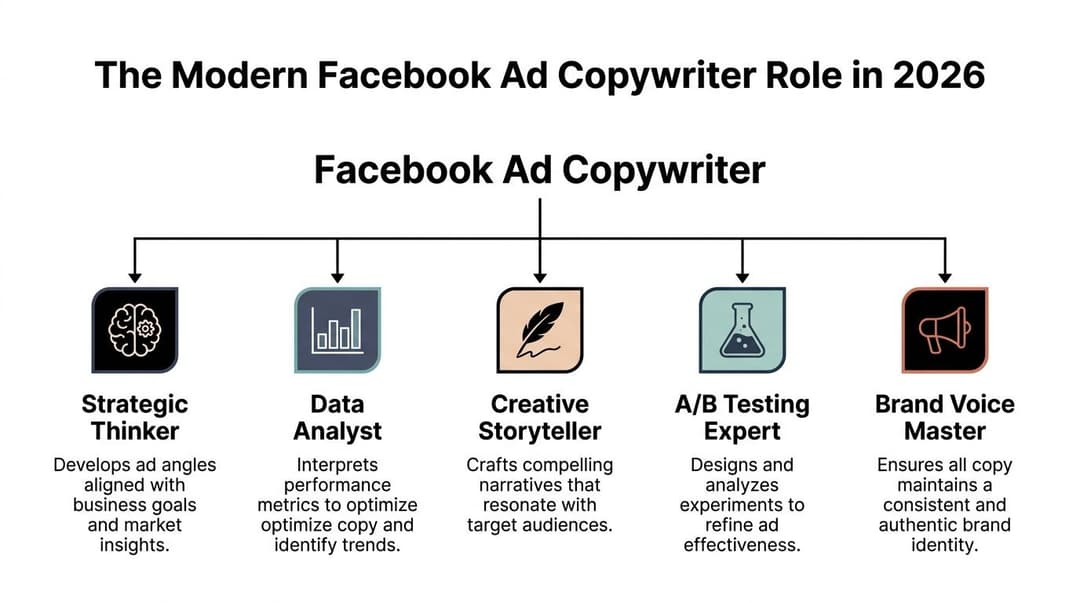
They ask for someone who can write hooks, headlines, and calls to action. That’s part of the job, but it’s not the role. A modern facebook ad copywriter is closer to a creative strategist with direct response instincts.
What the role actually includes
A strong hire usually operates across five lanes:
| Skill area | What good looks like |
|---|---|
| Strategy | Connects copy angles to business goals, funnel stage, and audience maturity |
| Research | Pulls language from reviews, sales calls, surveys, support tickets, and competitor ads |
| Writing | Produces clear, native-to-platform copy in multiple lengths and tones |
| Testing | Structures copy variants so the team can isolate message performance |
| Collaboration | Works with designers, media buyers, founders, and product marketers without losing the thread |
That mix matters because Facebook ad performance rarely comes from wording alone. It comes from angle selection.
One of the most overlooked findings in ad creative work is that persona-driven ideation often matters more than production polish. In one documented case, an underserved persona that wasn’t even a strategic focus became three of the top four performing ads because the angle was novel to the account, as discussed in this persona-focused ad creative example.youtube.com/watch?v=Ugd7a2sPgZk).
That single observation explains why some copywriters outperform others with less “creative flair.” They see audience gaps before they write a line.
Junior writer versus growth partner
A junior writer usually does this well:
- Follows formulas: They can use PAS, benefit-led hooks, and testimonial structures.
- Matches tone: They can sound on-brand with enough examples.
- Produces options: They’ll give you multiple versions quickly.
That’s useful. It just won’t usually achieve new performance ceilings.
A senior writer does more:
- Finds the neglected persona: They notice who the account isn’t speaking to yet.
- Builds a testing thesis: They don’t send random lines. They explain what each variation is testing.
- Protects signal quality: They write with enough contrast between variants to help the media team learn something.
- Translates business context into creative angles: They know when the problem is awareness, skepticism, urgency, price resistance, or poor offer framing.
That distinction also helps when comparing adjacent roles. If you’re sorting out where copy ends and broader editorial work begins, this overview of content writing vs copywriting is useful because Facebook ads sit firmly in the performance end of that spectrum.
The underrated skill to hire for
Teams often overvalue verbal style and undervalue customer pattern recognition.
The writer who can pull recurring objections from support tickets and turn them into ad angles is usually worth more than the writer who produces polished prose with no strategic spine.
Look for someone who can answer questions like:
- What persona do competitors keep targeting?
- What adjacent persona is ignored?
- What does the customer call the problem before they know your product exists?
- Which claims need proof, and which just need better framing?
- What emotional state should the ad meet?
Good Facebook ad copy doesn’t start with language. It starts with deciding whose language matters.
That’s the role now. If you hire as if you only need a line writer, you’ll get line-writing output. If you hire for research, angle development, and testing judgment, you’ll get a contributor who can shape account performance.
The Hiring Playbook for Finding Top Talent
Hiring a facebook ad copywriter gets messy when the process rewards polish over thinking.
Most applicants know how to present themselves. Fewer know how to unpack a market, identify weak messaging, and create testable angles. Your hiring process has to expose the difference.
Start with the role scorecard
Before you post anything, define the actual outcomes you need.
Don’t write “seeking a talented direct response copywriter for Meta ads.” That attracts everyone and tells candidates nothing. Write the scorecard around the work.
A useful scorecard includes:
- Primary mission: Improve message-market fit across paid social creative.
- Core outputs: New angles, fresh copy variants, brief responses, testing recommendations, iteration rounds.
- Collaborators: Media buyer, designer, founder, product marketer, retention lead.
- Success signals: Better test quality, stronger briefs, clearer segmentation, more useful learning from creative cycles.
- Failure modes: Recycled angles, overlong copy, random variants, weak research, inability to take feedback.
If your team also needs campaign assembly help, not just copy, it helps to understand what a broader facebook advertising service typically covers so you don’t blend media buying and copywriting into one unrealistic hire.
Source where strategic writers actually show up
Big job boards produce volume. They don’t reliably produce fit.
Some of the best candidates come from narrower channels:
- Specialized freelance networks: Better for experienced operators than general marketplaces.
- Paid social communities: Writers who spend time around media buyers tend to understand testing reality.
- Referral chains: Good copywriters often know other good copywriters.
- LinkedIn posts and comments: Not because posting equals skill, but because strategic thinking often shows up in how someone critiques ads or discusses offers.
- Agency overflow networks: Writers who’ve done overflow work for agencies often know how to move quickly inside constraints.
The goal isn’t just to find strong writers. It’s to find people who are already close to performance conversations.
Review portfolios with the right filters
Most portfolios are weak screening tools.
A pretty swipe file, a few polished samples, and a personal website tell you very little. Ask for context around the work instead.
Look for these signals:
- They explain the audience.
- They explain the angle.
- They explain the offer.
- They show variants, not just one finished ad.
- They can discuss what they’d test next.
Red flags are easy to spot once you know them:
- Everything sounds the same: One tone across every brand.
- No audience specificity: The writing could be for anyone.
- No testing logic: Variations are cosmetic.
- No collaboration evidence: They talk like copy exists in isolation.
- Too much cleverness: The ad sounds smart but doesn’t sell a next step.
Interview for diagnosis, not charisma
A strong interview should feel like a working session.
Ask questions that force the candidate to reason under constraints. For example:
- What would you ask for before writing ads for a new product?
- How would you find the language customers already use?
- If an account has stale performance, what would you audit first in the copy?
- How do you decide when short copy beats long copy?
- What makes a copy test invalid?
- How do you write for an audience that doesn’t yet know it has the problem?
Good answers are usually concrete. They mention reviews, landing pages, call transcripts, comments, support logs, competitor ads, and creative fatigue.
Weak answers stay abstract. They talk about “storytelling” and “engagement” without tying them to an actual decision.
Use a paid audition, not a theoretical prompt
The most reliable hiring tool is a small paid test that mirrors real work.
Keep it scoped. You’re not asking for free campaign strategy. You’re checking how the person thinks, organizes research, and handles practical constraints.
A solid paid audition prompt looks like this:
You’re writing Facebook ads for a brand selling a premium product in a competitive category. You have the product page, customer reviews, three competitor examples, and a brief summary from the founder. Deliver three distinct audience angles, two ad variations per angle, and a short note explaining what each angle is trying to prove.
That format reveals a lot:
- Did they mine the source material well?
- Are the angles different?
- Do the variants preserve the same core thesis?
- Does the CTA fit the awareness level?
- Did they write platform-native copy or mini landing pages?
Here’s a simple rubric.
| Category | What you’re scoring |
|---|---|
| Research depth | Did they extract usable customer language and objections? |
| Angle quality | Are the concepts distinct and relevant? |
| Copy clarity | Is the writing direct, specific, and easy to process in-feed? |
| Testability | Can a media buyer learn something from these variants? |
| Collaboration | Did they follow instructions and explain choices clearly? |
Check how they handle feedback
A facebook ad copywriter rarely wins on first draft alone.
Give one round of feedback inside the paid test if possible. Not to get more work from them. To see if they can absorb direction without collapsing the strategy or becoming defensive.
You want someone who can do all three:
- Defend a strong idea when it matters
- Drop weak lines quickly
- Revise without losing the original angle
That combination is harder to find than writing talent.
A useful interview add-on is a short teardown video. Watch how another marketer critiques real ads, then ask the candidate where they agree or disagree.
Make the final decision like an operator
The best hire isn’t always the person with the strongest surface-level copy.
Choose the one who most clearly improves your creative system. That’s the writer who can:
- Find new personas
- Turn research into angles
- Write in multiple lengths
- Structure clean tests
- Collaborate with media and design
- Iterate without drama
If they can do that, they won’t just write ads. They’ll help your team learn faster.
Crafting a Bulletproof Creative Brief and Test Plan
Even excellent copy falls apart when the brief is vague.
Most bad briefs have the same flaw. They describe the brand, not the buying decision. A writer can’t produce strong Facebook ads from “our product is premium, and trusted by customers.”” That language is too far from the moment someone decides whether to scroll or click.

What a useful brief must contain
A creative brief for paid social should answer seven questions:
Who is this ad for
Name the persona in plain language. New buyer, returning buyer, skeptical switcher, price-sensitive shopper, problem-aware prospect, and so on.
What problem are they feeling right now
Use customer language. Not internal language.
What does the offer promise
State the concrete outcome or benefit clearly.
Why should they believe it
Include proof inputs the writer can use, such as reviews, demo points, founder credibility, or product specifics.
What tone fits the market
Direct, expert, conversational, contrarian, simple, polished.
What should be avoided
Claims you can’t support, off-brand language, overused competitor angles, legal sensitivities.
What exactly is being tested
Persona, pain point, promise, objection handling, offer framing, or CTA style.
A plug-and-play version can be as simple as this:
- Audience segment
- Awareness level
- Core pain point
- Desired outcome
- Offer details
- Reason to believe
- Voice guidance
- Competitor angle to avoid or challenge
- Placements
- Primary test hypothesis
That’s enough to anchor the writing.
Keep the brief close to real customer language
The best raw material usually comes from places marketers ignore because they aren’t “creative” sources.
Use inputs like:
- Review mining: Pull repeated phrases, not isolated compliments.
- Support tickets: Great for objection language.
- Sales call notes: Useful for hearing what buyers need clarified.
- On-site search queries: Strong for intent patterns.
- Comments and DMs: Often reveal emotional friction more clearly than polished surveys.
If the brief doesn’t contain the customer’s words, the ad usually ends up sounding like the brand talking to itself.
If you need a repeatable structure for generating test concepts from those inputs, this framework for a test for ads is a useful reference point.
Build the test plan before the writer starts
Good creative teams don’t write first and decide what the test was later.
A proven A/B testing approach starts with one framework such as Problem-Agitate-Solve, then runs it across 3 to 4 lengths. Top copy can retain a 20 to 30% CTR lift after 50+ conversions, and a common pitfall is testing too many variables at once. Sticking to copy variants only can improve testing efficiency by 15 to 25%, based on this Facebook ad creative testing guidance.
That tells you two things. First, the copywriter should write into a planned test structure. Second, the media team should protect the integrity of that structure.
A clean test matrix might look like this:
| Variable held constant | Variable changed |
|---|---|
| Audience | Copy length |
| Creative concept | Headline framing |
| CTA destination | Objection handling angle |
| Offer | Persona emphasis |
What you should not do is change the copy, image, audience, and offer in the same round and then pretend you learned something useful.
What strong teams do differently
They separate ideation from validation.
The writer proposes several message paths. The team picks one path per controlled round. Then they evaluate what happened and only expand after they’ve got a signal worth building on.
A practical workflow:
- Round one: Test angle clarity
- Round two: Test length and hook style
- Round three: Test CTA and urgency treatment
- Round four: Expand the winning thesis into more variants
That sequence keeps the account from turning into a pile of half-related ads with no learning value.
Common brief and testing mistakes
These show up constantly:
- Overstuffed briefs: Too much brand copy, not enough buyer context.
- Wish-list copy requests: Asking for witty, premium, high-converting, disruptive, playful, and authoritative at the same time.
- Weak proof inputs: No testimonials, no specifics, no reason to believe.
- Messy experiments: Too many variables changed at once.
- Premature iteration: Teams rewrite before enough data accumulates to judge the angle.
The writer can’t fix a bad system alone. But a good brief and test plan give that writer room to do high-value work.
From Great Copy to Scalable Campaigns with AI
Once a team finds a winning angle, the next bottleneck shows up fast.
It isn’t usually idea generation. It’s production. Someone has to turn one strong message into enough usable variants to test across placements, hooks, lengths, calls to action, and persona emphasis. That’s where many teams slow down.

Human strategy still comes first
AI doesn’t replace the part that matters most.
A strong facebook ad copywriter still needs to decide:
- which persona deserves focus
- which pain point is mature enough for direct framing
- which claim needs proof
- which emotional tone matches the market
- which angle is distinct enough to merit spend
That judgment is human work.
What AI can do well is take a validated direction and help operationalize it faster. That includes producing copy variations, adapting message length for placements, maintaining structure across multiple concepts, and helping teams avoid repetitive manual setup.
Where AI helps in the workflow
The useful place for AI is after the strategic choices are made and before the campaign build becomes a bottleneck.
For example, a writer may produce one solid control around a pain-point angle. From there, an AI workflow can help generate structured variants that explore:
- Hook style: question, direct statement, contrast, benefit-first
- Message depth: short, medium, longer narrative versions
- CTA framing: shop now, learn more, try it, see how it works
- Persona adaptation: beginner, switcher, skeptic, category-aware buyer
- Voice adjustment: sharper, warmer, more direct, more brand-led
That’s useful because it preserves strategic intent while expanding the testing surface.
Some teams pair that workflow with AI-powered platforms like Parakeet AI for content and workflow assistance across campaign operations. The important point isn’t the tool brand. It’s whether the tool helps the team create clean, usable outputs instead of flooding the account with low-discipline noise.
What a good AI setup looks like
A productive AI-assisted process usually works like this:
The copywriter defines the angle
They choose the persona, promise, and objection path.
The team locks the test logic
Everyone agrees on what should remain constant and what should vary.
AI generates controlled variants
Not random rewrites. Structured variants inside the agreed framework.
The team reviews and trims
Bad outputs get cut. Similar outputs get merged. Off-brand language gets fixed.
The media buyer launches cleaner tests
The account gets more volume without losing interpretability.
One platform built for that kind of workflow is what AI copywriting looks like in AdStellar. It focuses on generating and organizing ad copy variations, along with other campaign components, so teams can move from angle to launch with less manual assembly.
The trade-off most teams get wrong
Teams often swing to one of two extremes.
One group stays fully manual and burns time on repetitive variant production. The other group lets AI generate too much, too loosely, with no strategic gatekeeping. Both approaches create waste.
The better model is narrow and disciplined. The copywriter remains accountable for research, message selection, and quality control. AI handles the repetitive transformation layer.
Use AI to multiply a good hypothesis. Don’t use it to compensate for a weak one.
That distinction matters. A weak angle scaled quickly is still a weak angle. A strong angle expanded into useful permutations can materially improve testing speed and team throughput.
What this means for managers and writers
Managers should treat AI as workflow infrastructure, not creative judgment.
Writers should treat it as a tool for greater output. If the tedious part of your week is rewriting variants, adjusting formats, and packaging copy for multiple test rounds, that’s exactly the work software should absorb. The strategic part of your role becomes more valuable, not less.
The writer who knows how to pair strong research with fast execution is the one who becomes difficult to replace.
For Copywriters Leveling Up Their Game
If you’re the writer reading this, the move upmarket is straightforward in theory and harder in practice.
Stop positioning yourself as someone who writes ads. Start acting like someone who helps a team find and test messages that convert.
Build a portfolio around decisions
Most copywriter portfolios are galleries.
That’s not enough for paid social. A performance-focused portfolio should show your thinking. Even when you can’t share account data publicly, you can still show the logic behind the work.
Include:
- The audience: Who the ad was for.
- The problem: What friction or desire the copy addressed.
- The angle: Why you chose that message path.
- The variants: How the ads differed and what each one tested.
- The iteration: What changed after feedback or early performance.
If you need examples of how ad copy itself should be structured, studying strong facebook ad copy examples and dissecting the logic behind them is more useful than collecting clever lines in a swipe file.
Learn to speak with media buyers
A copywriter becomes more valuable when they can hold a useful conversation with the person running spend.
You don’t need to become a media buyer. You do need to understand what makes your work easier to test and easier to learn from.
That means asking better questions:
- What audience is this reaching?
- What stage of awareness is this campaign targeting?
- Is the account suffering from fatigue or poor message fit?
- What variable are we trying to isolate?
- Which objection keeps showing up in comments or call notes?
That shift changes how clients see you. You stop looking like a task-taker and start looking like a partner.
Use AI without outsourcing your judgment
AI can help you draft, expand, compress, and reframe. It can also flatten your thinking if you let it.
Use it for the repetitive layer:
- generating alternate hooks
- adapting copy to placement constraints
- creating first-pass variations from a fixed angle
- tightening language after you’ve chosen the strategy
Don’t use it to decide the audience, the thesis, or the proof structure for you. That’s still your job.
Develop the habits clients remember
The most in-demand Facebook ad copywriters usually do a few things consistently:
- They research before writing
- They submit organized work
- They explain what each variation is trying to test
- They make feedback easy to process
- They revise fast without getting precious
A lot of careers stall because the writer keeps trying to impress with style. Paid social rewards usefulness more than style. The copy has to carry an offer into a noisy environment and survive real-world testing.
Clients keep the writer who helps them think more clearly, not just the one who writes the prettiest draft.
If you can identify underused personas, write with customer language, and package your work in a way that helps a team test faster, you’ll become much harder to replace and much easier to refer.
If your team already has strong copy angles but struggles to turn them into organized, testable Meta campaigns at scale, AdStellar AI is built for that operational layer. It helps teams generate bulk creative and copy combinations, launch them faster, and use historical performance data to rank what’s working so human strategists can spend more time on research, angle development, and iteration.