Most local businesses don’t start with a broken ad account. They start with mixed signals.
A café wants more weekday traffic, a salon needs more repeat bookings, a retailer wants to move seasonal stock, and a three-location service business wants to stop running the same generic ad everywhere. They boost a few posts, target a wide radius, see some clicks, and still can’t answer the question that matters most. Did those ads bring in real customers?
That’s where most facebook ads local business efforts drift off course. The platform can absolutely drive local demand, but only when the account is built around real business outcomes, not vanity metrics. Local campaigns work differently from broad ecommerce campaigns. You’re often trying to influence store visits, calls, appointment requests, repeat purchases, and neighborhood awareness at the same time.
The upside is the scale is there. Over 90% of marketers use Facebook Ads, with more than 10 million active advertisers reaching over two billion active users each month, and the platform remains especially useful for local reach because geographic targeting lets businesses focus spend where customers live and shop, according to Marketing LTB’s Facebook Ads statistics roundup. For many owners, that’s the draw. You can compete in a tight radius without paying for broad national exposure.
The harder part is execution. Local advertisers need clean objectives, disciplined targeting, creative that feels native to the neighborhood, and attribution that includes what happens offline after the click. If you need a quick primer on account setup before any campaign work starts, this walkthrough on creating a Meta account is useful: https://www.adstellar.ai/blog/create-facebook-ad-account. If you're comparing channels and budget allocation, this guide to social media advertising for small business is also worth reviewing because it helps frame Facebook ads inside a broader local acquisition mix.
Getting Started with Facebook Ads for Local Business
A neighborhood café is a good example of how these campaigns usually begin. The owner doesn’t need impressions across an entire state. They need nearby people to notice a lunch offer, remember the shop later in the week, and walk in.
That’s why local Facebook campaigns should start with a simple operating model. One business goal. One matching campaign objective. One tight local audience. A small set of creatives that speak to a specific place and reason to visit.
What a practical local setup looks like
For a single-location business, the early version is usually enough:
- One core offer: lunch special, consultation request, open house event, free trial, seasonal promotion.
- One primary action: visit the store, book an appointment, call, submit a lead form.
- One local audience: people in the service area, not everyone the owner thinks “might be interested.”
- A few ad variants: different images, headlines, and local hooks.
The businesses that struggle usually skip this discipline. They launch one campaign for everything, use broad copy, and then judge performance on likes or comments. That doesn’t hold up when cash is tight.
Why local campaigns can work so well
The economics can be favorable when the offer and targeting are aligned. The same Marketing LTB source notes that the average small business spends $1,000 to $3,000 per month and sees around 4x ad spend ROI, while 70% of advertisers report positive returns within three months. It also reports useful local benchmarks, including 1.67% CTR, $0.72 CPC, and 18.25% conversion rate for Restaurants & Food, plus 4.13% CTR and $0.34 CPC for Shopping, Collectibles & Gifts.
Practical rule: Local ads rarely fail because Facebook “doesn’t work.” They fail because the campaign asks the algorithm to optimize for the wrong action.
That’s why strong local operators treat Facebook less like a billboard and more like a demand-capture system. The ad gets attention. The offer gives people a reason to act. The follow-up and attribution prove whether the campaign deserves more budget.
A 2025 bookstore example cited by Marketing LTB showed what that can look like in practice. Using community partnerships and engagement-driven ads, the store saw a 78% increase in foot traffic, 42% growth in new customers, and a 31% rise in average transaction value within three months from that campaign approach.
Choosing the Right Objectives for Local Campaigns
The objective decides who Facebook looks for. That single setting shapes delivery more than most owners realize.
If a local business wants booked appointments but chooses Traffic because clicks feel easy to measure, the platform will usually find clickers, not buyers. If the goal is walk-ins for a weekend event, Reach or local awareness style delivery often makes more sense than optimizing for low-cost website traffic.
Match the objective to the business outcome
Use the business goal first. Then pick the campaign type.
| Objective | When to Use | Typical KPI |
|---|---|---|
| Reach | Promote store openings, local events, neighborhood visibility | Local reach, frequency |
| Traffic | Drive visits to a location page, menu, service page, or directions page | Landing page views, clicks |
| Leads | Capture consultation requests, bookings, quote requests, form fills | Cost per lead, lead quality |
| Sales | Drive online purchases or track strong lower-funnel actions | Purchases, return on ad spend |
| Engagement | Build social proof around community content or event posts | Post engagement, video views |
Common local mismatches
A few mistakes show up constantly in small business accounts:
- Using Traffic for foot traffic. Click volume can look healthy while in-store impact stays weak.
- Using Engagement as the main growth campaign. Social proof helps, but comments don’t pay payroll.
- Using Sales without proper tracking. If the pixel or event setup is weak, the campaign won’t have enough signal.
- Optimizing for leads when the business can’t respond quickly. Cheap leads decay fast when no one follows up.
Restaurants often benefit from awareness plus retargeting to menu viewers or past engagers. Salons and clinics usually need Leads because appointment intent matters more than broad visibility. Retail stores can split by goal. Reach for seasonal promotions, Sales or Traffic for products and click-through catalog behavior.
A simple decision rule
If the campaign’s success will be judged by a form fill, choose Leads. If it will be judged by a purchase, choose Sales. If the business mainly needs nearby people to know a promotion exists, use Reach.
Don’t choose the objective that makes reporting easy. Choose the objective that matches what the business owner will count as a win.
For local operators, objective discipline also keeps team conversations cleaner. You stop debating whether a campaign “felt active” and start asking whether it generated the action you paid for.
Configuring Local Targeting and Audiences
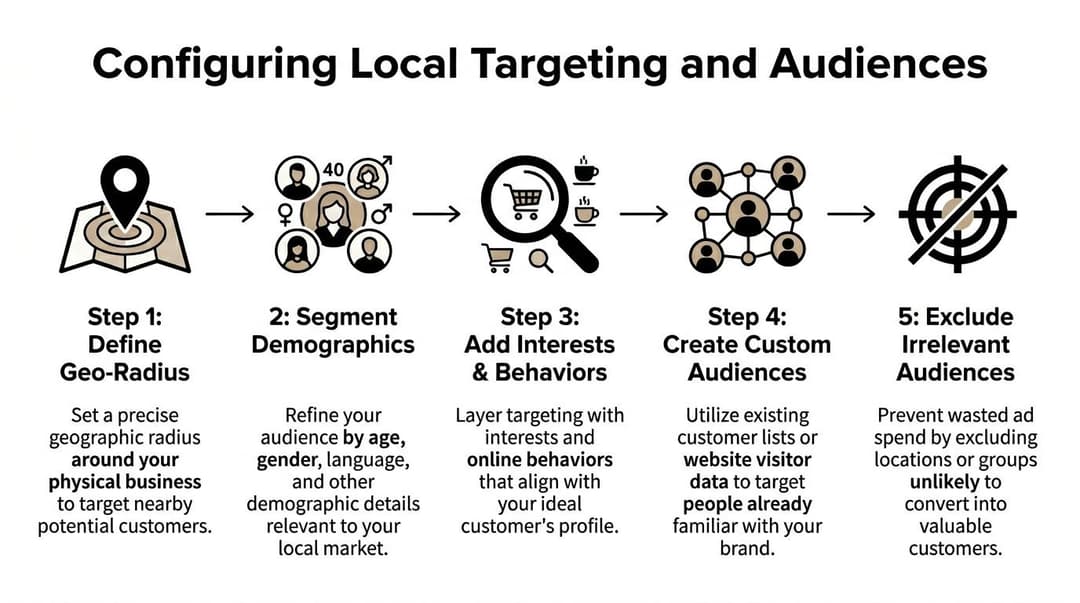
Targeting is where most facebook ads local business accounts leak money. Owners either go too broad and pay for irrelevant attention, or they stack so many filters that delivery stalls.
The better approach is tighter and simpler. Build audiences around geography first, then add just enough behavioral context to make the message relevant.
Start with geography, not interests
For a local business, the first question isn’t “who likes coffee” or “who likes fitness.” It’s where the customer is realistically willing to travel.
Urban campaigns usually need a tighter radius because crossing a city can feel like a long trip. Rural businesses often need a wider service area because customers already expect to drive farther. Multi-location brands should avoid dumping every store into one ad set. Segment by store, cluster, or trade area so the ad copy and measurement stay useful.
Build audiences in layers
A clean setup often looks like this:
- Core local audience based on radius, zip, or neighborhood.
- Refined audience using one or two relevant interests or behaviors.
- Custom audiences from website visitors, customer lists, lead lists, event RSVPs, and past engagers.
- Retargeting pools for warmer users.
- Exclusions to stop overlap and wasted spend.
A useful reference on audience strategy is this guide to target audience types: https://www.adstellar.ai/blog/type-of-target-audience.
The audience design matters because overlap creates internal competition. Best Version Media’s local Meta targeting guide recommends defining buyer personas first, then using 1 to 2 specific interests or behaviors instead of stacking many layers. It also advises testing audiences in the 500K to 2M range to preserve enough scale for learning, warns against broad age-only setups like 18 to 65 all genders, and notes a 0.9% global average CTR with $0.72 CPC as of June 2025 in the broader benchmark context for Meta ads. The same source says 62% of small businesses fail due to poor strategy including misguided targeting, and highlights how conversion performance varies by relevance, with fitness at 14.29% CVR versus tech at 2.31% in its cited benchmarks, all of which reinforces the need for precise local audience construction in Best Version Media’s Meta ads resource for local businesses.
What works for multi-location businesses
Single-store advice breaks down when you’re managing several locations. The fix is to localize both audience and message.
Use separate audience pools for each location when possible:
- Website visitors by area: route traffic to location pages and build retargeting around those visits.
- CRM segments by store: assign leads or past buyers to the nearest branch.
- Local event audiences: build campaigns around each store’s event RSVPs or community promotions.
- Exclusions between stores: stop neighboring locations from bidding against each other.
If two stores share one audience and one generic ad, neither location gets clear performance data.
Offline data makes this sharper. If your POS or CRM can identify which store a customer visited, feed that back into your campaign structure. Then your retargeting isn’t just “all customers.” It becomes “past buyers from location A,” “quote requests near location B,” or “event attendees tied to location C.”
Designing Creatives and Writing Copy that Drives Foot Traffic
Most local ads don’t need expensive production. They need recognition.
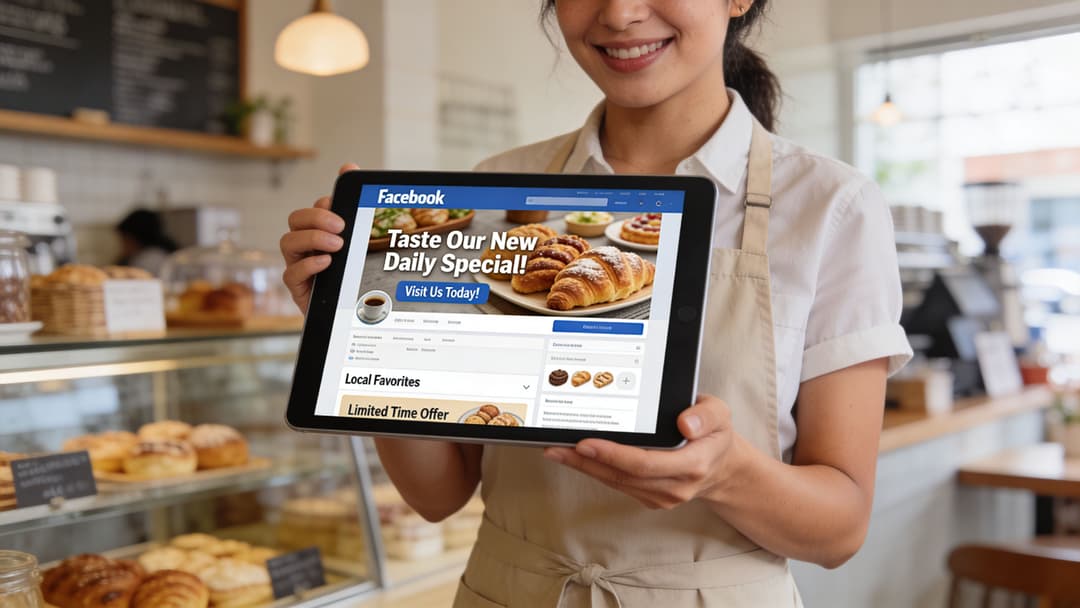
When someone scrolls Facebook or Instagram, they decide fast whether an ad feels nearby, useful, and credible. Local creatives work when people can place the business in their real world. A landmark. A neighborhood name. A familiar product shot. A staff member they might meet.
Use local cues early
The strongest local copy usually follows a simple formula:
Local trigger + benefit + CTA
Examples:
- Downtown lunch break? Grab a fresh sandwich and coffee two minutes from the square. Order ahead today.
- Need a haircut before the weekend? Book your appointment in Westfield now.
- Visiting the market on Saturday? Stop by our High Street boutique for new arrivals.
The point isn’t cleverness. It’s instant relevance.
A helpful creative reference for structure and format choices is this resource on designing Facebook ads: https://www.adstellar.ai/blog/designing-facebook-ads.
Formats that fit local campaigns
Not every local business needs the same ad format.
Single-image ads
These work well for straightforward offers. Use them when the business has one clear message.
Good use cases:
- daily specials
- one featured service
- seasonal event promo
- store opening announcement
Keep the image recognizable. Real storefronts, products, staff, or in-use service scenes usually beat generic stock visuals.
Carousel ads
Carousels are useful when the business needs to show multiple products, service categories, or store-specific variations. They also work well for multi-location businesses because each card can adapt to a location, offer, or inventory category.
Use each card differently:
- one for the offer
- one for social proof
- one for convenience
- one for the call to action
Short-form video
Video is strong for local businesses when it shows motion, place, and familiarity. Walk through the shop. Show the menu being prepared. Capture a trainer greeting a client. Show a technician arriving at a home.
A useful example of creative thinking for Meta ads is below.
Copy templates you can actually use
Coffee shop
Headline: Your weekday coffee stop in [Neighborhood]
Primary text: Fresh pastries, strong coffee, and a quieter table for your afternoon reset. Visit us today.
CTA: Get Directions
Gym
Headline: Train close to home in [Area]
Primary text: Small-group sessions, real coaching, and a welcoming local community. Book your first visit.
CTA: Learn More
Boutique
Headline: New arrivals in [Town]
Primary text: Updated styles just landed in-store. Stop by this week and see what’s new.
CTA: Shop Now or Get Directions
What usually hurts performance
Weak local ads tend to have one of three issues:
- Generic visuals: they could belong to any business in any city.
- No local cue: there’s nothing in the copy that signals place.
- Soft CTA: “Learn more” with no reason to act now.
A local ad should answer three questions in seconds. Is this near me, is this relevant to me, and what should I do next?
For multi-location scaling, dynamic text can help. Swap neighborhood names, nearby landmarks, or store-level offers across many variants without rewriting every ad manually. The creative idea stays consistent, but the local signal changes.
Setting Budgets and Bids for Efficient Spend
Budget mistakes in local accounts are usually structural, not tactical. The business either spreads too little money across too many ad sets, or shoves spend into a campaign before there’s proof the offer works.
A cleaner structure gives Facebook a better chance to learn.
Use a simple campaign hierarchy
The account setup that holds up best is straightforward:
- Campaign
- Ad set
- Ads
Neil Patel’s small business Facebook ads guide recommends a simplified structure of Campaign > Ad Set with 1 to 3 per campaign > Ads with 5 to 10 variants per set, along with non-overlapping audiences. The same source says local advertisers should start with $50+ daily budget per ad set for 3 to 7 days, because the system typically needs about 50 optimization events to move through learning. It also recommends starting with ABO and moving to Advantage+ once performance stabilizes, while noting an average CVR of 9.21% and 13 to 14% in stronger categories such as education and fitness, plus Meta’s 3.48B users as of June 2025 in Neil Patel’s guide to small business Facebook ads.
If you’re trying to benchmark spend expectations before launch, this budget explainer is a useful companion: https://www.adstellar.ai/blog/facebook-ads-cost.
Where owners overspend
Most wasted budget comes from one of these patterns:
- Too many ad sets: every audience gets its own tiny budget, so none gather enough signal.
- Overlapping local zones: neighboring audiences compete against each other.
- Early scaling: one decent day leads to an aggressive budget increase.
- No cut rules: weak ads keep running because no one wants to turn them off.
A practical local budgeting approach
For a single store, begin with one campaign tied to one outcome. Keep the number of ad sets low. Put enough spend behind each set for the platform to collect meaningful data. Review quickly, but don’t panic over the first few hours.
For multi-location businesses, resist the urge to equalize spend across all stores by default. Budget should follow opportunity and signal. A high-performing location with clean conversion data often deserves more support than a weak branch with vague demand.
Bidding can stay simple early on. Lowest-cost delivery is often enough while you test offer, audience, and creative. Tight manual controls are more useful later, once the business knows its economics and response quality.
Measuring Conversions with Offline and Online Attribution
The biggest reporting mistake in local advertising is acting like the sale only counts if it happened online.
That logic falls apart for restaurants, clinics, home services, retail stores, showrooms, and any business with meaningful in-person revenue. Someone sees the ad, visits the website, checks reviews, then walks in two days later. If you only track the click and not the visit or purchase, the campaign looks weaker than it really is.
Online attribution gives speed, not the full picture
Meta Pixel still matters. Install it sitewide. Track key actions, not just page views. Make sure events reflect the actual funnel, such as lead submissions, bookings, purchases, or quote starts.
But even a clean pixel setup won’t capture every local outcome. Privacy changes have reduced visibility. Brawn Media notes that post-2025 iOS changes created signal loss that can affect 30 to 50% of attribution for small advertisers, while audience sizes in local campaigns can be down 20 to 40%. The same source points to a shift toward contextual targeting such as people who live in a location, says layered audiences combining broad awareness with tight retargeting can recover 45% higher conversions, reports 2.5x engagement lift for video ads featuring local landmarks, and notes Meta’s April 2025 Local Awareness API for event-based targeting without pixels, while only 15% of content mentions it, according to Brawn Media’s discussion of why Facebook ads are important for local businesses in 2025.
If server-side tracking is part of your stack, this overview of Meta’s server-side setup is useful: https://www.adstellar.ai/blog/meta-conversions-api.
Offline attribution is what local businesses actually need
Offline attribution connects ad exposure to real-world action. That can include:
- POS sales imports
- CRM status updates
- Appointment attendance
- Call outcomes
- Store-level transaction matching
The account becomes actionable for multi-location businesses. Instead of asking which campaign got the most clicks, you can ask which store, offer, and audience combination drove actual revenue.
A practical attribution workflow
A reliable local setup often looks like this:
| Signal type | What it captures | Main limitation |
|---|---|---|
| Pixel events | Website actions and online conversions | Misses many in-store outcomes |
| Lead form data | Form fills and contact intent | Doesn’t confirm closed revenue |
| Offline conversion uploads | POS, CRM, and in-person sales signals | Requires disciplined data handling |
| Store-level analysis | Performance by location or trade area | Needs clean location mapping |
Local reporting should reconcile ad platform data with POS and CRM records. If those numbers never meet, the business is optimizing in the dark.
The strongest local teams review both. They use Meta for directional speed and internal sales systems for business truth.
Continuous Testing and Optimization for Lasting Success
A local account can look busy and still learn nothing.
That happens when a business keeps the same ad live for months, mixes multiple audience changes into one launch, and judges every store by the same benchmark. The result is familiar. Some locations look strong, some look weak, and nobody can say which variable drove the difference.
What good optimization looks like
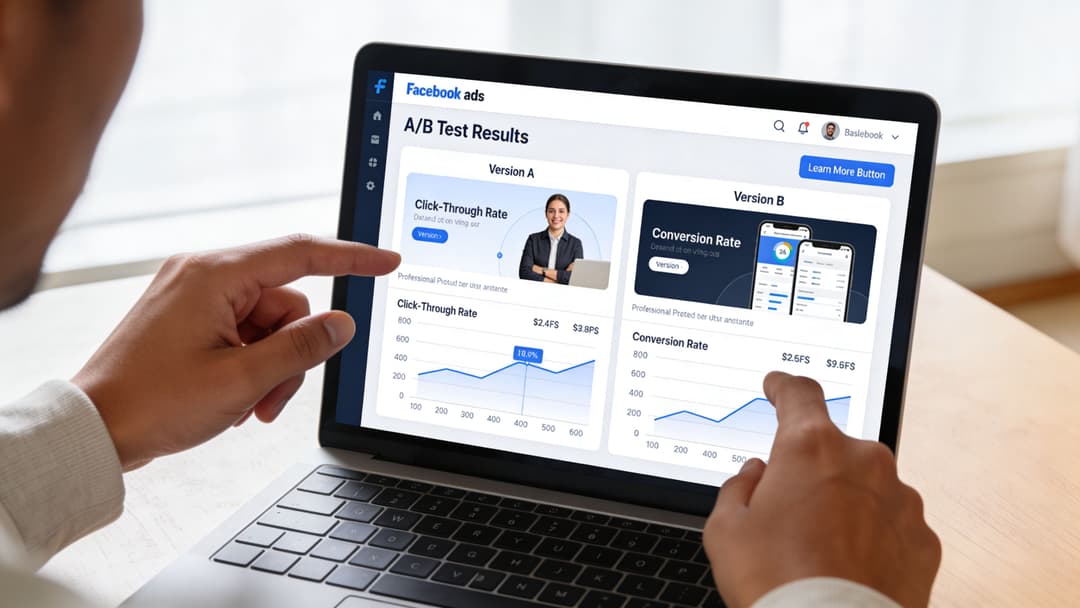
Useful testing stays tight. Change one major variable at a time so the result is clear.
That usually means testing:
- one headline against another
- one local image against another
- one store-level audience against another
- one offer against another
If the copy, audience, budget, and creative all change together, the account produces noise, not insight.
Why multi-location testing needs a different playbook
Single-location advice breaks down fast once several stores are involved. A franchise, clinic group, retailer, or home service brand cannot copy one ad set across every market and expect clean results. Different trade areas respond to different triggers. One store wins with proximity and convenience. Another needs social proof. A third gets better response from event-driven creative because local familiarity matters more than discounting.
That is why multi-location optimization needs store-level reporting and a production process that can generate many localized variants without creating chaos in the account. The Leadenforce analysis of Facebook ads for multi-location businesses targeting best practices makes the same point from a different angle. Geo-specific audience building, localized creative, and store-aware retargeting improve performance only if the account structure supports them.
A better operating rhythm
The accounts that hold up over time usually follow a simple loop:
- Launch controlled variants
- Review results by store, audience, and offer
- Pause weak combinations
- Increase budget on proven winners carefully
- Refresh creatives before response drops
For multi-location teams, the challenge is not just deciding what to test. It is producing enough clean variations to test at all. Bulk creative systems help by reducing the manual work of duplicating campaigns, swapping location details, and keeping naming conventions usable. AdStellar AI is one example. It connects to Meta, builds bulk combinations of creative, copy, and audiences, and ranks performance using historical results.
The bigger point is operational. Testing only works when the team can connect what happened in Ads Manager to what happened in stores. If Store A gets cheaper leads but Store B closes more booked jobs or rings more POS revenue, the optimization decision should follow the offline result, not the prettier click-through rate.
The winning habit is designing tests that produce a clear lesson, then scaling only what holds up in store-level revenue.
Local businesses that keep Facebook profitable build that discipline into the account. They test small, read results by location, reconcile ad response with offline outcomes, and scale winners without assuming every store needs the same message.