You’ve got a solid campaign post ready. The creative is approved, the offer is live, and now the ugly part starts. You need to push that post into a pile of Facebook Groups, maybe a few Pages, maybe a distribution workflow your team has repeated for months.
That’s the moment people search for a facebook auto share bot.
The appeal is obvious. Manual sharing is repetitive, slow, and hard to scale when your team should be focused on testing angles, refining creative, and managing spend. But in 2026, the conversation can’t stop at convenience. Meta’s detection is sharper, account risk is higher, and the difference between smart automation and reckless automation matters more than ever.
The Tempting Promise of Automated Sharing
A lot of marketers arrive at auto-sharing for the same reason. They’re not lazy. They’re overloaded.
A launch post that needs to reach dozens of relevant communities turns into a copy-paste treadmill. You open Group after Group, swap captions, upload the same asset, wait for approvals, and try not to trip a rate limit. By the time you’re done, you’ve spent energy on mechanics instead of performance.
That pain is exactly why automation became attractive when Facebook tightened distribution. After Facebook’s post-2016 algorithm changes, organic reach for Pages fell to under 6% by 2017, pushing marketers toward tools that could preserve visibility. In the same period, businesses using automated schedulers saw 41% higher page engagement by publishing at better times, according to Evergreen Feed’s write-up on Facebook auto-sharing.
Why the promise feels so strong
The promise isn’t just “save time.” It’s three things at once:
- More reach: Get one post into more places without doing the labor manually.
- More consistency: Keep publishing even when the team is stretched.
- More efficiency: Spend your time on targeting, offers, and creative instead of repetitive distribution.
That’s why auto-share tools spread so quickly among affiliate marketers, DTC operators, solo founders, and agencies managing too many accounts at once. The workflow looked simple. Write once, distribute everywhere.
Practical rule: When a channel gets harder to win organically, marketers start automating the repetitive layer first.
Where the allure turns into a gamble
There’s also a psychological trap. A facebook auto share bot looks like a growth shortcut because it sits close to the metric you want: more exposure. But exposure gained through brute-force posting is fragile.
The short-term version of the tactic feels productive. The long-term version can damage the exact asset you depend on, your account, your Page, your ad access, and your reputation in the communities you’re trying to reach.
That’s the core tension. The search for a bot usually starts from a legitimate operational problem. The danger comes from solving that problem with the wrong tool.
What Exactly Is a Facebook Auto Share Bot
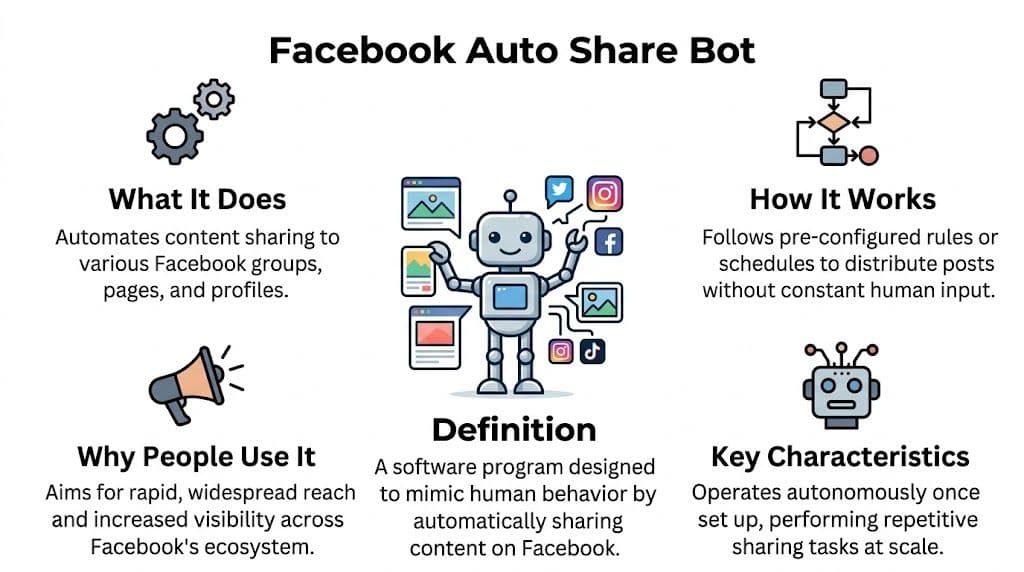
A facebook auto share bot is software that logs into Facebook and performs sharing actions for you. It acts as a robotic intern with your account access. You tell it what to post, where to post it, and sometimes when to post it. Then it clicks, pastes, uploads, and publishes at scale.
Unlike a normal scheduler for your own Page, these tools often operate by imitating human actions inside the Facebook interface. They don’t just plan content. They actively act on your behalf inside Groups, Pages, or other destinations.
What the bot is actually doing
At a basic level, most of these tools handle a simple chain of tasks:
Select content
The bot pulls in text, links, images, or video you want to distribute.Choose destinations
You assign a list of Groups, Pages, or posting targets.Execute actions The software interacts with Facebook and performs the posting steps automatically.
Some tools let you queue variants. Others let you rotate wording, add delays, or work from a spreadsheet. The user experience can look polished, but the underlying action is still the same. The bot is controlling your Facebook presence in a way that tries to look human.
How it differs from official scheduling
This distinction matters.
Official tools are designed for assets you own or are authorized to manage. A bot often pushes beyond that boundary by automating behavior in places where Facebook expects authentic, user-led interaction. That’s where the risk starts.
Here's a useful idea:
| Tool type | Primary job | Typical environment | Oversight level |
|---|---|---|---|
| Official scheduler | Plan and publish content | Owned Pages and approved workflows | High |
| Auto share bot | Perform repetitive sharing actions | Groups, Pages, or broad posting targets | Lower |
| Browser bot wrapper | Make risky automation easier to use | Consumer-facing extensions and no-code tools | Often opaque |
A remote control is useful until it starts pressing buttons faster than any human would.
Why marketers still buy them
They sell a very specific fantasy. Set it once. Load your targets. Walk away.
For busy operators, that’s enough to trigger a trial. But the phrase “automate Facebook sharing” hides an important truth. The simpler the promise sounds, the more you need to inspect how the tool behaves inside Meta’s ecosystem.
How Auto Share Bots Technically Work
Most facebook auto share bot tools fall into one of three technical buckets. If you can identify which one you’re looking at, you can usually predict the risk profile before you install anything.
Browser automation and screen scraping
This is the most common pattern in gray-area tools. The software opens Facebook in a browser, then clicks buttons, types text, uploads assets, and submits posts as if a person were sitting there.
That’s also why many of these tools advertise “human-like” features. Browser bots such as FB Group Bulk Poster use Spintax content variation and randomized delays to avoid obvious repetition. User benchmarks reported by the vendor say these tactics reduced account suspension risk by 70-80% compared with uniform posting patterns, which often hit rate limits within 48 hours, according to FB Group Bulk Poster’s explanation of Spintax and delay tactics.
The key word there is reduced, not removed. A browser bot is still pretending to be a person.
The official API route
Meta’s sanctioned automation path runs through its API stack. This is the method serious software companies use when they want durable access, proper permissions, and account-level governance.
It’s more restrictive by design. That frustrates people who want unlimited sharing, but the restriction is the point. API-driven systems create a permissioned framework for what apps can do, who authorized them, and how access is controlled. If you want the security model behind that approach, it helps to understand how OAuth authentication works in approved platform connections.
In practice, official API access is better for ad operations, owned asset publishing, and managed workflows than for aggressive group-spam behavior. That’s why many “growth hacks” avoid it.
No-code wrappers and polished front ends
A lot of modern tools present themselves as simple automations, but under the hood they’re often just browser bots with a friendlier setup flow.
Axiom.ai is a good example of the mechanism. Its Facebook posting recipe automates browser interactions from Google Sheets, including steps like clicking “What’s on your mind?”, entering text, uploading a file, and deleting the processed row after posting. It can automate posting without Meta’s Graph API, but that convenience comes with fragility. When Facebook’s interface changes, these automations can break. Axiom notes success can drop sharply when selectors drift, which is exactly the weakness of browser-driven automation.
Comparison of Facebook Automation Methods
| Method | How It Works | Primary Risk | Best For |
|---|---|---|---|
| Browser automation | Controls a browser to click and post like a user | Detection, account restrictions, workflow fragility | One-off experiments and low-trust hacks |
| Official API | Uses authorized app permissions and structured access | Limited capabilities compared with aggressive bot behavior | Durable, compliant automation |
| No-code bot wrapper | Simplifies browser automation through templates and UI | Hidden dependency on unstable page elements | Non-technical users who may not realize the underlying risk |
The practical takeaway is simple. Don’t evaluate a tool by its dashboard. Evaluate it by its method.
The Unseen Risks of Auto Share Bots in 2026
The biggest mistake I see is treating bot risk like a minor nuisance. It isn’t. In 2026, unauthorized automation can affect distribution, account integrity, and future ad operations all at once.
Meta’s projected 2025-2026 updates have made that worse. One source tracking automation communities reports ban rates for these tools rising by up to 300%. The same source says posting over 50 times per day via a bot triggers shadowbans in 72% of cases, and aggregated dashboard data showed 68% of automated accounts in the US and EU faced suspensions in Q1 2026, based on this report discussing Meta’s projected 2025-2026 detection patterns.

Policy risk is the obvious one
If your bot is sharing at unnatural speed or repeating the same posting pattern across many destinations, you’re stepping into spam and inauthentic behavior territory.
That doesn’t always end with a clean, visible ban. Sometimes the account keeps functioning while reach collapses. Sometimes posting works but engagement dies. Sometimes the damage expands into business assets connected to the same Meta identity.
If you’ve already seen strange throttling or access problems, this guide on what it means to get restricted on Facebook is useful context because many marketers notice the symptom before they understand the cause.
Security risk is usually underestimated
A lot of facebook auto share bot tools ask for direct login access, browser sessions, cookies, or extension permissions that are far broader than they need to be.
That creates two problems:
- Credential exposure: You’re trusting a third party with account-level access.
- Session abuse: A browser extension or automation layer may keep working in ways you can’t fully inspect.
This is one reason the broader conversation about risks associated with social media bots matters beyond one platform. Once a team gets comfortable handing credentials to automation tools, the same mistake often spreads across channels.
The real cost of a bad bot often shows up after the “successful” posts. It appears when access breaks, reach falls, or the account needs to be recovered.
Performance risk hurts even if you avoid a hard ban
Marketers often focus on whether the bot “works.” The better question is whether it preserves performance quality.
If a bot gets your content posted but trains Meta to classify your behavior as low-quality or suspicious, your distribution engine gets weaker over time. You might still see output. You won’t necessarily see healthy outcomes.
The brand cost matters too. Groups are social environments, not dumping grounds. Repetitive cross-posting is one of the fastest ways to get ignored by admins and distrusted by buyers.
Compliant Alternatives for Scaling Your Reach
The goal isn’t to give up on automation. The goal is to automate the right layer.
If you need scale, there are safer ways to get it. Good marketers stop asking, “How do I force this post into more places?” and start asking, “How do I systemize distribution without creating platform risk?”

Start with owned and approved surfaces
Your first automation layer should live where permission is clear. That means your own Pages, approved publishing tools, and connected workflows inside Meta’s ecosystem.
For some teams, basic scheduling is enough. For others, the better move is structured cross-channel planning. If you’re rethinking how content gets redistributed across platforms without brute-force botting, this piece on automatic crossposting strategies is a useful reference because it frames automation as workflow design, not account abuse.
Use no-API tools with caution
There are moments when browser automation looks attractive because it bypasses approval friction. Axiom.ai, for example, can automate Facebook posting from Google Sheets without using Meta’s API and can handle 200+ posts a day, but it’s unstable. Axiom’s own documentation shows success can fall from 95% to 60% when Facebook’s UI changes, which is a strong reminder that non-API methods are built on shifting ground, as shown in Axiom’s browser automation recipe for Facebook posts.
That’s the trade-off in one line. Speed now, fragility later.
Shift from organic blasting to paid distribution
This is the move mature teams make.
Instead of trying to inject the same post into dozens of groups, build a system that promotes the message to the right audience through approved paid channels. That gives you cleaner targeting, stronger measurement, and less dependence on organic loopholes.
A practical framework looks like this:
- Use organic posting for credibility: Publish to owned assets and communities where you’ve earned attention.
- Use paid promotion for scale: Let ads expand distribution to relevant audiences instead of forcing group saturation.
- Use automation for production and testing: Systemize ad creation, creative iteration, and launch workflows with approved tooling.
For teams that need a more structured view of that last point, this overview of Facebook ads automation workflows is a better direction than chasing another sharing bot.
A short walkthrough helps make the contrast clear:
Field note: The safest automation usually happens farther down the funnel, where permissions are explicit and results are measurable.
A Modern Playbook for Automated Distribution
The strongest automation setups don’t behave like spam machines. They behave like disciplined media systems.
That means using automation to improve precision, not volume for its own sake. A modern playbook is less about “post everywhere” and more about matching message, audience, and channel with enough operational efficiency that your team can keep testing.

Build around relevance first
If you automate weak content, you only scale irrelevance.
A better workflow starts by defining which message belongs to which audience segment. Group admins, warm prospects, retargeting pools, and cold interest audiences shouldn’t all receive the same packaging. Automation should help you distribute variants, not duplicate noise.
Use these operating rules
- Prioritize fit over footprint: A smaller number of relevant placements will usually outperform broad, repetitive posting.
- Create message variants: Change hooks, framing, and creative context for different audience states.
- Automate measurement, not just publishing: Track what people respond to, then feed those learnings back into the next round.
- Protect core assets: Keep account quality, Business Manager health, and ad access ahead of short-term reach grabs.
Treat paid and organic as separate jobs
Organic distribution builds trust, signal, and community memory. Paid distribution buys reach and testing speed.
When teams mix those jobs badly, they start using organic channels like ad inventory. That’s usually when a facebook auto share bot enters the picture and quality drops. A healthier approach is to let content earn attention organically where it belongs, then use sanctioned advertising workflows when you need scale across Facebook and Instagram. This matters even more if your campaigns span placements and formats across both surfaces, which is why understanding how Facebook ads and Instagram distribution work together is more valuable than trying to brute-force one post into every corner of Meta.
“Automation should remove repetitive labor, not remove judgment.”
Review the system weekly
A durable automation process needs routine inspection.
Look at content fatigue, placement quality, approval friction, and downstream conversion behavior. If a workflow increases output but lowers signal quality, fix the workflow. Smart automation is iterative by nature.
Why Smart Automation Is the Future Not Bots
The old facebook auto share bot model was built for a looser platform era. That era is gone.
Meta isn’t just policing spam because it dislikes aggressive marketers. It’s operating inside a broader internet environment where bad bots accounted for 32% of all web traffic in 2023, and advanced evasive bots have doubled in prevalence since 2022, according to Statista’s bot versus human traffic data. When platforms see that kind of pressure, detection gets stricter and unauthorized automation gets less tolerated.
That changes the risk-reward math. The upside of brute-force sharing is temporary. The downside can touch every part of your Meta operation.
The future belongs to automation that works with platform rules instead of fighting them. That means better creative systems, better audience testing, better approval models, and better feedback loops. If you’re investing in automation now, put it where advantages multiply and account risk stays controlled.
For teams thinking in that direction, the more useful question isn’t “Which bot can still slip through?” It’s “How do we use AI for ads and campaign decision-making to scale faster without damaging the channel?”
If your team wants the speed of automation without the risk of gray-area bots, AdStellar AI is built for that reality. It connects to Meta through secure OAuth, helps you generate and launch large volumes of ad variations quickly, and gives performance teams a cleaner way to test, learn, and scale on Facebook and Instagram without putting core accounts at unnecessary risk.