You’re probably seeing the same pitch everywhere. A tool, a reseller, or a freelancer promises facebook automatic likes that will make your Page look established by tomorrow morning. If you’re under pressure to show traction, that offer can sound practical. It feels faster than waiting for content, creative testing, and ad optimization to do their job.
That’s where many teams make the wrong decision. They treat likes as a vanity number instead of a signal inside a much larger ad system. The safer path isn’t buying automatic likes. It’s automating the machinery that earns real ones from people who might buy, share, comment, and convert.
The Dangerous Promise of Instant Popularity
A common scenario goes like this. A brand launches a new Page, boosts a few posts, then notices the page still looks thin. Someone on the team searches for facebook automatic likes and finds a menu of offers that sound harmless. Cheap likes. Fast delivery. No effort.
That shortcut is tempting because Likes matter far more than generally realized.
A 2015 University of Cambridge and Microsoft Research study found that with just 300 Facebook Likes, an analytical model could predict a user’s personality traits with over 90% accuracy, showing how aggregated likes become a rich data signal for advertisers and platforms alike, as described in this summary of the Cambridge and Microsoft Research findings.

When marketers chase likes, they aren’t only chasing optics. They’re chasing signals that can influence targeting, creative learning, and downstream optimization. That’s why low-quality engagement is so dangerous. Bad inputs don’t stay isolated. They leak into your reporting and shape future decisions.
Two very different meanings
In practice, facebook automatic likes has split into two very different ideas:
- Black-hat automation: Bots, click farms, fake accounts, or scripts meant to create the appearance of popularity.
- White-hat automation: Systems that automate ad setup, testing, audience discovery, and campaign management so real people engage at scale.
Those are not minor variations of the same tactic. They lead to different data, different risk profiles, and different business outcomes.
Practical rule: If the system is automating the click itself, you should be skeptical. If it’s automating campaign workflow to reach real people, that’s standard performance marketing.
A lot of confusion comes from the broader automation ecosystem around Facebook. Some tools automate shares, posting, or account actions, and teams assume likes belong in the same category. They don’t. If you want a sense of how adjacent gray-area tactics get framed, this look at a Facebook auto share bot and related automation patterns is useful background.
The right question isn’t “How do I get likes automatically?” It’s “What exactly am I automating, and what kind of signal will it create?”
The Two Worlds of Automatic Likes A Critical Distinction
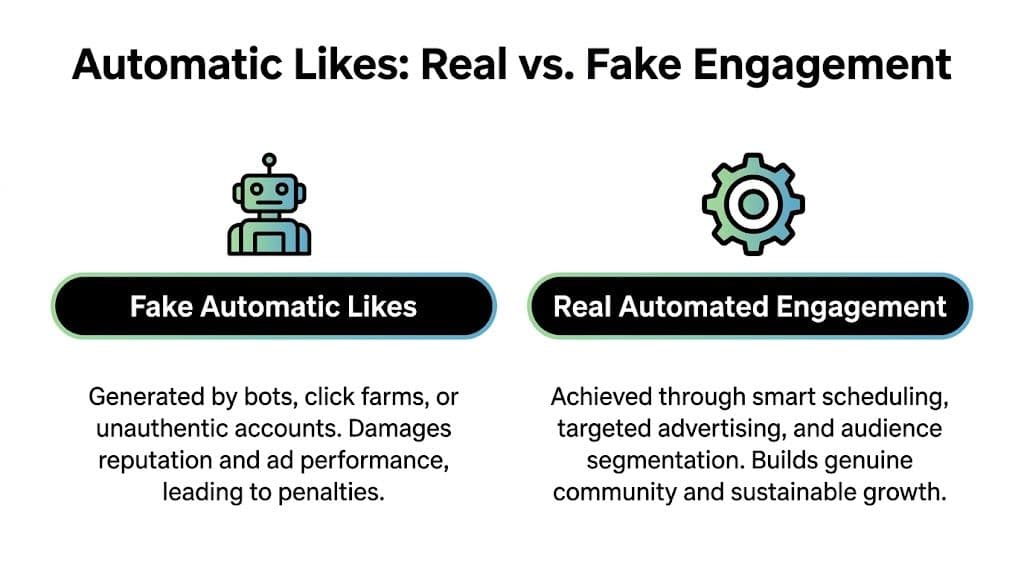
The easiest way to think about this is simple. One approach rents a crowd. The other earns an audience.
The rented crowd shows up, makes noise, and disappears. The earned audience responds because your offer, message, or creative matched what they care about. From the outside, both can raise a like count. Inside an ad account, they behave nothing alike.
Renting a crowd
Fake automatic likes usually come from some combination of low-quality accounts, engagement networks, scripted browser actions, or device-based automation. The sales page focuses on volume and speed. It rarely explains who those people are, why they would care about your brand, or how that engagement helps actual campaign performance.
In practical terms, these likes create surface-level numbers with weak business value:
- No buying intent: The account that liked your post often has no relationship to your product.
- No reliable feedback loop: Creative teams can’t tell whether the message worked or the likes were manufactured.
- No stable optimization signal: Media buyers end up reading contaminated data.
Earning an audience
Real automated engagement works very differently. You automate the operational layer around Facebook, not the reaction itself. That includes creative variation, testing workflows, audience segmentation, launch speed, and measurement.
A well-run system does things like:
- Queue many ad variants: Different hooks, images, formats, and offers go live faster.
- Route spend toward promising segments: You keep feeding the system real user behavior.
- Measure quality, not just counts: Saves, comments, click behavior, downstream actions, and post-like patterns all matter.
A real like has context. It comes from someone who saw a message, understood it, and chose to respond.
That’s why experienced buyers rarely ask for “more likes” in isolation. They ask what generated them.
Fake automation vs. real automation A Comparison
| Attribute | Fake Likes (Bots & Click Farms) | Authentic Engagement (Ad Automation) |
|---|---|---|
| How it works | Simulates or purchases engagement | Automates campaign setup, testing, and delivery to real audiences |
| Audience quality | Unclear, often irrelevant | Built from real targeting and creative-market fit |
| Data value | Pollutes account learning | Improves learning with genuine behavior |
| Account risk | Elevated policy and detection risk | Aligned with normal ad operations when run properly |
| Brand credibility | Can look inflated or suspicious | Builds trust through visible, consistent response |
| Long-term ROI | Weak and unstable | Stronger because it compounds with useful data |
| Use case | Vanity inflation | Scalable acquisition and community building |
Why the distinction matters to professionals
A junior marketer can confuse these because both are forms of automation. A senior marketer shouldn’t. The core issue is intent and signal quality. If automation exists to fake user behavior, it weakens the system. If automation exists to remove manual bottlenecks around real campaign execution, it strengthens the system.
That’s the dividing line worth keeping.
Why Chasing Fake Likes Will Wreck Your Ad Account
Fake likes don’t just fail passively. They can create active damage inside your account.
The first problem is obvious. If Meta strips low-quality engagement, the number you paid for starts evaporating before your team has even finished reporting on it. According to this review of recent Meta autolike enforcement claims, recent 2025 Meta updates intensified AI-driven purges of inorganic engagement, with reports showing up to 40% of purchased likes removed within 72 hours.
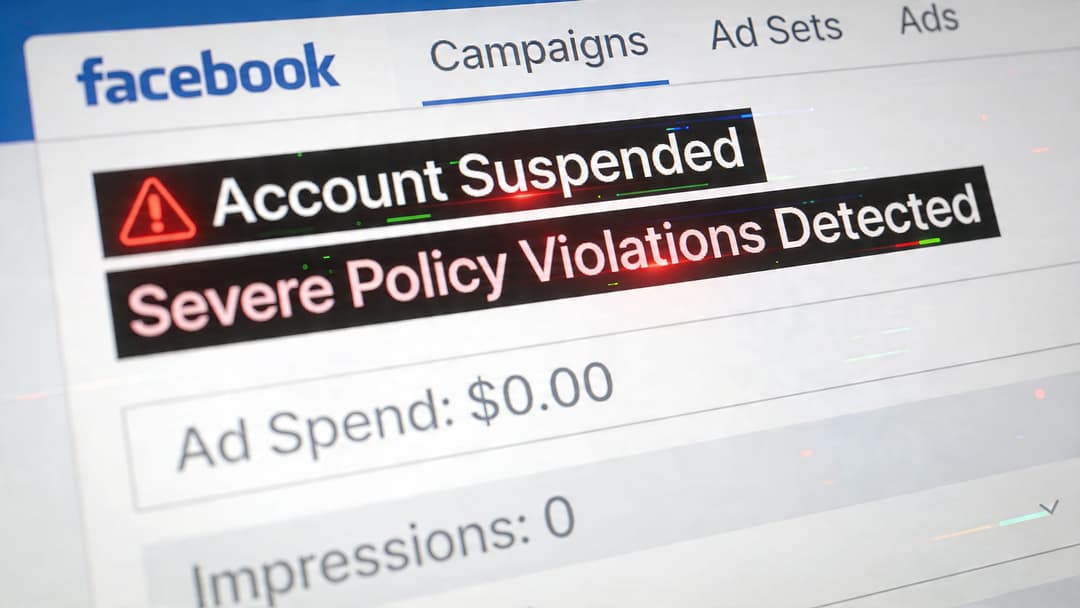
A lot of teams stop the analysis there and call it a waste of money. That’s too narrow. The bigger issue is what fake likes do before and after removal.
Bad engagement poisons your learning
Meta’s ad systems learn from interaction patterns. When you feed those systems low-quality engagement, you distort the feedback loop that should help your campaigns improve.
That distortion shows up in a few ways:
- Creative misreads: A weak ad can appear healthy because the engagement layer is inflated.
- Audience confusion: You can’t tell which segment cared and which one was padded by artificial reactions.
- Retargeting pollution: Anyone building audiences from post engagement risks seeding them with useless accounts.
For performance teams, this is the actual cost. You’re no longer optimizing around customer behavior. You’re optimizing around noise.
The penalty isn’t only numerical
Platforms don’t need to catch every fake interaction manually. They can look for patterns that don’t match normal behavior. That’s why black-hat providers keep advertising technical evasions such as separate device fingerprints, rotated proxies, and staggered action timing. The need for that infrastructure tells you the basic truth. This is adversarial behavior, not legitimate marketing.
Once you enter that game, your account inherits the downside:
- Warnings and restrictions
- Reduced trust in your engagement quality
- Harder debugging when performance drops
- More friction when appealing enforcement decisions
If you’ve watched social platforms crack down on manufactured engagement in other ecosystems, the pattern is familiar. This discussion of fake engagement and algorithm penalties on another network is relevant because the same operational logic applies. Artificial activity may look like momentum at first, then the platform treats it like manipulation.
If a tactic forces you to worry about evasion, fingerprinting, and detection thresholds, it’s already the wrong tactic for a brand account.
Why the reporting damage lingers
The most expensive consequence often appears later. Teams export campaign data, compare winners and losers, and use that history to guide the next launch. If the source period included fake engagement, your benchmark set is compromised.
That leads to bad decisions such as:
- Scaling the wrong creative
- Trusting the wrong audience segments
- Repeating messaging that never resonated
- Overestimating social proof from posts that were propped up artificially
The result is a slower team with less confidence in its own dashboard.
If your account is already under review or showing restrictions, it helps to understand how Facebook enforcement behaves in practice. This guide on being restricted on Facebook and what to check is a useful operational reference.
What fake likes never solve
They don’t improve offer quality. They don’t fix weak hooks. They don’t make your landing page clearer. They don’t create actual community. They don’t tell you which message deserves more budget.
They only create the illusion that your Page is working while making the ad system less trustworthy underneath.
Debunking Common Automatic Like Myths
The most persistent bad tactics survive because they sound plausible in a meeting. Here’s where that logic usually breaks.
Myth one A big like count is social proof no matter where it comes from
A like count only helps if the surrounding behavior feels real. Buyers notice when a Page has a large number on top and weak comment quality, low discussion, or irrelevant reactions underneath. Media buyers notice it too when post engagement doesn’t line up with clicks, saves, or conversions.
A fake crowd doesn’t create trust. It creates inconsistency.
Social proof works when the audience sees other real people validating a brand. Empty reactions don’t do that job.
Myth two Fake likes are fine as a short-term kickstart
This is one of the most expensive myths because it sounds controlled. The idea is that you’ll inflate the Page early, then switch to real growth later. In practice, the damage starts at the beginning, when the account most needs clean data and clear signals.
A new Page needs honest feedback. It needs to know which offer gets ignored, which angle sparks comments, and which audience is curious. Fake likes blur all of that.
Myth three All automation is against the rules
This is the misunderstanding that blocks smart teams from scaling. Scheduling posts, systematizing creative production, managing campaigns more efficiently, and using software to organize launch workflows are all normal parts of modern marketing.
The problem isn’t automation itself. The problem is automating fake user behavior.
Myth four If competitors are doing it, the risk must be small
Competitors can make bad decisions for a long time before you see the consequences. You don’t know whether their engagement is helping, whether their account has hidden restrictions, or whether they’re dealing with unstable performance behind the scenes.
A tactic being common doesn’t make it professional.
Myth five A smaller real audience can’t compete with a larger fake one
For paid social, a smaller engaged audience is usually far more useful than a larger dead one. Real fans comment, share objections, ask product questions, and react to offers in ways your team can learn from. That feedback sharpens both creative and targeting.
A Page with authentic response gives you something to build on. A Page padded with fake likes gives you cleanup work.
The Real Goal Automating Authentic Engagement
The professional version of facebook automatic likes doesn’t automate the like. It automates the process that makes liking your content more likely.
That distinction matters because it changes what you build. Instead of buying engagement, you build a repeatable engine for producing relevant messages, reaching the right people, and learning from what happens next.
Page likes still matter when they’re real
Page likes have been part of Facebook business growth since 2007, and as Meta’s ad platform matured, Pages with over 100,000 authentic likes often reported 20 to 30% lower CPA because the platform had a richer dataset for ad delivery optimization, according to this Sprout Social breakdown of Facebook analytics and Page Like performance.
That doesn’t mean every brand should chase Page likes as a standalone objective. It means authentic engagement can become a useful asset when it reflects genuine market response.
What teams should automate instead
Most ad teams waste time on repeatable work that software should handle. That’s where white-hat automation earns its keep.
Focus the machine on tasks like these:
- Creative packaging: Turn one offer into many ad-ready variations.
- Audience organization: Keep segments structured, testable, and easy to compare.
- Launch operations: Push approved combinations live without hand-building every ad.
- Performance review: Surface what’s resonating so the next round gets sharper.
The key shift is this. You’re not paying for a result to appear. You’re reducing the manual friction that keeps real results from happening fast enough.
Authentic engagement is a systems outcome
Good engagement usually follows a chain of decisions:
- The audience was relevant.
- The message matched a real pain point or desire.
- The format fit the feed.
- The offer was easy to understand.
- The team measured the response and iterated.
Automation helps at every point in that chain. It doesn’t need to fake the endpoint.
Operator’s view: The best automation removes repetitive setup work so humans can spend more time on angles, offers, and analysis.
If you’re refining this part of your strategy, it’s worth reviewing a practical perspective on Facebook ads for engagement and how to structure them. The useful lesson isn’t “get more reactions.” It’s “build campaigns that earn them from the right people.”
That’s what scales safely.
How to Automate and Scale Real Facebook Engagement
The cleanest workflow starts with a simple premise. Treat engagement as an output of disciplined campaign operations, not as a product you purchase.
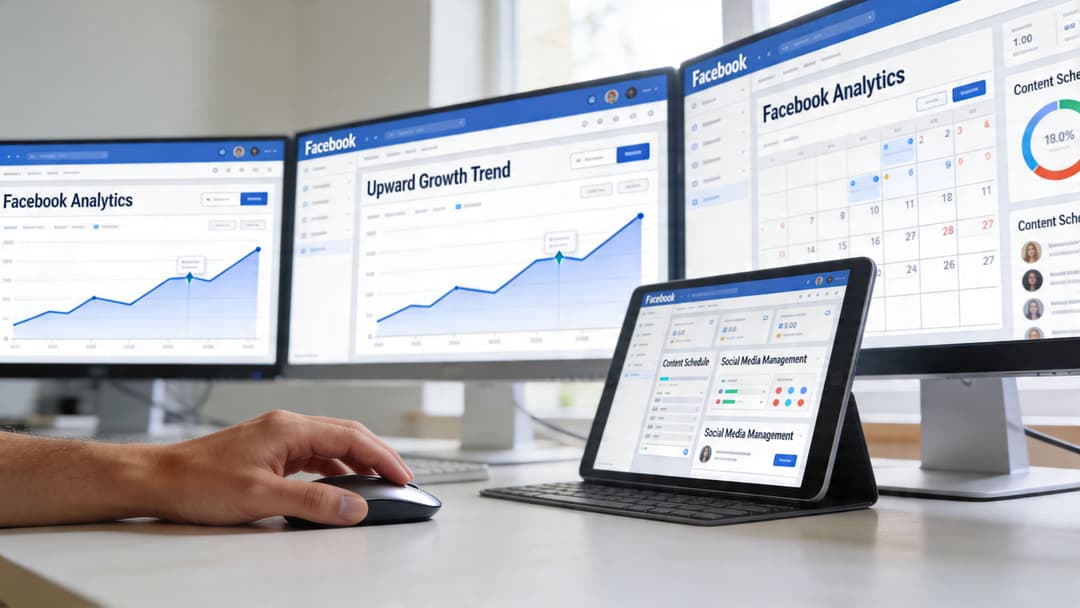
Teams that do this well usually automate four layers. They don’t all look the same, and that’s the point. Each layer removes a different kind of bottleneck.
Start with creative automation
Most engagement problems are creative problems in disguise. The audience might be fine. The budget might be fine. The hook is what fails.
So the first automation layer should help you produce and test more message variations without turning every launch into a manual production sprint.
That means building systems to vary:
- Opening hooks
- Primary text length
- Image or video concepts
- Calls to action
- Offer framing
A practical content operation can support this too. If you need a broader workflow for planning and consistency, this guide on how to automate social media posts and boost engagement is useful because it focuses on repeatable publishing discipline rather than fake reactions.
Creative automation doesn’t mean random output. It means structured variation tied to a hypothesis.
Build audience automation around relevance
A lot of marketers automate too late. They hand-build audience structures, then wonder why scaling is slow. Real automation starts earlier by organizing the audience model itself.
You want systems that make it easy to separate:
- Prospecting audiences from warm retargeting pools
- Broad testing from niche message matching
- High-intent segments from early-awareness segments
The goal is clean comparison. When engagement improves, you should know whether the improvement came from the message, the segment, or both.
Use campaign automation to move faster than manual buyers
Manual campaign management creates hidden drag. Someone has to duplicate ad sets, update naming, check settings, re-upload assets, and keep launch logic consistent. That work doesn’t create strategy. It just consumes time.
Campaign automation helps by standardizing execution:
- Approved creative combinations move into launch-ready formats.
- Audience groups map into pre-defined campaign structures.
- Budget allocation follows performance rules instead of seat-of-the-pants changes.
- Teams can relaunch proven frameworks with less setup friction.
That speed matters because the faster you can test, the faster you can earn authentic engagement from live market feedback.
If your team is still doing too much of this by hand, a practical next read is how to automate Facebook campaigns, especially if you’re trying to reduce repetitive setup work across multiple launches.
Measurement automation closes the loop
Many teams falter at this stage. They automate ad creation and launch, then go back to manual analysis. That breaks the system.
You need an automated measurement layer that surfaces patterns such as:
- Which creative themes generate meaningful interaction
- Which audience pockets engage but don’t convert
- Which ads create both visible engagement and business value
- Which losing variants should be retired quickly
A good review process doesn’t obsess over likes alone. It evaluates whether engagement aligns with the outcome you care about, whether that’s leads, purchases, trials, or lower acquisition costs.
The reason this matters is simple. Authentic engagement is useful only when it supports broader account efficiency.
Here’s a useful visual overview of campaign automation thinking in practice:
What works and what doesn’t
A lot of teams ask for a shortcut, so it helps to be blunt.
What works
- Testing many real creative angles: You learn what people respond to.
- Keeping audience structures clean: You can trust the signal.
- Scaling winners methodically: Budget follows evidence.
- Using scheduling and workflow tools: The team spends less time on repetitive setup.
What doesn’t
- Buying likes for appearance
- Using bot-driven engagement packages
- Mixing fake reactions into otherwise legitimate campaigns
- Judging post quality only by visible like count
The safest automation is boring operational automation. It’s naming conventions, launch templates, audience structures, asset pipelines, and reporting discipline. That’s what compounds.
When teams reframe facebook automatic likes this way, the tactic stops being shady. It becomes what it should have been all along: a disciplined system for creating more chances to earn real response.
Your Path to Scalable and Authentic Social Proof
There are two paths behind the phrase facebook automatic likes.
One path is short, flashy, and unstable. It buys numbers that don’t reflect demand, weakens your optimization signals, and can create policy headaches you didn’t need. It looks like growth for a moment, then turns into cleanup.
The other path is slower at the surface and stronger underneath. It automates the work around creative testing, audience discovery, launch execution, and measurement. That path earns likes from people who matter to the business.
The difference comes down to what you’re trying to build. If you want a screenshot, fake automation can provide one. If you want a Page, ad account, and feedback loop that improve over time, you need real engagement generated by real campaign systems.
That’s the version worth scaling. Not automatic likes as a product, but automated marketing operations that make authentic social proof easier to earn again and again.
Frequently Asked Questions
Are bought Facebook likes illegal or just against platform rules
They’re typically discussed more as a platform compliance and account-quality issue than a criminal one. For marketers, the practical concern is that bought likes can violate platform expectations around authentic engagement and create enforcement risk.
Can Meta actually detect fake likes
Meta actively removes inorganic engagement and updates its enforcement systems over time. Detection doesn’t have to be perfect to hurt you. Even partial removals, warnings, or degraded signal quality are enough to make the tactic unprofitable.
Is a small engaged Page better than a large fake one
Yes. A smaller real audience gives you usable feedback and better downstream learning. A larger fake audience mostly creates reporting noise.
Should I run Page Like campaigns at all
Sometimes, yes, if they fit a broader strategy and the engagement is genuine. The key is to treat likes as one signal among many, not the whole goal. If you’re weighing that route, this guide on Facebook ads for Page Likes can help frame the decision.
If you want the safer version of scale, AdStellar AI helps teams automate Meta campaign creation, testing, and optimization so they can earn real engagement faster instead of faking it. It’s built for marketers who want cleaner workflows, better learning loops, and more revenue from authentic signals.