Making commercials used to be a high-stakes gamble. You'd spend a fortune on one big-budget shoot, throw it on the air, and just hope for the best.
Those days are over.
Today, winning in advertising isn’t about that one perfect ad. It’s about building a scalable system for creating, testing, and optimizing your commercials—a system that turns creative work into predictable results. This guide is your playbook for building that very system, using the power of AI to get there faster.
The Modern Playbook for Creating Commercials
Forget the old "one and done" model. In a performance-driven market, knowing how to create commercials that actually convert means building an agile, data-backed engine. It's less about gut feelings and more about a science of rapid iteration and measurement.
This isn't just a niche trend; it’s where the money is flowing. Big time. Video advertising has completely taken over, with total ad spend projected to soar past $150 billion in the U.S. alone by 2028. That incredible investment shows a clear shift: brands are ditching the single, high-stakes creative for a more flexible and measurable approach.
Your New Commercial Workflow
The modern process really boils down to three core phases: scripting, production, and testing. But here’s the key difference: it's not a straight line. It's a continuous loop where the insights you get from testing feed directly into the next round of creative.
This visual shows that simple, iterative flow in action.
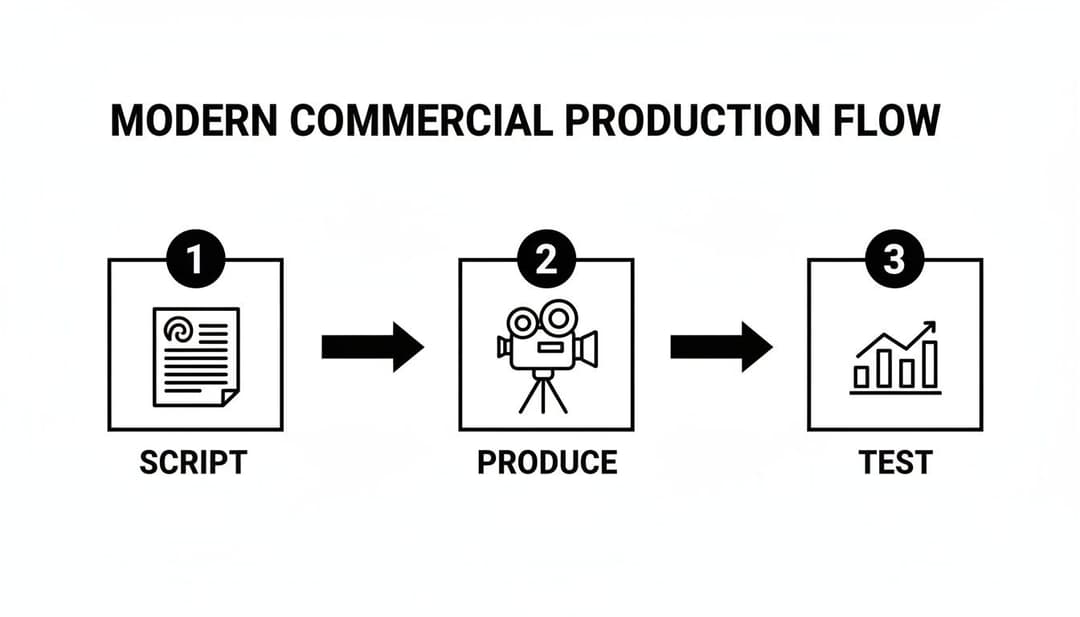
The biggest takeaway here? Testing isn't the finish line. It's the starting gun for the next cycle, making your advertising smarter with every iteration. This loop lets you adapt quickly to what the market is telling you, without needing a full-blown creative overhaul every time a campaign starts to fade.
To see how this agile process stacks up against the old way of doing things, let’s break down the key stages.
Modern Commercial Workflow at a Glance
This table contrasts the slow, linear path of traditional commercial production with the fast, cyclical process that modern performance teams are adopting.
| Stage | Traditional Approach | Modern AI-Powered Approach |
|---|---|---|
| Brief & Concept | Single, rigid concept approved for one large shoot. | Multiple hypotheses and creative angles developed for testing. |
| Scripting | One master script with minor variations. | Modular scripts with swappable hooks, value props, and CTAs. |
| Production | Expensive, location-based shoot to produce a single "hero" ad. | Agile content shoots, stock footage, and user-generated content. |
| Editing & Variants | A few cut-downs for different platforms (e.g., 30s, 15s). | Hundreds of ad variants created by mixing and matching assets. |
| Testing | Limited A/B testing, often post-campaign. | Continuous, automated testing of variants to find winners. |
| Optimization | Insights inform the next major campaign months later. | Real-time data feeds directly into the next creative sprint. |
The difference is stark. The modern, AI-powered approach is all about speed, learning, and constant improvement.
The goal isn't to create one perfect commercial. It's to build a system that produces a constant stream of high-performing ads by understanding what truly resonates with your audience.
In this guide, we'll walk you through every step of this modern playbook. You’ll learn how to write a sharp creative brief, use AI platforms like AdStellar AI to generate hundreds of ad variations effortlessly, and turn your creative assets into a powerful library that fuels automated testing and turns ad spend into revenue. For a deeper dive, check out our guide on leveraging video for advertising.
Building Your Creative Strategy and Brief
A high-converting ad doesn't just happen. It’s born from a rock-solid creative brief long before anyone ever hits record or writes a line of code. Think of the brief as the strategic blueprint for your entire project.
This isn’t about filling out forms for the sake of it. It's about preventing the kind of expensive guesswork that tanks campaigns. Without a clear brief, your copywriter might be aiming for brand awareness while your designer is optimizing for clicks. It’s a recipe for wasted money and mediocre results. A tight brief gets everyone—from creatives to AI platforms—pointed in the exact same direction.
Define Your One Measurable Objective
First things first: what does a "win" actually look like? Before you even think about scripts or visuals, you have to define success with a single, measurable number. A fuzzy goal like "more sales" just won't cut it. You need to tie your ad's purpose to a specific key performance indicator (KPI).
Why the intense focus on one metric? Because it’s the only way to truly test and optimize your campaign.
Your primary objective will almost always be one of these:
- Return on Ad Spend (ROAS): How much revenue comes back for every dollar spent? This is the go-to for e-commerce and DTC brands.
- Cost Per Acquisition (CPA): What’s the price tag for acquiring one new customer? Absolutely essential for subscription services or products with a high ticket price.
- Cost Per Lead (CPL): How much does it cost to get a single qualified lead into your funnel? This is the lifeblood for most B2B companies.
Picking just one primary objective is the most important decision you'll make at this stage. It makes every other choice simpler and gives you a clear yardstick to measure every ad variant against.
Articulate Your Core Message and Audience
Once your objective is locked in, you need to get crystal clear on who you're talking to and what you're going to say. This means going way beyond basic demographics and building out a real audience persona. What keeps them up at night? What are their deepest motivations? What jargon do they use?
Your ad's core message has to hit a specific pain point and offer a must-have solution. Let’s see how this plays out in the real world.
Scenario 1: DTC Skincare Brand
- Audience Persona: "Stressed Sarah," a 32-year-old professional. She's tired of confusing skincare routines and is secretly worried about "tech neck" from staring at her phone all day.
- Pain Point: Her skin feels dull, but she doesn't have 20 minutes for a 10-step ritual.
- Core Message: "Get a healthy, radiant glow in under 2 minutes. Our 3-in-1 morning serum does it all."
Scenario 2: B2B SaaS Company
- Audience Persona: "Marketing Mike," a 45-year-old marketing director. He's buried in spreadsheets and struggling to prove his team's ROI to the C-suite.
- Pain Point: He can’t connect his team’s activity to actual revenue and spends hours trying to piece the story together.
- Core Message: "Stop guessing. Our dashboard instantly connects all your marketing data to show you exactly what's driving revenue."
See the difference? Each message is surgically precise, solving a real problem for a real person. That’s the kind of focus that makes people stop scrolling and actually listen.
A great creative brief doesn't just list features; it translates those features into emotional benefits that solve a real-world problem for your target customer. This is the bridge between your product and their needs.
This detailed planning isn't just for your human team, either. When you plug into an AI platform like AdStellar AI, the objectives and messaging from your brief are the most critical inputs you can provide. The AI needs to know if it's optimizing for CPL or ROAS. It needs to know which value props to test. Exploring the fundamentals of a successful media strategy and planning process is a great next step to see how this all connects.
A strong brief gives the machine the clear direction it needs to do its job—turning your strategic vision into hundreds of testable ad variants and, ultimately, measurable results.
Scripting and Storyboarding for Mobile Feeds
In a world of infinite scrolling, your commercial doesn't get a slow wind-up. You've got about three seconds—maybe less—to stop a thumb dead in its tracks. This is the new reality for anyone making ads for Meta, TikTok, and YouTube Shorts. Your script and storyboard have to be engineered for this environment from the very first frame.
The old model of building suspense to a grand reveal is completely dead on mobile. What you need now is a narrative that delivers value almost instantly. Proven frameworks are your best friend here; they're built around human psychology and the lightning-fast pace of social media, giving you a reliable blueprint to grab attention and drive action.
Choosing Your Narrative Framework
Two of the most effective structures I've seen for short-form video ads are Problem-Agitation-Solution (PAS) and Hook-Story-Offer (HSO). They just work because they get straight to the point.
The PAS framework is perfect for products that solve a clear, frustrating problem. You start by calling out a relatable pain point, dig into why it's so annoying, and then position your product as the immediate, obvious hero.
On the other hand, the HSO model is a bit more flexible. It leads with a powerful hook—a surprising visual, a bold claim, or an intriguing question—then tells a quick story to build context and desire, and finishes with a compelling offer. This one is great for just about anything, from aspirational lifestyle brands to everyday essentials.
Let's look at how these actually play out.
Problem-Agitation-Solution Example (for a meal-kit service):
- Problem: "It’s 6 PM and you have no idea what to make for dinner. Again."
- Agitation: "You're sick of takeout, and the thought of another trip to the grocery store is just draining."
- Solution: "Get fresh, pre-portioned ingredients and a 20-minute recipe delivered. Tap to get 50% off your first box."
Hook-Story-Offer Example (for sustainable sneakers):
- Hook: A quick shot of plastic bottles being transformed into yarn.
- Story: "8 million tons of plastic enter our oceans every year. We decided to do something about it, turning recycled waste into incredibly comfortable sneakers."
- Offer: "Join the movement. Shop the collection and get free shipping."
The best mobile commercials don't just sell a product; they solve a problem or tell a story that resonates in seconds. Your script's job is to deliver that punchline immediately.
Storyboarding for the Vertical Screen
Once you’ve locked in your script framework, the storyboard is where you bring it to life visually. For mobile, this means you have to think vertically from the get-go. One of the most common mistakes is trying to shoehorn a horizontal video into a vertical frame, which almost always leads to awkward framing and text getting cut off.
Don't do it. Instead, build your storyboard scene by scene with the 9:16 aspect ratio in mind. This is the only way to make sure your key elements are always visible and have the impact you want.
A few key things to keep in mind for your vertical storyboard:
- Brand Presence: Your logo or product needs to be visible within the first three seconds. Don't save the "big reveal" for the end—no one will stick around to see it.
- Safe Zones: Keep your critical text and graphics away from the very top and bottom of the screen. This is where the platform's UI (like usernames or captions) lives and will cover your work. Our article on the Instagram Stories format has some great diagrams on this.
- Visual Pacing: Your storyboard should plan for quick cuts, dynamic motion, and text overlays that maintain a high level of energy. A good rule of thumb is to introduce a new visual element every 1-2 seconds to keep eyeballs glued to the screen.
Designing Modular Storyboards for AI
If you want to truly scale your commercial creation, you need to stop thinking of your storyboard as a single, rigid plan. Think of it as a collection of modular components. This means designing scenes, messaging points, and calls-to-action as interchangeable pieces that can be mixed and matched.
This "modular storyboarding" approach is a total game-changer. It perfectly sets the stage for an AI platform like AdStellar AI to generate hundreds of ad variations on its own. You can create a few different hooks, a couple of story angles, and several offers, then let the AI combine them to find the highest-performing combinations. This method transforms one script into a powerful testing engine, letting real-world data tell you what actually works.
Assembling Your Assets for Scalable Production
 With your script and storyboard locked in, it’s time to start gathering the raw materials. For performance marketers, this stage is less about shooting a single, perfect commercial and more about building a massive library of reusable parts. This “asset-first” approach is the real secret to creating ads at scale.
Your production will generally follow one of two paths: shooting live-action footage or assembling pre-existing assets. The truth is, the best strategies usually mix a bit of both. The end goal isn't one finished video but a well-organized vault of high-quality clips and graphics ready to fuel your ad engine for months.
Think of it this way: instead of baking a single cake, you're stocking your pantry with every possible ingredient. This gives you—and any AI you work with—the freedom to create hundreds of unique combinations on the fly.
Curating Footage for Maximum Versatility
Whether you’re behind the camera or sifting through stock sites, your mantra should be variety and reusability. Every clip is a building block, a flexible component that could pop up in dozens of different ad concepts.
The Live-Action Path
Shooting your own footage doesn't mean you need a Hollywood-sized budget. The camera on your phone is a powerhouse, and if you plan your shots right, you can capture professional-grade clips that are perfect for social ads. The key is to grab a wide variety of shots to give your editor (or AI) maximum flexibility.
A successful shoot for ad variation should include:
- Product Close-Ups: Get detailed shots of your product from every conceivable angle. Show it in different lighting, in action, and highlight its quality.
- User Testimonials: A genuine customer reaction is marketing gold. Film real users talking about their experience—even raw, unscripted moments hit hard.
- Lifestyle Scenes: Put your product in a real-world context. Help your audience see exactly how it fits into their own lives.
- "B-Roll" Footage: Never underestimate the power of extra footage. Gather shots of the environment, interesting textures, or related actions to smooth out transitions and add visual flair.
The most valuable asset you can create is a library of authentic moments. A single, genuine 5-star video review from a real customer can be more impactful than a polished, high-budget scene.
The Asset-Based Assembly Path
You don’t always need a camera crew to make a killer commercial. Asset-based creation is all about mixing and matching existing media to tell your story. This approach is fast, incredibly cost-effective, and perfect for churning out a high volume of creatives to test.
Your go-to sources for asset-based assembly will be:
- Stock Footage: Platforms like Artgrid or Storyblocks offer incredible, high-quality video clips. They’re perfect for filling narrative gaps, setting a mood, or showing concepts that would be a nightmare to shoot yourself.
- User-Generated Content (UGC): Don't just wait for it to appear—actively collect and license content from your actual customers. UGC-based ads almost always feel more authentic and trustworthy, which can lead to killer engagement rates.
- Graphic Templates: Use tools like Canva or After Effects templates to quickly create dynamic text overlays, animated logos, and slick, branded end cards.
Organizing Your Asset Library for AI
Once you’ve gathered all these clips and graphics, how you organize them is everything. A messy folder of randomly named files will absolutely grind your workflow to a halt and make scaling impossible. The goal is to build a system so clean that you, your team, or an AI platform like AdStellar AI can find and combine assets in seconds.
A well-organized media library is the fuel for an AI engine. When you upload your media, the platform can systematically test every combination, but only if it knows what it's looking at.
Here's a simple checklist to get your library in fighting shape:
| Action Item | Description | Why It Matters |
|---|---|---|
| Use Descriptive File Names | Ditch MOV_2345.mp4. Use Product_Serum_Close-Up_01.mp4 instead. |
This enables instant searching and lets AI understand a clip's content without having to "watch" it. |
| Create a Clear Folder Structure | Organize files into logical buckets like UGC, Product Shots, Testimonials, and Graphics. |
This makes it dead simple to locate specific asset types and build ads with different creative angles. |
| Tag Your Media | Add metadata tags to each file. Tags could include the product shown, the shot type, or the messaging angle. | This adds a powerful layer of organization that AI systems use to spot patterns in your top-performing ads. |
Following a structured system like this transforms a jumble of files into a strategic creative arsenal. It's the critical step that connects content gathering to scalable, automated ad production. You're building an asset library that an AI can use to generate hundreds of commercial combinations in minutes, not days.
This is where the game completely changes. Traditional editing has always been the bottleneck in ad production. It's a slow, manual grind that puts a serious damper on your agility and limits how many concepts you can ever hope to test.
Think about it. An editor who cranks out five or ten versions of an ad is having a productive day. But that's not a system built for the speed of modern marketing. It's just not scalable.
This is where you can bring in AI to handle the repetitive, time-consuming work. Imagine you have your library of assets ready to go—a mix of video clips, headline ideas, different copy hooks, and various calls to action. Instead of sending these off to a person for a long, drawn-out editing process, you upload them to an intelligent system.
This is exactly what a platform like AdStellar AI is built for. It takes all your raw ingredients and programmatically assembles them into hundreds of ready-to-launch ad variants in minutes.
The Creative Assembly Line
It’s best to think of this as a creative assembly line. The AI can instantly test every possible combination you give it. That killer opening shot you filmed? The AI can pair it with all five of your headlines, three different value propositions, and four unique CTAs, generating dozens of distinct ads from that one clip alone.
But this isn't just about moving faster; it's about getting smarter. You get to swap guesswork for large-scale, simultaneous experimentation. Instead of launching one or two ads and crossing your fingers, you can launch 100+ micro-experiments all at once.
The platform handles the tedious part—creating unique ads for every combination—which allows a single marketer to achieve the output of an entire creative department in a fraction of the time.
AI variant creation transforms advertising from a game of chance into a science. You stop betting on a single creative and start running a portfolio of experiments, letting the data show you the path to better performance.
This screenshot gives you a sense of how you can organize all your creative assets within one central hub, setting the stage for automated variant generation.

These organized folders—for hooks, body copy, CTAs, and more—are the fuel for the AI engine. It pulls from these libraries to build out your campaigns automatically.
A Real-World Scenario for Massive Testing
Let's walk through an example. Say you're a DTC brand selling a new energy drink, and your main goal is to maximize ROAS.
You've done the shoot and have your assets ready:
- Video Hooks (3 options): A person looking tired at their desk, someone opening the can with a satisfying fizz, and a dynamic shot of the product's clean ingredients.
- Value Propositions (2 options): "All-day energy without the crash" and "Clean ingredients, zero sugar."
- Calls to Action (2 options): "Shop Now" and "Try the Starter Pack."
Creating every combination by hand (3 hooks x 2 value props x 2 CTAs) means an editor has to sit down and produce 12 separate videos. It’s doable, but it’s slow. Now, what happens when you add five more video clips, three more headlines, and two background music tracks? The number of variants explodes into the hundreds, and the manual approach becomes impossible.
This is where AI shines. It can generate all those combinations in minutes. Even better, platforms like AdStellar AI can push these hundreds of variants directly into your Meta Ads Manager with a single click, automatically creating the campaigns, ad sets, and ads. The hours of tedious setup just disappear. If you want to go deeper, our guide on how to generate ad variations with AI breaks it all down.
This automated approach doesn’t replace human creativity; it supercharges it. Your creative team can focus on producing a wider variety of high-quality assets, knowing that every single one will be tested for performance. As you plan your shoot, think about everything you’ll need. Exploring options for production equipment rental can ensure your team has the right tools to capture a diverse range of high-quality footage. The more varied your inputs, the richer the data you’ll get back.
Launching, Testing, and Scaling With AI Insights
 Hitting "launch" on a new campaign can feel like crossing the finish line. In reality, you've just started the most important leg of the race: measurement and optimization.
The moment the data starts rolling in, the real work begins. This is where you pivot from creative production to data analysis, turning raw performance numbers into actionable intelligence. It's also where an AI-powered system becomes your most valuable player.
Instead of getting buried in spreadsheets inside Ads Manager, an AI platform plugs directly into your ad account. It gets to work analyzing performance against the very business goals you set in your brief—whether that’s ROAS, CPL, or CPA. The system automatically highlights your top-performing creative elements, giving you clear answers to the questions that matter most.
Uncovering What Actually Works
Imagine trying to sort through hundreds of ad variants by hand. It's a nightmare. An AI platform cuts through the noise, finding insights that are nearly impossible to spot manually.
The system will rank performance and show you:
- Top Creatives: Which specific video clips, images, or hooks are driving conversions?
- Winning Copy: What headlines and body copy are generating the best engagement at the lowest costs?
- Best Audiences: Which audience segments are responding most powerfully to your ads?
This automated analysis takes the guesswork out of the equation. You can see precisely which combination of video, copy, and audience is crushing your primary KPI. To get a deeper understanding of this data-first mindset, you can explore various methods for testing your ads and finding winners faster.
This clarity gives you the confidence to double down on what’s working and kill the losers without a second thought.
The goal is to move past simply making commercials and start building a predictable revenue engine. AI provides the intelligence to make that happen by tying every creative decision directly to a business outcome.
The Virtuous Cycle of Optimization
Every marketer dreads creative fatigue—that unavoidable cliff where an ad just stops working because your audience has seen it too many times. A smart AI system automatically flags this performance decay, alerting you that it's time for a refresh.
This is where the magic happens. It triggers a virtuous cycle of optimization. The system doesn't just tell you an ad is failing; it uses the performance data from all your winning campaigns to inform the next wave of creatives.
For instance, the AI might notice that your top ads all featured a specific hook and testimonial. For your next campaign, it can assemble new variations that lean into those proven elements. This gives your new commercials a much higher probability of success from day one.
This continuous learning loop is how you stop guessing and start building a smarter, more efficient advertising machine that gets better with every dollar you spend.
Frequently Asked Questions About Creating Commercials
Switching gears from the old-school way of making ads to a faster, data-driven approach can feel like a big leap. We get it. Marketers we talk to every day have a lot of the same questions, so let's tackle the most common ones head-on.
How Much Does It Cost to Create a Commercial?
This is the million-dollar question, isn't it? The honest answer is, it's all over the map. You could go the traditional agency route and watch your budget climb into the tens of thousands for a single shoot. Or, you could hire a freelance editor to splice together some stock footage for a few hundred dollars.
But the smartest play is building a library of your own assets—think user-generated content, simple product shots, and bits of stock footage. When you feed that library into an AI platform, your costs change completely. You're no longer paying for one-off productions; you're on a predictable subscription.
This strategy flips the script. You lower your "cost per tested creative" to almost nothing, which means you can gather the data you need to pour your budget into what's actually working and boost your campaign ROI.
What Is the Ideal Length for a Commercial?
For platforms like Meta or TikTok, fast is good. Shorter is almost always better. You should be aiming for a total run time of 15-30 seconds, but the real magic has to happen in the first 3 seconds. That’s your hook. Your whole story needs to be sharp, clear, and get to the call-to-action without wasting a single frame.
That said, there's no magic number that works for every single ad. The best approach is to create a few different versions of your commercial—maybe a 6s, 15s, and 30s cut. Then, let the performance data tell you what your audience actually wants to see.
How Can I Create Hundreds of Ad Variations?
Trying to do this manually is a perfect recipe for creative burnout. It's the exact problem AI ad creation platforms were designed to fix. For most teams, it’s just not realistic to produce and manage hundreds of variants by hand.
An AI platform like AdStellar AI becomes your automated production house. You just give it the ingredients:
- Your best video clips and images
- A handful of headline ideas
- Different options for your ad copy
- A few calls-to-action to test
The AI engine then programmatically mixes and matches everything, creating every possible combination in minutes. Suddenly, a single marketer can do the work of a whole creative agency, making massive-scale testing not just possible, but easy.
Ready to stop guessing and start scaling? AdStellar AI can help you launch, test, and optimize hundreds of ad variations in minutes, not weeks. Discover how to unlock more revenue from your campaigns today.