You increase the budget on last quarter's winning Meta campaign, the CPM barely moves, and the cost per lead rises anyway. The ads still generate form fills, but sales reports that new contacts aren't answering, booking, or progressing. The campaign appears active in Ads Manager while the pipeline gets worse.
That pattern usually points to a funnel-quality problem before it points to a bidding problem. A cheap form fill that never becomes a qualified opportunity is not efficient acquisition. One 2026 benchmark dataset reports an average MQL-to-SQL conversion rate of 9.8%, down from 13% in 2024, and a lead-to-closed-won rate of 0.94%, or about one closed deal per 106 leads. Another 2026 benchmark summary says about 79% of marketing leads never convert into sales. Those figures make the operating principle clear: better targeting, qualification, creative, and nurture can reduce effective CPL even when raw lead volume stays flat. (Lead generation benchmark data)
Paid-media teams often try to solve rising CPL by changing bids first. The more reliable sequence is to audit where spend produces qualified outcomes, test creative against lead-quality signals, refine audiences around disqualifying behavior, adjust delivery toward qualified volume, repair the post-click experience, and only then automate the system. The channel auction matters, but it can't rescue a campaign that attracts the wrong intent.
Why Your CPL Is Stuck And What to Fix First
You increase the budget on a campaign that has been producing leads, expecting the same audience and creative to deliver more volume. Instead, form submissions rise while sales rejects more contacts, follow-up rates weaken, and blended CPL climbs. The auction is only part of the problem. The campaign is attracting activity without enough buying intent, so funnel quality comes before bidding.
A discount-led message can bring in bargain hunters. A vague “learn more” offer may attract people who are not ready to speak with sales. A broad job-title audience can generate clicks from people who influence a purchase but cannot approve one. These signals point to a mismatch between the promise in the ad and the qualification required after submission.
Practical rule: Do not call a lead cheap until you know what happens after the form submission.
Compare raw CPL with MQL-to-SQL, SQL-to-opportunity, and lead-to-customer performance. Independent B2B lead-generation benchmarks place visitor-to-lead conversion around 2% to 5%, MQL-to-SQL around 13% to 27%, SQL-to-opportunity around 50% to 70%, and overall lead-to-customer conversion around 1% to 5%. A campaign can produce an attractive surface CPL and still lose money when its leads perform at the weak end of those downstream ranges.
Use that comparison to choose the next intervention:
- Audit spend by outcome: Tag leads to their source, campaign, audience, and offer, then measure qualified pipeline rather than form volume alone.
- Test creative for intent: Keep concepts that generate sales-accepted leads, not only strong click-through rates.
- Refine audiences carefully: Exclude clear non-buyers while retaining enough flexibility for the platform to learn.
- Rebalance delivery: Move budget toward channels and ad sets that produce qualified volume.
- Repair the post-click path: Match the landing-page promise to the ad and ask only questions that support qualification.
- Automate after validation: Apply rules and AI to a clean funnel, not to a source of waste.
The sequence matters because each improvement gives the next test better input. Lead-quality benchmarks establish the target, while AI-assisted creative testing helps identify messages that attract the right intent. Those gains can compound instead of producing a single temporary reduction in raw CPL.
For the distinction between lead acquisition and customer acquisition, see Silva Marketing's CPA breakdown. Use the campaign performance analysis guide to structure the review around spend, conversion stages, and creative-level outcomes.
Auditing Your Campaigns Before You Touch the Ads
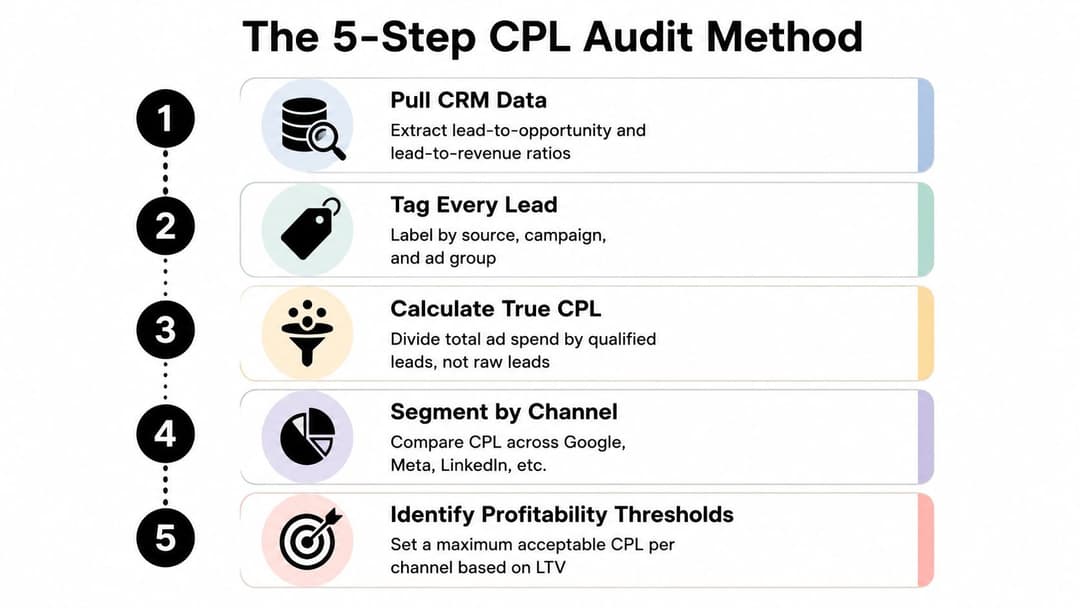
Don't launch new ads while your reporting still treats every form fill as equal. A proper CPL audit identifies which dollars create qualified opportunities and which dollars only create CRM maintenance.
Start with revenue-connected data
Step one is CRM reconciliation. Pull lead-to-opportunity and lead-to-revenue ratios from the CRM. Then tag each record by source, campaign, audience, offer, and the ad or placement where the available tracking allows it. If Meta reports a lead but the CRM shows no sales acceptance, the discrepancy belongs in the campaign diagnosis.
The basic calculation remains simple:
CPL = total marketing spend ÷ leads generated
For optimization, create a second operational view that divides spend by qualified leads, using your agreed MQL or SQL definition. Don't replace the standard CPL report. Keep both views visible so a campaign can't hide poor qualification behind cheap volume.
Segment before making cuts
Step two is channel segmentation. Break out spend, impressions, leads, and CPL by channel, then separate campaign objectives. Awareness-style campaigns optimized for reach or engagement shouldn't sit in the same comparison as campaigns optimized for lead generation.
Channel benchmarks show why blended CPL can mislead. One 2026 benchmark table reports average CPLs of $3.80 for email marketing, $21.98 for Meta Ads, $47 for Google Ads, and $75 for LinkedIn Ads. Another industry summary lists $840 for trade-show leads, $463 for PPC, $267 for webinars, $206 for SEO, and $225 for cold email. (B2B CPL benchmark comparison) These aren't interchangeable targets. They're prompts to investigate intent, sales cycle, and qualification quality by source.
Find the waste inside the ad set
Step three is placement and device analysis. Break performance down by ad set, placement, device, location, and audience overlay. A placement that produces inexpensive submissions may still create poor records. Check the qualification rate before removing it.
Step four is audience scoring. Rank segments by sales acceptance and opportunity creation, not CTR. Flag audiences that generate many forms but weak SQL progression. A CRM export often contradicts the platform dashboard.
Step five is controlled reallocation. Cut or restructure placements that sit materially above your benchmark, but don't pause an entire campaign when only one component is weak. Move budget toward the strongest performers, preserving useful delivery while improving the blended result. The Facebook ad account audit guide provides a practical framework for inspecting account structure and performance signals.
Testing Creative and Copy That Move CPL
Creative functions as a targeting signal, not just a visual layer. Meta observes the behavior produced by the message, format, offer, and proof, then searches for people likely to respond similarly. The right test asks which ad attracts leads that meet the quality threshold, not merely which one reports the lowest CPL.
For cold B2B prospecting, a clear static product image can outperform polished video when buyers need immediate context. DTC and local-service offers may gain more from UGC-style vertical video because it makes the value easier to understand in the feed. Short copy is often easier to process on mobile, although the offer determines how much explanation is necessary.
Use lead-quality benchmarks alongside creative results. If an ad generates cheap forms but few accepted leads, its apparent efficiency is misleading. A stronger concept can reduce wasted volume, improve downstream conversion, and lower blended CPL over time.
Test one meaningful variable at a time:
- Hook: Change the opening three seconds of a video, or the first visual and headline area of a static ad.
- Offer framing: Compare price-led messaging with transformation-led and objection-focused angles.
- Proof placement: Move testimonials, customer evidence, or demonstrations closer to the decision point.
- Call to action: Compare direct language with phrasing that asks for a lower commitment.
Keep the test set small enough to produce interpretable results. Rotate fresh concepts, but judge each variant against qualified outcomes in the CRM. An ad that delivers inexpensive leads below the SQL benchmark is underperforming, even when the platform labels it a top performer.
Creative variables ranked by likely impact
| Variable to Test | Format That Wins on Meta | Expected CPL Impact | Test Cadence |
|---|---|---|---|
| Hook | Direct problem statement, product demonstration, or strong UGC opening | Can materially change lead cost and intent quality | Test first, then refresh regularly |
| Offer framing | Clear outcome, relevant price context, or objection response | Often changes who completes the form | Test after the hook |
| Social proof | Specific testimonial or proof point near the decision moment | Can improve confidence and filter for serious prospects | Test after offer framing |
| CTA phrasing | Action aligned with commitment level | Can change volume, but quality must decide the winner | Test after core message |
| Format | Static, UGC-style video, carousel, or motion graphic | Varies by audience and offer | Maintain a rotating mix |
A structured split-testing process keeps creative decisions separate from unrelated account edits. AI-assisted production can then generate new executions around proven qualified angles, while lead-quality benchmarks determine which concepts remain in rotation. That feedback loop creates compounding CPL improvement instead of a one-time reduction.
Refining Audiences Without Killing Your Reach
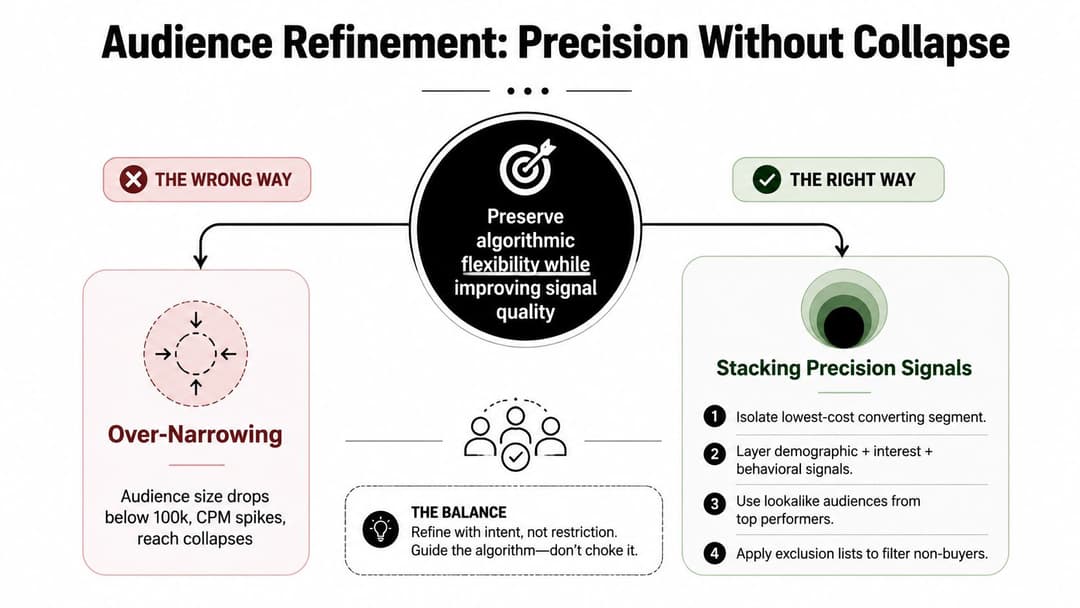
Audience refinement shouldn't mean shrinking the account until delivery becomes fragile. The better approach is to stack meaningful signals while leaving Meta enough room to find people who resemble your proven converters.
Begin with the audience that has already produced the strongest qualified outcomes. Use CRM-backed converters rather than link clickers or video viewers when building lookalikes. A lookalike based on people who merely engaged may reproduce cheap engagement behavior. A lookalike based on accepted or revenue-connected leads gives the platform a more useful definition of value.
Build the refinement loop
Start with a broad lookalike or high-quality customer seed. Layer interest signals only when they support the objection addressed by the creative. If the ad solves a reporting problem for B2B SaaS teams, an interest stack should reflect that problem or buying context, not a random collection of adjacent interests.
Apply exclusions with equal care:
- Past converters: Suppress customers and recent converters so acquisition spend doesn't pay for people who already completed the desired action.
- Non-converting engagers: Exclude engaged video viewers who repeatedly fail to qualify when the data supports that decision.
- Warm visitors: Separate site visitors from cold acquisition so the campaign doesn't mix different intent levels.
- Existing customer lists: Remove purchased customers from prospecting unless the campaign has a legitimate expansion objective.
Know when to narrow and when to expand
If CPL rises while qualification remains strong, don't automatically narrow. Check frequency, creative fatigue, placement mix, and landing-page conversion first. A rising frequency level can mean the audience needs new creative, not that the audience itself has failed.
Validate one audience and creative combination before introducing more complexity. Once the combination produces stable qualified outcomes, widen the lookalike incrementally or test broad targeting against it. Keep the original control intact so expansion doesn't erase the evidence you already have.
The wrong move is changing audience, offer, creative, bid, and landing page at the same time. You may see a better CPL, but you won't know which lever created it, and you'll struggle to reproduce the result.
Bidding and Budget Strategies That Protect Lead Quality
Bidding controls more than price. It influences which conversion opportunities the platform considers acceptable, especially when the account has enough reliable conversion data to distinguish valuable leads from casual form submissions.
Lowest Cost is useful when the priority is exploration or maximum volume. Its weakness is that it can pursue inexpensive conversions that don't match the sales team's definition of quality. Target Cost gives the system a cost objective while preserving room to find conversions. Cost Caps impose a harder ceiling, but delivery can become uneven if the cap is unrealistic or the campaign lacks sufficient signal.
| Strategy | Best For | Lead Quality Impact | Risk |
|---|---|---|---|
| Lowest Cost | Early exploration and campaigns seeking volume | Can maximize submissions without protecting qualification | Cheap leads may dominate |
| Target Cost | Stable campaigns with consistent conversion data | Encourages delivery near a defined efficiency target | May restrict delivery if the target is too aggressive |
| Cost Cap | Campaigns with a clear maximum acceptable CPL | Applies stronger cost control and can discourage expensive conversions | Delivery may become volatile |
| Manual or capped bid control | Advanced tests with strong auction knowledge | Gives tighter control over eligible auction prices | Can limit learning and reduce volume |
Budget discipline matters: A low CPL is useful only when the sales team accepts the leads and the CRM records meaningful progression.
Budget pacing deserves its own review. Daily budgets can spend heavily during early delivery windows, while lifetime budgets with scheduled pacing can smooth spend around the hours when your audience and sales team respond. This is particularly important when low-cost inventory produces weak engagement and high-cost inventory produces stronger buying intent.
A practical starting allocation is to put 70% of spend into proven ad sets and 30% into testing, with the benchmark cited in the campaign plan linked to Facebook ad budget management. Scale gradually rather than forcing a large budget jump that disrupts optimization. The plan notes recommend increases of no more than 20% every 48 hours, a figure that should be treated as an operating guardrail rather than a universal law.
For teams moving toward target-based bidding, these target CPA bidding setup steps provide useful implementation context. Whatever strategy you choose, monitor qualified-lead rate beside raw CPL. Incomplete information, low engagement, and weak sales acceptance should prompt a bid or targeting review even when the dashboard looks efficient.
Landing Page and Form Fixes That Drop CPL Fast
A campaign can buy qualified clicks and still produce an expensive CPL if the landing page breaks the promise made in the ad. Review the funnel before changing the bid. A clearer page and better qualification often reduce waste across every audience and placement.
Start with message continuity. The headline should repeat the ad's promise in language that fits the offer, audience, and expected outcome. If the ad promotes a discount, consultation, audit, or demo, show that offer in the hero section. Visitors should not have to search for the reason they clicked.
Remove friction without removing qualification
Ask only for information sales can use at the first interaction. For many campaigns, that means name, email, and one qualifying question. Collect supplementary details through progressive profiling, CRM enrichment, or a later sales conversation.
The qualifying question should identify intent rather than create busywork. Ask about the problem, purchase context, company fit, or timeline only when the answer changes routing or sales treatment. A shorter form that fills the CRM with unusable records has lowered completion friction, not improved CPL.
Keep the layout to one column, remove unnecessary navigation, and make the primary CTA easy to find on mobile. Put relevant proof beside the decision point. A specific testimonial, customer context, or product demonstration helps visitors judge fit more effectively than generic star ratings.

Teams that need to build and test forms without adding development work can use form software for lead generation for structured capture and qualification. The software matters less than preserving the ad promise, collecting usable answers, and sending complete data to the CRM.
Check the technical path
Test the full submission journey on the devices and browsers reached by the campaigns. Confirm that the confirmation state loads, the CRM receives the record, the correct owner is notified, and follow-up automation does not send a generic message that conflicts with the ad.
Run a practical page-speed audit as well. Compress oversized images, lazy-load nonessential media, remove scripts that do not support the conversion path, and keep the form close to the primary action. Landing-page conversion for B2B websites often falls within a 2% to 5% visitor-to-lead range, according to the B2B lead-generation benchmarks. Improving conversion from existing traffic lowers effective CPL without purchasing another impression.
Track qualified-lead rate beside form completion. A page that raises submissions while lowering sales acceptance is not a win. Pair those quality signals with creative test results, then keep the page and message combinations that attract intent, producing CPL improvements that can continue through later campaign optimization.
Scaling With Automation and AI to Compound the Gains
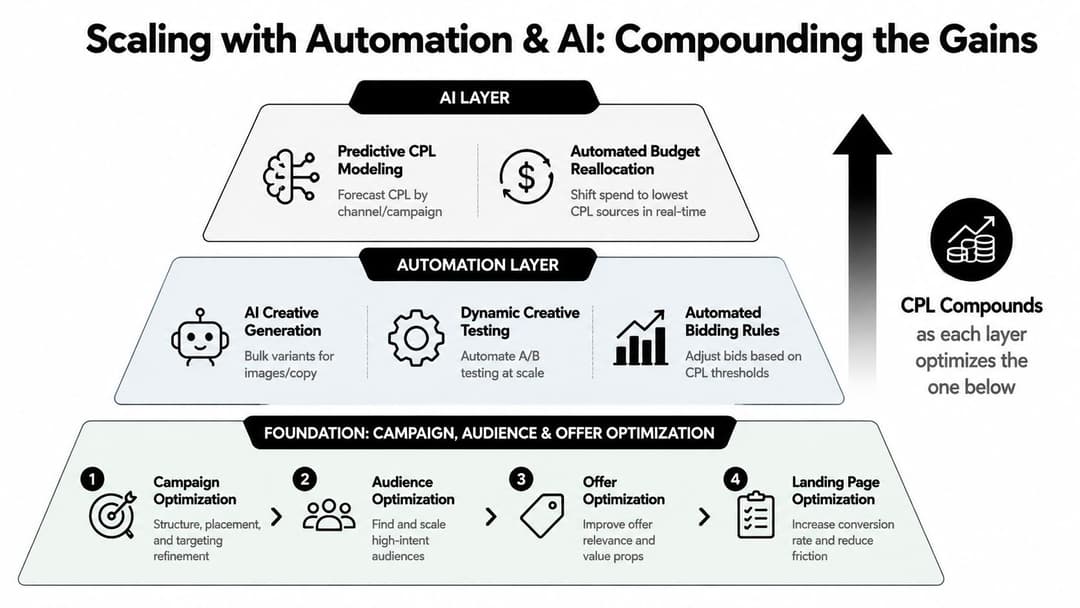
Automation works best after the account has a trustworthy definition of quality. If the CRM accepts every form as a success, an automated system will produce more forms. If the platform receives qualified-lead and revenue signals, it can help search for the people and messages that create pipeline.
The foundation is the audit. Feed campaign, audience, offer, placement, and sales-stage data into a reporting view that distinguishes raw CPL from qualified CPL. Next, use AI to generate structured creative variations around validated hooks, objections, proof points, and offers. The purpose isn't to publish random volume. It's to create enough controlled variation for the platform to identify which messages attract the right intent.
Automate production before decisions
When budget or headcount is limited, automate repetitive production first:
- Creative and copy variants: Generate multiple executions from approved brand assets and tested messaging angles.
- Naming and campaign assembly: Standardize campaign structures, tracking labels, and audience combinations.
- Performance sorting: Rank ads by qualified CPL, SQL rate, and downstream progression instead of asking a buyer to inspect every row manually.
- Budget alerts: Notify the team when spend rises, qualification falls, or a placement exceeds its acceptable threshold.
Dynamic creative testing can rotate combinations automatically, but keep a human review for claims, compliance, offer accuracy, and brand fit. A rapid launch loop should use hook-level performance data to decide which concepts deserve new executions. It shouldn't treat every early winner as permanent.
Connect platform learning to business outcomes
Meta's automated campaign structures can help with delivery and discovery, while manual campaign and CBO tests preserve controlled exploration. Use automated learning when event tracking is reliable and the account has enough quality signal. Reserve explicit exploration budget when the system is over-concentrating on one audience or repeatedly selecting cheap but weak lead paths.
Conversions API and CRM feedback are central to this setup. Send qualified lead stages back to the advertising platform so optimization isn't limited to the initial form submission. Map the stages carefully, preserve identifiers for attribution, and monitor delays between lead capture, qualification, opportunity creation, and close.
AdStellar AI is one option for teams that want to generate batches of Meta creative, copy, and audience combinations, connect with Meta Ads Manager, and rank performance against goals such as CPL or CPA. Its role should remain operational: accelerate testing and surface patterns while the media buyer controls quality definitions and budget guardrails. The Meta ads automation guide provides additional context on scaling workflows without treating automation as a replacement for measurement.
Set guardrails before increasing volume
Keep a written automation checklist:
- Quality threshold: Define the minimum sales-acceptance or SQL rate required before an ad can scale.
- Spend limit: Set rules that pause or notify when a campaign exceeds its qualified-CPL ceiling.
- Creative review: Require approval for claims, testimonials, pricing, and regulated language.
- Learning protection: Prevent constant edits that reset optimization and make results impossible to interpret.
- Feedback integrity: Verify CRM stages, deduplication, attribution, and conversion-event mapping.
- Testing reserve: Protect budget for new hooks and audiences so the system doesn't only exploit existing winners.
AI compounds gains only when each layer improves the next. The audit tells you where waste sits. Creative testing improves the signal. Audience and bidding controls direct delivery. Landing-page work converts paid traffic more efficiently. Automation then increases the number of useful experiments without multiplying the weaknesses you failed to fix.
AdStellar AI helps growth teams launch and test Meta campaigns with bulk creative, copy, audience combinations, performance insights, and automated workflows tied to goals such as CPL. Visit AdStellar AI to evaluate whether its campaign-building and testing workflow fits your paid-social process.