For years, most marketers wrote off Instagram as a top-of-funnel toy. It was all about brand awareness, follower counts, and maybe getting a few likes. We talked about "engagement," but rarely about tangible results like Cost Per Lead (CPL) or actual conversion rates.
That whole mindset is officially dead. Instagram has grown up into a serious engine for finding and acquiring high-intent customers. It’s no longer just a brand channel; it’s a core pillar of direct-response marketing.
Why Instagram Is a Goldmine for High-Quality Leads
The platform's highly visual, in-your-face nature creates a unique environment for grabbing attention. Unlike the endless scroll of text-heavy platforms, Instagram lets you show, not just tell. You can demonstrate value instantly with compelling images, snappy videos, and interactive Stories.
This visual-first approach is practically built for showcasing valuable lead magnets. Think about it:
- Exclusive access to a webinar
- A downloadable checklist or guide
- A free trial of your software
- A quiz to help users discover something new
More Than Just a Social Network
What really turns Instagram from a simple social app into a lead-gen machine is how people use it. They aren't just passively scrolling; they're actively looking for solutions, inspiration, and recommendations from brands they already follow and trust.
They’re primed to engage with content that solves a nagging problem or offers a shortcut to their goals. This creates the perfect opening for you to present a lead magnet that feels like a helpful next step in their journey, not some jarring ad.
The key is to stop thinking about Instagram as just a place to post pretty pictures. View it as a dynamic environment where you can spot user needs and offer immediate, valuable solutions in exchange for their contact info.
Making that mental shift is what separates the performance marketers crushing their goals from those still stuck chasing vanity metrics.
The Power of Scale and Profitability
The sheer scale here is hard to ignore. Instagram has over 2 billion active monthly users around the globe, giving you a massive pool of prospects no matter what industry you're in.
More importantly, that incredible reach translates directly into real financial returns. Research shows that Instagram delivers an average ROI of around 29% for brands that lean into visual engagement, proving just how effective it can be for sophisticated lead generation campaigns. You can dig into more of Neal Schaffer's research on Instagram's profitability to see the numbers for yourself.
This data makes one thing crystal clear: a well-executed strategy on Instagram isn't just about getting seen. It's about building a profitable, scalable customer acquisition channel that fuels your business.
Building Your Instagram Lead Generation Playbook
Throwing money at Instagram ads without a solid game plan is a recipe for disaster. A winning lead generation strategy doesn't start with a flashy creative; it starts with a clear, documented plan. If you can't define what success looks like, you’re just guessing.
Forget vague goals like "get more leads." That's not a strategy—it's a wish. You need to get hyper-specific and measurable with your targets.
For instance, wanting more webinar attendees is a weak goal. A powerful, actionable goal sounds more like this: "Achieve a $15 Cost Per Lead (CPL) for webinar sign-ups from our North American audience in Q3." See the difference? That level of clarity immediately informs your budget, your targeting, and the kind of creative you need to build. It’s the foundation for everything that follows.
Define Your Key Performance Indicators
Once your goal is locked in, you need to pick the right Key Performance Indicators (KPIs) to measure your progress. Think of these as the vital signs for your campaign. They tell you what's working, what's broken, and where you need to step in.
For Instagram lead generation, you should be watching these metrics like a hawk:
- Cost Per Lead (CPL): This is your north star. It's the total ad spend divided by the number of new leads you've captured. CPL tells you exactly how efficient your spending is.
- Lead Form Conversion Rate: Of all the people who opened your lead form, what percentage actually finished and submitted it? A low number here is a huge red flag that your form might be too long, confusing, or asking for too much information.
- Click-Through Rate (CTR): This classic metric shows the percentage of people who saw your ad and actually clicked on it. It’s a great way to gauge how compelling your creative and copy really are.
This simple process flow shows how these foundational pieces fit together. You start with the big-picture goal, which then dictates the specific actions you'll take.
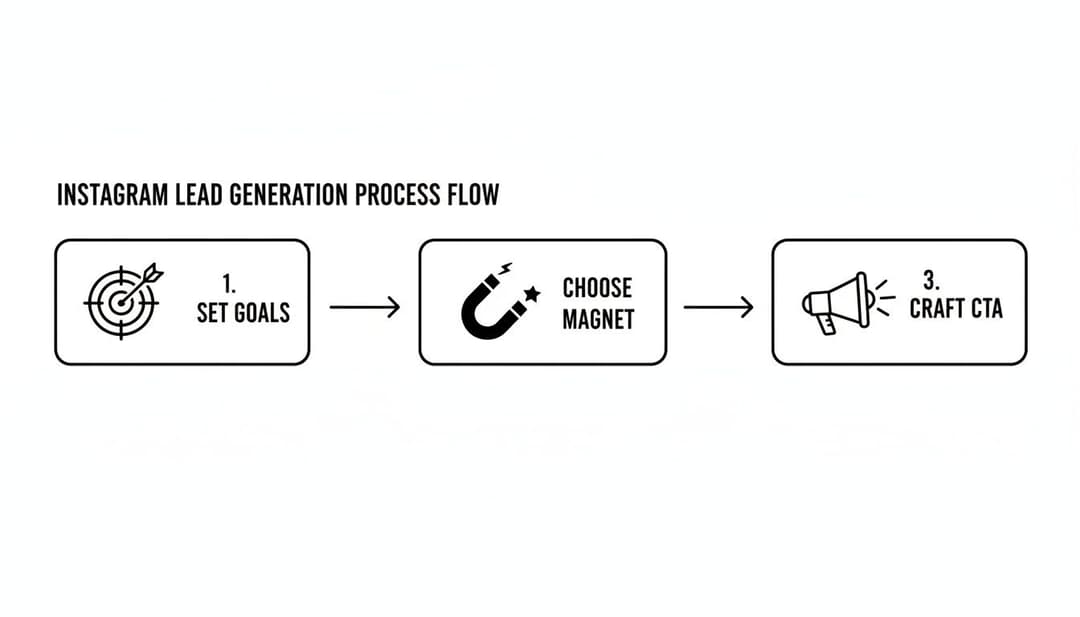
As you can see, a powerful lead magnet and a sharp call-to-action aren't just random creative ideas. They're direct responses to the goal you set from the very beginning.
Choose Your Lead Magnet and Craft a Strong CTA
Your lead magnet is the valuable thing you offer in exchange for someone's contact details. It absolutely must solve a real, specific problem for your ideal customer.
A B2B software company might create a "State of the Industry Report," while a fitness coach could offer a "7-Day High-Intensity Workout Plan." We’ve seen quizzes work incredibly well, too; they tap into people's curiosity and can generate thousands of subscribers for a relatively low cost.
To help you connect your goals to the right offer, here's a quick reference table.
Matching Lead Magnets to Your Business Goals
| Campaign Goal | Recommended Lead Magnet | Example CTA | Primary KPI |
|---|---|---|---|
| Brand Awareness | Informative Infographic or Quiz | "Take the Quiz & Find Your Style" | Reach / Impressions |
| Lead Generation | Ebook, Checklist, or Webinar | "Download Your Free Guide Now" | Cost Per Lead (CPL) |
| Lead Nurturing | Case Study or Free Consultation | "Book Your Strategy Call" | MQL to SQL Rate |
| Direct Sales | Discount Code or Free Trial | "Claim Your 20% Off" | Return on Ad Spend (ROAS) |
This table isn't exhaustive, but it provides a solid framework for making sure your offer aligns perfectly with what you're trying to achieve.
Key Takeaway: Your lead magnet's perceived value must be greater than the user's hesitation to share their email address. Make the offer so good they can't say no.
Finally, you need a Call-to-Action (CTA) that is direct, compelling, and leaves no room for confusion. Generic phrases like "Learn More" are conversion killers. Instead, you need to use action-oriented language that spells out the benefit.
- Instead of: "Learn More" -> Try: "Get My Free Checklist"
- Instead of: "Sign Up" -> Try: "Save My Spot for the Webinar"
This kind of specific language creates a sense of urgency and clarity, which is exactly what you need to push conversion rates higher.
Of course, these tactics work best when they're part of a cohesive plan to generate leads on social media across all your channels. And once you capture those leads, the work isn't over. For a deeper dive, check out our guide on using https://www.adstellar.ai/blog/instagram-direct-message-automation to engage and nurture them the moment they sign up.
Choosing the Right Instagram Formats for Lead Capture
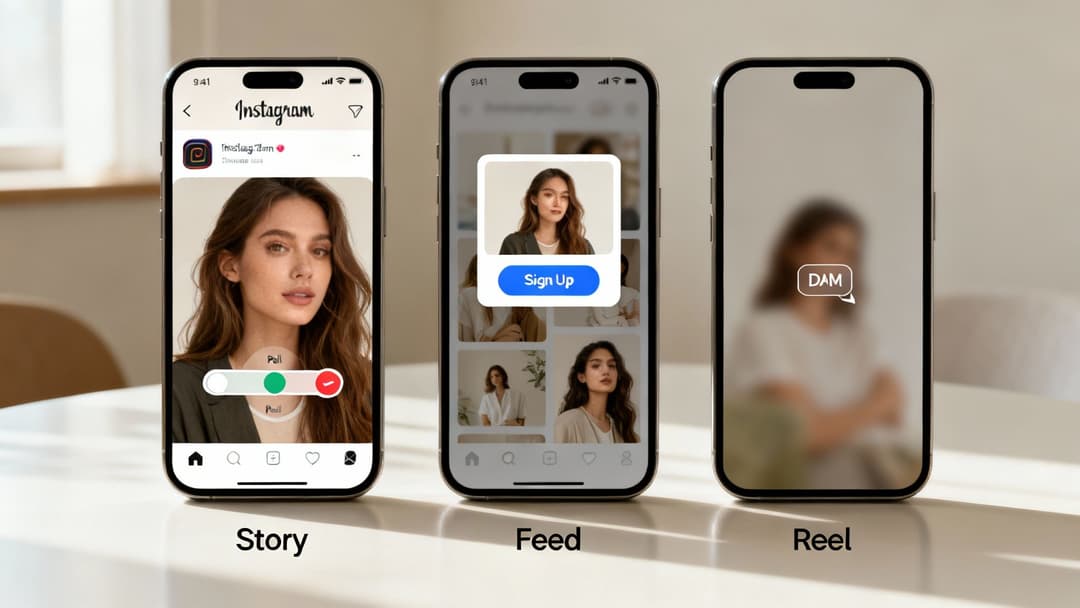
Not every Instagram format is built the same when it comes to generating leads. The one you pick has a direct impact on everything from user friction and cost to the actual quality of the leads you bring in. Getting Instagram lead generation right means knowing exactly when to use a Story, a Reel, or a dedicated Lead Ad to hit your mark.
Each format catches a user in a different frame of mind. Someone tapping through Stories is looking for something quick and interactive. A user scrolling their Feed, on the other hand, might be more receptive to a thoughtful carousel post. Understanding this context is the first step toward making smarter strategic decisions.
Driving Action with Instagram Stories and Reels
Stories are all about urgency. They’re quick, highly interactive, and gone in 24 hours. This makes them the perfect vehicle for time-sensitive offers like webinar sign-ups or flash sales on a digital download. That temporary nature creates a natural FOMO (fear of missing out) that nudges people to act now.
Get creative with the interactive stickers—they’re your best friend here:
- Poll Stickers: Toss out a qualifying question to see who’s interested before you even send a link. Something like, "Struggling with content creation? Yes/No." From there, you can slide into the DMs of everyone who voted "Yes."
- Quiz Stickers: Put together a simple quiz that ties into your lead magnet. It’s a great way to engage your audience and subtly show them why they need the resource you’re offering.
- Link Sticker: This is your direct line to the landing page. Make the call-to-action on the sticker impossible to misunderstand. Think "Get the Guide" or "Save My Seat."
Reels, on the other hand, are your top-of-funnel discovery engine. A Reel that hits the algorithm just right can introduce your brand to thousands of potential leads overnight. The trick is to weave your lead generation CTA into genuinely entertaining or educational content, then point people to the link in your bio. To make sure your video ads look sharp, it's worth knowing the right specs—our guide on the correct video size for Facebook ads has principles that apply here, too.
Converting with Feed Posts and Carousels
The Instagram Feed is where you get to unpack a more detailed story. While a single, punchy image or video post works well for a straightforward offer, carousels are where the real magic happens for lead gen.
Treat a carousel like a mini-landing page right in the feed. You have multiple slides to work with, so you can map out a full narrative:
- Hook them on the first slide with a compelling problem or a provocative question.
- Educate them over the next few slides with value-packed tips that solve part of that problem.
- Introduce your lead magnet as the natural next step to go deeper.
- Finish with a strong CTA telling them exactly what to do next (hint: click the link in your bio).
This multi-slide journey lets you build a strong case for your offer, warming up the prospect before they ever have to leave the app. It's a surprisingly effective way to build intent and drive high-quality clicks.
Don’t just announce your offer; build a narrative around it. A well-crafted carousel educates your audience, establishes your authority, and makes clicking that link in your bio feel like a no-brainer. This approach turns a simple post into a lead-generating powerhouse.
Maximizing Efficiency with Instagram Lead Ads
When speed and volume are the name of the game, nothing touches an Instagram Lead Ad. These are native forms that let users hand over their information without ever leaving the Instagram app. It gets even better—Instagram pre-fills fields like name and email directly from their profile, cutting the friction down to almost nothing.
This seamless experience usually leads to a much lower Cost Per Lead (CPL) than you’d get from sending traffic to an external landing page. The power of paid social here is undeniable. In fact, paid social ads are known to generate 2× higher lead volume than organic efforts alone. Plus, when you retarget these users, you can boost conversion rates by up to 70%.
The one watch-out? The sheer ease of submission can sometimes attract a few lower-quality or less-invested leads. To sidestep this, just add one or two custom qualifying questions to your form. It adds a tiny bit of friction that helps weed out the casual browsers, helping you find that sweet spot between lead quantity and quality.
Targeting Your Ideal Customers with Precision
When it comes to Instagram lead generation, effective targeting isn't about reaching the most people. It’s about reaching the right people. Spraying your ads across a broad, generic audience is one of the fastest ways to burn through your budget, ending up with a high cost-per-lead (CPL) and a list of people who will never buy from you.
Precision targeting is where you turn unpredictable ad spend into a reliable revenue stream.
The first step is to get beyond the basics. While demographic and interest targeting are decent starting points, the real magic happens when you start using your own data to build high-value audiences. This is where Custom Audiences and Lookalike Audiences come in, forming the backbone of any sophisticated lead gen strategy on Instagram.
Building Powerful Custom and Lookalike Audiences
You need to start with what you already have. The most valuable data points at your disposal come from people who have already raised their hands and shown interest in your brand.
You can create powerful Custom Audiences from several key sources:
- Website Visitors: Think about targeting users who have hit specific, high-intent pages, like your pricing or product pages, within the last 30-90 days.
- Email List: Upload your customer or newsletter subscriber list to find those exact users on Instagram. This is a goldmine.
- Engagement: Create an audience of people who have recently watched your videos, liked your posts, or slid into your DMs.
These are warm audiences. They already know who you are, making them perfect for retargeting with your lead magnet offers. Once you have these dialed in, the next step is to leverage them to find a constant stream of new customers.
This is where Lookalike Audiences become your scaling engine. A Lookalike Audience is created when Meta’s algorithm analyzes the common traits of your source audience (like your best customers) and then goes out to find new users who share similar characteristics.
Pro Tip: Your Lookalike Audience is only as good as the source you feed it. For the highest quality leads, build your Lookalikes from a list of your top customers (those with the highest lifetime value) or users who have completed a critical conversion, not just "all website visitors."
The Meta Ads platform gives you all the tools you need to create these audiences right from your own data sources.
As you can see, the interface is straightforward. You select your source audience, choose the size, and let the algorithm do the heavy lifting to find highly relevant new users for you.
Systematically Testing Your Audiences
Here’s a hard truth: you should never assume you know which audience will perform best. You have to test them, and you have to do it systematically.
Set up a structured A/B test comparing a few distinct audience segments. For example, you could run a head-to-head test between:
- A 1% Lookalike built from your top customers.
- A broad, interest-based audience (e.g., "digital marketing").
- A Custom Audience of your recent website visitors.
Run the exact same ad creative and copy to each audience, keeping the budget consistent. After a few days, dive into the data. Compare the CPL and lead form conversion rate for each segment. This data-driven approach removes all the guesswork and shows you exactly where your budget will get the best returns.
Of course, targeting is just one piece of the puzzle. To really boost your discoverability and reach, you also need the right hashtags; you can discover effective hashtag strategies for Instagram Reels to get that part right. For a deeper dive into audience building, check out our complete guide on how to identify a target audience.
How to Optimize and Scale Your Campaigns with AI
Getting your Instagram lead generation campaign live is just the starting line. The real money is made in the relentless cycle that comes next: testing, tracking, and intelligently scaling what’s actually working. This is where you stop gambling and start building a predictable system for bringing in new customers.
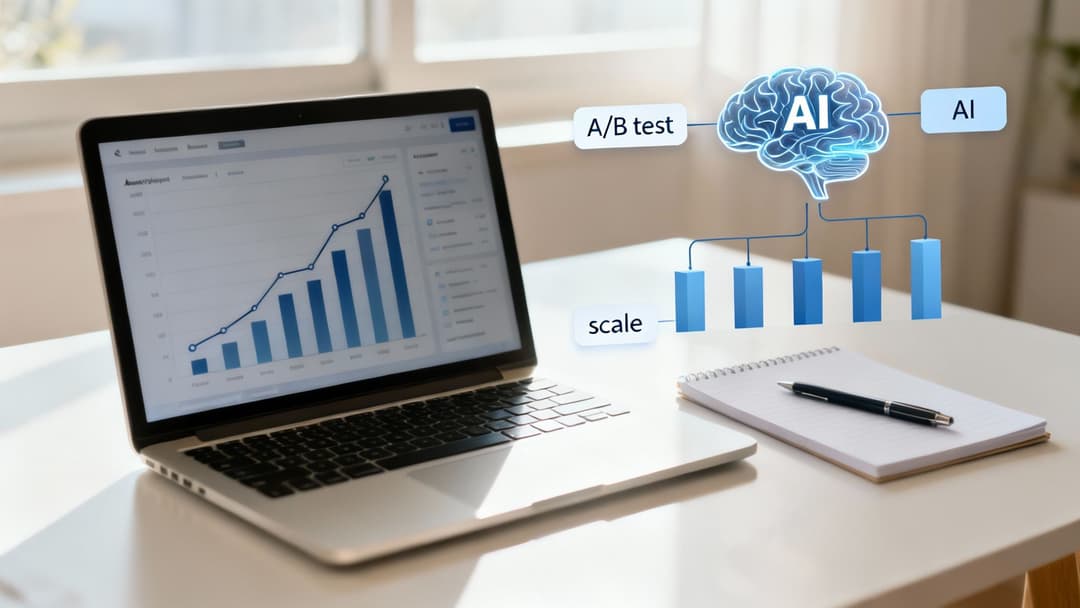
It all starts with creating a data-driven feedback loop. Get inside your Meta Ads Manager and become obsessed with your main KPIs—Cost Per Lead (CPL), conversion rate, and click-through rate (CTR). These aren't just numbers; they’re telling you a story about which ads are connecting and which are just burning cash.
Creating a Consistent A/B Testing Rhythm
Guesswork has no place in a high-performing campaign. You need a steady rhythm of A/B testing to systematically chip away at your CPL and improve results. The biggest mistake people make is testing too many things at once. That just creates messy data. You have to isolate one variable at a time to get clean, actionable insights.
Here’s a simple testing cadence you can steal:
- Week 1: Pit two completely different ad creatives against each other. Think static image vs. a quick video, using the exact same audience and copy.
- Week 2: Take your winning creative and now test it with two different headlines. See which hook grabs more attention.
- Week 3: Now that you have a winning creative/headline combo, test it against two distinct audiences. Maybe a Lookalike Audience vs. an interest-based one.
This methodical approach lets you stack your wins week after week. By the end of the month, you’ll have a seriously optimized ad built on real-world performance, not just a gut feeling.
The point of A/B testing isn’t just to find one "perfect" ad. It’s to build a deep, intuitive understanding of what makes your audience tick—which messages, visuals, and offers get them to take action. That knowledge is an asset that makes every future campaign you run that much smarter.
Leveraging AI for Faster Insights and Scaling
Trying to manage all this testing and optimization manually is slow, tedious, and leaves way too much room for human error. For anyone serious about scaling their Instagram lead generation, this is where AI and automation become non-negotiable. Modern tools can put this entire feedback loop on hyperdrive, turning weeks of manual analysis into a few clicks.
AI-powered platforms like AdStellar can automatically generate hundreds of ad variations, letting you test more combinations of creative, copy, and audiences than a human team ever could. These systems analyze performance data as it comes in, instantly flagging the top-performing elements for you.
For example, an AI might spot that images with a blue background paired with a question-based headline consistently deliver a 20% lower CPL. That's a powerful insight you can immediately double down on across your account.
Better yet, AI can act as a hyper-intelligent media buyer, automatically shifting your budget toward the ads and audiences that are actually delivering results. This takes emotion out of the equation and makes sure every dollar is working as hard as possible. With 32% of marketers calling Instagram a key source for leads, the efficiency you gain from AI is massive.
You can dig deeper into these trends with recent lead generation statistics. Our own guide on using AI for Facebook Ads also breaks down more advanced strategies that are directly applicable to your Instagram campaigns.
Common Questions About Instagram Lead Generation
Even with a killer strategy in hand, questions always pop up when you're in the trenches running an Instagram lead gen campaign. Getting clear on these common hurdles can be the difference between a campaign that stalls out and one that truly scales. Let's tackle some of the most frequent questions we hear from marketers.
One of the biggest uncertainties always circles back to cost. It's a question we get constantly, and the answer isn't as simple as you might think.
What Is a Good Cost Per Lead for Instagram Ads?
There’s no magic number for a "good" Cost Per Lead (CPL) on Instagram. It varies wildly depending on your industry, what you're offering, and who you're talking to.
A B2C e-commerce brand might be thrilled with a $15 CPL for a newsletter sign-up. On the other hand, a B2B SaaS company could be wildly profitable paying $120 for a qualified demo request.
Don't get caught up chasing universal benchmarks. The only number that really matters is your number.
The real question isn't "What's a good CPL?" It's "What CPL is profitable for my business?" You figure this out by looking at your customer lifetime value (LTV) and lead-to-customer conversion rate. If a $60 lead reliably turns into a $600 customer, you've got a winning formula.
Your first goal should be to set your own baseline CPL. From there, your job is to methodically work to bring it down through smart testing. For a deeper dive, check out our guide on what is Cost Per Lead, which gives you a framework for calculating your own target CPL.
How Can I Improve My Lead Quality?
Getting a flood of cheap leads that never convert is just as bad as getting no leads at all. It's a classic case of quantity over quality, and it kills your ROI. If your lead quality is suffering, the fix usually involves tightening your targeting and adding a little bit of strategic friction.
Here are a few things you can do right away:
- Refine Your Lookalikes: Don't just build Lookalike Audiences from all your website visitors. Instead, create them from a source of your absolute best customers. This feeds the algorithm much higher-quality data to work with.
- Add Qualifying Questions: Use Instagram's Lead Form to include one or two custom questions. A simple field asking "What is your company size?" can instantly weed out prospects who aren't a good fit.
- Be Hyper-Specific in Your Ads: Your ad copy needs to call out exactly who your offer is for and the specific problem it solves. This encourages the right people to self-select and tells the wrong people to keep scrolling.
Should I Use Instagram Lead Ads or a Landing Page?
This really comes down to the complexity of your offer. Both approaches have their place, and the best strategies often use a mix of both.
For simple, low-commitment offers—think downloading an ebook or signing up for a newsletter—Instagram Lead Ads are often the clear winner. They slash friction by keeping the user inside the app and pre-filling their contact info. This almost always results in a lower CPL.
But for more complex or high-consideration offers, like scheduling a demo or enrolling in a paid course, a dedicated landing page is usually the way to go. It gives you the space you need to add more detail, social proof, testimonials, and FAQs to convince someone to take that bigger leap.
When in doubt, run an A/B test. Pit a Lead Ad against a landing page and see which one delivers the best balance of lead volume and quality for your specific campaign.
Ready to stop the guesswork and start scaling your campaigns with precision? AdStellar AI automates the entire process, from bulk ad creation to AI-powered optimization, helping you launch, test, and scale your Meta ads 10x faster. See how it works at https://www.adstellar.ai.