Cost Per Lead (CPL) is the exact price you pay to get one potential customer’s contact information. Think of it as the cost of getting an interested person to raise their hand and say, “Hey, tell me more.” It's a foundational marketing metric that connects your ad spend directly to tangible results.
Understanding What Cost Per Lead Really Means

Let’s stick with a simple cafe analogy. Say you spend $100 on flyers to promote a new coffee blend. If ten people walk in holding that flyer and ask for a free sample (becoming a "lead"), your Cost Per Lead is $10. Easy enough, right?
But CPL is more than just a number on a spreadsheet; it’s a core health indicator for your marketing campaigns. It acts as a compass, pointing you toward the marketing efforts that are efficiently attracting potential customers and warning you about the ones that are just draining your budget. It bridges the gap between spend and outcome, answering the all-important question: "How much are we paying to start a conversation with someone new?"
Why There Is No Universal CPL
One of the first things you need to get straight about CPL is that there's no single "good" number. A successful CPL is entirely relative—it all depends on your specific business and industry. Several factors will always influence what you should expect to pay:
- Industry: A lead for a high-ticket B2B software product is naturally going to cost a lot more than a lead for a direct-to-consumer t-shirt brand.
- Marketing Channel: Leads from high-intent platforms like Google Search, where people are actively looking for a solution, will usually cost more than leads from awareness-focused channels like Facebook.
- Lead Quality: A lead who requests a product demo is far more valuable (and therefore more expensive to acquire) than someone who just downloads a free checklist.
Cost Per Lead is the unit-economics metric that tells you how much you pay to generate a single lead, calculated by dividing your total campaign spend by the number of leads generated. It's a critical lever on profitability, especially when 53% of marketers report spending over half their budget on lead generation.
CPL as a Performance Benchmark
At the end of the day, knowing your CPL is the first step toward optimizing it. For performance-driven channels like Google Ads, the average CPL across all industries was $53.52 in 2023.
But that average hides a huge range, from $23.57 in Automotive Services to a whopping $132.95 in the hyper-competitive employment sector. These benchmarks show you just how much audience intent and competition shape your costs. You can discover more Google Ads benchmark insights to see how your industry stacks up.
Getting a handle on this foundational metric sets the stage for everything else—measuring, benchmarking, and most importantly, actively improving your own CPL.
How To Calculate Your True Cost Per Lead
Figuring out your Cost Per Lead seems simple on the surface, but it's an area where many marketers trip up. The biggest mistake? Only counting direct ad spend. This gives you an incomplete, and frankly, dangerously misleading picture of what it really costs to get a new lead in the door.
The basic formula is straightforward. You take the total cost of your marketing campaign and divide it by the total number of new leads you generated from that specific push.
CPL Formula: Total Marketing Spend / Total New Leads Generated = Cost Per Lead
To get a CPL number you can actually trust, you have to account for every single dollar that went into the effort. This means going beyond just the ad platform fees. We're talking about creative production, software tools, and even the time your team sinks into the project. If you want a hand tracking all the moving parts, a dedicated online Cost Per Lead Calculator can help you get the breakdown right.
B2B SaaS Webinar Example
Let's make this real. Imagine a SaaS company running a LinkedIn campaign to drive registrations for an upcoming webinar. For them, a "lead" is anyone who signs up.
Here’s a look at their total marketing spend, not just the ads:
- LinkedIn Ad Spend: $2,500
- Video Ad Creative Production: $500 (what they paid a freelancer)
- Webinar Software Subscription (prorated for campaign): $50
- Landing Page Tool Subscription (prorated): $30
The campaign was a success, bringing in 154 webinar registrations (their new leads).
So, the math looks like this:
Calculation: ($2,500 + $500 + $50 + $30) / 154 leads = $20.00 CPL
D2C E-commerce Quiz Example
Now for a totally different scenario. A direct-to-consumer (D2C) skincare brand is using a "Find Your Perfect Skincare Routine" quiz on Meta (Facebook and Instagram) to capture emails. Here, a "lead" is anyone who finishes the quiz and hands over their email to get the results.
Let's tally up their costs:
- Meta Ad Spend: $1,000
- Quiz Software Subscription (monthly fee): $75
- Graphic Design for Ads (one-time cost): $200
This campaign generated 420 new email subscribers.
Let's run the numbers:
Calculation: ($1,000 + $75 + $200) / 420 leads = $3.04 CPL
By tracking every related cost, both of these businesses get a true measure of how efficient their campaigns are. This CPL figure is a critical early indicator that feeds directly into your final customer acquisition cost. To see how these two essential metrics connect, check out our guide on how to calculate cost per acquisition.
So, you've calculated your Cost Per Lead. The very next question that pops into your head is always, "Is this number any good?"
The honest answer? It depends. There’s no universal magic number for CPL. What’s considered a home run in one industry could be a complete disaster in another.
Think of it like comparing the cost of a meal. A $5 CPL might be the equivalent of a fantastic taco from a food truck—it’s efficient, satisfying, and gets the job done. On the other hand, a $500 CPL is more like a Michelin-star dinner. The investment is way higher because the expected return, or customer lifetime value, is exponentially greater.
The whole game is about comparing your costs against the right benchmarks, not some imaginary industry-wide figure.
At its core, CPL is a simple but powerful equation, as this visual breaks down.
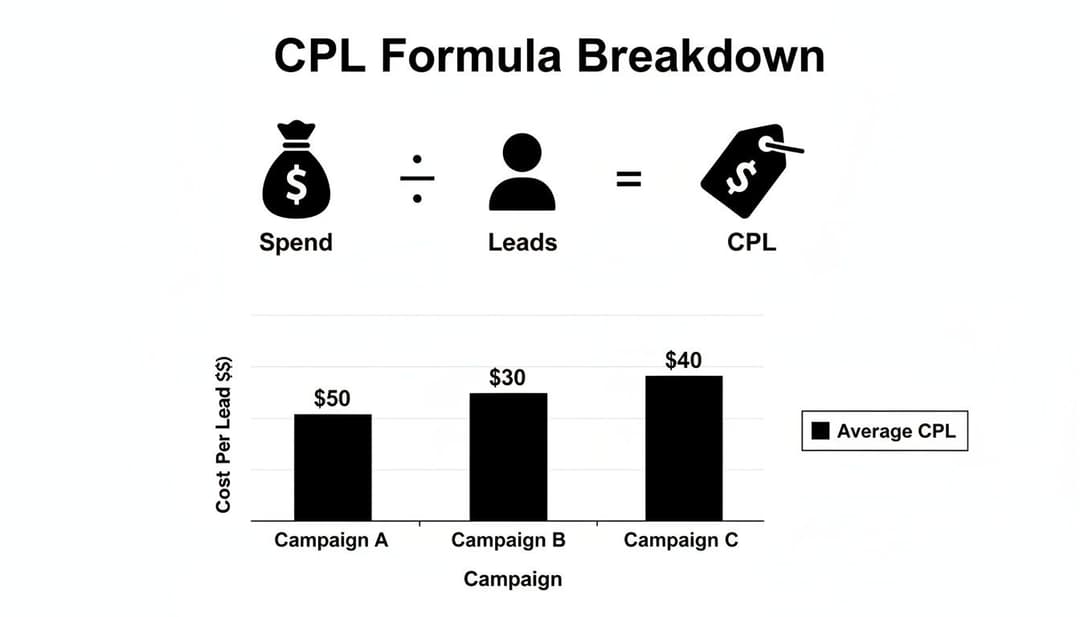
It’s a direct relationship: your CPL is a result of how much you spend versus how many leads you actually generate. Simple as that.
How Different Channels Impact CPL
One of the biggest factors driving your CPL is the marketing channel you're using. Someone actively typing a solution into Google is a much warmer prospect than a person casually scrolling through their social media feed. That difference in intent shows up directly in the cost.
Global benchmarks show just how dramatically CPL can swing from one channel to the next. This is why savvy growth teams focus on a blended CPL across their portfolio instead of getting hung up on a single number.
To give you some perspective, the average B2B CPL across all channels hovers around $200. But when you look closer, the story gets more interesting. Let’s look at some estimated benchmarks.
Average Cost Per Lead (CPL) by Marketing Channel
| Marketing Channel | Average CPL (B2B) | Key Considerations |
|---|---|---|
| Search Engine Marketing (SEM) | $50 - $150 | High-intent audience, but can be highly competitive. |
| Social Media Advertising | $50 - $100 | Great for top-of-funnel awareness; lead quality can vary. |
| Content Marketing/SEO | $75 - $200 | Higher upfront investment, but delivers compounding, high-quality leads over time. |
| Email Marketing | $50 - $100 | Very effective for nurturing an existing audience, less so for cold acquisition. |
| Webinars & Virtual Events | $75 - $250 | Captures engaged leads but requires significant promotion and content creation effort. |
| In-Person Events & Trade Shows | $400 - $800+ | Extremely high cost, but often produces the highest quality, sales-ready leads. |
As you can see, the numbers are all over the place. In-person events can send CPLs soaring as high as $811, while well-targeted social media ads can bring in leads for an average of $58. It's all about matching the channel to the goal.
Key Takeaway: Don't judge all your channels by the same CPL standard. A higher CPL on a high-intent channel like LinkedIn might deliver far more value than a lower CPL from a broad awareness campaign on Facebook.
Of course, the ad spend itself is a huge part of this equation. To get a better handle on how platform-specific costs contribute to your final CPL, it's worth digging into the details of social media marketing cost.
Industry-Specific CPL Benchmarks
Just like channels, different industries have wildly different CPL averages. This is usually tied to things like the average deal size, the length of the sales cycle, and how crowded the market is. It makes sense that a competitive industry with a high customer lifetime value—like legal or financial services—will have a much higher acceptable CPL.
Here’s a quick snapshot of how CPLs can vary by industry:
- Legal Services: Often sees the highest CPLs, sometimes pushing past $600. This makes sense given the high value of a single client.
- IT & Software: Typically ranges from $500-$600, a reflection of complex solutions and long, considered sales cycles.
- Manufacturing: CPLs can land around $391, balancing high-value equipment sales with the challenge of reaching niche audiences.
- B2B SaaS: Averages are often closer to $188, which reflects a mix of high-value enterprise deals and more scalable, lower-touch sales models.
In the end, remember that these benchmarks aren't rigid rules—they're reference points. They give you a starting line to measure your own performance against, helping you set realistic goals and spot which parts of your marketing machine need a tune-up to become more efficient.
The Four Levers That Control Your CPL
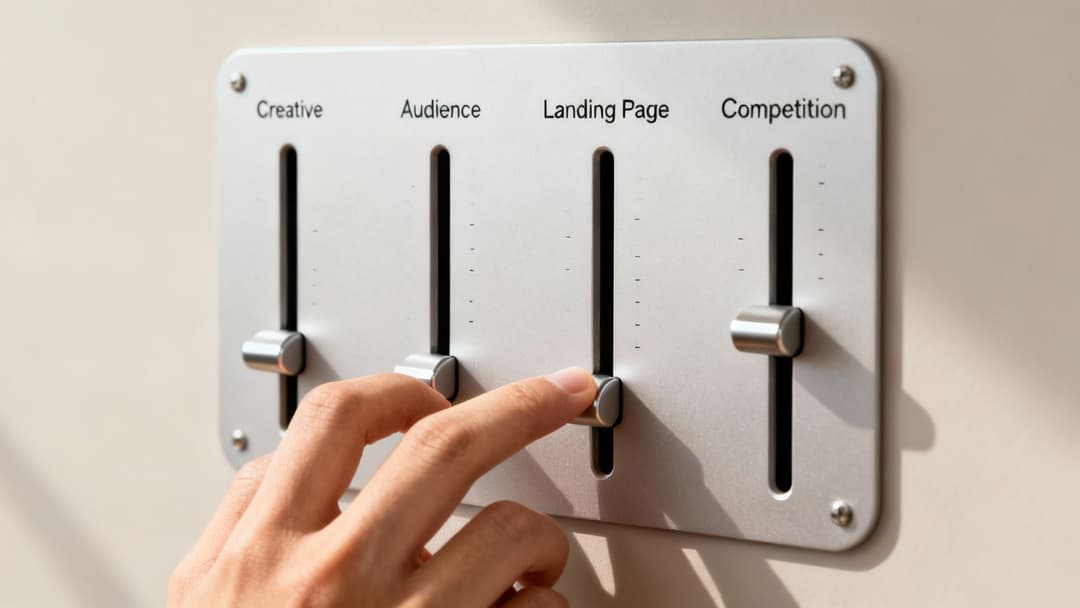
Knowing your Cost Per Lead is one thing, but actually getting it under control is a completely different ballgame. Your CPL isn’t some fixed number handed down from the marketing gods—it’s the direct result of a few key factors you can absolutely influence. Think of them as the four main control levers on your campaign’s dashboard.
When your CPL starts creeping up, it’s almost always because one of these levers is in the wrong position. By figuring out which one is causing the problem, you can make targeted adjustments instead of just throwing things at the wall to see what sticks. This approach turns you from a reactive marketer into a proactive strategist.
1 Creative And Offer
The first and most obvious lever you can pull is your ad creative and the offer it presents. This is the frontline of your campaign—it’s what your audience actually sees and interacts with. A generic, uninspired ad will always fight an uphill battle, leading to weak engagement and a painfully high CPL.
On the flip side, creative that hits a specific pain point stops the scroll and demands action. A truly compelling offer, like a high-value webinar or an exclusive industry report, gives someone a powerful reason to hand over their contact info. A weak offer, like a generic "sign up for our newsletter," just doesn't have the same pull anymore.
2 Audience Targeting
The next lever is all about who you’re showing your ads to. You could have the most brilliant, persuasive creative in the world, but if you show it to the wrong people, your CPL will go through the roof. Targeting is all about precision.
Are you actually reaching people who have a genuine need for what you sell? Targeting a broad, cold audience is always going to be more expensive than targeting a warm audience of recent website visitors or a lookalike audience built from your best customers. Nailing your audience segmentation is one of the fastest ways to bring your CPL back down to earth.
Your ad creative and audience targeting are two sides of the same coin. The goal is to achieve perfect message-to-market fit, where a highly relevant ad is shown to a precisely defined audience most likely to convert.
3 Landing Page And Funnel Experience
Once someone clicks your ad, their journey is far from over. This is where the landing page experience comes in—a critical lever that many marketers completely overlook. A slow, confusing, or poorly designed landing page creates friction and kills conversions, which sends your CPL soaring.
Think about these common culprits:
- Slow Load Times: If your page takes more than a couple of seconds to load, your potential leads are gone.
- Confusing Message Match: Does the headline on your landing page perfectly reflect the promise you made in your ad? If not, you create instant distrust.
- Complicated Forms: Asking for too much information on a lead form is a guaranteed way to scare people off. Just removing one unnecessary field can make a huge difference.
A smooth, fast, and trustworthy path from the ad click to the "thank you" page is non-negotiable for a healthy CPL. While getting the click is important, it’s just the first step. To understand this relationship better, see our complete guide on what is a good cost per click and how it influences your lead generation costs.
4 Competitive Landscape
Finally, there’s the one lever you can’t directly control but always have to account for: competition. If you’re operating in a crowded market where everyone is bidding on the same keywords or targeting the same audiences, your costs are naturally going to be higher. It's just supply and demand.
While you can't make your competitors disappear, you can outsmart them. This means finding underserved audience niches, using creative that stands out from the noise, or crafting an irresistible offer that your rivals can’t easily copy. Understanding the competitive pressure helps you set realistic CPL goals and build a smarter, more differentiated strategy.
Proven Strategies To Lower Your Cost Per Lead
Alright, you understand the levers that control your Cost Per Lead. Now it’s time to actually start pulling them.
Bringing your CPL down isn't just about spending less money; it’s about spending smarter. The goal is to make every piece of your campaign, from the first ad impression to the final thank-you page, work more efficiently. This means turning your campaigns into a learning engine where every ad, landing page, and audience is a chance to gather data and figure out what really works.
Let’s get into the most impactful tactics you can start using today.
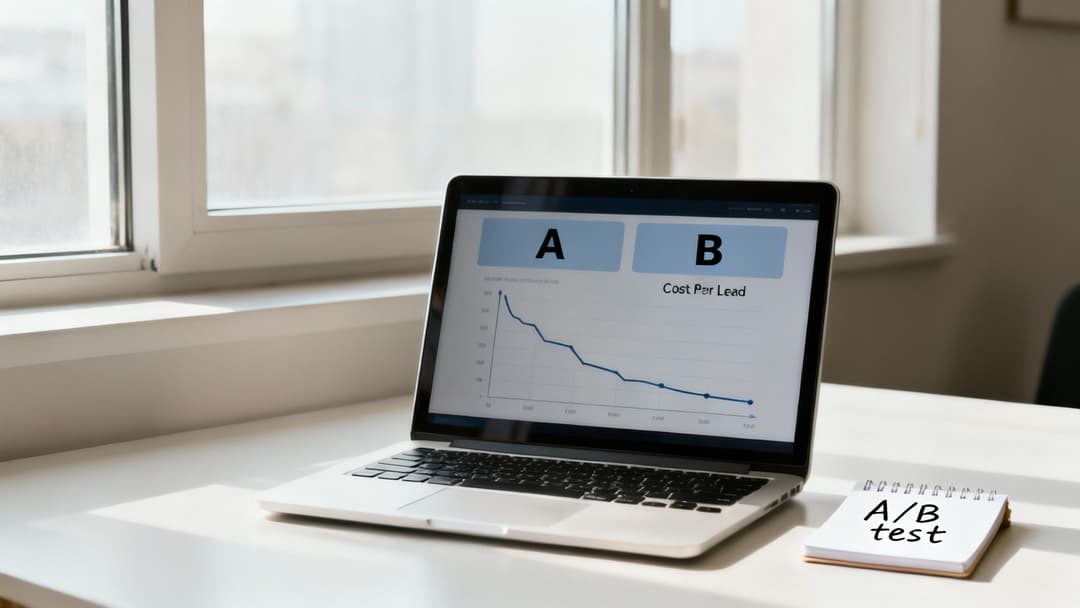
Aggressively A/B Test Your Creative
Your ad creative is your single biggest point of leverage. Period. Don’t ever assume you know which image, headline, or call-to-action will get the best results. The only way to find out for sure is to test, test, and test again.
A disciplined A/B testing process will consistently uncover winning combinations that can slash your CPL. Start by testing the big, high-contrast elements first:
- Images vs. Videos: Does a slick, dynamic video grab more attention than a striking static image?
- Short Copy vs. Long Copy: Is a quick, punchy message more effective than a detailed, story-driven ad?
- Benefit-Driven vs. Pain-Point Headlines: Test headlines that promise a positive outcome against those that solve a specific problem.
A higher ad click-through rate (CTR) is almost always a leading indicator of lower lead costs. To get a better handle on this, check out our detailed guide on how to improve click-through rate.
Pro Tip: Don’t just test random ideas. Every test should start with a hypothesis. For example: "I believe a product demo video will lower our CPL because it shows the value more clearly than our current static image."
Refine Your Audience Targeting
Showing the perfect ad to the wrong person is one of the fastest ways to burn through your budget. Sharpening your audience targeting is a constant process that has a direct, immediate impact on your CPL. It's time to move beyond broad demographics and get granular.
Here are three powerful ways to refine your audience:
- Build Lookalike Audiences: Take a list of your best customers, upload it to a platform like Meta, and let their algorithm find new people with similar behaviors and interests. These audiences often convert at a surprisingly low cost.
- Use Exclusion Lists: Actively exclude people who have already converted or are existing customers from your lead gen campaigns. This is a simple but often overlooked step that stops you from paying to acquire leads you already have.
- Layer Behavioral and Interest Targeting: Don't just target one interest. Combine interests (like "small business marketing") with behaviors (like "Facebook page admins") to build a hyper-specific and highly motivated audience.
Optimize Your Landing Page and Forms
All the great creative and targeting in the world won't matter if your landing page drops the ball. This is where the conversion actually happens, and even a tiny bit of friction here can send your CPL through the roof. Your job is to make it as easy and painless as possible for someone to become a lead.
Start by auditing your lead form. Seriously. Studies have shown that removing just a single unnecessary field can boost conversion rates significantly. Ask yourself, "Do I really need their phone number right now?" If the answer is no, get rid of it.
Of course, platforms like AdStellar AI can automate a huge chunk of this optimization. Our platform can test hundreds of creative variations and pinpoint winning audiences much faster than any manual effort ever could. By constantly learning and shifting your budget, it makes sure your campaigns are always running at the lowest possible CPL, helping you scale what works without scaling your workload. A great way to start is with a focused ad experiment to save your marketing budget to identify your most efficient channels.
Getting Lower CPL on Meta Ads With AdStellar AI
Trying to pull all these optimization levers at once—creative testing, audience analysis, budget shifting—is a massive undertaking. Let's be honest, it's enough to overwhelm even the most seasoned marketing teams. The sheer volume of manual work is staggering. This is exactly where smart automation stops being a "nice-to-have" and becomes a total game-changer for hitting your CPL goals.
Tools like AdStellar AI are built to run these proven tactics at a scale and speed that humans just can't match. It gets right to the heart of what drives up CPL by fundamentally changing how you build and manage your campaigns.
Automate Creative Testing At Scale
Instead of sinking hours into building just a handful of ad variations, what if you could spin up hundreds of creative and copy combinations in a matter of minutes? That’s the idea. This massive creative output lets you rapidly discover what actually clicks with your audience, helping you find those breakout ads that slash your CPL way faster than traditional A/B testing ever could.
This dashboard gives you a feel for how the platform visualizes performance, making it simple to spot what’s moving the needle.
When all your data is in one place, you can shift from just reacting to results to building a proactive strategy around what truly delivers.
Get AI-Powered Insights and Optimization
Guesswork is the biggest enemy of a healthy CPL. AdStellar’s AI Insights feature is designed to eliminate it. The system automatically crunches your performance data to surface the winning ads, audiences, and messages that are hitting your specific CPL targets.
This means no more getting lost in endless spreadsheets trying to connect the dots. The platform points you directly to what’s working and explains why, so you can confidently put more budget behind your most profitable campaign elements.
Beyond just insights, the platform also intelligently reallocates your budget in real-time, shifting spend to the top-performing campaigns automatically. This ensures every dollar is working as hard as possible to bring in the lowest possible CPL. To see this in action, you can learn more about AdStellar’s AI optimization features. By automating these high-impact (and high-effort) tasks, modern performance teams can consistently get ahead on platforms like Meta.
Unpacking Common CPL Questions
Even after you've got the basics down, a few questions always pop up when it's time to put Cost Per Lead into practice. Let's tackle some of the most common ones I hear from marketers.
What Is a Good Cost Per Lead?
This is the million-dollar question, isn't it? The honest answer is: there’s no single "good" CPL. The right number for you is completely tied to your industry, the marketing channel you're using, and—most importantly—your customer lifetime value (LTV).
For a high-ticket B2B software company, a CPL of a few hundred dollars could be fantastic. But for a low-cost subscription box, anything over $10 might be a disaster. The best way to know if your CPL is any good is to benchmark it against industry averages and, crucially, make sure it rolls up into a profitable Customer Acquisition Cost (CAC).
How CPL Relates To CPA And CAC
It’s easy to get these acronyms mixed up, but they each tell a different part of the story. Think of them as steps in your customer's journey.
- CPL is your top-of-funnel cost. It's what you pay to get someone to raise their hand and say, "I'm interested."
- CPA (Cost Per Acquisition) is more flexible. It measures the cost of a specific action, which could be a lead, a free trial sign-up, or even a sale.
- CAC (Customer Acquisition Cost) is the bottom-line number. This is your total cost to get a paying customer through the door.
Your CPL is an upstream metric. A low CPL is a great sign for a healthy CAC down the road, but it’s just one piece of a much larger puzzle.
Should I Always Aim For The Lowest CPL Possible?
Absolutely not. Chasing the lowest possible CPL is a classic rookie mistake. It often leads you straight to a mountain of low-quality leads that clog your pipeline and never convert into actual customers.
Sometimes, a slightly higher CPL is far more profitable because it brings in highly qualified leads who are ready to buy. The real goal is to find that sweet spot between cost and quality—the CPL that maximizes your return on investment, not just minimizes your upfront spend.
Ready to stop guessing and start scaling? AdStellar AI automates the tedious work of creative testing and budget optimization, so you can consistently lower your CPL on Meta and unlock more revenue. Discover how AdStellar AI can help you win.