Marketing a video game used to be pretty straightforward. You'd build up to a big launch, drop a cool trailer, and hope for the best. That playbook is officially broken. Today, launching a game is less like a one-time firework show and more like tending to a garden—it needs constant attention before, during, and long after release.
The New Rules of Video Game Marketing in 2026
In a world where thousands of games hit the market every year across PC, console, and mobile, just having a great game isn't enough. Visibility is everything. Your marketing can't be an afterthought; it has to be a living, breathing part of your game's entire lifecycle.
The stakes are massive. The global video game market pulled in a staggering USD 298.98 billion in 2024, with projections showing it could explode to USD 600.74 billion by 2030. Mobile gaming is the undisputed king here, making up USD 164.01 billion of that 2024 total all by itself, simply because everyone has a smartphone in their pocket.
The Three Core Marketing Phases
To cut through the noise, you have to think about your marketing in three distinct stages. Get one of these wrong, and even a fantastic game can get lost in the shuffle. It all breaks down into Pre-Launch, Launch, and Live-Ops—the three pillars of any modern game marketing strategy.
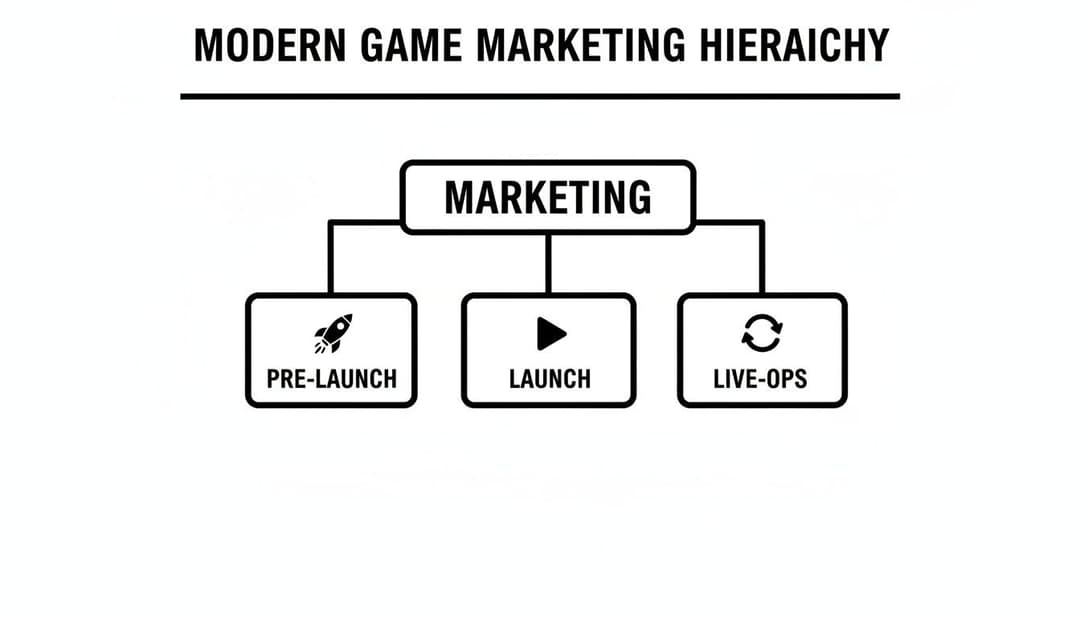
As you can see, this isn't a straight line. It’s a continuous cycle. The work you do before launch fuels your release, and how you manage the game post-launch feeds right back into long-term growth. When you get all three phases firing together, you build a powerful engine that keeps your game relevant for years.
This phased approach is designed to tackle the biggest headaches marketers are facing right now:
- Rising Acquisition Costs: It’s getting more expensive to find new players, so every dollar you spend has to be smarter and more targeted than ever before.
- Creative Fatigue: Players are drowning in ads. Your creative has to grab them by the collar and stay fresh, or they’ll tune you out in a heartbeat.
- Market Saturation: With endless entertainment options, being a "good game" is just the price of entry. You have to give players a reason to choose you—and stick around.
Think of it this way: your game's marketing is no longer just a megaphone to shout about your launch. It’s a sophisticated conversation with your audience that begins months before release and evolves over years.
This guide will break down the modern playbook for winning at each stage. We’ll cover how to build that crucial pre-launch buzz, nail your user acquisition at launch, and then keep the momentum going with smart live-ops. With mobile’s ongoing dominance, we'll pay special attention to its unique demands—for more on that, you can check out these 10 Proven Mobile App Marketing Strategies for Explosive Growth in 2026.
Finally, we’ll look at how AI-powered tools are giving teams a serious edge, helping them automate the grind and out-maneuver the competition at scale.
Building Unshakeable Pre-Launch Momentum
A huge launch day doesn't just happen by accident. It's the final, explosive result of months spent laying the right groundwork. The best video game marketing starts long before anyone can click "download."
Think of it like a band that spends a year building a die-hard following before their first album even hits the shelves. By the time it drops, they aren't hoping for an audience—they're selling out the show.
This pre-launch window is your time to build that groundswell. You’re turning curious onlookers into true fans who will shout about your game from day one. It’s a mix of smart technical prep, media outreach, and building a real community.
Your Pre-Launch Marketing Checklist
To make sure you're hitting all the right notes, you need a plan. This checklist breaks down the essential activities that will help you build that crucial momentum, turning a quiet release into a can't-miss event.
| Activity | Key Objective | Platform/Tool |
|---|---|---|
| ASO Keyword Research | Identify high-intent search terms your players use. | AppTweak, Sensor Tower |
| Create Store Visuals | Design a standout icon, screenshots, and video. | Your design/video team |
| Build a Press Kit | Package assets for easy media and influencer coverage. | Google Drive, Dropbox |
| Start a Community Hub | Create a space for direct player engagement. | Discord, Reddit |
| Influencer Outreach | Secure early coverage from relevant content creators. | Your PR team, email |
| Set Up Pre-Registration | Allow players to sign up for launch day notifications. | App Store Connect, Google Play Console |
| Plan Launch Day Ads | Prepare creative and audience lists for paid campaigns. | Meta Ads Manager, AdStellar AI |
Following these steps methodically will ensure you’re not just launching a game, but igniting a community that’s been waiting for it.
Getting Seen: App Store Optimization (ASO)
For any mobile game, App Store Optimization (ASO) is your lifeline. It's basically SEO for the App Store and Google Play, and it’s what makes sure players can actually find you. Nail your ASO, and you'll show up when people search for games just like yours, driving a huge chunk of your organic installs.
Your ASO strategy really boils down to three core things:
- Keyword Research: Figure out what words your ideal players are typing into the search bar. Weave those terms naturally into your game's title, subtitle, and keyword fields.
- Killer Visuals: Your icon, screenshots, and preview video are your game's first handshake. They need to look sharp, instantly show off the fun, and pop against a sea of competitors.
- A Hooking Description: Your description needs to grab them in the first couple of lines. Clearly explain what makes your game different and, most importantly, fun to play.
When you get these pieces right, your game is the one they see when they're itching for something new to play.
Fanning the Flames: Community and Coverage
While ASO gets you discovered, building a community creates your army of fans. This is where platforms like Discord and Reddit become your best friends. These are the places you can talk directly with potential players, drop behind-the-scenes peeks, and make them feel like they're part of the journey.
A healthy community doesn't just give you feedback; they create content, spread the word, and become your most powerful marketing engine. This is also where a solid press kit makes a world of difference. It's just a simple folder with high-quality gameplay footage, key art, and a fact sheet that makes it dead simple for a journalist or streamer to talk about your game. To get the most out of your influencer outreach, an Influencer Drops strategy can seriously amplify your voice.
Key Takeaway: Pre-launch isn't about just telling people your game exists. It's about building an entire ecosystem around it. You're not starting from scratch on launch day—you're just lighting the fuse on a fire you've already built.
The Final Push: Pre-Registration Power
The last major piece of the pre-launch puzzle is a pre-registration campaign. This is where you let players sign up to get a notification the second your game goes live, usually with a little in-game goodie as a thank you.
First off, it’s a crystal-clear way to measure interest. Watching those pre-registration numbers climb is a real-time report card on how well your marketing is working.
But more importantly, that list of early fans is gold for your launch day advertising. It becomes the perfect "seed" audience. You can take that list to platforms like Meta and create lookalike audiences, targeting a massive group of new users who have similar habits and interests to the people who are already hyped for your game. It makes your first ad dollars work so much harder. Of course, your ad creative needs to be on point, too. You can see what makes a great ad by checking out a sample video advertisement.
Executing an Explosive Launch Day Ad Strategy
If pre-launch is all about building a fire, launch day is about dousing it in gasoline. A truly great launch isn’t just a trickle of organic installs from your existing community. It's a shockwave of new players, all driven by a highly scientific and aggressive paid user acquisition (UA) strategy. This is where the marketing of video games stops being an art and starts becoming a numbers game.
Think of your launch day ad spend like a full-scale invasion. You need to hit hard, fast, and on every front to carve out a foothold in the ridiculously crowded app stores. Your main goal is to generate a massive spike of initial installs, which tells the platform algorithms that your game is the next big thing. This triggers more organic visibility, creating a powerful feedback loop that snowballs.
Structuring Your Initial Ad Campaigns
Your very first ad campaigns on platforms like Meta (Facebook and Instagram) are all about moving from broad exploration to surgical precision. It’s a process of casting a wide net, seeing what you catch, and then methodically tightening it as the data starts telling you who your best players really are.
This journey almost always breaks down into three key audience stages:
- Broad Interest Targeting: You kick things off by targeting users based on what they’ve told the platform they like. This means fans of similar game genres (think Match-3, RPG, or FPS), people who follow your competitors, and even audiences interested in related media like sci-fi movies or fantasy novels.
- Value-Based Lookalike Audiences: Once players start installing your game and—crucially—making their first purchase, you feed that data right back to Meta. This lets you build lookalike audiences, targeting new people who statistically "look" just like your paying customers.
- Advanced Lookalike Refinement: Finally, you get even more granular. You create hyper-specific lookalikes based on only your top 1% to 5% of spenders. These are your whales, and finding more people just like them is how you ultimately achieve a positive Return on Ad Spend (ROAS).
Your goal isn't just to find players; it's to find players who will stick around and spend money. Moving from broad interest targeting to value-based lookalikes is the single most important transition in early-stage UA.
The Science of Creative Testing
A killer audience strategy is completely worthless if your ad creative is mediocre. On launch day, you shouldn’t be launching just one or two ads. You should be launching hundreds of different variations to see what actually connects with people. This is the exact spot where most marketing teams drop the ball.
The best studios don’t guess what works; they test everything, methodically. This includes:
- Visual Hooks: The first 3 seconds of a gameplay video, swapped out with different scenes.
- Ad Copy: Posing questions versus making bold statements, or testing long-form stories against short, punchy text.
- Calls-to-Action (CTAs): Does "Play Now" work better than "Download Free" or "Join the Fight"?
- Creative Formats: Static images, raw gameplay videos, content that looks like it was made by a user, and even clips from influencers.
When you start multiplying all these combinations, you can see how manual campaign creation quickly becomes an impossible bottleneck. No human being can efficiently build, launch, and track hundreds of unique ad sets. This is precisely the challenge that modern marketing tech was built to solve.
Using AI as a Force Multiplier
This is where AI-powered platforms completely change the game. Imagine being able to generate and test 500 ad variations across dozens of audiences in the time it takes you to grab a coffee. That's the edge that tools like AdStellar AI give you. They act as a massive force multiplier for your marketing team.
Instead of burning days manually setting up campaigns in Meta Ads Manager, you can automate the entire workflow. The AI can rapidly mix and match your best video clips, headlines, and audience segments to create a huge test at a scale that would be impossible by hand. The system then launches these campaigns and uses machine learning to analyze the early performance data in real time. For anyone looking to truly maximize their launch impact, learning how to use bulk campaign launching is a game-changer.
This automated approach lets you instantly pinpoint the winning combinations—that perfect marriage of ad creative and audience that delivers the lowest Cost Per Install (CPI) and the highest ROAS. While your competitors are still sifting through last week's spreadsheets, you’re already scaling the budget on proven winners. This is how you ensure your launch day shockwave turns into a sustained, profitable tide of new players.
Sustaining Growth with Live-Ops Marketing

The launch party is over, the initial buzz has peaked, but your job isn't done. Far from it. In modern video game marketing, launch day is just the starting pistol for the real marathon. Your game is no longer a one-time product; it's a living, breathing service, and your marketing has to match that long-term reality.
This is the world of live-ops, where the focus pivots from just getting new players in the door to keeping your existing ones happy, engaged, and invested. Think of your player base like a garden. If you walk away after planting the seeds, it will wither. But if you tend to it, you can cultivate a thriving ecosystem that lasts for years.
Keeping the Flame Alive with In-Game Events
Your most powerful tool in the live-ops arsenal is a constant drumbeat of in-game events. These aren't just minor bug fixes; they are compelling reasons for players to log back in right now. A well-crafted event creates urgency and FOMO (fear of missing out), keeping your community buzzing and active.
These events come in all shapes and sizes, each with a specific job to do:
- Seasonal Celebrations: Holidays like Halloween and Christmas are low-hanging fruit. They’re the perfect excuse to drop themed content, special cosmetics, and limited-time game modes that feel timely and exciting.
- Community-Driven Contests: Nothing fuels engagement like a little friendly competition. Leaderboard challenges, tournaments, or even creative contests get players fired up and reward your most dedicated fans.
- Major Content Updates: Think of new characters, maps, or story arcs as mini-launches. They give you a massive platform to run re-engagement campaigns and win back players who may have drifted away.
By consistently rolling out fresh experiences, you turn your game from a simple pastime into a daily habit.
The core idea behind live-ops marketing is simple: always give your players something new to look forward to. A static game is a dying game. One that constantly evolves keeps players invested, engaged, and most importantly, retained.
The Power of Re-Engagement
Even with the most exciting events, some players will inevitably churn. That’s okay. Bringing them back is far cheaper than acquiring a brand-new user, which is where smart re-engagement tactics come into play. It’s all about sending the right message at the right moment, without being annoying.
Push notifications and segmented email campaigns are your best friends here. Forget the generic "We miss you!" messages. Use player data to send personalized nudges. For example, you can send a notification to a player who hasn't logged in for a week about a new event featuring a character they love to play. For a deeper dive into these tactics, our guide on Facebook retargeting ads has some great strategies.
Turning Players into Marketers with UGC
One of the most powerful shifts in video game marketing is the rise of the creator economy. Titans like Fortnite and Roblox have absolutely mastered this by turning their own players into their most passionate and authentic advertisers through user-generated content (UGC).
This creates a powerful, self-sustaining flywheel. In fact, video game marketing is now heavily fueled by UGC. Creator economies in hits like Fortnite and Roblox are projected to pay out over USD 1.5 billion to creators in 2025 alone. With Roblox already paying out USD 923 million in 2024 and Fortnite adding another USD 352 million, they’ve built a viral loop where players are financially motivated to become marketers. You can dig into this trend in this detailed video gaming report.
When you give players the tools to create and share—whether it’s custom maps, character skins, or epic gameplay montages—you build a community that doesn't just play your game but actively promotes it. This kind of organic promotion is often more persuasive than any paid ad because it’s born from genuine passion, building trust and drawing in new players in a way that traditional marketing just can't replicate.
Amplifying Your Strategy with AI and Automation
So you’ve got your strategy nailed down. The pre-launch buzz is building, your launch plan is set, and you know exactly who you’re targeting. Now comes the hard part: execution at scale. This is where the winners pull away from the pack.
While everything we've covered so far relies on sharp strategy and manual effort, this is where you get a serious competitive advantage. Artificial intelligence and automation aren't just buzzwords anymore; they are the engine room for scaling your campaigns and squeezing every drop of value from your ad spend.
Think of your marketing team as a group of world-class chefs. They have incredible recipes (your creative ideas) but are stuck preparing a massive banquet by hand. No matter how talented they are, their output is limited. AI platforms are like giving that team a state-of-the-art, fully automated kitchen. It doesn't replace their expertise—it amplifies it, letting them test, iterate, and serve ads at a scale that was previously unimaginable.

This is what a modern control center looks like—connecting creative performance directly to key metrics in real-time. The magic of AI is its ability to chew through all this complex data instantly and spit out clear, actionable insights. It turns a sea of numbers into your next strategic move.
Breaking the Manual Bottleneck with AI Creative Generation
Let’s be honest: the single biggest roadblock in paid user acquisition is almost always creative production. The process of manually creating dozens, or even hundreds, of ad variations—testing different video hooks, swapping headlines, trying new CTAs—is painfully slow. It’s a tedious grind that drains your team's energy and kills their ability to test hypotheses quickly.
This is exactly the problem AI-powered marketing platforms like AdStellar AI were built to solve. You simply upload your core game assets—gameplay footage, character art, logos—and the platform does the heavy lifting, mixing and matching them with different text and audience targets.
- Rapid Variation: A marketer can generate hundreds of unique ad combinations in the time it takes to grab a coffee, not in a week-long sprint.
- Bulk Launching: Forget the soul-crushing process of setting up each ad set one by one in Meta Ads Manager. The platform can launch an entire testing matrix in a single click.
This isn't just about saving a few hours. It’s a fundamental shift in what your team can accomplish. You can finally test more ideas, uncover hidden winning combinations, and react to performance trends before they go cold.
From Guesswork to Data-Driven Decisions
Once your campaigns are live, the next headache is figuring out what’s actually working. Which creative is driving the best Return On Ad Spend (ROAS)? Which audience is giving you the lowest Cost Per Acquisition (CPA)? Trying to answer these questions manually often means wrestling with massive spreadsheets and spending hours just trying to connect the dots.
Here’s where AI-driven insights become your superpower. By plugging directly into your ad accounts, these platforms ingest all your historical performance data and analyze it against your most important goals.
Instead of drowning in a spreadsheet, you get a clear, ranked list of winners and losers. AI can tell you, "This video creative is your top performer for driving in-app purchases, and this lookalike audience is your most cost-effective for new installs." This clarity removes the guesswork and gives you the confidence to make bold, data-backed decisions.
This analytical firepower is crucial for optimizing the long-term profitability of your game. By pinpointing the creative and audience factors that correlate with high Lifetime Value (LTV), you can steer your budget toward acquiring the players who will stick around and contribute to your game’s success for months or even years.
Automating the Path to Scale
Finding a winning ad is only half the battle. The other half is scaling it effectively without watching your performance metrics fall off a cliff. AI and automation streamline this entire process, using machine learning to manage your budget and optimize campaigns on the fly.
Imagine you've launched 50 different ad variations. An AI-powered system can monitor their performance in real time. As soon as it spots a few top performers that are consistently hitting your target CPA, it can automatically:
- Shift Budget: Gradually pull ad spend away from the duds and pour it into your proven winners.
- Prevent Fatigue: Automatically cycle in new creative variations to keep your campaigns feeling fresh and effective.
- Identify New Opportunities: Analyze the DNA of your best ads to inform the creation of new campaigns, building a virtuous cycle of testing and optimization.
This automated scaling ensures your budget is always working as hard as it can for you. If you want to go deeper on this, you can learn more about how to leverage AI to create and scale your ads and completely change your campaign management workflow. By automating these critical but repetitive tasks, you free up your team to do what they do best: focus on high-level strategy, creative direction, and finding the next big growth opportunity.
Measuring the Metrics That Actually Drive Growth
In the world of game marketing, gut feelings and cool ideas are great, but they won't get you across the finish line. If you aren’t measuring your marketing efforts, you're essentially flying blind. Data is your cockpit, giving you the critical feedback needed to make smart adjustments, optimize your ad spend, and steer your game toward real, sustainable success.
But here’s the catch: not all data is created equal. It's easy to get distracted by "vanity metrics"—things like social media likes or total impressions. They look good on a chart and feel great to report, but they don't actually tell you if you're growing. True success comes from focusing on the key performance indicators (KPIs) that directly impact your bottom line at every stage of your game's life.
KPIs for Your Pre-Launch and Launch Phases
During the whirlwind of pre-launch and your initial launch window, the mission is crystal clear: build an audience and get those first installs as efficiently as possible. The numbers you track should be a direct reflection of that goal.
Your most important metrics at this stage are:
- Pre-Registrations: This is your very first signal of market interest. A healthy pre-registration number doesn't just validate your concept; it gives you a ready-made audience to target when you go live.
- Cost Per Install (CPI): This is your ad spend divided by the number of new players it brought in. Simply put, a lower CPI means you're getting more bang for your buck on player acquisition.
- Return On Ad Spend (ROAS): This is the ultimate report card for your launch campaigns. It measures the revenue you've earned from players acquired through ads, divided by what you spent on those ads. A ROAS above 100% means you're in the green—your ads are profitable.
A classic rookie mistake is chasing a low CPI above all else. A cheap install is completely worthless if that player churns after five minutes. ROAS is your true north because it ties your acquisition cost directly to the money coming in.
Live-Ops Metrics That Signal Long-Term Health
Once your game is out in the wild and you have a steady stream of players, your focus has to shift. It's no longer just about getting new people in the door; it's about keeping them there and building a sustainable business. These live-ops KPIs tell you whether you've built a hit game or a leaky bucket that constantly needs refilling.
If you want to go deeper, you can learn more about the most important performance marketing metrics in our dedicated guide.
The crucial metrics to watch after launch include:
- Retention Rate: This is the percentage of players who come back to your game after a specific time, like Day 1, Day 7, or Day 30. High retention is the best indicator you have that your game's core loop is genuinely fun and engaging.
- Average Revenue Per User (ARPU): This metric breaks down the average amount of money you earn from each active player. It’s a direct reflection of how well your monetization strategy is working.
- Lifetime Value (LTV): This is the holy grail metric. LTV is a projection of the total revenue a single player will generate over their entire time with your game. When your LTV is greater than your CPI, you've built a profitable growth engine.
Getting a handle on these numbers transforms your marketing from a guessing game into a data-driven science. By tracking the right metrics at the right time, you can spot problems before they grow, jump on opportunities, and confidently invest in the channels that will fuel your game’s long-term growth.
Diving into the world of game marketing can feel like stepping into a fog machine. A lot of noise, not a lot of clarity. This is especially true if you're a smaller studio or just starting out.
Let's cut through that fog. Here are some of the most common questions we hear, with direct, no-nonsense answers to help you navigate your budget, choose the right platforms, and get your first players.
What’s a Realistic Marketing Budget for an Indie Game?
The classic rule of thumb says to set aside 20% to 50% of your total development cost for marketing. For a small indie game, that might only amount to a few thousand dollars—enough to run some highly targeted social media ads and, more importantly, start building a community.
But here’s the secret: the size of your budget is less important than how you use it. Your most powerful, cost-effective asset will always be an organic community. Before you spend a dime on ads, pour your initial resources into building a home for your fans on places like Discord and Reddit.
When you do start running paid ads, start small. Test your creative ideas like a mad scientist, and only pour gas on the fire when you see a clear, positive return on ad spend (ROAS).
How Does Marketing Change for Mobile, PC, and Console Games?
While the goal is always to find your players, the playbook changes dramatically depending on the platform.
- Mobile Marketing: This is a numbers game, plain and simple. It's all about user acquisition (UA) on visual-heavy platforms like Meta and TikTok. Your success will live or die by your data analysis skills and how well you master App Store Optimization (ASO).
- PC Marketing: This world runs on hype and community. The grind is all about building Steam wishlists, getting influencers on Twitch and YouTube to showcase your game, and fostering a deep, engaging community on Discord.
- Console Marketing: This is often a bigger-budget play. It leans heavily on traditional public relations, striking deals with platform holders like Sony or Microsoft, and fighting for those coveted featured spots on their digital storefronts.
Can I Really Market My Game with a Tiny Budget?
Absolutely. In fact, a small budget forces you to be creative, and creativity almost always beats a huge, unfocused ad spend. Your energy is best spent creating highly shareable content. Think awesome gameplay GIFs, funny memes that hit your niche, or behind-the-scenes dev logs that make people feel invested.
Get into the trenches. Genuinely engage in the niche subreddits and forums where your ideal players already hang out. A passionate community that acts as your champion because they feel a real connection to you and your game is the single most effective and efficient marketing tool you will ever have.
Ready to stop guessing and start scaling your game's ads with precision? Let AdStellar AI automate your creative testing, audience discovery, and campaign optimization. Unlock faster growth on Meta today.