Think of PPC advertising software as a co-pilot for your ad campaigns. It's a specialized set of tools designed to automate, analyze, and scale your advertising efforts across platforms like Google and Meta. Instead of manually pulling levers and checking gauges, you get an intelligent system that helps you fly higher and faster.
What Is PPC Advertising Software
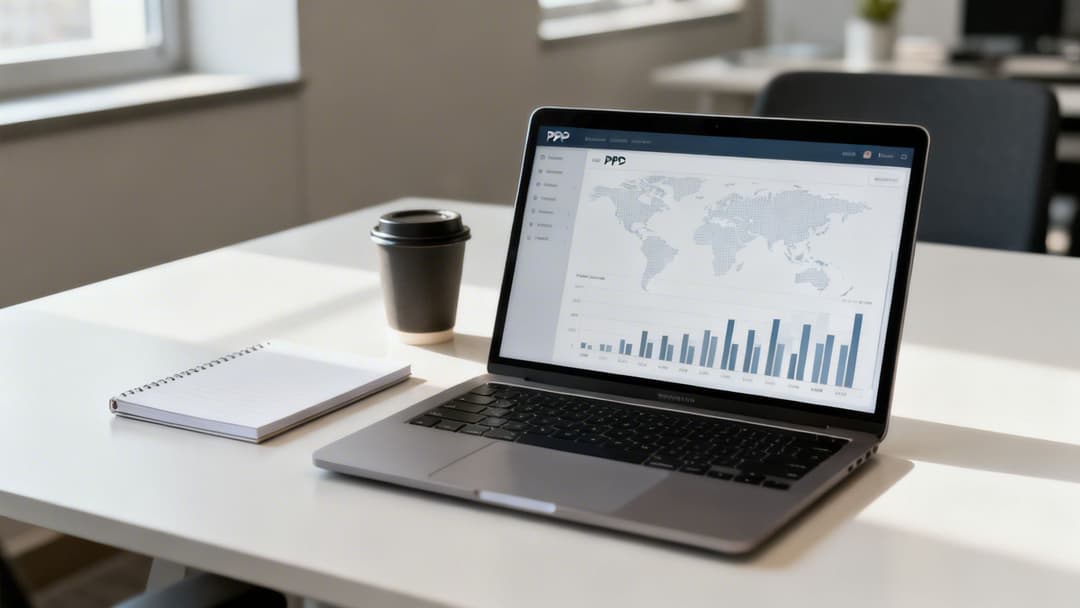
Trying to run modern PPC campaigns by hand is a bit like trying to manage a global shipping operation from a single notebook. You're tracking every package, plotting every route, and manually rerouting for traffic, all in real-time. It’s a recipe for burnout, missed opportunities, and costly mistakes.
PPC advertising software is the automated logistics hub that takes over that chaos for you. These tools were built to solve the fundamental headaches of manual campaign management—wasted ad spend, human error, and the frustrating inability to grow your campaigns effectively.
Why Software Is a Necessity, Not a Luxury
Years ago, only the biggest advertisers with the deepest pockets could afford sophisticated ad tech. Today, PPC advertising software is essential for any marketer who's serious about getting results. The sheer volume of data, audience segments, creative variations, and bidding signals across platforms like Google, Meta, and Microsoft Advertising makes manual oversight nearly impossible.
The reality is that managing pay-per-click campaigns manually is no longer practical at scale. The right software automates tedious tasks, surfaces insights you'd otherwise miss, and helps you spend your budget more effectively.
For instance, while you’re offline for the night, an automated bidding algorithm can adjust your bids hundreds of times to capture conversions at the lowest possible cost. It’s your 24/7 campaign assistant, always working to make sure you never miss an opportunity. While these tools are incredible for paid search, you can see how automation is changing other channels in our guide on social media advertising software.
Before we go deeper, here’s a quick look at how a software-driven approach completely changes the game compared to doing everything by hand.
Manual PPC vs Software-Driven PPC
| Task | Manual Approach | Software Approach |
|---|---|---|
| Bid Management | Manually adjusting bids based on periodic reports. Slow and reactive. | Automated, real-time bid adjustments based on performance data. |
| Campaign Creation | Building each campaign, ad group, and ad one by one. Time-intensive. | Bulk creation and duplication of campaigns using templates and rules. |
| Reporting | Pulling data from multiple platforms and combining it in spreadsheets. | Centralized dashboard with automated, cross-channel reporting. |
| Optimization | Relying on gut feelings and limited data to make strategic changes. | AI-driven recommendations for budget shifts, keyword additions, and more. |
| Scaling | Growth is limited by the number of hours in a day and team capacity. | Easily manage hundreds or thousands of campaigns simultaneously. |
Ultimately, the goal isn't just to save time—it's to transform your team’s entire focus. Instead of drowning in bid adjustments and report-building, you can finally concentrate on what truly moves the needle: understanding your customer, crafting better creative, and developing winning strategies. This is how you unlock a level of performance that is simply out of reach with manual methods.
The Core Features of Modern PPC Platforms
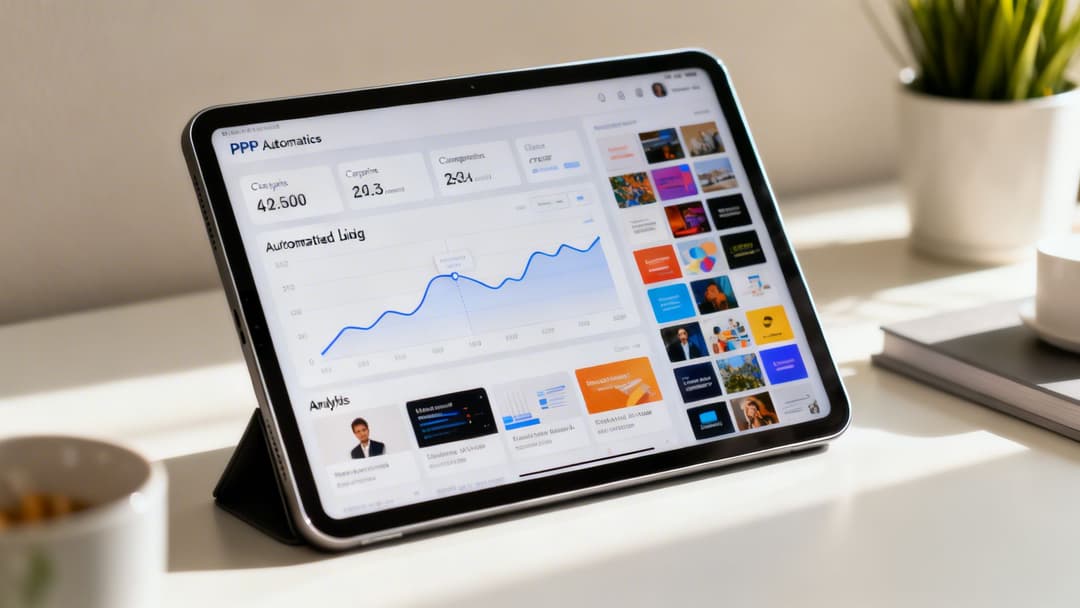
Before you can really grasp what PPC advertising software can do, you have to look under the hood. These platforms aren't just fancy dashboards; they're sophisticated engines built from specialized parts, all working together to turn manual grunt work into a serious strategic advantage. Each feature is there to solve a real-world problem marketers face every day.
Think of it like a high-performance car. You have a central command center for steering (Campaign Management), a self-driving system that nails the details (Automated Bidding), a rapid assembly line for building new parts (Creative Automation), and a deep diagnostics computer (Analytics). Put them all together, and you get where you’re going faster and more efficiently than ever before.
Centralized Campaign Management
The first—and most fundamental—feature is a single, unified place to manage all your campaigns. Instead of jumping between Google Ads, then Meta Ads, then Microsoft Advertising, you get one control panel for everything. This is your mission control for building, organizing, launching, and pausing campaigns across every channel you use.
This integrated setup is a lifesaver. It prevents costly mistakes, keeps your campaign structures consistent, and saves an incredible amount of time. Your team can see and manage everything from one screen, giving you a clear, top-down view of all your advertising without the constant whiplash of switching between platforms.
AI-Powered Automated Bidding
This is where PPC software really starts to feel like magic. Automated bidding is like having an AI-powered stock trader working for you 24/7, focused solely on your ad auctions. You just set the objective—like a target Return on Ad Spend (ROAS) or Cost Per Acquisition (CPA)—and the algorithm does the rest.
It crunches hundreds of real-time signals—device, time of day, audience demographics, user behavior—to adjust your bids in every single auction. The goal is to spend your budget with ruthless efficiency, capturing high-intent users at the perfect price. It’s a job that’s simply impossible to do manually at any real scale.
Creative and Audience Automation
Creative fatigue is a silent killer, especially on social platforms where users see ads constantly. Creative automation tackles this head-on by letting you generate and test hundreds of ad variations in minutes. You can mix and match different headlines, images, copy, and calls-to-action to find winning combinations without the soul-crushing manual setup.
This is often paired with audience automation, which lets you quickly build and deploy new targeting segments. For anyone looking to dive deeper into this, our post on the top features of AI ad platforms is a great resource. This systematic testing is how you discover which messages truly connect with which audiences, fueling better and better performance.
Advanced Analytics and Reporting
Finally, any modern PPC platform worth its salt provides analytics that go miles beyond what the native ad managers offer. They turn mountains of raw data into a clear roadmap, showing you exactly which ads, keywords, and audiences are driving growth and which are just burning cash.
The most powerful PPC software doesn't just show you what happened; it provides actionable insights on what to do next. It connects ad spend directly to business outcomes, giving you a true picture of your marketing ROI.
Key metrics, like the ability to accurately calculate cost per lead (CPL), are vital for understanding if your campaigns are actually profitable. Good software makes this tracking seamless, presenting the data in customizable dashboards that put your most important numbers front and center. That clarity is what allows you to make smart, data-backed decisions and confidently scale your campaigns.
How to Choose the Right PPC Software
Picking the right PPC advertising software can feel a lot like buying a car. It's easy to get mesmerized by a slick dashboard and promises of high performance, but what you really need is a vehicle that fits your daily life. A two-seater sports car looks great, but it’s completely useless if you need to haul lumber for a weekend project.
The same principle applies here. The most feature-packed enterprise software could be total overkill for a growing e-commerce brand just finding its footing. To cut through the noise, you need a solid evaluation framework. We'll focus on four make-or-break criteria: integrations, automation, scalability, and reporting. Nailing these will help you find a tool that genuinely fits your team, whether you're a scrappy startup or a large agency juggling dozens of clients.
Evaluate Key Platform Integrations
First things first: connectivity. Your PPC software has to play nice with the other tools in your marketing stack. If it can’t seamlessly connect to the platforms where you actually run ads and track results, it’s not a solution—it's just another headache creating data silos and manual work.
Here are the essential integrations to look for:
- Ad Networks: Does it have a solid, native connection to your core channels, like Google Ads and Meta Ads?
- Analytics Tools: Can it talk to your analytics platforms, like Google Analytics 4? This is non-negotiable for a full-funnel view.
- CRM or E-commerce Platforms: Does it connect with your source of truth for revenue, like Shopify or HubSpot? This is how you tie ad spend directly to sales.
A tool with robust integrations acts as a central command center, making sure data flows exactly where it needs to without you lifting a finger.
Assess the Depth of Automation
Let's be clear: not all automation is created equal. Some tools offer basic bid adjustments and call it a day. Others use AI to give you a true co-pilot across the entire campaign lifecycle. The goal isn’t just to automate something; it's to automate the right things that are slowing your team down.
True automation isn’t just about tweaking bids. It’s about building a system for your entire workflow—from creative testing and audience discovery to campaign launches and performance analysis—so your team can finally get out of the weeds and focus on strategy.
Think about where your team's time really goes. Are you bogged down in the tedious process of building ads one by one? Look for a tool with features for bulk creation or creative generation. Are you spending half of Monday just pulling reports? Prioritize a platform with customizable, automated dashboards. This is often the biggest difference between a basic tool and truly advanced PPC advertising software.
Plan for Scalability and Growth
The software you choose today needs to be able to handle your ambitions for tomorrow. A platform that runs smoothly with ten campaigns might completely fall apart when you try to launch a thousand. Scalability isn't just about handling more volume; it's about maintaining efficiency and performance as your brand or agency grows.
Ask yourself these critical questions when evaluating any tool:
- Campaign Volume: If we 10x our number of active campaigns next year, will this platform keep up or will it start lagging?
- User Access: Does it support multiple users with different permission levels? You'll need this as your team expands.
- Feature Set: Are its features advanced enough to support more sophisticated strategies as our marketing matures?
Picking a scalable solution from the start saves you from a painful and expensive migration down the road. It’s a disruptive process you want to avoid at all costs.
Demand Clarity in Reporting
Finally, your software must transform mountains of complex data into simple, actionable insights. A confusing data dump is worse than no data at all. The best reporting answers the "so what?" behind the numbers. You can explore our other guide for more information on the various PPC advertising platforms and their reporting capabilities.
If a dashboard is cluttered with vanity metrics and doesn’t connect ad performance to real business outcomes like revenue or qualified leads, it's failing. A great tool makes it painfully obvious what's working, what's not, and exactly what you should do about it next.
Real-World Wins with PPC Advertising Software
All the theory in the world doesn't mean much without results. We can talk about the features of PPC advertising software all day, but where these platforms really prove their worth is out in the wild, solving real problems for marketing teams.
Let's walk through three common stories we see all the time. Each one paints a clear "before and after" picture, connecting specific software features to bottom-line results like more revenue, better team efficiency, and a lower cost to acquire customers.
Scenario 1: The Performance Marketing Team
Picture a performance marketing team bogged down by manual A/B testing. They would spend days just getting a test set up. By the time they finally had enough data to pick a winner, the market had already moved on. Their whole process was just too slow for the breakneck speed of paid ads.
Once they brought in PPC software, everything changed. They could suddenly launch hundreds of ad variations in minutes, not days. The platform's automation made large-scale testing possible, identifying the best ad combinations in a few days instead of a few weeks. This new speed let them shift their budget to top-performing ads almost instantly, sending their Return on Ad Spend (ROAS) through the roof.
This flowchart can help you think through the decision points for picking the right software for your own team, based on your size, the channels you use, or what you're trying to achieve.
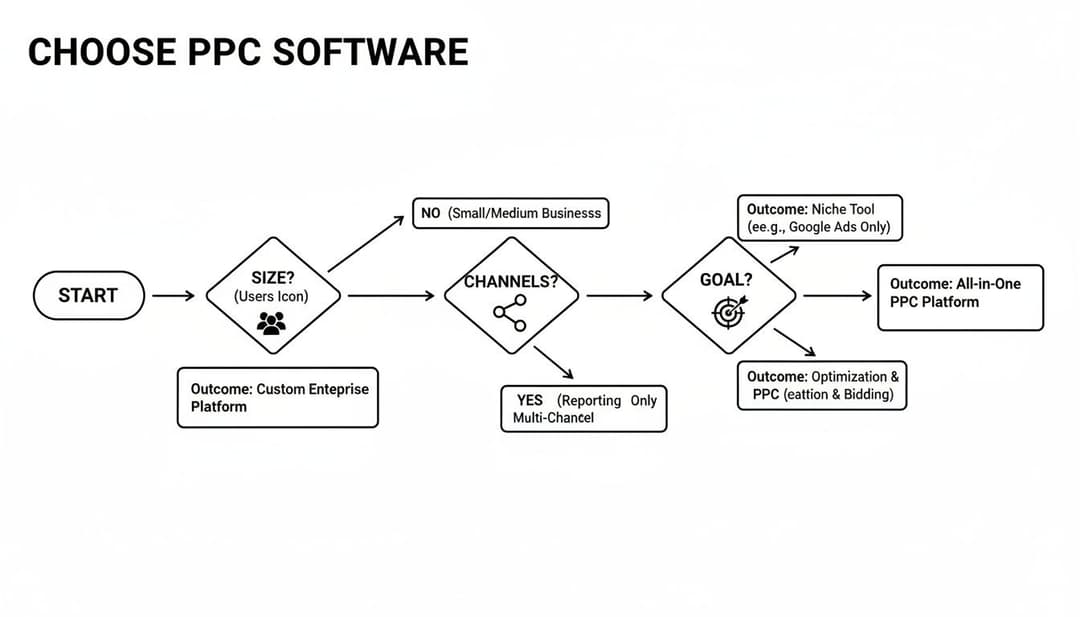
As the decision tree shows, the best tool really depends on your main goal, whether that's scaling up user acquisition or just getting a handle on all your channels.
Scenario 2: The Digital Agency
For a digital agency juggling a dozen clients, efficiency isn't a luxury—it's survival. Their team was practically drowning in manual reporting. The first week of every month was lost to pulling data and cobbling together spreadsheets, leaving almost no time for the strategic work that actually grows their clients' accounts.
When they adopted a centralized PPC platform, they were able to automate that entire reporting nightmare.
- Centralized Dashboard: All client data was pulled into one clean, unified view. No more logging in and out of countless ad accounts.
- Automated Reports: They could schedule client-ready reports to generate automatically, saving dozens of hours every single month.
This freed up their strategists to do what they do best: hunt for new growth opportunities and deliver killer results for their clients.
The biggest win wasn't just the time saved. It was the change in mindset. The team went from being data monkeys to strategic partners, which had a direct impact on client retention and happiness.
Scenario 3: The E-commerce Brand
An e-commerce brand was struggling to keep their ads in sync with a constantly changing inventory. They were burning a ton of ad spend promoting products that were out of stock or, worse, had razor-thin margins. Manually updating hundreds of product ads just wasn't an option.
Everything changed when they found PPC advertising software that plugged directly into their product feed. The platform automatically paused ads for out-of-stock items and spun up new ads whenever products were restocked. This guaranteed that every dollar was spent promoting available, high-margin products. The result was an immediate lift in sales and a huge drop in wasted ad spend. For mobile-first brands, you can also dig deeper into the specifics of advertising an app.
The AI Shift in PPC Management

Artificial intelligence isn't some far-off concept anymore—it's become the new engine for anyone serious about paid advertising. Think of it like this: managing your campaigns manually is like playing checkers, reacting to your opponent's last move. But with AI, it's like having a chess grandmaster on your team who sees ten moves ahead. It’s a fundamental shift from simply reacting to predicting what comes next.
Modern PPC advertising software now uses AI to crunch massive datasets that no human team ever could. It sifts through an endless stream of performance signals to figure out which ad creative, copy, and audience segment will hit a home run. This is what allows you to cut through the immense complexity of platforms like Meta with real precision and efficiency.
The proof is in the numbers. A staggering 62% of advertisers have already turned to AI for their bidding strategies, and the results speak for themselves. We're seeing gains like 40% superior returns on investment and a 22% jump in user engagement compared to campaigns managed by hand. The advantage is crystal clear.
Getting Past Our Human Limits
Even the most brilliant marketers have their blind spots. We get attached to a certain ad creative, or we stick with an audience that worked well last quarter, even when the data is screaming for a change. AI doesn't have those biases.
Its only goal is to hit the performance targets you give it. This complete objectivity lets it make the tough, data-backed calls that a human might hesitate on—like finally pulling the plug on a favorite ad that has stopped performing.
Scaling Your Growth Predictably
This is where AI really flexes its muscles. Imagine your software spotting your top-performing ads and then, on its own, building and launching new campaigns based on what made them successful. That's the heart of predictive scaling.
Instead of just manually duplicating an ad set and crossing your fingers, AI-driven software builds a repeatable system for growth. It finds the "winning DNA" in your campaigns and uses it to construct new ones with a much higher chance of success right out of the gate.
This proactive approach takes the guesswork out of scaling. You’re no longer just hoping for the best; you're putting your budget behind a proven formula, leading to more consistent and profitable growth over time.
This AI revolution also syncs up perfectly with other smart tools, like chatbots for marketing, which use AI to engage and qualify the leads your ads bring in. To really get into the weeds on this, take a look at our full guide on how to apply AI for ads to your own strategy.
Alright, let's get this section sounding like it was written by a seasoned pro. Here is the rewritten content following all the specified requirements.
Choosing Your Partner for Meta Ads Automation
Knowing that AI can help with PPC is one thing. Actually using it to tame a beast like Meta is a whole different story. This is where the theory ends and the real work begins—and picking the right tool can mean the difference between winning and just spinning your wheels.
For any team serious about mastering Meta ads, a specialized tool is non-negotiable. This is exactly why we built AdStellar AI. It’s designed from the ground up to solve the two biggest headaches for Meta advertisers: creative burnout and the nightmare of trying to scale your winning ads. It’s less about just "saving time" and more about building a smarter, more resilient advertising machine.
Launch and Test at a Ridiculous Speed
Think about your current process. How long does it take to build and launch a handful of new ad variations? Now, imagine launching hundreds of unique ads—testing countless combinations of images, headlines, and audiences—in that same amount of time. That’s what our bulk ad creation is all about.
You can generate a massive volume of creative combinations in minutes and push them straight to Meta in a single click. This completely gets rid of the soul-crushing manual work that drains your team's creativity and slows everything down. By automating the setup, you free your team up to think about strategy, not spreadsheets.
We wanted to help teams break free from the cycle of building one-off campaigns. The goal is to create a repeatable system for testing and learning, so you can figure out what works and then do more of it—faster than anyone else.
This systematic approach is the quickest way to find your next winning ad. Instead of relying on gut feelings, you’re using sheer volume and data to let the best combinations prove themselves. Suddenly, creative testing isn't a chore; it's your secret weapon.
From Insights to Intelligent Scaling
Once your tests are running, AdStellar’s AI-powered analytics kick in. The platform plugs directly and securely into your Meta Ads Manager via OAuth, pulling in your historical performance data. It learns what a "win" looks like for your specific business.
It then starts ranking every single creative, audience, and piece of copy against your goals, whether that’s ROAS, CPA, or CPL. This gives you a crystal-clear, data-backed plan for what to scale.
But the AI doesn't just show you what worked in the past. It digs deeper to find the "winning DNA" in your top-performing ads. It then uses those insights to help you build and launch new campaigns that are already primed for success, creating a powerful feedback loop that just keeps getting better.
Frequently Asked Questions About PPC Software
It's natural to have questions when you're looking at new PPC software. We get it. Here are the straight-up answers to the questions we hear most often from marketing teams just like yours.
What Is the Difference Between PPC Software and Native Ad Managers
Think of native ad managers like Google Ads or Meta Ads Manager as the basic toolkit that comes with your car. It’s got a wrench and a tire iron—enough to handle the fundamentals.
PPC advertising software is the professional-grade, powered-up mechanic's tool chest. It's an entire layer of intelligence and automation built on top of the native platforms, giving you capabilities like bulk campaign actions, advanced AI bidding, and automated creative testing that the basic tools just don't offer. The goal is to save you a ton of time while seriously improving performance.
Is PPC Advertising Software Only for Large Enterprises
Not at all. While big companies certainly get a lot out of them, modern PPC software is designed for teams of all sizes.
They are especially powerful for fast-moving startups, e-commerce brands, and agencies that need to scale efficiently without hiring a massive team. The real key is finding a tool that matches your specific goals and budget.
Efficiency gains, like time saved on campaign creation, are immediate. Performance results, such as improved ROAS or lower CPA, typically appear within a few weeks as the software’s AI gathers enough data to make statistically significant optimizations.
Ready to conquer Meta ads with a repeatable, data-backed system? See how AdStellar AI can help you launch, test, and scale campaigns 10x faster. Explore AdStellar AI today.