Stop guessing what works and start understanding why it works. Psychology in advertising isn't a soft skill—it's a hard-data advantage for performance marketers. It helps you move beyond surface metrics like CTR to unlock real, consistent campaign growth by getting to the heart of consumer motivations. This guide connects the dots between emotional triggers, cognitive shortcuts, and the science of attention, and translates them into measurable outcomes.
Why Psychology Is Your New Competitive Edge in Advertising

In a digital world overflowing with noise, the best ads don't just interrupt; they connect. The campaigns that consistently win aren't born from luck, but from a deep, practical understanding of human behavior. This is where applying psychology in your advertising becomes a game-changing competitive edge.
Instead of just chasing clicks and hoping for the best, this approach forces you to focus on the underlying reasons people buy. It transforms your creative process from a shot in the dark into a systematic method for building ads that actually convert.
The core idea is simple: when you understand the psychological triggers that drive decisions, you can design advertising that speaks directly to your audience’s needs, fears, and desires on a subconscious level.
This shift in perspective is what separates good marketers from great ones. It means moving from asking, "What ad performed best?" to "Why did that ad resonate so strongly with our audience?" The answer to that second question is where scalable, repeatable success is found.
Before we dive deep, here's a quick look at the core psychological principles we'll be exploring and how they directly influence your campaigns.
Core Psychological Drivers in Modern Advertising
| Psychological Principle | Core Concept | Impact on Ad Performance |
|---|---|---|
| Cognitive Biases | Mental shortcuts people use to make decisions quickly. | Shapes how users perceive value, risk, and urgency in your offer. |
| Emotional Triggers | Using specific emotions (joy, fear, trust) to create a connection. | Drives immediate engagement and makes your brand more memorable. |
| Social Proof | The tendency to trust what others are doing or saying. | Builds credibility and reduces friction, leading to higher conversions. |
| Loss Aversion | People prefer avoiding losses to acquiring equivalent gains. | Creates powerful urgency and motivates immediate action (e.g., "Don't miss out!"). |
| Reciprocity | The impulse to give something back after receiving something. | Increases lead generation and builds goodwill for future purchases. |
By integrating these principles, you start building a more predictable and powerful advertising engine.
Turning Insights Into Measurable Outcomes
Applying these concepts isn't just theory; it has a direct, measurable impact on your key metrics. A psychologically informed ad strategy helps you build campaigns that are more relevant, memorable, and persuasive, leading to tangible improvements across the board. For an in-depth look at the tools that can help you execute these strategies, check out our guide on performance marketing software.
Here’s how this approach starts moving the needle on your results:
- Improved Ad Creative: You'll learn to use specific colors, imagery, and copy that trigger desired emotional responses, making your ads feel less like ads and more like solutions.
- Higher Engagement Rates: By tapping into cognitive biases and social proof, your ads build instant trust and encourage more likes, comments, and shares—valuable signals for any platform's algorithm.
- Increased Conversion Rates: Understanding principles like loss aversion and urgency allows you to craft offers and CTAs that compel users to take action now, not later.
- Better ROAS: Ultimately, ads that connect on a deeper level don't just get clicks; they drive profitable conversions, leading to a much stronger return on ad spend.
Harnessing Emotions to Drive Real Conversions

Sure, product features and logical arguments have their place. But let’s be honest—they rarely close the deal on their own. The real engine of conversion? Emotion. The most effective ads don’t just inform; they make the audience feel something. Secure, accomplished, nostalgic, or simply like they’ve found their people.
This emotional connection is what separates an ad that gets scrolled past from one that gets remembered. Think about a feature-heavy car ad versus one showing a family laughing on a spontaneous road trip. The first one lists specs. The second one sells the feeling of joy and connection, embedding the brand much deeper into your mind.
The core principle is straightforward: features tell, but emotions sell. People make decisions based on feelings and then use logic to justify them. Your goal is to connect your product to a core human emotion that your audience craves.
And this isn't just fluff—the data backs it up. The psychology of emotional appeal in advertising has proven to be far more effective than just rattling off rational benefits. Ads that tap into emotional content see a 31% success rate, which is nearly double the 16% rate for campaigns that rely only on logical arguments. Time and again, feelings like pride, love, and achievement deliver the best results.
Matching Emotions to Funnel Stages
Now, applying emotional triggers isn't a one-size-fits-all strategy. The right emotion depends entirely on where your customer is in their journey. A brand-new prospect needs a completely different emotional hook than someone who’s just one click away from buying.
Here’s a practical way to map emotions to your marketing funnel:
- Top of Funnel (Awareness): Your main job here is to stop the scroll. Focus on broad, captivating emotions like curiosity and inspiration. Use imagery and copy that sparks intrigue or makes them feel seen and understood.
- Middle of Funnel (Consideration): Now you need to build trust and show your value. Shift to emotions like security and belonging. This is the time to show how your product solves a real problem and use testimonials to create a sense of community.
- Bottom of Funnel (Conversion): It's time to trigger action. Lean into emotions like achievement (the feeling of making a smart choice) or urgency (the classic fear of missing out). This is where you close the loop and turn interest into a sale.
Translating these emotions into compelling stories is where great advertising is born. For a deeper dive into crafting messages that truly connect, check out our guide on writing https://www.adstellar.ai/blog/good-ad-copy.
To see the tangible impact of these psychological insights, it's crucial to understand the practical methods that can help you improve your ecommerce conversion rate. By building emotionally intelligent campaigns, you create a powerful system for consistently driving better performance and higher ROAS.
Decoding the Consumer Brain with Cognitive Biases

While tapping into emotions gets you halfway there, the human brain has another layer of programming advertisers need to understand. To navigate a world overflowing with information, our minds rely on a network of mental shortcuts called cognitive biases. These are the brain's built-in cheat codes for making decisions quickly without getting bogged down.
For advertisers, knowing these subconscious drivers exist is like being handed a map to the consumer's thought process.
The smartest ad strategies don't try to fight these ingrained tendencies; they work with them. When you align your message with how people already think and process information, your offer feels more intuitive, compelling, and urgent. This isn't about trickery. It's about communicating in a way that resonates on a deep, almost automatic level.
The Power of Loss Aversion
One of the most powerful cognitive biases in a marketer’s toolkit is loss aversion. The core idea is simple but profound: humans feel the sting of losing something about twice as strongly as they feel the pleasure of gaining something of equal value.
Put simply, we are wired to avoid a loss far more than we are motivated to chase a gain.
This is the psychological engine powering almost every scarcity and urgency tactic you’ve ever seen. Countdown timers, "only 3 left in stock!" alerts, and limited-time offers all work by tapping into our deep-seated fear of missing out. The focus instantly shifts from what a customer might gain by buying to what they are guaranteed to lose if they don't act now.
Anchoring and Social Proof in Action
Beyond the fear of loss, a few other biases consistently move the needle on ad performance. Two of the most reliable are anchoring and social proof.
The Anchoring Effect: This is our tendency to latch onto the first piece of information we see (the "anchor") and use it as a reference point for all future decisions. In pricing, this is why showing a high original price crossed out next to a sale price works so well. The original price becomes the anchor, making the current offer feel like an incredible deal by comparison.
Social Proof: At our core, we're social creatures. We constantly look to others for clues on how to think, feel, and act. When a potential customer sees that plenty of other people have already bought and loved your product, it acts as a powerful risk-reducer and trust-builder.
Social proof isn't just a nice feature to add to your ads; it’s a fundamental conversion driver. It sends a clear signal to the brain: "Others have already taken this risk and it paid off. You're safe to proceed."
Weaving these elements into your ads is pretty straightforward, but it only works if you have a rock-solid understanding of who you're trying to reach. To get that part right, check out our guide on how to identify a target audience. Using social proof effectively means showing testimonials from people your ideal customer sees as a peer, not just a random stranger.
To make this more concrete, let's look at how these mental shortcuts translate directly into campaign elements you can build in Meta Ads.
Applying Cognitive Biases in Meta Ad Campaigns
| Cognitive Bias | Psychological Trigger | Meta Ad Application Example |
|---|---|---|
| Anchoring | The first piece of information disproportionately influences decisions. | Creative: Show a crossed-out "Was $199" next to the new "Now $99" price. The initial higher price anchors the perceived value. |
| Loss Aversion | The pain of losing is a stronger motivator than the pleasure of gaining. | Offer/Copy: "Don't miss out! 50% off sale ends tonight." The copy frames inaction as a direct loss of savings. |
| Bandwagon Effect | People are more likely to do something if they see many others doing it. | Creative/Copy: "Join over 100,000 happy customers!" or use user-generated content (UGC) showing real people with the product. |
| Scarcity | Limited availability increases perceived value and urgency. | Copy: "Only 10 left in this color." or "Limited edition drop – when it's gone, it's gone." |
| Reciprocity | We feel obligated to give back when we receive something first. | Offer: "Download our free guide to X" (a lead magnet). The user feels a subtle obligation to consider your paid offer later. |
By testing these different angles in your ads, you can quickly discover which psychological levers resonate most strongly with your audience. Start with one or two, measure the impact, and build from there.
The Science of Grabbing and Holding Attention
In a world of infinite scrolling, attention is the ultimate currency. If your ad doesn't grab someone in the first three seconds, it might as well have never existed. This isn't about luck or just having a flashy design; it's about understanding the neuroscience of what makes our brains stop and look.
The human brain is an expert filter. It’s constantly scanning and discarding irrelevant information to save energy. To break through that filter, your ad creative has to speak the brain's native language. It needs visual cues that our minds are hardwired to notice, forcing that split-second pause. Think of it less as art and more as strategic, science-backed design.
At its core, attention-grabbing design isn't about being the loudest in the room. It's about being the most interesting and easiest to understand at a glance.
This is where the psychology of visual hierarchy comes into play. It’s the art of arranging every element on the screen to guide the viewer's eye in a specific, intentional order. By controlling where they look first, second, and third, you control how your message lands.
Designing for the Brain's Shortcuts
So, how do you do it? There are three core principles that can take your ad creative from invisible to unmissable. These aren't just abstract theories; they're scientifically validated shortcuts that tap directly into how we process visual information. Building them into your ads gives you a massive, built-in advantage.
The Power of Human Faces: Our brains are wired for faces. It’s a primal instinct. Eye-tracking research from markets all over the world confirms that ads featuring prominent faces consistently draw more attention, regardless of culture. This makes faces an incredibly powerful tool for instantly capturing focus and forging an emotional link.
The Von Restorff Effect: You might know this as the isolation effect. The principle is simple: an item that stands out from its peers is far more likely to be remembered. In ad design, this is your secret weapon for making CTAs pop. A brightly colored button on a neutral background, a bolded word in a line of text, or a single moving element in a static image—they all use this effect to pull the eye exactly where you want it to go.
Gaze Cueing: We are social creatures, and eye-tracking studies prove we instinctively look where other people are looking. It's a subtle but powerful trick. If a person in your ad is looking directly at your headline or CTA button, the viewer’s gaze will naturally follow. It's an effortless way to direct attention to the most important part of your ad.
Putting It All Together
Of course, knowing the principles is one thing; putting them into practice is another. This is where modern tools can give you an edge. For instance, you can apply similar attention-grabbing logic to your ad copy by optimizing YouTube content with AI to craft headlines that hook viewers instantly.
Ultimately, these design principles aren't just about making ads that look good. They're about engineering ads for maximum cognitive impact. When you combine a strong visual hierarchy with the magnetic pull of a human face and the standout power of contrast, you create ads that don't just get a glance—they hold it long enough for your message to sink in.
For a deeper dive, check out our complete guide on designing effective ad banners. This approach ensures your creative works smarter, improving recall and driving the conversions you're after.
Building Your Psychological Testing Framework
Knowing the psychology behind great ads is one thing. Actually turning those theories into profit is something else entirely. That’s where a solid testing framework comes in—it’s the bridge from insight to impact.
This isn't just about running a few A/B tests to see if a red button beats a blue one. We're talking about a systematic approach that pits specific psychological angles against each other. The goal is to create a feedback loop where every dollar you spend buys you not just sales, but also priceless data on what truly motivates your audience.
A psychological testing framework isn’t just about finding winning ads. It’s about building a deep, data-backed understanding of why certain messages resonate, allowing you to replicate that success again and again.
This turns your creative process from guesswork into a methodical, revenue-driving machine.
Formulating Strong Hypotheses
Every meaningful test starts with a strong hypothesis. Instead of just throwing ideas at the wall, you'll make an educated guess based on principles like emotion, cognitive bias, or attention. A proper hypothesis needs to be specific, measurable, and tied directly to a business goal.
Let's look at the difference:
- Weak Hypothesis: "Let's test a new headline."
- Strong Hypothesis: "A scarcity-based headline using loss aversion will lower our Cost Per Acquisition (CPA) by at least 15% compared to our current benefit-driven headline."
See the difference? The strong version names the psychological principle (loss aversion), the exact ad element (headline), the key metric (CPA), and what success looks like. It’s a clear "if-then" statement your data can prove or disprove.
Structuring Your Tests for Clarity
Once you have a hypothesis, you have to design a clean test. That means isolating the one variable you're examining.
If you’re testing a scarcity-driven ad against a social proof ad, everything else—the audience, budget, landing page, and placement—must be identical. This is non-negotiable. It’s the only way to know for sure that any performance difference is because of the psychological trigger you’re testing, not something else.
This process mirrors how our brains filter information in the first place, which is crucial for testing ad creative.
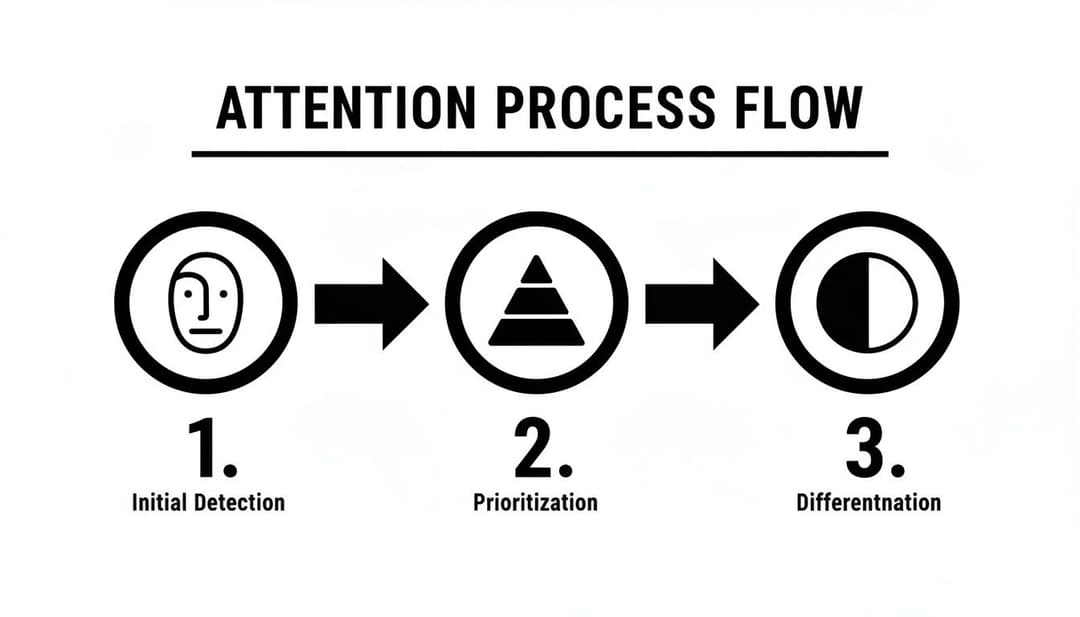
This simple flow—from noticing a face to focusing on high-contrast elements—is exactly why certain visual features grab attention in a crowded feed. It gives you a roadmap for what to test.
For more complex experiments, you might need to test multiple elements at once. You can learn more about those advanced methods in our guide on what is multivariate testing.
Identifying the Right Success Metrics
The final piece of the puzzle is tracking the right numbers. While Return on Ad Spend (ROAS) is the ultimate measure of success, other leading indicators can give you early signals that your psychological tactic is on the right track.
Here are the key performance indicators (KPIs) to watch for different types of tests:
- Click-Through Rate (CTR): This is your go-to for testing attention. If your hypothesis is that an ad with a human face will stop the scroll more effectively, a higher CTR is your first proof point.
- Cost Per Click (CPC): This tells you how efficiently you're earning that attention. A lower CPC often means your creative and copy are hitting the mark and feel highly relevant to your audience.
- Conversion Rate (CVR): The money metric. CVR is essential for testing bottom-of-funnel triggers like urgency or loss aversion. It proves your ad isn’t just getting clicks—it’s getting people to act.
- Cost Per Acquisition (CPA): This metric ties it all together. It balances the cost of traffic with its effectiveness, giving you a crystal-clear view of what it costs to get a customer using a specific psychological message.
When you consistently build strong hypotheses, run clean tests, and analyze the right data, you’re no longer just running ads. You’re building an engine for continuous improvement.
Have Questions About Using Psychology in Ads?
Even with a solid game plan, putting these psychological principles into action can bring up some tricky questions. Let's tackle the common concerns and clear up any misconceptions, so you can build a strategy that’s not just effective, but one you can feel good about.
Here are a few of the questions that performance marketers ask when they start weaving these powerful techniques into their campaigns.
Is It Ethical to Use Psychology in Advertising?
Absolutely, as long as it's done responsibly. There’s a fine but critical line between persuasion and manipulation. Ethical advertising psychology isn't about tricking people into buying things they don't want or need. It's about truly understanding what your audience is looking for and crafting messages that help them make better, more informed choices.
Think about it this way: using social proof like customer reviews isn't manipulative. It’s helpful. You’re showing a potential buyer that other people have had a great experience, which makes them feel more secure in their purchase. The real goal is to create a win-win, where the customer feels great about their decision and you build a long-term, loyal relationship.
The frameworks in this guide are all about ethical application. The goal is to better align the value you offer with your audience's needs, not to exploit their vulnerabilities.
This approach builds trust, and in the long run, trust is worth far more than any short-term conversion you might get from a deceptive tactic.
How Can I Test These Principles on a Small Budget?
You don't need a huge budget to start seeing results—you just need to be smart about it. The trick is to focus on one high-impact idea at a time instead of trying to test a dozen things at once.
Start by isolating a single, important variable. For example:
- Create a simple hypothesis: "I bet a headline that creates a sense of urgency (Loss Aversion) will get a better Click-Through Rate than the feature-focused one we're running now."
- Set aside a controlled budget: Dedicate a small, specific slice of your ad spend to run that single A/B test.
- Watch the leading indicators: You don't have to wait for sales to roll in. Look at early metrics like CTR and engagement. Which message is grabbing more eyeballs?
Even a small, well-designed test can give you powerful clues about what really connects with your audience. Once you find a winning principle, you can roll it out across your other campaigns and make your entire budget work harder.
Which Psychological Principle Drives the Best ROAS?
There’s no magic bullet that works for every single brand, but two principles consistently pack a punch when it comes to ROAS: Emotional Appeal and Loss Aversion.
- Emotional Appeal: Ads that create a genuine emotional connection are memorable. They build stronger brand recall and foster the kind of loyalty that drives higher customer lifetime value.
- Loss Aversion: Using urgency and scarcity is incredibly good at getting people to act now. It’s a powerful way to boost short-term conversion rates.
The most successful campaigns often find a way to blend the two. An ad that tells an emotional story and finishes with a time-sensitive call-to-action can be an absolute powerhouse for your Return on Ad Spend. The best move is to test both and see what your specific market responds to.
How Does AI Fit into All This?
AI is a massive force multiplier here, especially for testing at scale. A human marketer might be able to juggle a few ad variations at a time. An AI platform, on the other hand, can generate and analyze hundreds of combinations built around different psychological triggers.
For instance, AI can whip up ad variations that test angles like social proof, authority, and scarcity across all your different audience segments. It then crunches the performance data in real-time to pinpoint which triggers work best for which group. It automates all the grunt work, freeing you up to think about the big picture—strategy and creative insights.
Ready to stop guessing and start scaling? With AdStellar AI, you can launch, test, and analyze hundreds of psychologically-informed ad variations in minutes, not days. Discover which emotional triggers and cognitive biases truly drive performance for your brand. Get started with AdStellar at https://www.adstellar.ai.