Your display campaigns are live. Spend is flowing. Impressions look fine. But the click-through rate barely moves, and the creative team keeps shipping another set of static banners that feel different internally and identical to users.
That’s a familiar trap. Many teams don’t have a traffic problem. They have an attention problem. People scroll past flat image ads because those ads ask for too much belief from too little information.
Rich media advertising changes that exchange. Instead of showing one frame and hoping for a click, it gives users something to do: expand, swipe, watch, explore, compare, or interact. For performance marketers, that matters because interaction creates better signals. Better signals lead to better optimization. Better optimization usually leads to stronger business outcomes.
Beyond the Banner The Rise of Rich Media Advertising
A lot of marketers hit the same wall at the same time. Static banners are cheap to produce, easy to approve, and simple to launch across display inventory. Then the results flatten. CTR drops, view-through impact feels murky, and every new variation starts to look like cosmetic change instead of meaningful improvement.
That frustration is easier to understand when you look at where display advertising started. The first-ever banner ad on HotWired.com in 1994 achieved a 44% click-through rate, while standard banner ads today average 0.05% to 0.12% CTR. Modern rich media ads, by contrast, reach 1.12% to 1.53% CTR, which represents a 267% performance lift over standard formats, according to this overview of rich media performance.
Why static banners struggle now
The first banner worked because it felt new. Users hadn’t learned to ignore it yet. Today they have. Many users can spot a standard banner instantly, classify it as an ad, and move on before the message lands.
Rich media advertising is a response to that behavior change. It doesn’t try to win with a single still image. It gives the ad motion, depth, and user-triggered interaction. That one shift changes the role of the unit from background decoration to active experience.
Practical rule: If your display ad can be understood in a glance but gives no reason to pause, users usually won’t pause.
What changed for performance teams
For media buyers, the problem isn’t just lower CTR. Static formats also give you thinner feedback. A click tells you something. It doesn’t tell you much about curiosity, consideration, or intent before the click.
Rich media advertising starts to fill that gap. If someone expands an ad, watches part of a video, swipes through a gallery, or interacts with a product view, you learn more than you would from an impression alone. That richer signal is why these formats fit the way modern teams buy media and iterate creative.
If you’re tracking where ad systems are heading, the broader shift toward more adaptive, signal-driven creative is part of the larger future of advertising technology. The practical takeaway is simpler: static banners were built for scale. Rich media is built for attention.
Defining the Interactive Ad Experience
A standard display ad is like a printed flyer taped to a wall. It can communicate a headline, an image, and a call to action. But the conversation is one-way.
A rich media ad is closer to an interactive kiosk. It still promotes something, but it also responds. A user can tap, swipe, expand, watch, hover, or reveal more information without immediately leaving the page or app.
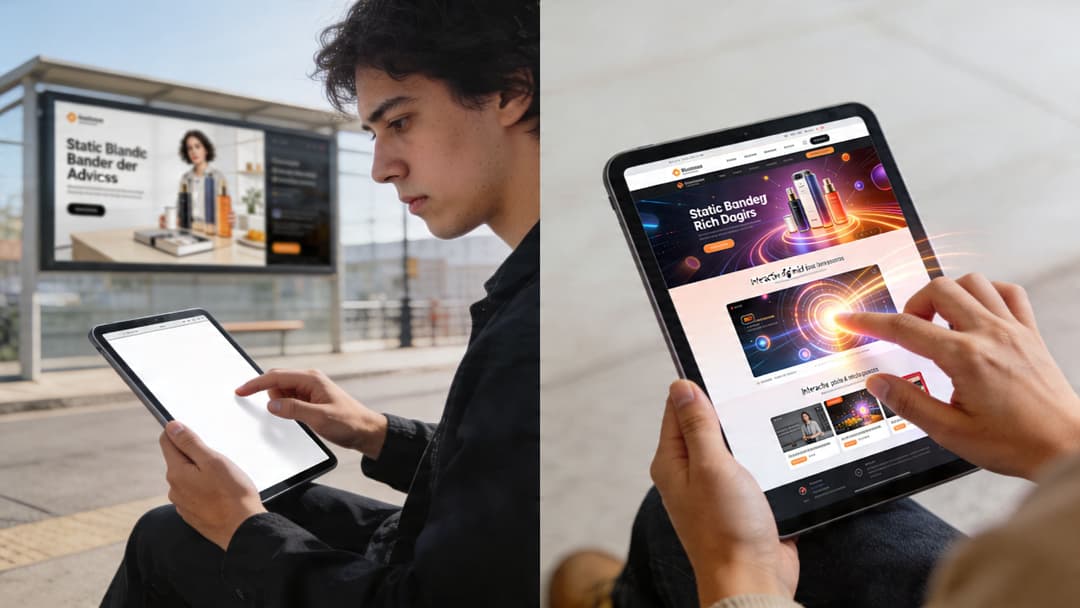
Rich media is an experience, not just a format
That distinction trips people up. Many marketers hear “rich media” and think it is just animated banners. Animation can be part of it, but animation alone isn’t the point.
The core idea is interaction plus media depth. Rich media advertising combines elements like video, audio, animation, expandable panels, product galleries, or gesture-based actions so the user can do more than just click or ignore. The best units feel like small product experiences embedded inside ad space.
The simplest way to judge whether an ad is rich media
Ask one question: can the user meaningfully interact with it inside the ad unit?
If the answer is yes, you’re likely in rich media territory. If the unit only shows a static image and a button, you’re in traditional display.
A useful mental model looks like this:
- Static banner: One frame, one message, one possible action.
- Rich media ad: Multiple layers, more context, several possible interactions.
- User outcome: Less guesswork before the click, and often stronger intent by the time the click happens.
Rich media advertising works best when the interaction helps the user evaluate the offer, not when it exists just to show off creative technique.
That last point matters. A spinning animation with no purpose can distract. A swipeable product gallery can help. A tap-to-expand demo can educate. A short interactive video can answer objections before the landing page has to.
If your team is thinking through what makes ad creative effective more broadly, this guide on creatives in digital marketing is a useful companion. The same principle applies here: good creative doesn’t just look better. It reduces friction between attention and action.
A Tour of High-Impact Rich Media Formats
Once you stop treating rich media advertising as one thing, format selection gets easier. Different formats solve different problems. Some create quick engagement. Others create space for product education. Others help bridge brand storytelling and direct response.
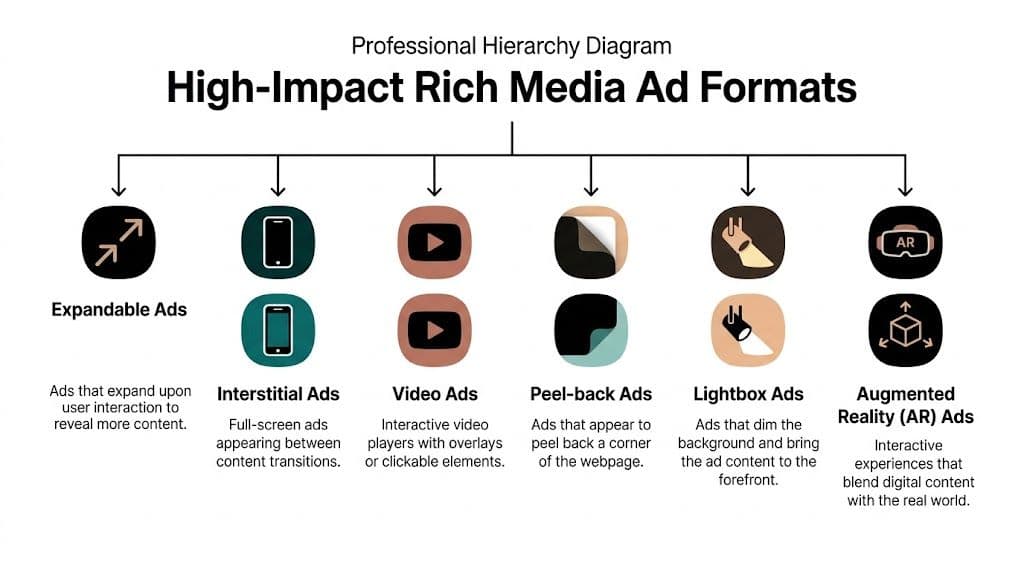
Expandable and interactive banner units
Expandable ads start compact and open after a tap, click, or hover. That makes them useful when you want to preserve page experience but still give interested users a deeper layer of content.
They work well for:
- Product exploration: Show features, colorways, or use cases without sending the user away too early.
- Lead generation: Reveal more context, proof points, or form prompts after interest is shown.
- Retail promotions: Let shoppers browse multiple items inside one placement.
The performance value comes from intent. An expansion is a stronger signal than a passive impression.
Video-led rich media
Interactive video units combine motion with clickable overlays, product hotspots, or layered calls to action. If you’re comparing placements, Adwave’s explainer on in-stream advertising is helpful for understanding where these video experiences fit within broader media plans.
Use these when the product needs demonstration. Software, beauty, home goods, apparel, and consumer electronics all benefit when the ad can show rather than tell.
A good video rich media unit usually does one of three jobs:
- Demonstrates the product
- Handles an objection
- Shortens the path from awareness to action
Interstitials, lightboxes, and takeovers
These formats give you more canvas. Interstitials take over the screen between content transitions. Lightboxes expand into immersive views. Site takeovers surround the environment with brand elements and interactive modules.
They’re best when the campaign needs strong visual impact and enough space to tell a fuller story. That makes them a better fit for launches, seasonal pushes, premium publisher placements, and campaigns where message depth matters.
Here’s the trade-off: more canvas means more responsibility. If the experience is heavy, confusing, or intrusive, performance can drop quickly.
The technology under the hood
Rich media formats are built on HTML5 for cross-platform compatibility, use CSS3 for efficient animations that conserve mobile CPU, and often rely on Dynamic Creative Optimization (DCO) to personalize content based on user data. That foundation can drive up to 10x higher CTRs, with 0.4% CTR for rich media versus 0.04% for static, according to AI Digital’s explanation of rich media ad technology.
That technical stack sounds more intimidating than it is. Think of it this way:
| Technology | What it does in practice |
|---|---|
| HTML5 | Makes the ad work across browsers, devices, and app environments |
| CSS3 | Handles visual motion efficiently so the ad feels smooth |
| DCO | Swaps content dynamically based on signals like audience or context |
Choosing the right format for the job
If your goal is quick interaction, start with an expandable banner. If you need demonstration, use video-led rich media. If the campaign is about immersion, look at interstitials or lightboxes.
A common pitfall is picking the flashiest format first. Start with the buying objective instead. Then ask what kind of interaction helps a user move one step closer to conversion.
For a grounding in how these units relate to standard web inventory, this overview of the web banner ad helps clarify where rich media extends the traditional banner model rather than replacing it outright.
The Performance Advantage Over Standard Display Ads
Creative teams may love rich media for the storytelling room. Performance teams care for a different reason. The format tends to produce better user response and better post-view quality than standard display.
The strongest case is the direct comparison. According to Adform and eMarketer data summarized by Publift, rich media ads deliver a 267% higher performance lift than static banners, with average CTRs of 0.44% for rich media versus 0.12% for standard display. The same comparison shows 56% purchase interest after rich media exposure versus 38% for standard ads, as noted in Publift’s review of rich media performance.
Rich Media vs. Standard Display Ads A Performance Breakdown
| Metric | Standard Display Ad | Rich Media Ad | Performance Impact |
|---|---|---|---|
| Average CTR | 0.12% | 0.44% | Higher click response from richer interaction |
| Purchase interest after exposure | 38% | 56% | Stronger post-view intent |
| User experience depth | Limited to message and click | Can include video, expansion, galleries, interaction | More chances to educate before the click |
| Behavioral data captured | Mostly impressions and clicks | Interaction patterns and richer engagement signals | Better optimization inputs |
Why this lifts ROAS in practice
CTR alone doesn’t pay the bills. But CTR often signals whether the creative earns attention at all. If a user never pauses, the landing page doesn’t matter.
Rich media helps because it does more work before the visit. A user can self-qualify by engaging with product details, testing curiosity through interaction, or watching a short explanation. That often means the click is less accidental and more informed.
A static banner asks for the click first and explanation second. Rich media lets you explain first, then earn the click.
That difference matters for ROAS. When ad traffic arrives with better context, on-site behavior often gets cleaner. Bounce risk drops. Product understanding improves. Retargeting segments also get smarter because engagement is no longer binary.
When the extra complexity is worth it
Rich media isn’t always the right answer. If you need rapid asset turnover across a huge catalog, simple dynamic display may still play a role. But when standard banners stall, upgrading the format can produce a more meaningful change than rewriting the headline for the tenth time.
Teams already using display dynamic ads will recognize the pattern. Relevance drives performance. Rich media extends that idea by adding interaction to relevance.
The key business question is simple: does your current creative give users enough information and enough reason to care? If not, standard display usually tops out quickly.
Creative Best Practices for Engaging Users
Rich media advertising can outperform static formats. It can also annoy people faster if the creative is bloated or confusing. Good execution feels intuitive. Bad execution feels like a page got hijacked.

Design for the first interaction
Most users won’t study your ad. They’ll scan it. That means the first interaction must be obvious and low-friction.
A few practical rules help:
- Show one clear prompt: “Tap to explore,” “Swipe to view,” or “Expand for details” works better than multiple competing actions.
- Make the benefit visible: If the user expands, what do they get. More product detail, a demo, a comparison, a limited offer.
- Reward the action quickly: Don’t make people interact just to find another static message.
Keep mobile constraints in mind
Rich media often looks great in creative review and weaker on a real phone in a busy feed or app. Mobile-first design fixes that.
Prioritize:
- Large touch targets: Tiny buttons create missed taps and frustration.
- Fast visual comprehension: Headlines and visual hierarchy need to land instantly.
- Lightweight motion: Smooth beats flashy. Motion should guide attention, not compete for it.
- Clear exit controls: People should always know how to close or collapse the unit.
Field note: The best rich media ads feel easier to use than the page around them.
That usually means fewer elements, not more.
A quick walkthrough can help your team review rich media with the right lens:
Build the ad like a landing page preview
Strong rich media creative doesn’t try to replace the landing page. It previews it. Think of the ad as the first useful interaction, not the full sales argument.
That leads to a simple “do this, not that” checklist:
| Do this | Not that |
|---|---|
| Lead with one product story | Cram several offers into one unit |
| Use interaction to clarify value | Add interaction just for novelty |
| Keep file weight and loading lean | Front-load heavy assets unnecessarily |
| Match CTA to user intent | Push “Buy now” before the user understands the product |
Respect beats interruption
Marketers sometimes confuse impact with aggression. Full-screen units, audio, or aggressive expansions can generate attention briefly, but not the kind you want.
Users engage more willingly when the ad gives them control. That means no hidden close button, no unclear gestures, and no surprise behavior. The cleaner the interaction, the more likely the performance gain comes from genuine interest rather than accidental action.
How to Measure Rich Media Campaign Success
If you judge rich media advertising by CTR alone, you’ll miss most of the value. These formats produce layered behavior. Measurement needs to reflect that.
Effective rich media measurement goes beyond CTR to include metrics like dwell time, interaction rate, and video completions. These “rich events,” captured through advanced analytics, create the optimization data teams need, and campaigns optimized on these signals can improve ROAS because higher engagement correlates with conversion, as described in AdPersonam’s rich media ad tech guide.
The metrics that actually matter
CTR still has a place. It tells you whether the unit can drive traffic. But rich media can answer more interesting questions.
Focus on metrics like these:
- Interaction rate: How often users engage with the ad in any meaningful way.
- Dwell time: How long they stay engaged once they start.
- Expansion rate: Whether compact formats successfully earn deeper exploration.
- Video completions: Whether the message holds attention through the end.
- Rich events: Specific actions like swipes, taps, reveals, gallery movement, or hotspot clicks.
Each one points to a different creative truth. A high interaction rate with low dwell time often means the opening hook works, but the expanded experience disappoints. Good dwell time with weak click-through can mean the ad educates well but needs a stronger next step.
Read the ad like a funnel
A useful way to analyze rich media is to think in micro-stages:
| Stage | What to inspect | What it usually tells you |
|---|---|---|
| Attention | Initial interaction rate | Did the opening creative earn curiosity |
| Engagement | Dwell time, swipes, expansions, video progress | Did the experience hold interest |
| Action | CTA clicks, downstream conversion behavior | Did the ad move people toward outcome |
That framework keeps teams from overreacting to one top-line number. A campaign can have moderate CTR and still be highly valuable if it builds stronger intent before the visit.
Don’t ask only whether users clicked. Ask what they did before the click, and what that behavior suggests about purchase readiness.
Tracking quality matters too
Rich media measurement also depends on implementation. If events aren’t tagged properly, you’ll get partial stories and bad decisions.
A practical setup should define:
- Which interactions count as meaningful
- Which events map to funnel stages
- Which creative elements trigger those events
- How those signals connect back to conversion reporting
Industry guidelines matter here because rich media can inflate reporting if impressions and expansions aren’t counted consistently. Teams should align with platform and ad server standards so the numbers reflect real user behavior, not tracking noise.
What to do with the data
Once you have rich event data, optimization gets sharper. You can compare not just ad A versus ad B, but also:
- Which intro frame drives the strongest first interaction
- Which expansion layout keeps users engaged longer
- Which CTA appears too early or too late
- Which format works best for prospecting versus retargeting
That’s where rich media starts acting less like a creative experiment and more like a performance system.
Scaling Your Rich Media Strategy with AI
The challenge isn’t usually understanding rich media advertising. It’s operationalizing it. One polished interactive ad is manageable. Building, testing, and iterating dozens of them across audiences, offers, and angles is where the process usually breaks.
That’s why scale requires workflow, not just creative ambition.
Start with a repeatable build-test-learn loop
A workable rich media program usually follows a pattern:
Choose one conversion path Start with a focused objective such as product education, prospecting click-through, or retargeting re-engagement.
Build a small set of interaction models Test a few meaningful variations. For example, compare expandable product detail, interactive video, and swipeable gallery.
Define success signals in advance Don’t wait until launch day to decide what matters. Pick the engagement and outcome metrics that should drive decisions.
Review at the element level Look beyond the overall ad. Which opening frame, prompt, CTA, or content sequence improved user behavior.
Why manual scaling breaks down
Rich media introduces more variables than static display. Creative format, interaction type, copy length, media order, CTA wording, device behavior, audience context, and placement all affect outcomes.
A human team can review this. It just can’t review it fast enough at scale without structure. That’s where AI becomes useful. Not as a replacement for strategy, but as a way to process variation and performance faster than manual workflows allow.
For teams exploring that shift, this overview of AI for ads is helpful because it frames AI as an execution layer, not magic.
Where AI actually helps in rich media operations
AI is most valuable in three places:
- Variation generation: It helps teams create more combinations of copy, creative, and message without rebuilding everything by hand.
- Pattern detection: It surfaces which creative elements correlate with stronger engagement and better downstream results.
- Scaling decisions: It helps teams move budget and attention toward winning combinations faster.
This is especially useful when rich media campaigns feed channels like Meta or broader performance programs where speed matters. The bottleneck usually isn’t launching one ad. It’s turning early signal into an organized next round of creative and audience tests.
The real gain from AI isn’t that it makes ads for you. It’s that it shortens the time between insight and the next better version.
Keep the workflow grounded in creative reality
AI can accelerate production, but it won’t rescue weak concepts. Start with a solid interaction idea. Then use automation to multiply and refine it.
For example, if your team wants to animate static assets into motion-ready creative concepts before building full rich media units, tools like Image Animator AI can be useful for early-stage exploration. That kind of workflow helps reduce the gap between “we have images” and “we have interactive-ready creative ingredients.”
The strongest operating model looks like this:
| Workflow layer | What your team should do |
|---|---|
| Strategy | Pick the audience, offer, and interaction goal |
| Creative system | Build modular assets that can be rearranged and tested |
| Measurement | Track rich events that show quality, not just clicks |
| AI support | Generate variations, identify winners, speed up iteration |
Rich media advertising becomes profitable when this loop runs consistently. Not once. Repeatedly. The advantage compounds when your team can launch, read signal quickly, and expand winning ideas before competitors finish debating which version to test first.
If your team wants to launch and scale more rich media-inspired ad variations without getting buried in manual setup, AdStellar AI gives performance marketers a faster path from idea to execution. It helps you generate large volumes of ad combinations, test them quickly, learn from real performance data, and focus spend on the creative and audience mixes that drive stronger ROAS, CPA, or CPL.