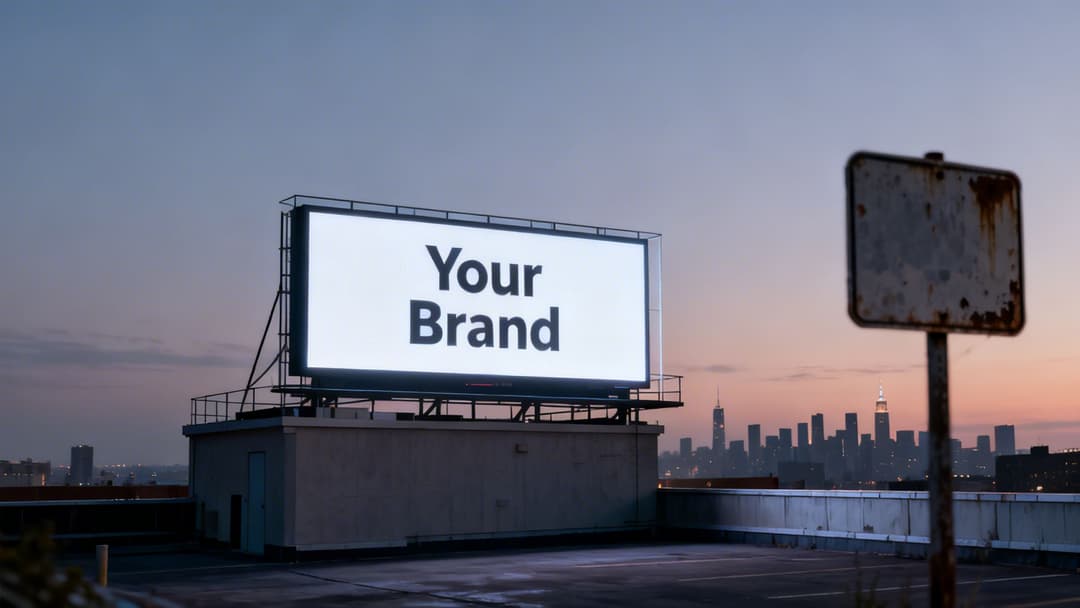
If you’ve spent any time online, you’ve seen a web banner ad. You can think of them as the digital version of a classic billboard, occupying prime real estate on websites to grab your attention and pull you toward a brand, product, or special offer.
Why Web Banner Ads Still Drive Growth
Let’s be honest, banner ads have a bit of a reputation problem. It’s easy to dismiss them as an annoying relic from the dial-up era. We’ve all heard about “banner blindness,” the phenomenon where our brains just automatically tune out anything that looks like an ad.
But writing them off entirely means overlooking just how much they’ve transformed. Modern banner advertising isn’t about shouting at everyone—it's about having a quiet, relevant conversation with exactly the right person.
Think about two billboards. One is a faded sign on a deserted highway, seen by a few and remembered by none. The other is a dynamic screen in a busy airport, showing a timely flight deal only to travelers whose plane is boarding soon. Today’s web banners are much more like that smart screen.
The Evolution From Static to Smart
The whole idea started with a single, game-changing ad. On October 27, 1994, HotWired ran the first-ever banner for AT&T that asked, "Have you ever clicked your mouse right HERE? YOU WILL." It wasn't just a gimmick; it worked. The ad pulled in a mind-boggling 44% click-through rate, a number that seems almost mythical today but was enough to ignite the entire digital ad industry.
Since that first click, banner ads have evolved from simple static images into incredibly sophisticated marketing instruments. Their power isn't just in being seen, but in being seen by the right people at the right time.
Today, a smart campaign uses data to hit very specific goals:
- Building Brand Recall: Showing your logo and message to a well-defined audience keeps your brand at the front of their minds.
- Retargeting High-Intent Users: Serving ads to people who already visited your site or ditched a shopping cart is a powerful way to bring them back to finish the job.
- Driving Measurable Sales: By tracking conversions and optimizing for return on ad spend (ROAS), banners become a direct line to real revenue.
Banners in a Full-Funnel Strategy
Web banner ads are a crucial player throughout the entire marketing funnel, not just a tool for getting a quick click. They are essential for guiding potential customers along their journey with your brand.
By getting a handle on the different ways to target your audience, you can make your banners work much harder for you—whether it's building top-of-funnel awareness or pushing for that final bottom-funnel conversion.
When done right, a banner campaign is still a vital lever for growth. Success all comes down to the right mix of compelling creative, intelligent targeting, and a commitment to constant testing and optimization.
Ever seen a banner ad and just completely ignored it? Of course, you have. We all have. It’s a phenomenon called “banner blindness,” and it’s the default response for most people online. So, what makes one ad break through that wall of indifference while another simply fades into the background?
It’s not magic. It’s a mix of sharp design and a bit of psychology. A great banner ad has to work incredibly hard and incredibly fast, grabbing attention and delivering a clear message in the blink of an eye. Think of it like a perfectly crafted movie trailer—it has to be exciting, tell you just enough to get you interested, and leave you wanting to see the whole film. A cluttered, confusing ad is like a bad trailer; you know instantly you're not interested.
The best banner ads you see online are almost always built on the same three foundational elements. Nail these, and you're no longer just creating noise; you're building an ad that actually gets results.
The Three Core Components
A Compelling Value Proposition: This is the heart of your ad. It’s the direct answer to the viewer’s unspoken question: “What’s in it for me?” It's not about what your product is; it's about what it does for them. Don't say, "Our Software Has AI." Instead, try something like, "Finish Your Work in Half the Time." One is a feature, the other is a life-changing benefit.
Attention-Grabbing Imagery or Visuals: People process images thousands of times faster than text. High-quality photos, crisp graphics, or even a simple, smooth animation are your first line of attack in the battle for attention. The visuals can’t just look good, though; they have to instantly connect to your offer and feel like they belong to your brand.
A Clear and Urgent Call-to-Action (CTA): You’ve got their attention, you’ve told them the benefit—now what? You have to tell them exactly what to do next. A vague "Click Here" just doesn't cut it anymore. Use strong, benefit-driven commands like "Get Your Free Trial" or "Shop 50% Off Now." Adding a little urgency never hurts, either.
A truly effective banner ad is a swift, three-part story. The visuals grab attention, the headline offers a solution to a problem, and the CTA provides the immediate next step to get that solution. Anything that distracts from this narrative weakens the ad's performance.
Beyond the Basics to Beat Banner Blindness
Just having those three pieces isn’t quite enough to guarantee success. How they’re arranged matters. This is where visual hierarchy comes in—making sure the most important part of your message (like a big discount or a key benefit) is what people see first. Use bold colors and smart contrast to make your CTA button the most clickable thing on the screen.
We dive much deeper into these advanced techniques in our full guide. For a masterclass on creating high-performance layouts, check out our post on strategic web banner ad design.
In the end, a banner ad that converts is more than just a pretty picture. It’s a direct, efficient communication tool that understands the viewer's mindset. By focusing on a clear value proposition, backing it up with strong visuals, and giving users an unmissable CTA, you can turn your banner from a passive digital billboard into a real engine for growth.
Choosing the Right Banner Ad Sizes and Specs
Stepping into the world of web banner ads can feel like you’ve been handed a puzzle with a thousand mismatched pieces. With dozens of different ad dimensions floating around, it’s easy to get overwhelmed. But here’s the thing: the sizes you choose will make or break your campaign, dictating where your ads can run, how much inventory is available, and ultimately, how many people you can reach.
Think of it like digital real estate. Some ad spots are small and plentiful, while others are like premium storefronts, offering a bigger canvas to tell your story. The trick is to stop obsessing over a long list of dimensions and start thinking in strategic categories.
But before we get into sizes, let's talk about what goes inside the banner. No matter the dimensions, every effective ad shares the same core anatomy.
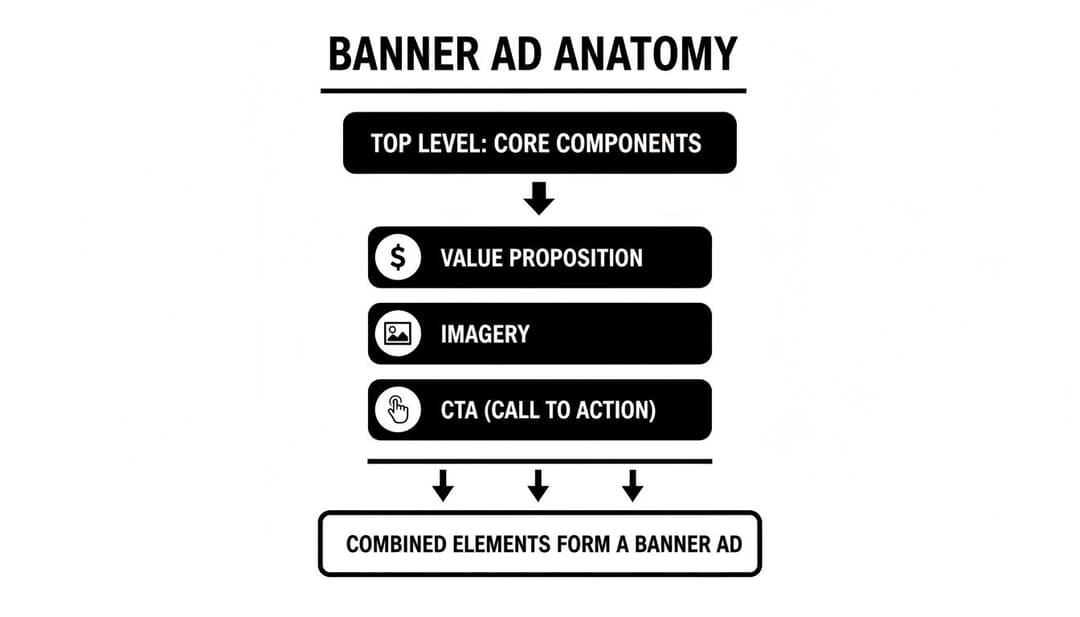
Every great ad starts with a crystal-clear value proposition, backed by compelling visuals and sealed with a can't-miss call to action. Get these three elements right, and you're already ahead of the game.
The Most Common Banner Ad Sizes for Maximum Reach
Some ad sizes are the undisputed champions of the ad world. They’re so widely adopted by publishers on networks like the Google Display Network that they give you access to the largest possible pool of ad space. These are your workhorses.
- 300 x 250 (Medium Rectangle): This is the king. It’s incredibly versatile, fitting neatly into content on both desktop and mobile, and it accounts for a huge slice of all available ad inventory.
- 336 x 280 (Large Rectangle): The slightly bigger cousin of the Medium Rectangle. It gives you a little more room for your creative and performs just as well, especially when it’s embedded directly within an article.
- 728 x 90 (Leaderboard): You’ll usually see this wide banner sitting right at the top of a webpage. It's fantastic for grabbing immediate attention and building brand awareness right off the bat.
If you’re ever in doubt, just start with these. The 300 x 250 is so dominant that it’s often the best place to begin any new campaign. You can dive deeper into this powerhouse format in our detailed guide on the 300 x 250 banner ad.
Standard Banner Ad Dimensions and Specs for 2026
To make things even easier, here's a quick-reference table covering the most effective and widely accepted banner ad sizes for 2026. This includes their technical specs, which are just as important as the dimensions themselves.
| Ad Name | Dimensions (pixels) | Best For | File Size Limit |
|---|---|---|---|
| Medium Rectangle | 300 x 250 | Versatility, embedded content | Under 150 KB |
| Large Rectangle | 336 x 280 | More visual space in-content | Under 150 KB |
| Leaderboard | 728 x 90 | Top-of-page awareness | Under 150 KB |
| Half Page | 300 x 600 | High-impact storytelling | Under 200 KB |
| Large Mobile Banner | 320 x 100 | Mobile brand awareness | Under 150 KB |
| HTML5 Animated Ad | Various | Dynamic engagement | Under 300 KB |
Think of this table as your cheat sheet. Adhering to these file size limits is non-negotiable—if your ad file is too heavy, ad networks will simply reject it, and your campaign will be dead on arrival.
Always double-check the specific requirements for the platform you’re running on, but keeping your files as light as possible is a universal rule. A lean, compliant ad ensures your message gets seen without a single technical hiccup.
How to Target and Measure Your Ad Campaigns
Let's be honest: a stunning banner ad is completely wasted if it's shown to the wrong person. Now that we've nailed down the creative side, it's time to talk strategy—how to find your ideal customers and prove your campaigns are actually making money.
If you don't have smart targeting and clear measurement, you're not advertising. You're just throwing money into the digital void and hoping for the best.
Think of it like delivering a high-value package. You wouldn't just drop it on a random doorstep and walk away, right? Of course not. You'd use a specific address. Ad targeting is that address, making sure your message lands squarely in front of the people who are most likely to care.
Key Targeting Strategies
So, how do you find your audience? There are three main ways to do it. Each one comes at the "who" from a different angle, and the most effective campaigns often mix and match all three to get the best results.
Contextual Targeting: This is the most straightforward approach. It puts your ad on websites based on the content of the page itself. Selling hiking gear? Your ad pops up on a blog reviewing the best new hiking boots. Simple and effective.
Behavioral Targeting: This method gets a little more personal. It follows the user, not the website. By tracking past browsing behavior—like sites they've visited or products they've looked at—it builds an interest profile. That same hiking gear ad might now show up on a news site, all because the user was shopping for tents yesterday.
Retargeting: This is your precision strike. It’s all about targeting users who have already interacted with your brand in some way, like visiting your website or, the classic example, abandoning a shopping cart. It's your second chance to close the deal.
The goal isn't just to be seen, but to be seen by someone with intent. An ad for a new software tool is far more valuable on a tech review site (contextual) or shown to someone who just visited a competitor's page (behavioral) than it is randomly placed on a celebrity gossip blog.
This obsession with data-driven precision is what's driving the entire industry forward. The global digital banner ad market is set to grow steadily through 2026, and it's almost entirely because of these sophisticated targeting options.
In fact, recent data shows that display retargeting costs (CPMs) jumped 18% year-over-year as advertisers double down on high-intent audiences. Meanwhile, broader prospecting CPMs actually fell by 11%. The message is clear: advertisers are paying a premium to reach the right people.
Measuring What Truly Matters
Once your campaign is live and reaching the right people, you need to know if it's working. But not all metrics are created equal. It's incredibly easy to get obsessed with vanity metrics like Click-Through Rate (CTR).
A high CTR might feel good, but it means absolutely nothing if those clicks don't turn into actual business. To really know what’s working, you need to get comfortable with A/B testing and understand how to interpret the results, especially when it comes to testing statistical significance.
Instead, zero in on the key performance indicators (KPIs) that are tied directly to your business goals:
- Cost Per Acquisition (CPA): On average, how much are you paying in ad spend to get one new customer? This tells you if your advertising is efficient.
- Return on Ad Spend (ROAS): This is the big one. For every single dollar you put into your ads, how many dollars in revenue do you get back?
Tracking these two numbers is everything. If you're running campaigns on social and want to dive deeper into the technical side of tracking, our guide on Meta ads attribution and tracking is a great place to start.
By prioritizing ROAS and CPA, you ensure your banner ads stop being an expense and start becoming a predictable, profitable engine for growth.
Scaling Ad Production and Testing with AI

So you've figured out your ideal audience and know which metrics to track. Now comes the hard part—the biggest bottleneck in digital advertising today: actually creating enough high-quality ads to figure out what works.
Manually designing even one solid web banner ad takes time and effort. But to really move the needle, you need to test dozens, if not hundreds, of different combinations of copy, images, and offers. This manual grind is a fast track to creative fatigue, where your team runs out of fresh ideas and campaign performance just flatlines. For any team focused on growth, it's a completely unsustainable model.
The Shift from Manual Grind to AI Speed
This is exactly where AI-driven tools completely change the game. Think of it this way: manual ad creation is like a single skilled chef painstakingly cooking one perfect dish at a time. It’s impressive, but slow. An AI platform is the equivalent of a fully automated professional kitchen, producing, testing, and perfecting thousands of on-brand dishes at once.
This technology hits the core challenge of scale head-on. To ramp up your ad production and testing efficiently, you need to look at platforms for AI ad creation that boost both your speed and performance. These tools automate the soul-crushing, repetitive tasks that bog marketing teams down.
For example, a platform like AdStellar AI can completely overhaul your workflow. Instead of briefing a designer and waiting a week for a handful of ad options, you can generate hundreds of creative and copy variations in minutes. This isn't just about moving faster; it’s about unlocking a level of testing that used to be impossible for most businesses.
The real power of AI in advertising isn't just making ads faster. It's the ability to test creative hypotheses at an unprecedented scale, quickly learning which messages, images, and offers resonate most with your target audience.
This new approach lets you shift from guesswork to confident, data-backed decisions. By generating a massive volume of on-brand ads, you create the raw material needed for truly meaningful A/B testing. You’re no longer stuck testing just one or two variables at a time.
How AI Empowers Large-Scale Testing
With an AI platform, you can systematically test every single element of your web banner ads to see what actually drives results. It’s about breaking down the ad into its components and finding the winning formula.
- Headlines and Copy: Test dozens of value propositions—from benefit-driven messages to urgent, FOMO-inducing calls—to find the copy that converts.
- Visuals and Imagery: Pit different product shots, lifestyle photos, and graphic styles against each other to identify what truly stops the scroll.
- Calls-to-Action (CTAs): Experiment with button text ("Shop Now" vs. "Learn More"), colors, and placement to see what drives the highest click-through and conversion rates.
By automating this process, you can finally gather enough data to know—not just guess—what works. Instead of relying on intuition, you get clear, actionable insights that tell you exactly how to optimize your campaigns for maximum performance. This is how you find those winning combinations that turn a decent campaign into a highly profitable one.
The ability to generate a vast range of ad variations with AI is no longer a luxury; it's essential. This iterative cycle of generating, testing, and learning is the key to scaling your advertising effectively and achieving a much higher return on your investment.
Frequently Asked Questions About Web Banner Ads
It’s easy to have questions about web banner ads. The technology changes so fast that last year's winning strategy might be totally obsolete today. Let's clear up some of the most common questions marketers are asking so you can make smarter, more confident decisions.
Are Banner Ads Still Effective in 2026
Yes, but they’ve changed. The days of "spray and pray"—where you’d blast the same generic ad across the internet and hope for the best—are over. Today, a banner ad's power comes from its precision.
They're now a go-to tool for strategic retargeting, warming up audiences who've already visited your site, and building brand recognition in very specific markets. When you combine them with good data and head-turning creative, they absolutely drive conversions. Success isn't about getting random clicks anymore; it's about showing the right ad to the right person at just the right time.
What Is the Most Important Metric for Banner Ad Success
It’s tempting to obsess over Click-Through Rate (CTR), but honestly, it's often a vanity metric. What good is a high CTR if it doesn't lead to any sales? You're just paying for clicks that go nowhere.
The most important metric will always be the one tied directly to your main business goal.
- For an e-commerce shop, that's almost always Return on Ad Spend (ROAS).
- For a B2B software company, it might be Cost Per Acquisition (CPA) or Cost Per Lead (CPL).
Always put the focus on metrics that measure real business results, not just surface-level clicks. If you need a quick refresher, we have a great guide on how to use ROAS to measure your campaign success. Thinking in terms of profitability turns your ad spend from an expense into a true investment.
How Do I Fight Banner Blindness
You beat banner blindness with two things: relevance and creative that pops. People have gotten incredibly good at subconsciously ignoring anything that looks like a standard, boring ad. To get noticed, your ad needs to feel less like an annoying interruption and more like a genuinely helpful idea.
It all starts with sharp targeting to make sure your message is even reaching the right eyeballs. After that, it’s all about the creative execution:
- Use striking, high-quality visuals that literally stop the scroll.
- Write a clear, straight-to-the-point value proposition that immediately answers the user's question: "What's in it for me?"
- Design a bold, impossible-to-miss call-to-action (CTA) that makes people want to click.
This is exactly where rapid-fire testing comes into play. AI tools can help you cycle through creative ideas lightning-fast to find the designs and messages that actually grab your audience's attention and break through the noise.
How Can I Create Many Ad Variations Without a Big Team
This is a classic problem for growing companies, and it’s precisely what AI-powered creative platforms were designed to solve. Trying to get a designer to manually build dozens—or hundreds—of ad variations is a massive time and money sink that most teams simply can't handle.
Instead of having your team build every single banner by hand, tools like AdStellar AI can automate the heavy lifting. You just give it the basic ingredients—logos, product shots, headline ideas, and your brand colors—and the AI generates hundreds of on-brand, ready-to-use ad variations in a matter of minutes.
This gives a single marketer or a small team the power to test creative at a scale that used to be reserved for huge corporations with massive budgets. It massively stacks the odds in your favor for finding those winning ad combinations that fuel profitable growth.