Ever wonder what Facebook impressions really are? At its core, the term represents the total number of times your content—whether it's an ad or an organic post—shows up on someone's screen.
It’s that simple. But the key thing to remember is that this metric counts every single time it appears, even if the same person sees it over and over again.
Understanding Facebook Impressions: A Simple Analogy

Think of your Facebook ad as a massive digital billboard alongside a busy highway. Every single time a car drives by and that billboard comes into view, that’s one impression.
It doesn’t matter if it’s the same commuter driving past that billboard ten times on their way to and from work. That one person just generated ten separate impressions. This is the perfect way to understand the concept: impressions are all about measuring total exposure, not the number of unique people who saw your ad. It's a raw count of visibility opportunities.
Served vs. Viewed Impressions
To really get into the weeds, Meta actually tracks two different kinds of impressions behind the scenes. It's a small distinction, but an important one for advertisers.
- Served Impressions: This is the moment Facebook's ad server gets the signal to "serve" your ad to a user's feed. Think of it as the ad being loaded and ready to go.
- Viewed Impressions: This is what most of us care about. An impression is only counted as "viewed" once at least one pixel of the ad has physically appeared on the user's screen.
This distinction matters because it confirms you’re paying for the opportunity for your ad to be seen, which is the bedrock of all digital ad measurement.
An impression is the most basic unit of digital advertising. It confirms your content was delivered to a user's screen, setting the stage for every other action, from a simple click to a final purchase.
Facebook impressions are a fundamental yardstick for gauging how much visibility you’re getting in a very crowded feed. Historically, a decent organic Facebook post could expect somewhere between 1,500 to 2,500 impressions. Of course, this number swings wildly based on your page size, how good your content is, and your engagement.
While that's a typical range for brands with a moderate following, top-tier pages can easily blow past that into the tens of thousands. To learn more about how to analyze these numbers, you can check out our guide on social media impressions and what they mean for your brand.
Impressions vs Reach The Difference That Defines Your Strategy
Talk to marketers long enough, and you'll hear impressions and reach used almost interchangeably. But they measure two completely different things, and getting this distinction right isn't just about sounding smart—it’s about making every dollar you spend on Facebook ads count.
Let’s go back to our highway billboard analogy. Reach is the number of unique cars that drove past your billboard. If 1,000 individual cars saw it over the course of a week, your reach is 1,000. It’s your total audience size, plain and simple.
Impressions, on the other hand, count the total number of times any car passed by. If one commuter drives past your billboard five times that week, that single car contributes one to your reach but five to your impressions.
When to Prioritize Each Metric
This difference has a massive impact on your campaign strategy. Which one you focus on really depends on what you're trying to achieve.
For instance, you'll want to prioritize high reach when your main goal is getting your name out there as widely as possible.
- Product Launches: You’ve got something new, and you need to introduce it to the largest possible group of unique people. High reach ensures maximum exposure to a fresh audience.
- Brand Awareness Campaigns: The goal is to become a household name. Casting a wide net with a high-reach objective gets your brand in front of as many potential customers as you can.
On the flip side, a strategy built around high impressions is perfect for nurturing existing interest. This is when you intentionally show your ad to the same people multiple times to stay on their radar.
The core question isn't whether impressions or reach is "better." The right question is: "Does my campaign need to introduce my brand to new people, or remind existing prospects why they were interested in the first place?"
A classic retargeting campaign is the perfect example. You're targeting people who have already visited your website or, even better, added an item to their cart. In this scenario, seeing your ad multiple times is a powerful nudge, keeping your brand top-of-mind and encouraging them to finally click "buy." This logic holds true across Meta's platforms, including when you're looking at impressions on Instagram, where the same strategic thinking applies.
Breaking Down The Different Types Of Facebook Impressions
Not all visibility on Facebook is created equal, and if you want to measure your performance accurately, you need to get familiar with how Meta slices and dices impression data. This is where we move past simply asking "what are impressions?" and start asking the more important question: "which impressions are actually driving my business forward?"
The most fundamental split is between Paid and Organic impressions. Think of Paid impressions as the ones you buy directly through Meta Ads. They're the backbone of your advertising campaigns, deliberately pushed out to the specific audiences you’ve hand-picked.
Organic impressions, on the other hand, are earned, not bought. These happen when your regular, non-promoted content—like a standard Page post—shows up in someone's feed all on its own.
Served vs. Viewed Impressions
Digging a bit deeper, there’s a technical but critical difference in how Meta counts these moments of visibility. Served impressions are logged the instant Meta's system decides to send your ad to a user. It's like putting a letter in the mail.
But viewed impressions are only counted once at least one pixel of the ad physically appears on their screen. This is the confirmation that the letter was actually opened. This distinction ensures you're measuring real visibility, not just delivery attempts.
Understanding the nuances between impression types is vital. It allows you to analyze ad reports with greater precision, diagnosing whether your budget is building earned media or just paying for basic visibility.
Viral Impressions: The Power of Social Proof
The last and arguably most powerful category is viral impressions. These occur when a user’s friends see that they've interacted with your Page or post—for instance, by liking your Page or sharing your content.
This is a potent form of earned media because the visibility comes with an implicit endorsement from a trusted source. A friend's like is far more persuasive than an ad, which is why viral impressions are often the most valuable of all.
Your campaign goals will ultimately determine which types of impressions you should prioritize.
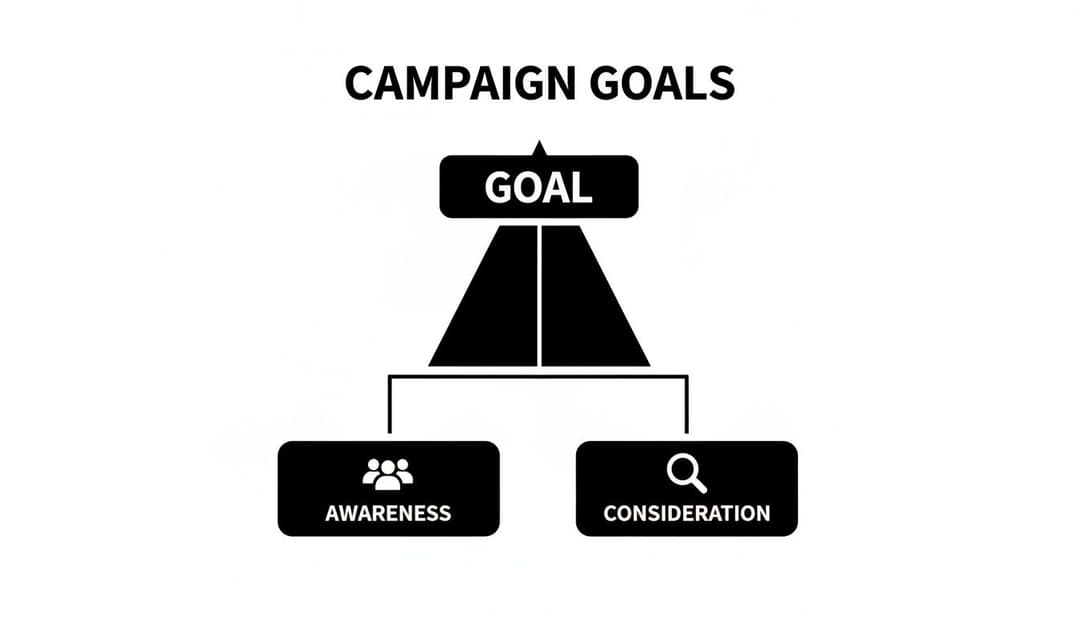
As the diagram shows, high-level goals split into Awareness (reaching new people) and Consideration (engaging interested prospects), which helps guide your impression strategy. Mastering these concepts is essential, especially as tracking technology evolves. You can learn more about the Facebook Pixel to see how this data is collected behind the scenes.
How Impressions Fuel Your Most Important Ad Metrics
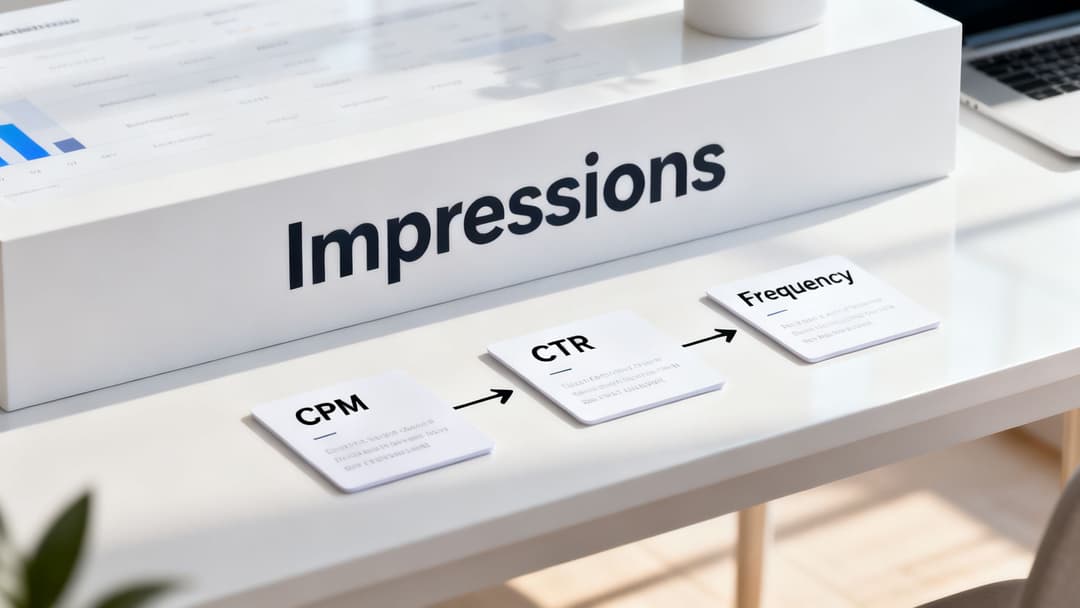
It’s tempting to write off impressions as a vanity metric—just a big number showing how many times your ad appeared. But that would be a huge mistake. Impressions are the bedrock of almost every other performance metric in your ad account.
Think of them as the raw ingredient in your analytics recipe. Without impressions, you simply can't calculate the metrics that actually tell you what's working and what’s not. These calculations are what turn raw visibility into the kind of intelligence you can use to make smart, profitable decisions.
Cost Per Mille (CPM): Your Price for Attention
Your Cost Per Mille (CPM) is simply the price you pay for 1,000 impressions. It’s the most direct way to measure how expensive it is to get your ad in front of people. A high CPM often means you're targeting a very competitive audience, while a low CPM might point to a less crowded market.
Keeping a close eye on your CPM is fundamental for managing your budget. If it suddenly shoots up, it could be a sign your audience is too narrow or that competition in the ad auction is heating up, forcing you to pay more for the same eyeballs.
Click-Through Rate (CTR): Measuring Ad Appeal
Click-Through Rate (CTR) is where the rubber meets the road. It tells you how compelling your ad really is by dividing the total number of clicks by the total number of impressions. A high CTR is a great sign; it means your creative, copy, and offer are hitting the mark and grabbing attention.
On the other hand, a low CTR is a massive red flag. It’s telling you that even though plenty of people are seeing your ad, they just aren't interested enough to click. That almost always points to a problem with the ad itself. You can get a better handle on this and other key indicators in our complete guide to Meta ads performance metrics.
Impressions are the denominator in your most critical performance equations. A low CTR isn't a "click problem"—it's an impression problem. Your ad is failing to convert visibility into action.
Frequency: Preventing Ad Fatigue
Finally, Frequency shows you how many times, on average, a unique person has seen your ad. You get this number by dividing total impressions by your reach. This metric is your key to avoiding ad fatigue—that point where users see your ad so often they start to tune it out or even get annoyed.
For many campaigns, a frequency of 3-5 is a healthy sweet spot. But if you see it climbing much higher without a matching increase in conversions, it’s a clear signal that it’s time to switch up your creative.
With Facebook projecting a staggering 3.07 billion monthly active users in 2025, its ad platform isn't going anywhere. Its ads are expected to reach 2.28 billion users, and as placements diversify across Feeds, Stories, and Reels, mastering these core metrics is more crucial than ever. You can learn more about how to analyze Facebook stats to grow your business on USChamber.com.
Using AI To Turn Impression Data Into Actionable Insights
Trying to manually sift through impression data from hundreds of ad variations is a recipe for a headache. It's one thing to see which ads got a lot of views, but connecting those views to what actually matters—like Return on Ad Spend (ROAS) or Cost Per Acquisition (CPA)—is a whole different beast. At scale, it's practically impossible.
This is exactly where modern AI tools are changing the game.
Platforms like AdStellar AI completely automate this heavy lifting, digging up hidden performance trends you’d never spot on your own. By analyzing all of your historical ad performance, these systems can draw a straight line from impression volume to your bottom-line business goals.
What this really means is you can finally move past surface-level vanity metrics. Instead, you can pinpoint the specific creative, copy, and audience combinations that generate the most valuable impressions—the ones that actually get people to convert.
Pinpointing Profitable Ads Automatically
Imagine a direct-to-consumer brand running a campaign with over 200 different ad variations. Good luck trying to find the real winners by staring at a spreadsheet for a few days.
The real challenge isn't just seeing which ads got impressions; it's understanding which impressions drove profit. AI closes this gap by linking visibility directly to revenue, turning raw data into a clear roadmap for what to scale next.
An AI-driven platform can chew through that entire dataset in minutes. It instantly identifies the top-performing assets—maybe flagging the 5 specific ads that are consistently driving profitable growth.
This empowers marketers to make fast, data-backed decisions. No more guesswork. You can immediately cut wasted ad spend on the duds and double down on the creative combinations proven to work. By connecting what Facebook impressions are to real-world outcomes, AI transforms a simple visibility metric into a powerful tool for strategic growth and a much more efficient campaign.
Common Questions About Facebook Impressions Answered
Even with a solid grasp of the basics, a few common questions always pop up once marketers really start digging into their campaign data. Getting these cleared up is key to correctly interpreting what you see in your own reports.
Let's tackle a few of the most frequent points of confusion.
Are Impressions the Same as Views for Videos?
This is a great question, and the answer is a firm no. They're two totally different things.
An impression gets counted the instant any tiny part of your post or ad shows up on someone's screen—even for a split second as they scroll past. But a video view is a much higher bar. Meta typically counts a "view" only after someone watches for at least three seconds, or a good chunk of the video if it's a super short one.
Because of this, you’ll always have way more impressions than video views. Most of those impressions happen in the blink of an eye, long before the 3-second timer for a "view" ever kicks in.
Do Impressions Cost Money on Facebook?
This one depends entirely on where the impression comes from.
- Paid Impressions: Absolutely. This is what you're buying with your ad spend. When you run a campaign, you're usually paying on a CPM basis—that's Cost Per Mille, or cost per 1,000 impressions.
- Organic Impressions: Nope, these are the free ones. They happen when your non-promoted content shows up in someone's feed naturally.
- Viral Impressions: These are also free! Think of them as a bonus layer of organic reach that happens when people see their friends interacting with your page or posts.
If you want to go deeper on the costs, we break down the numbers in our guide to the average cost per impression on our blog.
An impression itself isn't an indicator of quality or engagement. It’s simply a measure of exposure. The real work is in analyzing what happens after the impression—clicks, shares, and conversions.
Why Are My Impressions So High but My Clicks Are Low?
Ah, the classic question. If you're seeing tons of impressions but hardly any clicks, you've got a classic disconnect between your ad and your audience.
The good news? Your ad is being delivered, so your targeting is probably working from a technical standpoint. The bad news is that your creative, your copy, or your offer just isn't compelling enough to stop the scroll and earn that click.
It’s a clear signal from the market: it's time to head back to the drawing board and test some new creative.
Ready to turn those impressions into profitable results? AdStellar AI connects your performance data to your creative, automatically identifying the ad variations that drive real growth so you can scale what works, faster. Learn how AdStellar AI can optimize your Meta campaigns.