If you've ever stared at a campaign report, drowning in a sea of clicks, impressions, and likes, you know how easy it is to lose track of what actually matters. What’s the one metric that cuts through the noise? Return on Ad Spend, or ROAS.
This is your advertising report card. It tells you, in plain dollars and cents, how much revenue you’re generating for every single dollar you put into an ad campaign.
The Real-World Meaning of ROAS
At its core, Return on Ad Spend is all about measuring the direct financial payback from your advertising efforts. For anyone running ads—especially performance marketers and growth teams—it's the most straightforward indicator of whether a campaign is actually working. You can dig deeper into the concept with HubSpot's glossary on the topic.
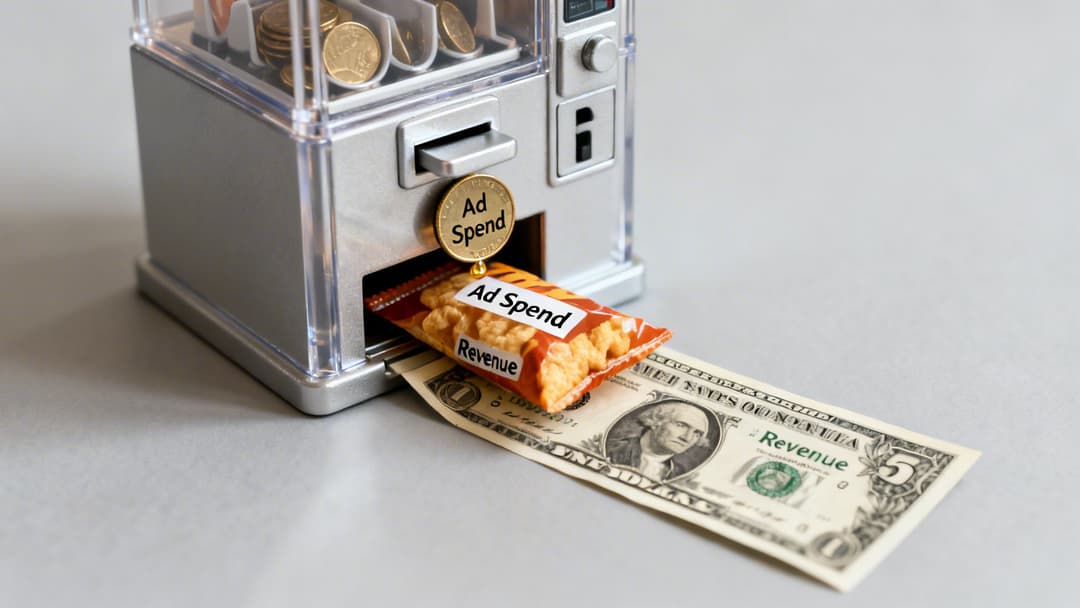
Think of it like a simple vending machine. You slide in a $1 coin (your ad spend) and out pops a snack worth $5 (your revenue). That simple exchange gives you a 5:1 ROAS. You made five dollars for every one dollar you spent.
Let's break that down with a quick reference table.
Here's a simple way to look at the core components of ROAS.
ROAS At a Glance
| Concept | Definition |
|---|---|
| Return on Ad Spend (ROAS) | A marketing metric that measures the amount of revenue earned for every dollar spent on advertising. |
| Formula | Total Revenue from Ad Campaign / Total Cost of Ad Campaign |
| What It Measures | The direct profitability and financial efficiency of an advertising campaign. |
This table shows just how direct the connection is between your ad budget and the money coming back into your business.
Why ROAS Is a North Star Metric
There’s a reason why so many e-commerce brands and marketers on platforms like Meta and Google treat ROAS as their guiding light. It directly connects ad budgets to revenue, cutting through vanity metrics to answer the most critical question: "Are my ads actually making money?"
A clear understanding of your ROAS empowers you to:
- Justify your ad spend: Show stakeholders the real financial impact of your campaigns.
- Optimize your budgets: Confidently shift money to winning ads and platforms while cutting the ones that are draining your funds.
- Scale with confidence: Know exactly when and how to ramp up your ad budget without just guessing and hoping for the best.
In short, ROAS isn't just another industry acronym; it's the language of advertising profitability. It gives you the clarity you need to turn a marketing expense into measurable business growth.
Calculating Your ROAS with Real-World Examples
Alright, you get the theory behind ROAS. Now, let’s get our hands dirty and put it into practice. The concept really clicks once you start plugging in real numbers. The formula itself is wonderfully simple, yet it's one of the most powerful metrics in any marketer's toolkit.
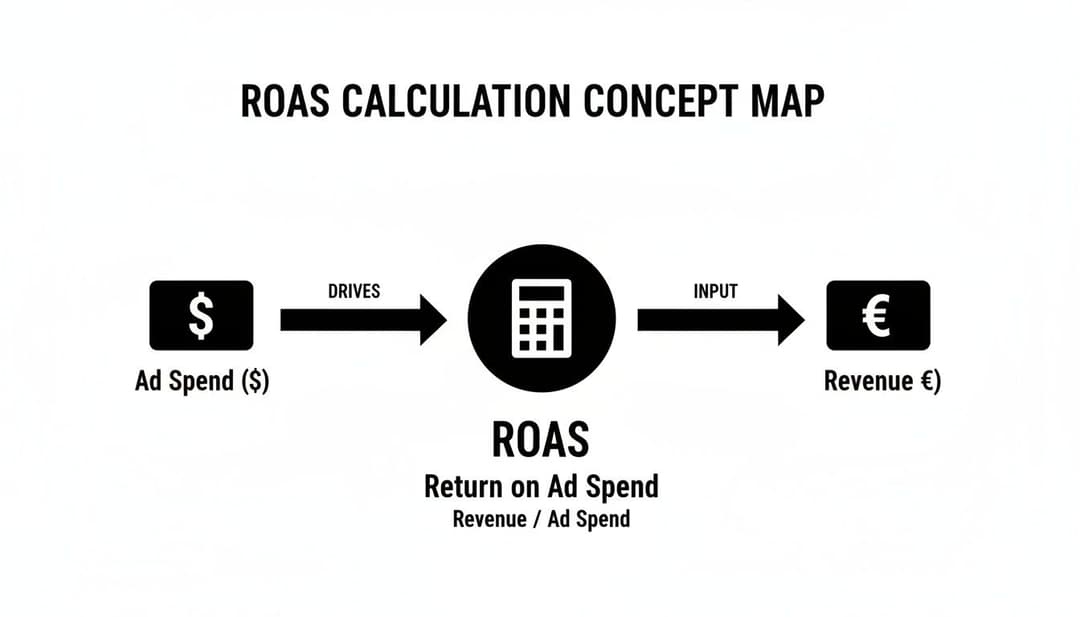
The math is refreshingly direct: just divide the total revenue you made from an ad campaign by what you spent to run it.
ROAS Formula: Total Revenue from Ads / Total Ad Spend = Your ROAS
This ratio tells you exactly how many dollars you earned for every single dollar you put in. A ROAS of 5 means you generated $5 in revenue for every $1 of ad cost. Simple as that.
Seeing the ROAS Formula in Action
Formulas are fine, but concrete examples are better. Let's walk through a few scenarios to see how this plays out for different types of businesses.
Imagine an e-commerce clothing store launching a new seasonal collection. They invest $25,000 in an ad campaign that directly results in $120,000 in sales. The ROAS here is a solid 4.8 ($120,000 / $25,000). You can dig into more examples like this and learn about how other brands calculate return on ad spend.
Let's look at a couple more.
Scenario 1: The Local Restaurant
- Ad Spend: A neighborhood pizza spot spends $500 on a Meta campaign to promote a new delivery deal.
- Revenue Tracked: They smartly use a unique promo code in the ad, allowing them to track $2,500 in orders tied directly to that campaign.
- Calculation: $2,500 (Revenue) / $500 (Ad Spend) = a 5x ROAS. For every dollar they spent, they brought five dollars back through the door.
Scenario 2: The B2B Software Company
- Ad Spend: A SaaS company puts $10,000 into a LinkedIn ad campaign aimed at generating demo requests.
- Revenue Tracked: The campaign brings in 20 demo requests. Based on historical sales data, each demo is assigned a pipeline value of $2,000, creating a total value of $40,000.
- Calculation: $40,000 (Pipeline Value) / $10,000 (Ad Spend) = a 4x ROAS.
By applying this straightforward math, you can quickly get a pulse on whether your advertising is actually making money or just costing it. For a more detailed walkthrough, check out our guide on how to calculate return on ad spend.
Understanding ROAS vs. ROI vs. CPA
It’s easy to get lost in a sea of marketing acronyms, but getting a handle on the difference between ROAS, ROI, and CPA is non-negotiable for anyone running ads. They all measure success, but they tell very different stories.
Think of ROAS as your tactical sniper. It’s laser-focused on one thing: the revenue generated directly from your ad spend. It answers the simple question, "For every dollar I put into this specific ad campaign, how many dollars did I get back?" It's all about campaign-level efficiency.
On the other hand, Return on Investment (ROI) is the wide-angle lens for your entire business. ROI zooms out to look at the big picture. It considers not just ad spend but all the other costs that go into making a sale—things like software fees, team salaries, shipping, and the actual cost of your goods.
This is why a great ROAS doesn't automatically mean your business is profitable. You could have a fantastic ROAS, but if your other costs are too high, you could still be losing money. That’s why you need both metrics to get a complete view.
ROAS vs. CPA: Revenue vs. Cost
So, where does Cost Per Acquisition (CPA) fit into all this? While ROAS measures revenue efficiency (how many dollars you get back), CPA measures cost efficiency (how much you pay to get one customer or sale).
A low CPA seems great on the surface, but it doesn't tell you anything about the value of that acquisition.
A campaign might have a fantastic, low CPA of $10, but if customers are only buying a $12 item, your profit margin is razor-thin. Another campaign could have a $50 CPA but drive $500 purchases, resulting in a much healthier ROAS and actual profit in your pocket.
They’re two sides of the same coin, and you need to look at both. When you’re trying to understand the nuances of your performance, it’s also useful to see how different media channels contribute to your returns. For instance, many brands are weighing the value of Podcasts Vs YouTube: Which Platform Wins for Brands in 2026.
For a deeper dive into this specific metric, check out our complete guide on what is cost per acquisition.
ROAS vs. ROI vs. CPA Key Differences
To help clear things up, here’s a quick-glance table breaking down these three essential metrics.
| Metric | What It Measures | Focus | Best For |
|---|---|---|---|
| ROAS | Gross revenue generated for every dollar spent on advertising. | Campaign-Level Efficiency | Evaluating the direct performance and revenue generation of specific ad campaigns. |
| ROI | Total profit generated from an investment after all associated costs are deducted. | Overall Business Profitability | Assessing the overall financial health and profitability of your marketing initiatives as a whole. |
| CPA | The average cost to acquire a single customer or conversion. | Action-Based Cost | Optimizing ad spend to acquire customers as cost-effectively as possible. |
Ultimately, using ROAS, ROI, and CPA together gives you a complete dashboard for your marketing performance. ROAS tells you if your ads are working, CPA tells you if they're efficient, and ROI tells you if your business is actually making money.
What Is a Good ROAS in 2026

It’s the question every marketer eventually asks: "Is my ROAS good enough?" If you’re looking for a simple, one-size-fits-all number, I’m afraid there isn’t one. An honest answer is that it completely depends on your business. The target that works for one brand could spell disaster for another.
You’ve probably heard the classic 4:1 ROAS benchmark bandied about—making $4 for every $1 you spend. It’s a decent starting point, but it's far too generic to be a reliable goal. Your ideal ROAS is deeply tied to your profit margins, industry, and what you’re trying to achieve with a specific campaign.
Why Your Ideal ROAS Is Unique
Just think about two different businesses. A high-end jewelry brand with massive profit margins might be throwing a party with a 3:1 ROAS. On the flip side, a dropshipping store with razor-thin margins might need a 10:1 ROAS just to stay afloat after factoring in product costs, shipping, and platform fees.
The most powerful ROAS target isn't some generic industry standard; it's your own break-even ROAS. This is the absolute minimum ROAS you need to cover both your ad spend and the cost of the goods you sold.
Once you know this number, ROAS transforms from a vague vanity metric into a sharp tool for profitability. It tells you the exact tipping point where your ads go from being a cost center to a money-making machine. This figure is also tied to your campaign costs, and you can get a better handle on those by checking the average price per click for your industry.
Actionable Strategies to Improve Your ROAS
Okay, so you know your ROAS. The big question is, what are you going to do about it? Improving your Return on Ad Spend isn’t about flipping a single magic switch. It’s about being a great mechanic for your campaign engine.
You need to systematically tune every part to get more power from the same amount of fuel. By making smart, targeted adjustments, you can stop wasting money and start turning every dollar into profitable growth.
Fine-Tune Your Audience Targeting
Showing ads to the wrong people is like shouting into an expensive void. Even the most brilliant ad on the planet will flop if it never reaches someone who actually cares. Your goal here is to cut out the guesswork and put your budget to work on the people most likely to click "buy."
- Build Lookalike Audiences: Take a list of your best, most loyal customers and upload it to a platform like Meta. The algorithm will then go out and find new people who share similar traits. You're basically cloning your success.
- Implement Retargeting: Someone who visited your site and left without buying isn't a lost cause; they're a warm lead. Use retargeting campaigns to bring them back for a second look, maybe with a friendly reminder or a special offer to sweeten the deal.
- Use Exclusion Lists: Be ruthless about who shouldn't see your ads. For instance, make sure you exclude existing customers from a campaign built to acquire new ones. There’s no point in paying to reach people who have already converted.
A/B Test Your Ad Creatives
Your ad creative is your digital handshake. If it doesn’t connect, you’ve lost the click and any chance of a sale. Instead of just going with your gut on what looks good, let the data be your guide. For a deeper dive, you can learn more about creating stunning digital marketing creatives that stop the scroll.
A/B testing, also known as split testing, is simply running two nearly identical ads with one key difference to see which one performs better. This approach takes the emotion out of the creative process and puts the focus squarely on what drives results.
Optimize Your Landing Page for Conversions
Getting the click is only half the job. Your landing page is where the real magic happens—or doesn't. A clunky, confusing, or slow landing page will absolutely demolish your ROAS, no matter how great your ad creative is.
Make sure the message on your landing page is a perfect match for the promise in your ad. If your ad promotes a 20% discount, that offer had better be front and center when the user lands. For a step-by-step guide, a solid conversion rate optimization checklist can walk you through the process of turning more of those hard-won visitors into happy customers.
How AdStellar AI Helps You Get the Most Out of Your Ad Spend

Let’s be honest—trying to manually optimize ROAS across hundreds of ad variations is a fast track to burnout and wasted ad spend. It’s a messy, overwhelming process. This is exactly where automation gives you an almost unfair advantage.
For marketers who are serious about getting the absolute best return, AdStellar AI is designed to turn that creative chaos into a predictable revenue-generating machine. We help you find winning ad combinations at a scale you could never manage by hand, so you’re not just guessing what works—you know for sure.
Turn Data Into Decisive Action
AdStellar’s AI engine doesn’t just spit out data; it directly analyzes performance against your specific ROAS goals. This gives you clear, simple instructions on which ads to cut and which ones to double down on.
The core idea is simple: let AI handle the repetitive grind of testing and analysis so you can focus on big-picture strategy. By automating the grunt work, you can drive higher ROAS from your Meta ads with less effort.
For example, our dashboard gives you a single source of truth for all your campaigns.
This centralized view helps you immediately spot which campaigns are crushing your ROAS targets and which ones are lagging behind. You can see how our AI optimization features make this entire process seamless and intuitive.
Common ROAS Questions Answered
Once you get the hang of what ROAS is, a few big questions usually pop up. Let's tackle the most common ones so you can start putting this metric to work the right way.
Can You Have a Good ROAS and Still Lose Money
Yes, and it happens more often than you'd think. It's a classic trap because ROAS is a revenue metric, not a profit metric. It only looks at the gross revenue your ads brought in versus what you spent on them, completely ignoring all the other costs of doing business.
Think about it: your cost of goods, shipping fees, software subscriptions, and team salaries aren't part of the ROAS formula. If your profit margin on a product is only 30%, a 3:1 ROAS means you’re just breaking even on the product itself. You're still losing money once you factor in everything else.
This critical distinction is why you must calculate your break-even ROAS and analyze it alongside your overall Return on Investment (ROI) to see the true profitability of your advertising efforts.
How Do You Track ROAS for Lead Generation
For B2B or service-based businesses that don't make direct sales online, you have to do a little homework first. The key is to assign a concrete monetary value to each lead you generate.
Start with two numbers: your average customer lifetime value (LTV) and your lead-to-customer conversion rate. If a new customer is typically worth $5,000 to your business and you know that 1 out of every 25 leads becomes a customer, then each lead is worth $200 ($5,000 / 25). That $200 figure becomes the "revenue" you use in your ROAS calculation.
Ready to stop guessing and start knowing exactly which ads are driving profitable growth? AdStellar AI automates your ad testing and provides clear, ROAS-driven insights to maximize your return from every dollar spent. Discover how our platform turns creative chaos into a predictable revenue engine by visiting https://www.adstellar.ai.